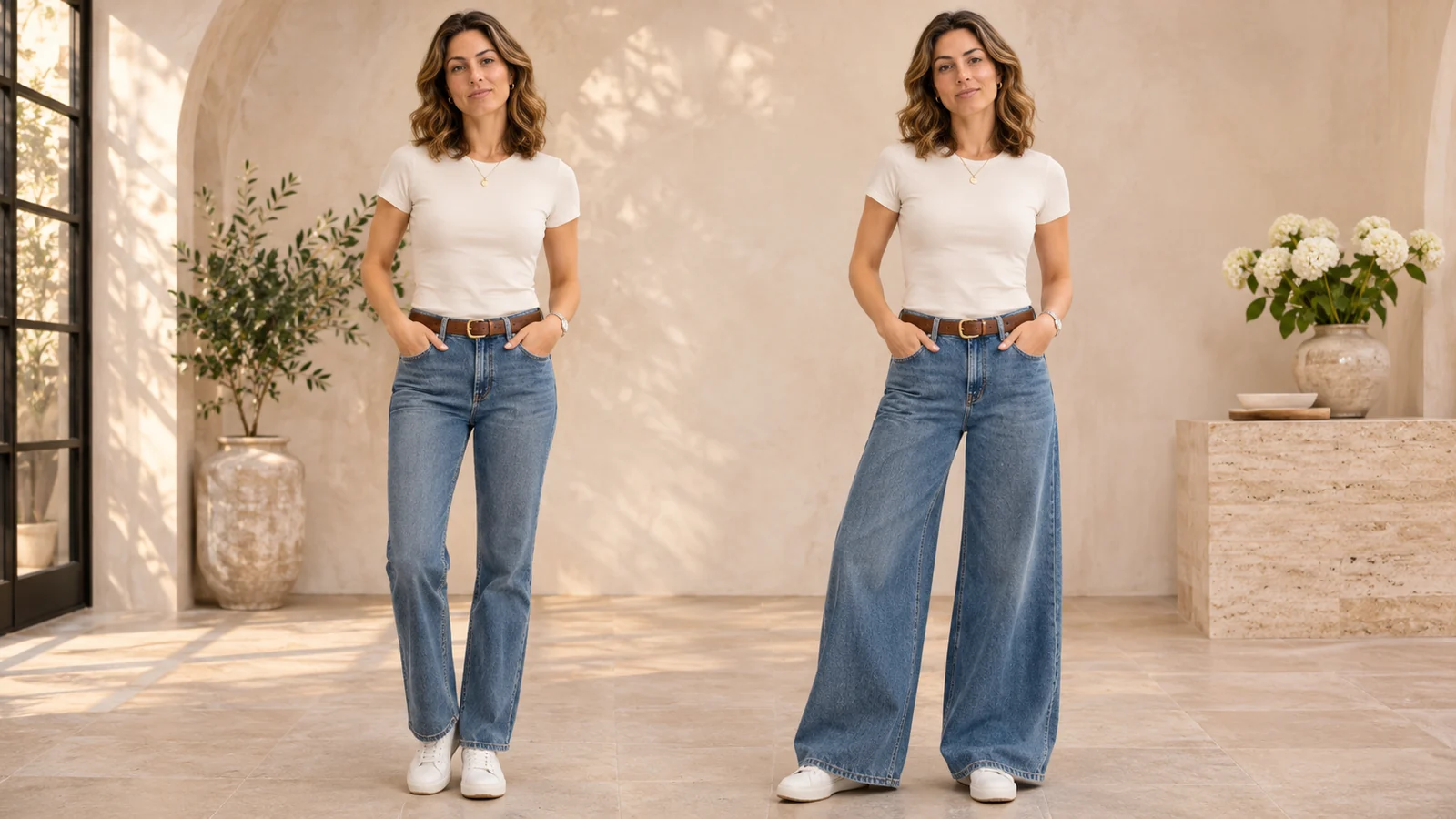
Straight-leg jeans keep a relatively consistent width from around the knee to the hem; wide-leg jeans are roomier through more of the leg. Straight cuts read comparatively streamlined, while wide cuts add more volume—but the right choice depends on garment measurements, fabric, rise, length, shoes, comfort, and how you like to dress.
The label on the hangtag is only a clue. A straight-leg pair can feel restrictive or relaxed; a wide-leg pair can fall crisply or softly. To compare them usefully, look at the garment itself, then imagine it with the clothes and shoes you already wear.
A preference-led starting point
Denim Fit Finder
Answer a few questions about the clothes and shoes you actually use. This is an educational comparison—not a size predictor or fit guarantee. Your answers stay in this browser session.
Straight-leg vs wide-leg: the practical differences
| Decision point | Straight-leg | Wide-leg |
|---|---|---|
| Leg silhouette | Relatively consistent from knee to hem | Roomier through much of the leg |
| Thigh and knee | Varies from slim to relaxed; check garment width | Typically more volume, but not guaranteed by the label |
| Hem | Usually narrower than a wide-leg opening | Usually broader; exact opening varies by maker |
| Drape | Structured or fluid depending on denim | Fabric weight and drape strongly affect apparent volume |
| Styling | Works with fitted, relaxed, tucked, and untucked tops | Volume contrast is one option, not a rule |
| Comfort | Depends on actual ease, fabric, construction, and preference | Depends on actual ease, fabric, construction, and preference |
| Footwear | Many shoes; check crop and ankle/boot interaction | Many shoes; check hem clearance and shoe visibility |
| Best evidence when shopping | Waist, rise, thigh, knee, opening, inseam | Waist, rise, thigh, knee, opening, inseam |
Neither silhouette is automatically easier to style, more comfortable, or more polished. A medium-wash straight jean may integrate easily into a wardrobe built around existing shirts and loafers; a soft-drape wide leg may work well with the relaxed layers and flats already in rotation. Your wardrobe, not an abstract versatility ranking, decides.
What the silhouette names mean
Straight-leg jeans
Straight-leg jeans generally keep a relatively consistent width through the lower leg from around the knee to the hem. That does not mean the garment is narrow everywhere: waist, seat, thigh, knee, and opening all vary. A classic straight often leaves more room than a slim straight; a relaxed straight adds ease in selected areas while preserving a straighter line.
Common names include classic, slim, relaxed, cropped, full-length, high-rise, and mid-rise straight. They are retail descriptions rather than a universal measurement standard [1] [2]. Compare the flat thigh, knee, and leg opening if those proportions matter to you.
Wide-leg jeans
Wide-leg jeans have a roomier shape through much of the leg, often with a wider knee and hem than a straight cut. Some are tailored and structured; others are relaxed and fluid. A wide opening alone does not tell you how much ease there is at the hip or thigh.
Classic, tailored, relaxed, extra-wide, palazzo-inspired, cropped, and full-length are useful descriptive terms, but brands use them differently. Rise and fabric also change how the same labeled silhouette appears.
How nearby cuts differ
Narrower overall than many classic straights, while the lower leg still reads relatively straight.
Bootcut usually widens subtly toward the hem; a flare generally expands more noticeably below the knee.
Signals relaxed overall volume, which may come from seat, rise, thigh, and leg—not only the hem.
Uses a curved or rounded outer shape, sometimes narrowing again near the ankle.
Names differ by manufacturer. Use the garment’s measurements and on-body product photos as stronger evidence than the silhouette name alone.
Rise, denim fabric, and construction
Rise is the garment length from the crotch seam to the waistband, measured at the front or back. It affects where the waistband sits and how the jeans feel when sitting or bending. High, mid, and low are not universal categories; check the retailer’s measuring method and compare with a pair whose waistband position you prefer.
The waistband measurement, front and back rise, seat, and pocket placement all contribute to coverage and comfort. If a waistband gaps or pulls, the pattern, rise, or size grading may not suit the wearer; it is not a body flaw.
Conceptual flat-garment diagram. Retailers may use different measurement reference points.
Fabric feel is more than fiber percentage
Rigid denim typically has little or no elastane, while stretch denim may include elastane or another elastic fiber. Stretch amount and recovery vary. Cotton content alone does not tell you whether a garment will feel soft, recover well, or last [6] [8]. Yarn, weave, finishing, fabric weight, pattern, and construction all matter.
Fabric weight is often described in ounces per square yard. A heavier fabric may hold a more structured shape; a lighter one may move more easily, but weight alone is not a quality grade or comfort score. Compare the actual fabric, finish, and care label where possible.
| Denim feel | Possible characteristics | What to check |
|---|---|---|
| Rigid / structured | More defined shape; may feel firm initially | Ease at waist, seat, and thigh; shrinkage/care label |
| Stretch | Can allow more give; recovery differs by blend and construction | Composition, recovery expectations, and whether it feels comfortable after sitting |
| Lightweight / fluid | May drape more softly and move more easily | Opacity, creasing, seam stability, and intended use |
| Substantial / heavy | May preserve a stronger shape and feel weightier | Personal comfort, climate, care label; heavier is not automatically better |
How to measure jeans at home
Body measurements describe a person; garment measurements describe the clothing. A garment measurement includes ease and construction, so it should not be treated as the matching body circumference or used alone to infer a size.
- Lay a clean pair flat and smooth it without stretching the fabric. Use the same reference points for both pairs.
- Measure the waistband across; front rise from crotch seam to top of waistband; back rise along the back seam; and hip width at the same distance below the waistband.
- Measure thigh width below the crotch, knee width at a consistent point, and leg opening across the hem.
- Measure inseam from crotch seam to hem along the inside leg. Outseam runs from the waistband area down the outside seam to the hem.
Doubling a flat width may estimate circumference when the garment is laid flat evenly, but curves, waistbands, and construction make that an approximation. Rise, inseam, and outseam are linear lengths; do not double them. Retailers may measure at different points, so compare methodology as well as values [3] [4].
Compare garments, not size labels
Jeans Measurement & Cost Guide
Enter measurements taken the same way for both garments. If waist, hip, thigh, or hem values are flat widths, circumference is only an approximate doubled width; retailer methods may differ.
| Measurement | Jeans A (in) | Jeans B (in) | Unit conversion (A) |
|---|---|---|---|
| Waist | — | ||
| Front rise | — | ||
| Back rise | — | ||
| Hip | — | ||
| Thigh | — | ||
| Knee | — | ||
| Leg opening | — | ||
| Inseam | — | ||
| Outseam | — |
Matching measurements
Enter at least one matching measurement for Jeans A and Jeans B to see differences.
Flat widths are not full circumferences. Doubling a flat waist or other width only gives an approximation. Inseam, rise, and outseam are linear lengths and are never doubled. A numerical difference does not predict fit.
Optional cost-per-wear estimate
Estimated cost per wear = total acquisition cost ÷ estimated number of wears.
Add acquisition costs and a positive estimated wear count.
Fit for different proportions and comfort needs
Petite and tall shoppers may both prefer either silhouette. Look for rise and inseam measurements, where the knee falls, and whether the hem clears your usual shoes. A cropped hem, ankle hem, and full-length hem each make a different outfit; none is mandatory.
If you have fuller hips or thighs, compare actual seat and thigh ease and notice fabric tension when sitting. If a waistband gaps, consider a different rise or pattern, an available curvy cut, or a waistband alteration. If thigh movement is restricted, more leg opening will not necessarily solve the problem—the thigh measurement matters too.
For shorter or longer torsos, compare where the waistband sits on your body rather than relying on “high-rise” alone. For sensory or mobility needs, pay attention to closure, seams, stretch, seated movement, shoe access, and safe hem clearance. Fit issues describe a garment/body interaction, not a personal shortcoming.
Shoes, tops, and layers
Sneakers, loafers, ballet flats, ankle boots, sandals, platforms, and heels can pair with either cut. Check if a boot shaft sits under or over the hem and whether the hem catches on shoes, stairs, or mobility aids. Alter a pair for the shoes you wear most, not for an abstract universal hem distance.
With straight jeans, try a crew-neck T-shirt, button-down, knit, blouse, cardigan, sweatshirt, or structured top; tuck or leave it loose depending on the garment and desired line. With wide legs, fitted tops can create contrast, but relaxed shirts, oversized knits, longer coats, and intentional volume throughout can also work. A tuck is an option, not a rule.
Jacket length, shoulder structure, fabric weight, and total volume affect the composition. A cropped jacket may create a clear waistline; a long coat may make a continuous vertical layer. Try both with your own proportions and temperature needs. For casual offices and smart-casual events, check the specific dress code and event expectations.
Outfit proportions are a design choice
Color continuity, contrast, garment volume, horizontal divisions, and shoe visibility can change how an outfit reads. Some stylists use a “rule of thirds” as a composition prompt; it is not a scientific dressing law. Wear the proportions you like, including relaxed garments at both top and bottom.
Build, compare, and adjust
Outfit Styling Simulator
Illustrative garment figures help explain styling variables; this is not a virtual try-on. Change one option at a time to compare the effect.
Selected outfit
Straight-leg · Full length · Sneakers
Styling notes
The relatively consistent lower-leg line can work with varied top lengths and volumes. The selected sneakers may call for checking hem clearance.
Copyable formula: Basic T-shirt (french tuck) + medium blue straight-leg jeans + sneakers; none; everyday casual.
Illustrative outfit preview. Actual fit, fabric drape, garment length, and appearance depend on individual measurements and product construction.
24 everyday outfit formulas
Each is a starting point, not a shopping list. Replace pieces with similar clothes and shoes you already own.
| # | Silhouette | Formula | Occasion / season | Existing-wardrobe alternative |
|---|---|---|---|---|
| 1 | Straight | White T-shirt + straight-leg jeans + sneakers | Errands · All | Any simple tee and walking shoes |
| 2 | Straight | Blue button-down + straight-leg jeans + loafers | Casual office · Spring/Fall | Any woven shirt and comfortable flat |
| 3 | Straight | Fine-knit sweater + straight-leg jeans + ballet flats | Coffee · Spring/Fall | Any light sweater and flats |
| 4 | Straight | Neutral top + relaxed blazer + straight-leg jeans | Smart casual · Fall/Spring | Use an existing jacket or cardigan |
| 5 | Straight | Striped top + straight-leg jeans + flat sandals | Weekend · Summer | Any patterned tee and breathable shoes |
| 6 | Straight | Simple top + denim jacket + straight-leg jeans | Everyday · Spring/Fall | Any casual jacket already owned |
| 7 | Straight | Cardigan + straight-leg jeans + ankle boots | Weekend · Fall/Winter | Any warm layer and weather-appropriate shoe |
| 8 | Straight | Black T-shirt + dark-wash straight-leg jeans | Casual dinner · All | Any dark neutral top |
| 9 | Straight | Trench coat + straight-leg jeans + comfortable flats | Travel · Spring/Fall | Any longer light coat |
| 10 | Straight | Relaxed sweatshirt + straight-leg jeans + retro sneakers | Travel · Fall/Winter | Any soft pullover and supportive sneakers |
| 11 | Straight | Lightweight blouse + straight-leg jeans + loafers | Coffee date · Spring | Any top with a soft drape |
| 12 | Straight | Tonal neutral layers + straight-leg jeans | Everyday · All | Repeat one neutral color from existing pieces |
| 13 | Wide | Fitted or relaxed T-shirt + wide-leg jeans + sneakers | Errands · All | Any favorite tee |
| 14 | Wide | Button-down + wide-leg jeans + loafers | Casual office · Spring/Fall | Any woven shirt and flat shoe |
| 15 | Wide | Fine-knit top + wide-leg jeans + ballet flats | Coffee · Spring/Fall | Any knit and comfortable flat |
| 16 | Wide | Simple top + structured blazer + wide-leg jeans | Smart casual · All | Use an existing structured layer |
| 17 | Wide | Relaxed linen-blend shirt + wide-leg jeans + sandals | Weekend · Summer | Any breathable relaxed shirt |
| 18 | Wide | Cropped or regular-length jacket + wide-leg jeans + sneakers | Everyday · Spring/Fall | Try a jacket already owned at more than one buttoning position |
| 19 | Wide | Cardigan + wide-leg jeans + ankle boots | Weekend · Fall/Winter | Any cardigan and boots with safe hem clearance |
| 20 | Wide | Black top + dark-wash wide-leg jeans | Casual dinner · All | Any dark neutral top |
| 21 | Wide | Long trench + wide-leg jeans + suitable flats | Travel · Spring/Fall | Any longer coat that allows comfortable movement |
| 22 | Wide | Relaxed sweatshirt + wide-leg jeans + retro sneakers | Weekend · Fall/Winter | Use soft layers you already own |
| 23 | Wide | Lightweight blouse + wide-leg jeans + optional dressier shoes | Casual dinner · Spring/Summer | Any top with comfortable drape |
| 24 | Wide | Tonal neutral layers + wide-leg jeans | Everyday · All | Repeat neutrals from your existing wardrobe |
16 seasonal outfit starters
Climate and indoor heating vary across the United States; adjust fabric and layers to local weather and personal comfort.
Cropped straight jeans + light cardigan + sneakers
Full-length wide jeans + button-down + loafers
Ankle-length straight jeans + blouse + flats
Wide jeans + trench + comfortable shoes
Straight jeans + cotton tee + flat sandals
Lightweight wide jeans + tank + breathable flats
Cropped straight jeans + short-sleeve shirt + sneakers
Wide jeans + relaxed linen-blend top + sandals
Straight jeans + fine knit + ankle boots
Wide jeans + cardigan + loafers
Straight jeans + utility jacket + sneakers
Wide jeans + structured blazer + flats
Straight jeans + insulating layers + weather-ready boots
Wide jeans + long coat + shoes with hem clearance
Straight jeans + sweater + supportive sneakers
Wide jeans + warm knit + suitable ankle boots
Footwear compatibility matrix
Either silhouette can work with many shoe categories. Hem interaction, comfort, and the activity are more useful than an invented compatibility score.
| Footwear | Straight-leg | Wide-leg | Watch for | Comfortable alternative |
|---|---|---|---|---|
| Classic white sneakers | Use cropped, ankle, or full length; check hem break. | Works with cropped or full length; confirm shoe visibility and hem clearance. | Dragging hems; socks if ankle is exposed. | Any clean supportive sneaker already owned. |
| Retro sneakers | Casual proportions; ensure hem does not bunch awkwardly. | A substantial sole can sit under a broader hem; check walking clearance. | Bulk and stacking at the ankle. | A comfortable low-profile sneaker. |
| Loafers | Ankle or full length can show the shoe; test seated hem position. | A wider opening may partly cover a low-profile loafer. | Long hems hiding the shoe or dragging. | Comfortable flats. |
| Ballet flats | Cropped or ankle length shows more of the shoe. | Check that the hem does not pool over the toe. | Hem interference while walking. | Any flat with a secure fit. |
| Pointed-toe flats | Can create a narrow shoe shape below the hem. | May show only at the front depending on hem width. | Do not choose a shoe shape at the expense of comfort. | Rounded or square-toe flats. |
| Ankle boots | Check whether hem ends above, meets, or covers the shaft. | Ensure hem opening and boot shaft do not catch. | Fabric bunching at the boot top. | Chelsea boot or flat shoe. |
| Chelsea boots | Ankle/full length may meet shaft; try together. | Broad hem can fall over shaft; check mobility. | Hem catching at elastic gusset. | Supportive sneakers. |
| Knee-high boots | May tuck only if both garment and boot permit it. | A wide lower leg may not fit inside the boot shaft. | Bulk, pressure, and seam friction. | Wear the jean over a shorter boot. |
| Flat sandals | Cropped/ankle hems expose the sandal; check ground clearance. | Full length can skim; ensure it does not drag. | Wet or dirty hems outdoors. | Comfortable closed-toe flat. |
| Heeled sandals | Hem should not snag at heel or expose an uncomfortable rise. | Try intended heel height before hemming. | Never treat heels as necessary. | Flat sandals or loafers. |
| Pumps | A polished option when suitable; check hem length. | May be partially covered by full-length denim. | Personal comfort and event expectations. | Pointed or rounded flats. |
| Platform shoes | Measure hem with actual platform height. | May support longer hem styling; still avoid dragging. | Stairs, uneven surfaces, and trip hazards. | Flats or sneakers. |
Tops and outerwear: quick reference
All of these top categories can be tried with either cut. Full tuck, French tuck, untucked, and layered options depend on garment construction and your preference. Volume contrast is not mandatory.
| Top category | With straight-leg | With wide-leg |
|---|---|---|
| Basic crew-neck T-shirt | Try tucked or untucked; check garment length. | Contrast is optional; check total garment volume. |
| Fitted T-shirt | A close layer can sit under an open overshirt. | Try a relaxed version with layers you already own. |
| Relaxed T-shirt | Relaxed volume can balance or repeat the lower-leg line. | Tuck only if comfortable and the fabric allows. |
| Button-down shirt | Try tucked or untucked; check garment length. | Contrast is optional; check total garment volume. |
| Fine-knit sweater | A close layer can sit under an open overshirt. | Try a relaxed version with layers you already own. |
| Chunky knit sweater | Relaxed volume can balance or repeat the lower-leg line. | Tuck only if comfortable and the fabric allows. |
| Cardigan | Try tucked or untucked; check garment length. | Contrast is optional; check total garment volume. |
| Lightweight blouse | A close layer can sit under an open overshirt. | Try a relaxed version with layers you already own. |
| Tank top | Relaxed volume can balance or repeat the lower-leg line. | Tuck only if comfortable and the fabric allows. |
| Polo shirt | Try tucked or untucked; check garment length. | Contrast is optional; check total garment volume. |
| Relaxed sweatshirt | A close layer can sit under an open overshirt. | Try a relaxed version with layers you already own. |
| Structured top | Relaxed volume can balance or repeat the lower-leg line. | Tuck only if comfortable and the fabric allows. |
| Outerwear | Straight-leg outfit idea | Wide-leg outfit idea | Consider |
|---|---|---|---|
| Classic denim jacket | Classic denim jacket + simple top + straight denim | Classic denim jacket + existing knit or shirt + wide denim | Jacket length, shoulders, layering room, and weather. |
| Cropped jacket | Cropped jacket + simple top + straight denim | Cropped jacket + existing knit or shirt + wide denim | A shorter hem is optional; check walking movement. |
| Structured blazer | Structured blazer + simple top + straight denim | Structured blazer + existing knit or shirt + wide denim | Jacket length, shoulders, layering room, and weather. |
| Relaxed blazer | Relaxed blazer + simple top + straight denim | Relaxed blazer + existing knit or shirt + wide denim | A shorter hem is optional; check walking movement. |
| Trench coat | Trench coat + simple top + straight denim | Trench coat + existing knit or shirt + wide denim | Jacket length, shoulders, layering room, and weather. |
| Long wool coat | Long wool coat + simple top + straight denim | Long wool coat + existing knit or shirt + wide denim | A shorter hem is optional; check walking movement. |
| Lightweight cardigan | Lightweight cardigan + simple top + straight denim | Lightweight cardigan + existing knit or shirt + wide denim | Jacket length, shoulders, layering room, and weather. |
| Bomber jacket | Bomber jacket + simple top + straight denim | Bomber jacket + existing knit or shirt + wide denim | A shorter hem is optional; check walking movement. |
| Utility jacket | Utility jacket + simple top + straight denim | Utility jacket + existing knit or shirt + wide denim | Jacket length, shoulders, layering room, and weather. |
| Leather or alternative-material jacket | Leather or alternative-material jacket + simple top + straight denim | Leather or alternative-material jacket + existing knit or shirt + wide denim | A shorter hem is optional; check walking movement. |
Ten occasions, two silhouette options
| Occasion | Straight-leg option | Wide-leg option | Practical note |
|---|---|---|---|
| Everyday errands | Tee + sneakers | Relaxed top + sneakers | Prioritize movement and useful pockets. |
| Coffee date | Button-down + loafers | Button-down + flats | Check the applicable dress code. |
| Casual office | Blazer + clean tee | Structured layer + simple top | Choose layers for weather and activity. |
| Smart-casual event | Fine knit + flats | Cardigan + boots | Prioritize movement and useful pockets. |
| Travel | Soft tee + walking shoes | Relaxed shirt + comfortable shoes | Check the applicable dress code. |
| Weekend shopping | Tee + sneakers | Relaxed top + sneakers | Choose layers for weather and activity. |
| Casual dinner | Button-down + loafers | Button-down + flats | Prioritize movement and useful pockets. |
| Family gathering | Blazer + clean tee | Structured layer + simple top | Check the applicable dress code. |
| Outdoor leisure | Fine knit + flats | Cardigan + boots | Choose layers for weather and activity. |
| Creative workplace | Soft tee + walking shoes | Relaxed shirt + comfortable shoes | Prioritize movement and useful pockets. |
Petite and tall outfit examples
Examples are options, not height rules. Review actual rises, inseams, knee placement, favorite shoes, and preferred hem.
Petite length ideas
- Cropped straight jeans + loafers
- Full-length straight jeans + sneakers
- High-rise wide-leg + tucked shirt
- Mid-rise wide-leg + fitted knit
- Cropped wide-leg + ankle boots
- Full-length wide-leg + comfortable flats
Tall length ideas
- Full-length straight + loafers
- Ankle straight + sneakers
- Straight denim + long coat
- Wide-leg + flats with safe clearance
- Wide-leg + boots under the hem
- Cropped straight + sandals
20 example capsule combinations
This sample uses the same small closet inventory for illustration. Keep what you wear; skip anything you do not need.
- Straight jeans + T-shirt + sneakers + everyday bag
- Straight jeans + button-down + loafers
- Straight jeans + fine knit + flats
- Straight jeans + cardigan + sneakers
- Straight jeans + blazer + T-shirt + loafers
- Straight jeans + casual jacket + button-down + sneakers
- Straight jeans + sweater + seasonal footwear
- Straight jeans + T-shirt + blazer + sneakers
- Straight jeans + cardigan + button-down + flats
- Straight jeans + fine knit + casual jacket + seasonal footwear
- Wide jeans + T-shirt + sneakers + everyday bag
- Wide jeans + button-down + loafers
- Wide jeans + fine knit + flats
- Wide jeans + cardigan + sneakers
- Wide jeans + blazer + T-shirt + loafers
- Wide jeans + casual jacket + button-down + sneakers
- Wide jeans + sweater + seasonal footwear
- Wide jeans + T-shirt + blazer + sneakers
- Wide jeans + cardigan + button-down + flats
- Wide jeans + fine knit + casual jacket + seasonal footwear
Eight hypothetical fit scenarios
Petite reader considering wide legs
Compare rise and inseam, test hem with familiar flats or sneakers, and choose cropped or full length by preference.
Reader with fuller hips and thighs
Check seat/thigh ease and waistband comfort; the leg opening alone does not establish room.
Tall reader with limited inseam options
Verify actual garment length and knee location; do not rely only on a tall label.
Budget-conscious capsule
Restyle an existing pair with different layers, tucks, and shoes before shopping.
Comfort-first workwear
Check policy, seated movement, closures, waistband, fabric, and practical footwear.
Reader who likes relaxed outfits
Try relaxed tops with wide-leg denim intentionally; review hem and total volume.
Mobility or sensory needs
Prioritize easy closures, comfortable seams, seated movement, accessible footwear, and safe clearance.
Choosing between two online pairs
Compare garment method, measurements, fabric, total cost, returns, and wardrobe use.
20 common denim mistakes and fixes
Use the retailer’s chart and actual garment measurements.
Compare waist, rise, hip, thigh, knee, opening, and inseam.
Check the maker’s exact fit guide and leg widths.
Check thigh and seat measurements independently.
Try the hem with the footwear you wear most.
Compare material feel, weight, construction, and movement.
Choose the silhouette you prefer; avoid body-correction rules.
Use measurements and comfort, not a prescribed shape formula.
Check waist security, movement, and activity needs.
Test sitting, bending, and closure feel.
Treat contrast as an option, not a formula.
Consider garment condition, styling, and dress code.
Prioritize comfort, use, and hem clearance.
Walk, sit, and use stairs before settling on a hem.
Try new combinations with existing pieces first.
Consider likely wears and wardrobe compatibility.
Follow the particular garment’s care instructions.
Check the garment, specifications, and construction.
Alter or style for safer clearance.
Use a no-cost outfit audit before purchasing.
18 myths and practical corrections
Any height may wear either silhouette; check rise, inseam, knee position, hem, and preferred volume.
Wide-leg options include cropped, ankle, and full-length variations; fit and preference matter.
No silhouette belongs to a body category. Compare garment ease and waistband fit.
Trend coverage changes; usefulness and personal taste do not depend on a trend label.
The full outfit, hem, rise, shoe, and colors affect visual composition; there is no universal effect.
Rise is a personal comfort and garment-position preference.
Volume contrast is one option; relaxed-on-relaxed can be intentional.
Condition, styling, context, and workplace rules matter more than a single cut name.
Waist, seat, thigh, fabric, seams, and use determine comfort.
Fiber content alone does not establish quality or garment performance.
Durability depends on fiber, construction, care, and wear.
Price does not guarantee compatible pattern or measurements.
Charts and labels vary; compare the particular garment and method.
Choose safe clearance for shoes, stairs, weather, and mobility.
Flats, sneakers, and other shoes can work; test actual hem clearance.
Wash is only one styling variable; context and garment condition also matter.
Follow garment care instructions and wash according to actual need.
Existing jeans can be restyled; buy only when another pair serves a real need.
Silhouette descriptions are examples of manufacturer terminology, not universal definitions. See Lee and Levi’s. For measurement guidance, see 3sixteen and New Mexico State University Extension. Fabric, fit, and care evidence is scoped in the source register.
Copyable outfit formulas and a small capsule
White tee + straight jeans + sneakers
Use the colors and equivalent pieces you already own. Adjust layers for weather and activity.
Blue button-down + straight jeans + loafers
Use the colors and equivalent pieces you already own. Adjust layers for weather and activity.
Fine-knit sweater + straight jeans + ankle boots
Use the colors and equivalent pieces you already own. Adjust layers for weather and activity.
Neutral top + relaxed blazer + straight jeans
Use the colors and equivalent pieces you already own. Adjust layers for weather and activity.
Striped top + straight jeans + flat sandals
Use the colors and equivalent pieces you already own. Adjust layers for weather and activity.
Soft T-shirt + straight jeans + supportive sneakers
Use the colors and equivalent pieces you already own. Adjust layers for weather and activity.
Fitted or relaxed tee + wide jeans + sneakers
Use the colors and equivalent pieces you already own. Adjust layers for weather and activity.
Button-down + wide jeans + loafers
Use the colors and equivalent pieces you already own. Adjust layers for weather and activity.
Fine knit + wide jeans + structured blazer
Use the colors and equivalent pieces you already own. Adjust layers for weather and activity.
Linen-blend shirt + wide jeans + sandals
Use the colors and equivalent pieces you already own. Adjust layers for weather and activity.
Cardigan + wide jeans + boots with clear hem
Use the colors and equivalent pieces you already own. Adjust layers for weather and activity.
Tonal neutral layers + wide jeans + comfortable flats
Use the colors and equivalent pieces you already own. Adjust layers for weather and activity.
One-, two-, and three-pair planning
For one pair, begin with your most common activities, preferred rise, favorite shoes, and the tops you reach for. A two-pair wardrobe can add the other silhouette if it serves a distinct use. A third pair might add a different wash, weight, or length—but buy it only if it adds real value to your life.
Medium denim #6684A1 · Crisp white #F8F7F2 · Navy #263A55 · Tan #B58B63 · Soft gray #AEB2B5
Dark indigo #263653 · Ivory #F2EBDD · Camel #B88B61 · Chocolate #4F392F · Champagne #D7C7A5
Black denim #242526 · White #FAFAF7 · Charcoal #4A4B4C · Cool gray #BFC1C1 · Soft taupe #B3A89A
Light denim #A5BDD0 · Cream #F4F0E6 · Beige #D0C2AA · Sage #A4AA91 · Natural brown #80674D
Deep blue #354C69 · Rust #A85F43 · Olive #6A7054 · Burgundy #703D48 · Warm cream #F1E5D2
Medium denim #7891A9 · Dusty rose #C18E91 · Lavender #B8AEC9 · Ivory #F5F0E6 · Muted taupe #A89D91
Illustrative HEX values only. Fabric dyes, lighting, and screen calibration can change how colors appear.
Buying thoughtfully, tailoring, and care
Estimated cost per wear is the total acquisition cost—including optional tax, shipping, and alterations—divided by estimated wears. For example, a hypothetical $60 pair worn 60 times is $1 per wear; a hypothetical $120 pair worn 40 times is $3 per wear. These are estimates, not promises, and a lower figure does not mean you should buy something you do not need.
Common alterations include shortening a hem, preserving an original hem where possible, adjusting a waistband, or changing a selected seam. Tapering can alter a wide or straight silhouette; rise changes are more complex. Ask a tailor how seams, wash, pocket placement, and shape may change before proceeding.
Follow the garment’s care label. Water temperature, detergent, inside-out washing, separating dark colors, drying heat, spot cleaning, and storage depend on fiber, dye, finish, and construction. There is no universal schedule or shrinkage amount [9] [10] [11]. Freezing is not a reliable substitute for cleaning when the garment needs washing.
Small fixes before buying more
- Try different shoes with the jeans you own.
- Experiment with a full tuck, French tuck, and untucked shirt.
- Check that the hem suits the shoes and activities.
- Remove lint and mend loose threads when appropriate.
- Repeat one color from an existing layer or accessory.
- Change the jacket or top proportion before changing the jeans.
- Use the care label to preserve color and fabric condition.
Denim myths, briefly corrected
Any height can wear either cut; inseam, rise, and volume preference matter.
Fitted-versus-relaxed contrast is one styling option, not a requirement.
Trend cycles change; the garment and your preference matter more.
Wash is one factor; construction, condition, styling, and context also matter.
Durability cannot be inferred from stretch content alone.
Price does not guarantee the right pattern or measurements.
Rise preference depends on garment position and comfort.
Hem should work with footwear and avoid dragging or tripping.
Four quick decision scenarios
Classic wardrobe
Compare straight cuts with your usual shirts and shoes; choose the pair that adds combinations without duplicating what you own.
Relaxed contemporary
Try wide-leg denim with the relaxed layers you enjoy. Check fabric drape, hem length, and movement rather than forcing a fitted top.
Comfort-first
Prioritize waistband, thigh ease, seated movement, closure, and fabric feel. The silhouette label is secondary.
Limited budget
Start with existing denim, compare secondhand options and total costs, and check alteration/return terms before paying.
Frequently asked questions
What is the difference between straight-leg and wide-leg jeans?
Straight-leg jeans keep a relatively consistent width from around the knee to the hem. Wide-leg jeans have a roomier leg through more of the thigh and lower leg. Names vary by brand, so compare measurements and photos.
Which jeans are more versatile?
Neither is universally more versatile. The pair that works with your regular tops, shoes, activities, comfort needs, and dress expectations will likely earn more use.
Are wide-leg jeans more comfortable?
Not automatically. Comfort depends on waistband, rise, thigh and hip ease, fabric, seams, and how you move or sit.
Are straight-leg jeans still fashionable?
Straight cuts remain available alongside changing trend silhouettes. Wear the fit you enjoy and use; trend coverage is time-specific, not a requirement.
Can petite people wear wide-leg jeans?
Yes. Check rise, inseam, knee placement, hem clearance, and the amount of volume you prefer. Cropped and full-length options can both work.
Can tall people wear straight-leg jeans?
Yes. Check the garment’s actual inseam and knee position; a tall label does not guarantee the exact fit you want.
Which jeans suit fuller hips and thighs?
Either silhouette may work. Compare seat and thigh ease, waistband comfort, rise, and fabric movement; a wider hem does not guarantee thigh room.
Are wide-leg jeans the same as baggy jeans?
Not necessarily. Wide-leg describes the leg silhouette; baggy usually signals more overall ease and may include extra room at the seat, rise, or thigh.
What is the difference between straight and slim-straight jeans?
Slim-straight typically describes a narrower overall fit with a relatively straight lower leg. Brand measurements and naming differ.
How are wide-leg jeans different from flares?
Wide-leg cuts are roomy through much of the leg. Flares typically become more pronounced below the knee. Brand terminology varies.
What shoes work with wide-leg jeans?
Sneakers, loafers, flats, sandals, boots, and heels can all work. Check hem clearance and how the shoe sits under the actual hem.
What shoes work with straight-leg jeans?
Many shoes can work, including sneakers, loafers, flats, sandals, and boots. Hem length and boot-shaft interaction affect the result.
Can I wear sneakers with wide-leg jeans?
Yes. Try your usual sneakers and check the hem while walking, sitting, and using stairs.
Can I wear loafers with wide-leg jeans?
Yes. Check whether the hem partly covers the loafer or drags, and adjust length only if needed.
What tops work with straight-leg jeans?
T-shirts, shirts, knitwear, cardigans, blouses, sweatshirts, and structured tops are all options. Tuck or leave them loose based on garment length and preference.
What tops work with wide-leg jeans?
Fitted and relaxed tops can both work. Choose by fabric, length, occasion, and the total volume you want.
Can relaxed tops work with wide-leg jeans?
Yes. Wearing relaxed volume above and below can be intentional; consider layering, hem clearance, and the proportions you prefer.
What is the best rise for jeans?
There is no universal best rise. Choose by waistband comfort, where you prefer the garment to sit, torso proportions, and styling needs.
How do I measure jeans at home?
Lay a comfortable pair flat and smooth it without stretching. Measure waist, rises, hip, thigh, knee, opening, inseam, and outseam consistently; compare using the retailer’s method.
How do I choose an inseam?
Compare inseam on a pair with the shoes you expect to wear. Allow for desired crop or break while avoiding dragging or a tripping hazard.
How should wide-leg jeans fit at the waist?
Use the waistband measurement, rise, closure, and comfort while seated and moving. The wide-leg label does not specify waistband fit.
How long should straight-leg jeans be?
It depends on the shoe, intended crop, and personal preference. Check the hem during normal movement and avoid unsafe dragging.
What is the difference between rigid and stretch denim?
Rigid denim generally has little or no elastane; stretch denim may contain elastic fiber. Stretch and recovery vary with blend and construction.
Can jeans work in a smart-casual wardrobe?
Often, if denim is permitted and its condition, top, outerwear, and shoes suit the occasion. Dress codes vary.
How can I make denim outfits look more polished?
Try intentional hems, clean garment condition, compatible shoes, thoughtful layers, a tuck variation, repeated colors, or existing accessories.
Which jeans are best for a capsule wardrobe?
Choose the pair that coordinates with your real wardrobe and frequent activities. Add another silhouette only if it serves a distinct need.
Is expensive denim always better?
No. Price alone does not establish fit, fabric quality, construction, or durability.
Can a tailor shorten wide-leg jeans?
Often, but the original hem, wash, seams, and intended shape affect the result. Ask how the alteration changes the silhouette.
How should I care for jeans?
Follow the garment care label. Methods depend on fiber, dye, finish, construction, and how the item is used.
Which jeans should I choose if I can only buy one pair?
Choose by preferred silhouette, actual measurements, fabric, comfort, shoes, existing clothes, activities, and budget. There is no universal winner.
Final takeaway
Straight-leg jeans have a comparatively consistent lower-leg width; wide-leg jeans carry more volume through much of the leg. The label alone cannot tell you how either pair will fit or feel. Rise, measurements, fabric, hem length, footwear, activity, and personal preference all matter. The most suitable pair is not necessarily the most expensive or on-trend—it is the one that fits your comfort needs and works with your life and wardrobe.
CURATED DENIM & CAPSULE STYLING
Recommended Denim & Everyday Wardrobe Pieces
As an Amazon Associate I earn from qualifying purchases. Curated timeless denim cuts and coordinating capsule staples to build versatile everyday outfits.
Levi's Women's Classic Straight Jeans
Classic straight-leg jeans
Levi's Women's Ribcage Wide Leg Jeans
High-rise wide-leg jeans
Hanes Women's Perfect-T 100% Cotton Crewneck T-Shirt
Essential cotton crewneck tee
Timberland Women's Classic Leather Jean Belt
Classic leather accessory belt
The Drop Women's Blake Long Blazer
Relaxed everyday blazer
adidas Women's Grand Court 2.0 Tennis Sneaker
Everyday low-top sneakers
References and editorial notes
Manufacturer fit names and size charts are brand-specific; measurement landmarks and fabric results have limits. The verified source register explains the scope of each source, including manufacturer guidance, lab research, U.S. care-label rules, and current Google documentation. This guide is educational; it does not claim product testing or professional fitting services.
Related reading: Oversized vs Poorly Fitted · French Tuck vs Full Tuck · Casual Chic vs Smart Casual.