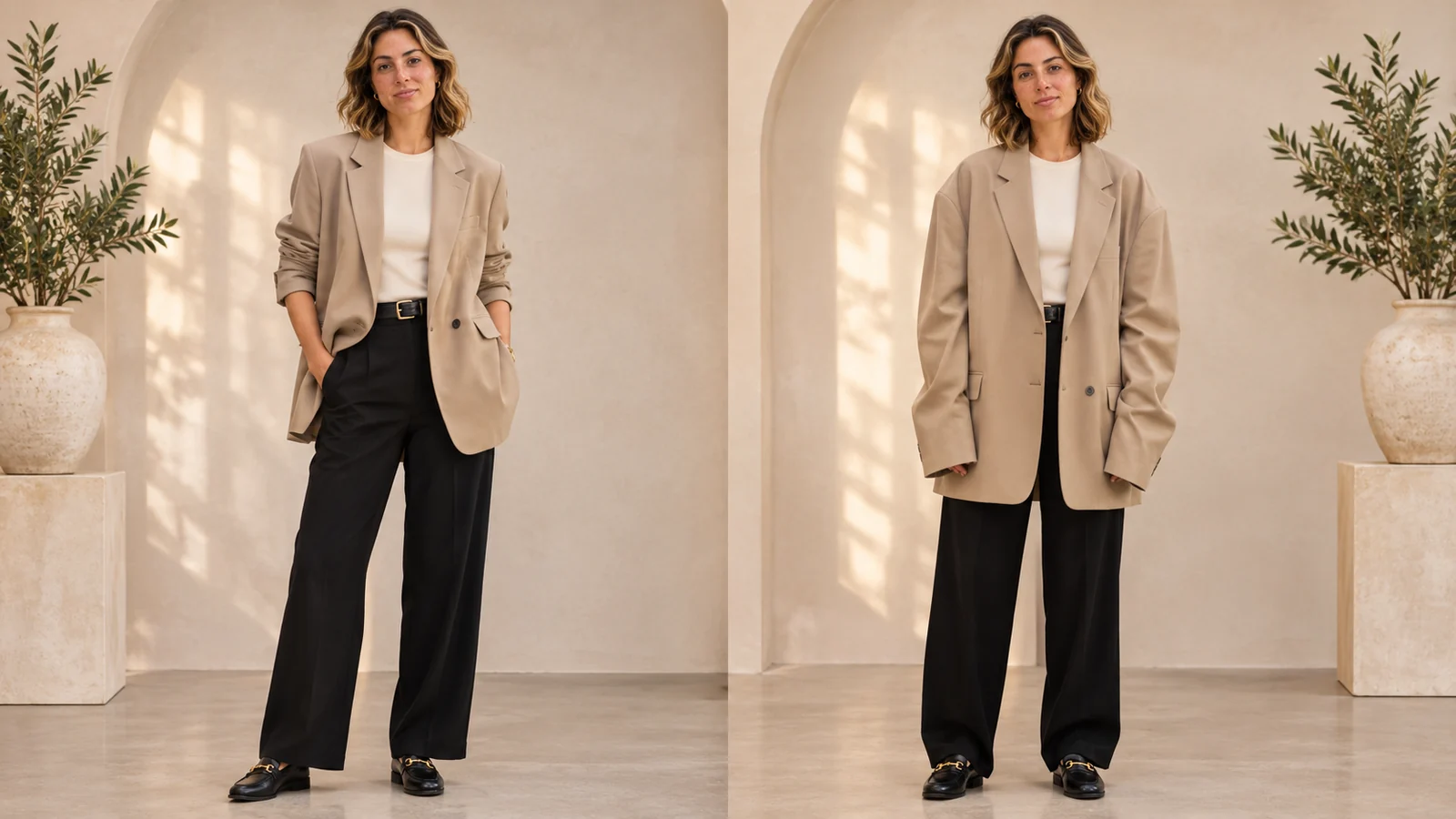
01 · INTENTIONAL VOLUME
What is oversized clothing?
Oversized clothing is a design or styling choice: a pattern may be cut with deliberately increased volume, wider proportions, extended sleeves, a dropped shoulder or extra room for layering. The volume is part of the garment’s intended silhouette, not simply a larger size label.
An oversized T-shirt may have a broader body and dropped shoulder; a relaxed button-down may add back and chest ease; a boxy jacket may emphasize width over length; and wide-leg trousers may be generous through the leg while retaining a secure waistband. Knitwear and coats can be designed to layer over other pieces.
“Oversized,” “relaxed” and “boxy” are not universal measurement standards. Brands may use the same word for different proportions, so product measurements and the actual garment matter more than the label.
02 · FIT IS PERSONAL AND FUNCTIONAL
What is poorly fitted clothing?
A garment is poorly fitted when a characteristic you do not want interferes with your intended appearance, comfort, movement or practical needs. It may be too tight, too loose, too long, too short, unbalanced or simply unsuitable for the task. A relaxed silhouette is not automatically a fit problem.
Possible concerns include a closure that pulls, an uncomfortable waistband, armholes that restrict reaching, sleeves that obstruct work, a neckline that shifts when you move, or a hem that drags where you walk. Natural folds, creases and asymmetry are not defects by themselves.
Oversized vs poorly fitted: compare the garment, not the label
| Check | Intentional oversized design | Potential unwanted fit issue |
|---|---|---|
| Design intent | Volume is part of the planned silhouette. | Volume or tightness conflicts with your aim. |
| Shoulders | Seam may extend by design; shape relates to sleeve type. | Seam/armhole causes strain, collapse or unwanted imbalance. |
| Sleeves | Length or width supports the look and remains usable. | Sleeve obstructs an activity or limits movement. |
| Chest / bust | Ease is distributed to support drape or layering. | Closures pull or excess fabric sits where you do not want it. |
| Hem | Position suits the design and intended activity. | Hem drags, catches or feels inconvenient. |
| Movement | Garment supports the movements you need. | Reaching, sitting or walking is uncomfortable. |
| Fabric | Drape or structure supports the intended form. | Fabric behavior frustrates your preferred silhouette. |
| Alteration | Adjustments preserve the designed volume. | Alteration may be possible but depends on seams and construction. |
03 · MEASUREMENT BASICS
Wearing ease vs design ease
Wearing ease is room added so a garment can accommodate the body and the movements required for its use. Design ease is additional volume used to create a particular silhouette. A garment may include both. Their appropriate amounts and placement vary with garment construction, fabric stretch, layering, intended activity and personal comfort.
For a transparent hypothetical example, if a body chest circumference is 36 inches and a comparable finished-garment chest circumference is 44 inches, the difference is 8 inches of total ease at that measurement line. It does not reveal how the volume is distributed, nor how much is wearing ease versus design ease; that requires information about the pattern and design.
Stretch garments may use little or negative ease. Negative ease means the finished measurement is smaller than the corresponding body measurement. That is not automatically a problem: stretch, recovery, construction and intended use matter. There is no universal oversized-ease number.
INTERACTIVE · LOCAL TO THIS PAGE
Explore garment ease
Use comparable dimensions. The result is total ease only; it cannot separate wearing ease from design ease.
04 · TERMS VARY BY BRAND
Fitted, slim, regular, relaxed, oversized and boxy
| Label | Common description | What to verify |
|---|---|---|
| Fitted | Relatively close to the body. | Movement, fabric give and intended wear. |
| Slim | Relatively narrow proportions. | Where the narrowness occurs; labels vary. |
| Regular | A brand’s baseline silhouette. | Brand’s chart and garment measures. |
| Relaxed | Additional room in selected areas. | Which panels, sleeves or layers have room. |
| Oversized | Deliberately generous volume. | Shoulders, body width, length and construction. |
| Boxy | Comparatively rectangular outline. | Width-to-length relationship and shaping. |
These are useful descriptions, not a standardized scale. A roomy silhouette can still have a deliberately shaped neckline or waistband.
Buying an oversized garment vs sizing up
A purpose-designed oversized garment may adjust body width, shoulder position, sleeve shape, neckline, length and details together. Ordinary size grading usually changes several pattern dimensions, but the result does not necessarily reproduce those design choices. Sizing up may nevertheless give you a look you like. Compare a comfortable garment’s measurements rather than assuming one approach is correct.
Stylized vector explanation only; it does not depict a brand or guarantee the fit of any product.
05 · REUSABLE FIT CHECK
Twelve garment-fit checkpoints
- 01 · Neckline
Check position, comfort, intended openness and stability during movement.
- 02 · Shoulder construction
Identify set-in, dropped, raglan or integrated construction before judging seam position.
- 03 · Armholes
Notice comfortable reach and whether the opening suits the design and layers.
- 04 · Chest or bust
Check closure behavior, intended ease and unwanted pulling.
- 05 · Back width
Look for tension during the movements you need.
- 06 · Sleeve length
Decide whether coverage is intentional and practical for your activities.
- 07 · Sleeve width
Consider layering, proportion and mobility.
- 08 · Waist position
Check intended placement and waistband comfort; shaping is optional.
- 09 · Hip and seat
Assess ease, sitting comfort and how the fabric falls.
- 10 · Garment length
Compare with your preferred look, layering and use.
- 11 · Hem position
Check clearance and whether it catches or drags during movement.
- 12 · Overall movement
Try sitting, reaching, walking and other relevant daily activities.
These are prompts, not pass/fail aesthetic standards. Your activity, access needs, sensory preferences and intended silhouette decide which checks matter most.
06 · READ THE SEAMS
Shoulders, sleeves and armholes
A set-in sleeve joins a shaped sleeve cap to a defined armhole. A dropped-shoulder design extends the shoulder line beyond the wearer’s shoulder point. Raglan seams run from the neckline toward the underarm, while dolman or batwing construction integrates more of the sleeve with the body. Terminology and exact pattern geometry can vary.
Because each construction creates a different seam path, judging every shoulder seam by the set-in sleeve position is misleading. Armhole shape, sleeve volume and fabric affect movement; a lower or wider armhole does not guarantee easier reaching in every garment.
Sleeve length is a use question
Extended cuffs, cropped sleeves, wide sleeves and rolled or pushed-up cuffs can all be deliberate. Check whether sleeves work for your everyday tasks. Fabric that repeatedly falls over hands may be inconvenient near food, machinery or heat; secure or adjust it appropriately for the task rather than treating a styling detail as universally right or wrong.
07 · FABRIC CHANGES THE RESULT
Drape, structure, weight and stretch
Fabric behavior is not determined by fiber content alone. Construction, yarn, weave or knit, finishing, thickness, stiffness, stretch and recovery all interact. A crisp poplin can hold a shape; jersey often follows movement; denim may feel more substantial; a fine knit can drape differently from a chunky knit; linen blends vary; wool blends depend on yarn and finishing; viscose can flow but varies by construction. Treat these as possibilities, not guaranteed properties.
Weight per area is not the same as stiffness or drape. Drape and stretch are measured under specified methods; a fiber label alone is not a laboratory assessment of a garment.
08 · STYLE WHAT YOU OWN
Relaxed silhouettes, styled with intention
Contrasting volumes is one option, not a rule. You can wear an oversized top with a narrower bottom, straight-leg trousers, wide legs or another relaxed piece. Consider fabric, garment lengths, color repetition, layering and what feels comfortable.
Oversized tee + straight-leg jeans + sneakers
Striped relaxed tee + denim + flats
Button-down + straight-leg jeans + loafers
Sweatshirt + wide-leg denim + sneakers
Boxy jacket + neutral top + casual trousers
Relaxed blazer + fine knit + dark denim
Oversized cardigan + simple top + jeans
Cream sweater + relaxed trousers + flats
Outfit proportions are tools, not laws
Visual balance can come from repeating a color, using a tonal outfit, contrasting textures, changing hem relationships or adding a structured layer. Rule-of-thirds advice and “balance the volume” are aesthetic conventions, not scientific requirements. Choose the effect you prefer.
Oversized clothing for different proportions and access needs
Petite, tall, broader-shouldered, fuller-bust, longer- or shorter-torso readers can all choose relaxed clothing. Relevant details might include garment back length, sleeve length, shoulder shape, chest ease, rise, inseam or the way layers sit. These are measurement considerations—not rules about what anyone should wear. Mobility, sensory comfort, dressing ease and assistive-device access can also shape a useful choice.
A petite pattern may adjust proportions differently from simply choosing a smaller regular size. Tall options may add sleeve, rise, inseam or back length; confirm the actual garment chart. No one needs heels, a defined waist, a fitted bottom or a particular silhouette.
Thirty outfit formulas to adapt
Use these as starting points, substituting pieces already in your wardrobe. Illustrations are schematic outfit concepts, not shopping recommendations.
Try existing pieces first; check that the volume, length and footwear work for your activity and comfort.
ivory · denim · white · EverydayTry existing pieces first; check that the volume, length and footwear work for your activity and comfort.
navy · cream · denim · ErrandsTry existing pieces first; check that the volume, length and footwear work for your activity and comfort.
white · indigo · brown · LunchTry existing pieces first; check that the volume, length and footwear work for your activity and comfort.
heather · blue · white · WeekendTry existing pieces first; check that the volume, length and footwear work for your activity and comfort.
olive · cream · taupe · LayeringTry existing pieces first; check that the volume, length and footwear work for your activity and comfort.
charcoal · ivory · indigo · Smart casualTry existing pieces first; check that the volume, length and footwear work for your activity and comfort.
blue · charcoal · brown · WorkTry existing pieces first; check that the volume, length and footwear work for your activity and comfort.
camel · cream · denim · CoffeeTry existing pieces first; check that the volume, length and footwear work for your activity and comfort.
blue · black · white · Day outTry existing pieces first; check that the volume, length and footwear work for your activity and comfort.
cream · stone · brown · TravelTry existing pieces first; check that the volume, length and footwear work for your activity and comfort.
ivory · denim · white · EverydayTry existing pieces first; check that the volume, length and footwear work for your activity and comfort.
navy · cream · denim · ErrandsTry existing pieces first; check that the volume, length and footwear work for your activity and comfort.
white · indigo · brown · LunchTry existing pieces first; check that the volume, length and footwear work for your activity and comfort.
heather · blue · white · WeekendTry existing pieces first; check that the volume, length and footwear work for your activity and comfort.
olive · cream · taupe · LayeringTry existing pieces first; check that the volume, length and footwear work for your activity and comfort.
charcoal · ivory · indigo · Smart casualTry existing pieces first; check that the volume, length and footwear work for your activity and comfort.
blue · charcoal · brown · WorkTry existing pieces first; check that the volume, length and footwear work for your activity and comfort.
camel · cream · denim · CoffeeTry existing pieces first; check that the volume, length and footwear work for your activity and comfort.
blue · black · white · Day outTry existing pieces first; check that the volume, length and footwear work for your activity and comfort.
cream · stone · brown · TravelRELAXED-FIT CAPSULE & TOOLS
Recommended Relaxed Pieces & Sizing Tools
Curated relaxed silhouettes and home measuring tools to evaluate garment ease and drape.
Big Dart Women's Oversized Button Down Long Sleeve Shirt
Relaxed poplin button-down
Trendy Queen Women's Oversized Crewneck Cotton T-Shirt
Dropped-shoulder boxy tee
ANRABESS Women's Oversized Cable Knit Pullover Sweater
Oversized chunky crewneck knit
Tronjori Women's High Waist Wide Leg Palazzo Trousers
High-waist wide-leg trousers
BOSTANTEN Women's Leather Shoulder Bag Tote
Minimalist leather shoulder tote
Singer Retractable Pocket Body Measuring Tape
Retractable fabric tape measure
Seasonal and occasion ideas
Spring: lightweight shirt, relaxed blazer, transitional jacket, breathable layers. Summer: loose silhouettes and light layers; ventilation depends on fabric, coverage, climate and activity, not looseness alone. Fall: knits, denim and adaptable layers. Winter: room for insulating layers, functional closures and footwear clearance. Climate varies by region.
For errands, travel, casual offices, lunches, family gatherings or home activities, start with the relevant dress code, comfort, weather and movement. Workplace expectations differ.
Six illustrative color palettes
Illustrative HEX swatches; garment colors vary with dye, fabric, light and screen calibration.
Twenty no-cost ways to refine an outfit
Try a different tuck if you like; roll a cuff if it stays put; compare existing footwear; adjust layers; repeat one color; remove a competing accessory; try a different jacket length or trouser silhouette; check hems; change neckline layering; choose a structured contrast or deliberately keep every layer relaxed; review occasion and movement. None is mandatory, and buying something new is not the default fix.
09 · MEASURE LIKE WITH LIKE
Measure body and garments at home
Body chest, waist and hip measurements are circumferences around the body. A garment laid flat across the chest gives a width; twice that width can approximate a circumference if measured across the full width without stretching and the garment is laid comparably. Shoulder width, sleeve length and body length are linear measurements; never double them. Garment curvature, seams, stretch and measurement methods can affect comparison.
For comparable ease, subtract the corresponding body circumference from the finished garment circumference. Compare the same location and measurement basis. This total ease does not reveal its design/wearing split or guarantee a fit.
INTERACTIVE · LOCAL TO THIS PAGE
Fit and outfit planner
Use the controls to frame a practical check. Nothing is saved or transmitted.
Before buying oversized clothing online
Check product measurements and the brand’s size chart; determine whether values are body or garment dimensions and whether width is flat or full circumference. Review fabric composition and stretch, length, sleeve and shoulder construction, closures, intended use, return terms and existing-wardrobe compatibility. Compare with a similar item you own using the seller’s method where available. Photos alone cannot guarantee fit.
Four-stage at-home fit check
- Stand: notice the silhouette, neckline, shoulder construction, length and whether you like the result.
- Move: try relevant reaches, sitting, walking and daily tasks.
- Layer: add the layer you actually intend to wear beneath or over it.
- Decide: keep, adjust, alter or pass based on comfort, use, cost and preference.
Can tailoring improve an oversized garment?
Simple side seams, hems or sleeves may be alterable, but results depend on fabric, seam allowance, lining, pockets, closures and construction. Shoulder and armhole changes to structured jackets can require extensive related work. Ask a tailor to inspect the garment before assuming an alteration is feasible or economical.
A practical relaxed-fit capsule
Start with pieces you already wear: one comfortable oversized shirt, a layering top, one relaxed knit, a jacket or coat suited to your climate, and bottoms that meet your comfort and activity needs. The number is a prompt, not a rule. Build combinations by repeating colors and checking that each item works with more than one existing piece.
Care for the garment you have
Follow the garment’s care label; fiber blends, knits, finishes and trims differ. Woolmark’s flat-drying advice is specific to wool sweaters and should not be generalized to every knit. Care instructions are not a guarantee that a garment’s dimensions will never change.
Myths and facts
Myth: A dropped shoulder means the garment is too big. Fact: It may be intentional construction.
Myth: Oversized outfits must have fitted bottoms. Fact: Styling contrast is optional.
Myth: A size label predicts fit across brands. Fact: Compare garment-specific dimensions.
Myth: Natural folds mean bad quality. Fact: Folds depend on fabric, construction and movement.
Frequently asked questions
Is oversized clothing just clothing that is too large?
Not necessarily. Purpose-designed oversized clothing uses intentional volume and construction; sizing up in a regular pattern may also work for you, but can change neckline, shoulder, sleeve and length proportions. Judge the actual garment against your comfort, intended look and use.
Where should an oversized shoulder seam sit?
It depends on sleeve construction. A dropped shoulder intentionally places the seam beyond the anatomical shoulder; a set-in sleeve is shaped around a defined armhole. Raglan and dolman constructions have different seam geometry. Seam position alone cannot diagnose fit.
How much extra room should oversized clothing have?
There is no universal amount. Fabric stretch, pattern, garment type, layers, activity and personal comfort all affect the amount and distribution of ease.
Can petite people wear oversized clothing?
Yes. Consider garment length, sleeve and shoulder construction, and footwear clearance only if those details matter to your preferred appearance or activities. Petite-specific patterns may adjust several proportions rather than simply reducing a conventional size.
Can a tailor fix a garment that is too large?
Sometimes. Simple seams may be adjustable; shoulders, armholes, linings, pockets and finished details can make alterations more complex. A tailor needs to inspect the garment before estimating feasibility.
Is negative ease always a poor fit?
No. A garment can measure smaller than the body and still be intended to stretch around it. The fabric’s stretch and recovery, construction, activity and comfort matter.
References and evidence notes
- ISO 8559-1: Anthropometric definitions for body measurement.
- Fashion Institute of Technology, Grading / Sizing / Standards.
- New Mexico State University, Sewing Sleeves, Guide C-211.
- ISO 9073-9: Determination of fabric drapability.
- U.S. Federal Trade Commission, Clothes Captioning.
- Threads Magazine, Ease Into Place.
- Threads Magazine, How to Fine-tune a Dolman Sleeve Pattern.
- AATCC, Cotton: The New Generation.
- Woolmark, How to dry a wool sweater.
- New Mexico State University, Pattern Alteration.
- Iowa State University Pressbooks, Adaptive Apparel Designer’s Guide to Research.
- WRAP, Citizen Insights: Clothing Longevity.
Fit labels and styling terms are not universal numeric standards. No specific brand or garment product specification was verified for this educational article.