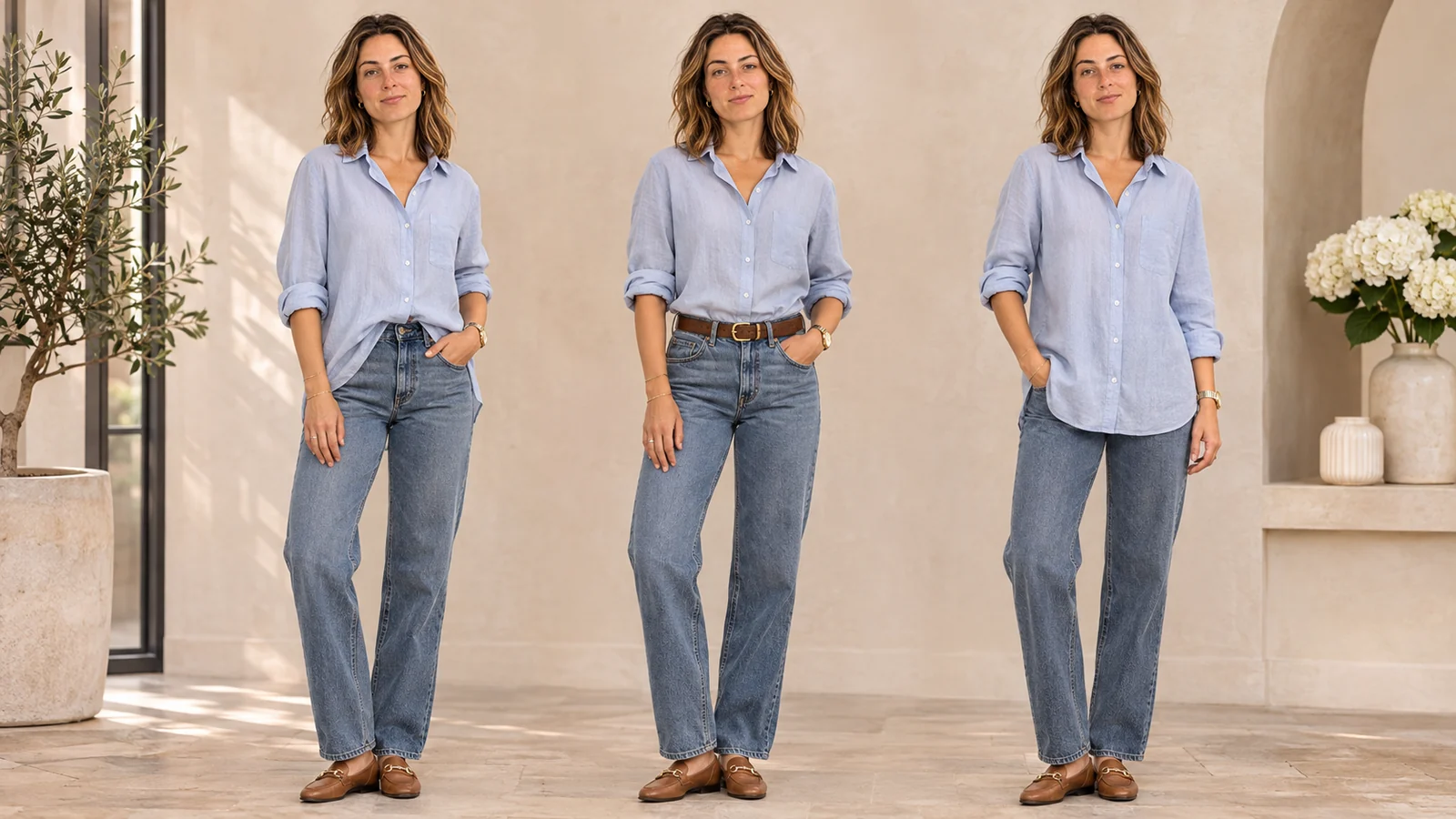
Classic French
01A section at the front is tucked; the sides and back hang free. Slip in a hand-width of fabric, then ease it out slightly so it does not pull.
THE WARDROBE FIELD GUIDE NO. 23
A little change in placement. A lot more possibility. Learn how to make the clothes you already own feel entirely your own.
A French tuck places a little of the front hem inside your waistband; a full tuck puts the suitable hem all the way in; untucked leaves it outside.
The best choice is the one that works with your garment, your comfort and the day ahead. None is inherently more polished—or more correct.
A MORE THOUGHTFUL WAY TO GET DRESSED
There are no rules to follow here—just useful ways to play with proportion, fabric and the pieces already in your closet.
01 / THE ESSENTIALS
Small changes in placement create different outfit compositions. All three are equally valid.
01 THE COMPARISON
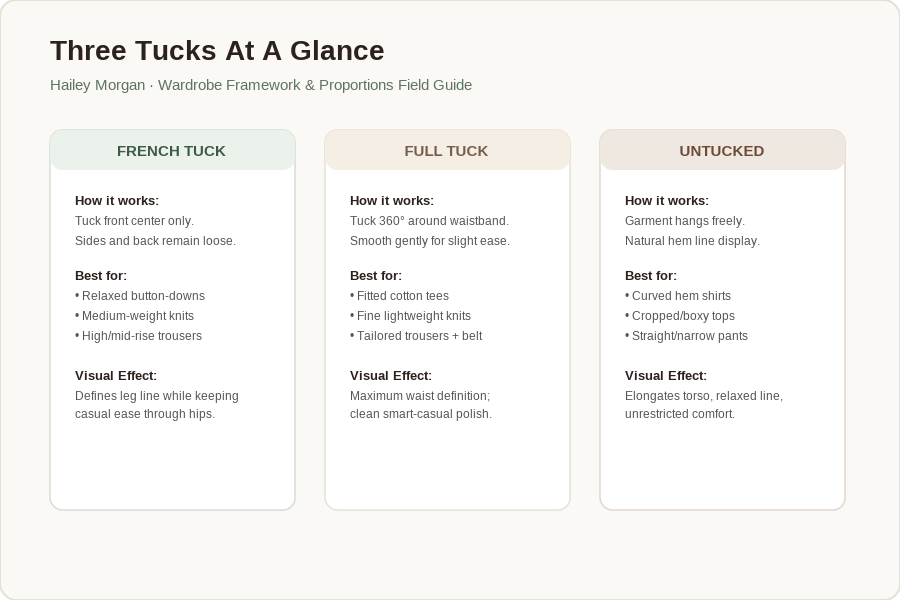
A French tuck puts part of the front hem inside the waistband while the sides and back remain loose. A full tuck places the entire hem inside; an untucked shirt leaves it all outside.
Each changes how the shirt sits, not how your body should look, so choose the placement that feels comfortable with your shirt and waistband.
The front goes in; the sides and back stay out.
CONSIDER Try it with a soft shirt and enough hem to stay in place without pulling.
The whole hem sits inside the waistband.
CONSIDER Leave a little ease above the waist; thick fabric can add bulk inside.
The whole hem remains outside the waistband.
CONSIDER Check the shirt length and hem shape when standing, reaching and sitting.
Same shirt, trousers, shoes and stance in each illustration. Placement is schematic; actual drape varies by fabric and fit.
02 THE REFERENCE
Names overlap and can mean different things to different people. These are practical descriptions, not strict rules.
A section at the front is tucked; the sides and back hang free. Slip in a hand-width of fabric, then ease it out slightly so it does not pull.
A small pinch of the front hem is tucked near the fly. Use just a few inches of fabric; a longer, soft hem is less likely to slip out.
A small section near one hip is tucked, with the rest left loose. Place the tuck near a side seam and check that the hem does not tug when you move.
One front panel is tucked while the other is left out. Try it with a button-front shirt and leave enough room across the buttons to sit comfortably.
The shirt hem is tucked all the way around the waist. Smooth the hem evenly into the waistband, then raise your arms to leave some ease.
A full tuck is gently loosened so fabric falls over the waistband. Pull a little fabric up evenly; this can give you more room to move and sit.
A full tuck with excess fabric folded into pleats at the sides. Fold the extra cloth back at each side before tucking; avoid pulling it uncomfortably tight.
The hem stays completely outside the waistband. Consider the length and whether a straight or curved hem gives the coverage you want.
The small drawings show the front only; a French tuck leaves the back out, while full, bloused and military-style tucks go all the way around. Fabric weight, shirt construction and waistband fit will affect the result.
03 THE DETAILS
A quick way to compare the practical details. On a small screen, scroll sideways to see all three.
| Consideration | French tuck | Full tuck | Untucked |
|---|---|---|---|
| Placement | Front section in; sides and back out | Entire hem inside | Entire hem outside |
| Waistband visibility | Partly visible at the front | Generally visible all around | Usually covered by the shirt |
| Bulk | Concentrated where the front is tucked | Distributed around the waist | No shirt fabric inside the waistband |
| Length | Enough front length to stay tucked; back remains loose | Enough length to stay tucked as you move | Choose a length and hem shape for the coverage you prefer |
| Comfort | Less fabric inside, though the front can bunch | A close waistband or thick fabric can feel snug | No tucked fabric at the waist; the hem moves freely |
| Sitting | The front may pull or come loose | Leave ease and adjust after sitting | Check that the hem stays where you want it |
| Occasion | An easy, in-between finish | Useful for tailored looks, uniforms or dressier settings | A relaxed finish for casual or intentional loose looks |
| Layering | A jacket may conceal the partial tuck | Works under layers when waistband bulk is comfortable | Consider how the hem sits beneath a shorter layer |
| Alternatives | Try a center-front or side tuck | Try a bloused or military-style tuck | Try a shorter hem or an open outer layer |
← Scroll to compare →
02 / YOUR PERSONAL GUIDE
A few details about your clothes—not your body—help reveal comfortable options to try.
A shirt-tuck finder for real clothes, real days, and your kind of comfort.
There is no right way to wear a shirt. Tell us a little about the outfit—not your body—and explore a few possibilities. Everything stays on this page.
All choices have a starting point. Change as many or as few as you like; your ideas update as you go.
This finder takes no measurements and does not save or send your choices. No purchase is required.
We are starting with untucked ideas to leave more room for comfort and movement.
Ideas, not rules. Fabric and comfort vary, so experiment gently and trust how it feels to you.
Use what you already have and skip any optional layer you do not own.
Starting suggestions. 3 ideas. First suggestion: Leave it loose. We are starting with untucked ideas to leave more room for comfort and movement.
Untucked · easy start
Keeping fabric outside the waistband leaves its limited space for you. Your top does not have to go into a waistband to look intentional.
Let the hem rest outside your trousers. Let the fabric fall in its own relaxed shape. Let it settle naturally as you move.
The hem may shift or cover the waistband. That is a valid look; adjust only if you want to.
Check a mid-rise waistband in your usual seated position or other comfortable posture; change course if anything presses or pulls.
No extra item is needed. Simply wear the top as it is.
Wear the top over trousers for an easy everyday combination.
Untucked · optional layer
An open layer can add a little structure for an everyday outfit while leaving the waistband and hem free. Let the fabric fall in its own relaxed shape.
Wear the top untucked. If you already have a comfortable jacket, shirt or cardigan, leave it open over the top. Skip the layer if it restricts movement or adds sensory discomfort.
An extra layer can feel warm, heavy or bothersome; it is entirely optional.
Sit and reach with the layer on. Remove or open it further if it pulls across your shoulders or waist.
No suitable layer? Wear the same top on its own; nothing needs to be bought.
Try the loose top with trousers, with or without an open layer you already own.
Partial tuck · optional
A small tuck can show a little of the waistband without enclosing the whole hem. Because space is limited, use only a very small amount of fabric—or skip it.
Place a small section at the center or one side of the front hem just inside the waistband of your trousers; leave the sides and back loose. Gently pull a little fabric back out so it is not taut.
It is not a good choice if you have to press fabric in or if the waistband feels tight.
Check in your usual seated position or other comfortable posture. If you feel pressure or pulling, release the tuck and leave the hem out.
Leave the whole hem untucked for the same outfit, with no accessories or purchases.
Try it with trousers for an everyday outfit; placement and symmetry are up to you.
Copy these notes, or print them for later. They will change if you edit your answers.
The best finish is the one that feels like you.
03 / THE VISUAL EDIT
An illustrated look at what changes when a hem moves—not a virtual fitting room.
THE INTERACTIVE FITTING ROOM
See how a shirt’s position changes the outfit—not the person wearing it. Start with pieces like the ones you already own.
Every look uses the same outfit, figure and pose.
Illustration, not a fit prediction
Only the shirt placement changes between the looks.
The shirt hem sits outside the waistband all the way around.
Only a small panel at the front center is tucked; both sides hang free.
The shirt hem is placed inside the waistband around the waist.
A TEXT ALTERNATIVE
Untucked: the whole hem stays outside. French tuck: only a small front-center section goes inside, leaving both sides loose. Full tuck: the hem goes inside around the waistband. A side tuck uses one front side; a bloused tuck eases some fabric back out after a full tuck. Try these with your own clothes and choose what feels comfortable.
These simplified drawings do not model every garment, fit, or body. Actual hems and waistbands can sit differently; cropped tops, chunky fabrics, and split hems may not suit every tuck.
Three-way comparison updated. Mid rise; straight-leg trousers.
Editorial illustrationStyle isn’t about having more.
It’s about seeing more in what you have.
04 / THE DEEPER DIVE
From hems and fabric to comfort and dress codes, here’s what makes a placement work in real life.
The French tuck—popularized on modern fashion runways and screens—tucks only the center front hem into your waistband while letting the sides and back cascade naturally. It defines your waistline without requiring a strict, restrictive tuck all around.
A full tuck secures the entire hem 360-degrees inside the waistband. Blousing the fabric slightly above the waistband provides comfortable movement when sitting or reaching.
Leaving your shirt untucked honors the natural silhouette of the garment. It works best with curved shirt-tail hems, square camp-collar hems, or cropped cuts designed to sit at hip level.
05 / THE OUTFIT LIBRARY
Real-life combinations to adapt to the pieces, places and preferences that are yours.
The wardrobe edit 60 ideas
Start with the clothes you already own. These are possibilities to adapt, not a shopping list or a claim about what is in your wardrobe.
Three ways to wear a hem.
Plenty of room to make them yours.
Not every hem works with every waistband. Thick fabrics can bunch, and cropped tops may not reach or stay tucked; results depend on the garments. If anything pinches, pulls or shifts, try less fabric, another pairing or leave it untucked. Comfort is the better guide.
The outfit library
Open a section to explore 20 complete combinations.
A small portion of the front hem sits inside the waistband; the rest stays loose. Try the center or a little to one side, without pulling it tight.
White poplin shirt + navy chinos + brown loafers; add a navy blazer if useful.
Consider Start with a small fold: crisp cotton can gather against a firm waistband.
Use what you have Use any light button-up or the flat shoes you already have.
Striped cotton tee + mid-wash straight jeans + white canvas sneakers; add an olive overshirt.
Consider A soft tee is easy to release if a snug jeans waist feels crowded.
Use what you have A plain tee and any comfortable trainers give the same easy idea.
Blue chambray shirt + black wide-leg trousers + tan espadrilles; add a fine cardigan.
Consider Ease only one small section into the waistband so the shirt can drape over the wider leg.
Use what you have Try a denim shirt with flats, or any dark trousers in your closet.
Fine cream merino tee + dark denim midi skirt + ankle boots; add a beige trench.
Consider A fine knit may lie more smoothly than a chunky one; release it if the skirt waist pulls.
Use what you have Use a lightweight cotton sweater and any closed-toe shoes.
Sky-blue linen shirt + stone cotton shorts + flat leather sandals; add a light cotton shirt as a layer.
Consider A soft, adjustable shorts waist may be more comfortable with a small tuck; linen will crease naturally.
Use what you have Choose a loose cotton shirt and any broken-in sandals or sneakers.
Black jersey tee + olive cargo trousers + canvas trainers; add a denim jacket.
Consider Keep the fold clear of a drawstring or front pocket opening so both remain usable.
Use what you have Replace cargos with relaxed chinos and use any casual jacket.
Ivory fluid blouse + chocolate satin midi skirt + low-heeled shoes; add a black cardigan.
Consider Delicate satin may show folds at the waist; try a tiny tuck or leave the blouse out.
Use what you have A dark cotton skirt and flat shoes work just as well.
Oatmeal fine-gauge knit + charcoal pleated trousers + black loafers; add a long coat.
Consider Thicker knits can add bulk and may not stay put; test a small edge rather than forcing it.
Use what you have Use a thin tee under a cardigan if your knit feels too substantial.
Navy-and-cream Breton tee + sand linen trousers + leather flats; add an open cotton shirt.
Consider With an elastic waist, leave enough ease to sit comfortably and let the front hang loose if needed.
Use what you have Use a plain navy tee and any breathable trousers.
Small floral blouse + dark straight jeans + brown ankle boots; add a plain cardigan.
Consider A long or slippery hem can shift during the day; re-tuck gently or wear it loose.
Use what you have A printed scarf with a plain top gives a similar accent without buying a blouse.
Sage jersey tee + rust A-line midi skirt + neutral sneakers; add a cropped denim jacket.
Consider Keep the tuck shallow if the skirt has a soft or elastic waistband.
Use what you have Use a skirt and tee in any two colors you enjoy.
Navy cotton polo + ecru straight trousers + flat sandals; add a cream cardigan.
Consider A short polo may not have enough hem to hold; let it sit out if it comes free.
Use what you have Trade the polo for a crew-neck tee and the sandals for loafers.
Soft checked shirt + dark denim skirt + loafers; add a light knit vest.
Consider Leave enough shirt loose around the skirt waistband to move and sit without tugging.
Use what you have Use a plain shirt and a sweater you already own instead of the vest.
Ivory henley + tobacco corduroy trousers + dark Chelsea boots; add a quilted jacket.
Consider Corduroy and a thick henley can stack up at the waist; a smaller fold may feel better.
Use what you have Try jeans and a cotton long-sleeve tee with any ankle boots.
Drapey black blouse + khaki tailored shorts + pointed flats; add an unstructured blazer.
Consider If the shorts have a high, firm waist, check comfort sitting before committing to the tuck.
Use what you have Use a dark tee and longer lightweight trousers if shorts are not practical.
Faded graphic tee + black straight jeans + lace-up boots; add an open flannel shirt.
Consider Avoid hiding the design you like; tuck a side edge instead of the center.
Use what you have Any favorite tee and trainers can stand in for the graphic and boots.
Pale-blue Oxford shirt + terracotta trousers + neutral sneakers; add a navy cardigan.
Consider An Oxford can be stiff: let the front blouse out slightly rather than packing in the hem.
Use what you have Any blue shirt with brown or navy trousers gives a similar contrast.
Coral tank + khaki midi skirt + flat sandals; add an open linen shirt.
Consider If the tank is cropped, it may not reach or stay inside the waist; wearing it loose is fine.
Use what you have Use a full-length tee and any comfortable summer shoes.
Soft cream blouse + navy pinstripe trousers + black lace-up flats; add a tailored vest.
Consider Try a side tuck if the trouser closure or pleats make the center uncomfortable.
Use what you have Plain dark trousers and a cardigan work in place of stripes and vest.
Lightweight grey sweatshirt + navy joggers + running shoes; add a puffer vest.
Consider Sweatshirt fabric can bunch or spring out of a drawstring waist; skip the tuck if it does.
Use what you have Use a thin long-sleeve tee for a flatter fold, or leave the sweatshirt out.
The hem goes inside the waistband all the way around, with enough ease to move. A tucked look is optional, never a requirement.
White cotton shirt + navy straight trousers + black loafers; add a navy blazer.
Consider A long shirt needs room in the waistband; gently blouse it out before sitting.
Use what you have Use any light shirt and dark trousers, or wear the shirt untucked.
Black fitted jersey tee + mid-wash straight jeans + white sneakers; add a denim jacket in a different wash.
Consider A soft tee is often easier to tuck than a thick one; check that the jeans do not pinch.
Use what you have Any plain tee and trainers make a useful version.
Pale-blue blouse + charcoal pleated trousers + burgundy flats; add a grey cardigan.
Consider Arrange the fabric lightly over the pleats rather than pulling it taut across them.
Use what you have Try a blue tee and any dark trousers with your own flats.
Cream ribbed long-sleeve tee + olive A-line midi skirt + brown ankle boots; add a trench.
Consider Ribbed fabric can cling or roll; use a comfortable skirt waist and adjust the hem as needed.
Use what you have Replace the ribbed tee with a soft cotton one and the boots with flats.
White linen button-up + rust linen trousers + tan sandals; add an open lightweight cardigan.
Consider Linen creases when tucked and sits differently in each waistband; loosen it for ventilation.
Use what you have Cotton pieces in similar light and earthy colors work too.
Soft ivory shell top + charcoal suit trousers + black low heels; add the matching jacket if available.
Consider A smooth, sufficiently long shell is easier to secure; if yours is short, leave it untucked under the jacket.
Use what you have Use separates in close dark tones and comfortable flats instead of a matching suit.
Burgundy drapey blouse + dark indigo jeans + black ankle boots; add a black cardigan.
Consider Slippery blouses can migrate out of denim; check the hem after sitting instead of tightening the waist.
Use what you have Use a dark tee and your everyday shoes for a quieter version.
Cobalt knit polo + cream wide-leg trousers + brown loafers; add a neutral blazer.
Consider Knit thickness matters: if the waistband feels bulky, try a partial tuck or leave it loose.
Use what you have A blue tee and any light-colored bottoms keep the color idea.
Soft striped tee + olive tailored shorts + canvas sneakers; add a light denim shirt.
Consider A longer tee can bunch in short shorts; fold less fabric in or try a French tuck instead.
Use what you have Wear any plain tee and comfortable shorts already in rotation.
Black sleeveless knit top + printed midi skirt + flat sandals; add an ivory cardigan.
Consider A soft skirt waist should not be stretched tight by the top; let the top out if it rolls.
Use what you have Use a plain skirt and a patterned scarf, or any full-length tee.
Blue Oxford shirt + dark brown corduroy trousers + leather lace-ups; add a navy wool coat.
Consider A heavier shirt and corduroy can feel bulky together; try a thinner shirt if the waist is tight.
Use what you have Use a cotton tee under a cardigan and any dark trousers.
Oatmeal jersey tee + taupe relaxed trousers + cream sneakers; add a brown cardigan.
Consider Tuck loosely into an elastic waist without trapping the drawstring; comfort comes first.
Use what you have Mix any neighboring neutrals, including grey and navy.
Fine black-and-white striped tee + black ankle trousers + red flats; add a camel jacket.
Consider Leave a little ease at the sides so the tee stays comfortable when reaching.
Use what you have Use black shoes and a red scarf or no red accent at all.
White fine cotton shirt + navy midi skirt + black loafers; add a grey sweater vest.
Consider Tuck the shirt, not necessarily the vest; a thick vest may sit better outside the waistband.
Use what you have A cardigan worn open replaces the vest without changing the base.
Terracotta cotton tank + cream cotton trousers + woven flats; add an open white shirt.
Consider A cropped tank may not reach the waistband securely; leave it out or choose a longer top.
Use what you have Use a full-length tee and any flats or sandals.
Navy satin-finish blouse + black wide-leg trousers + low block heels; add a black blazer.
Consider Satin can reveal folds, and a firm waistband may feel restrictive; try a loose tuck or leave it out.
Use what you have A soft dark shirt and flat shoes are equally valid.
Mustard cotton tee + navy utility trousers + white trainers; add an olive overshirt.
Consider Keep bulky seams away from a front closure and avoid covering pockets you need.
Use what you have Any bright tee with jeans or chinos offers the same contrast.
Thin black turtleneck + grey wool-blend trousers + black boots; add a long coat.
Consider Tuck the thin base layer only; a bulky sweater over it need not fit inside the waist.
Use what you have A long-sleeve tee and existing warm outerwear are enough.
Sage button-front shirt + dark denim midi skirt + tan loafers; add a cream cardigan.
Consider A denim waistband can be rigid: leave the shirt untucked if sitting pulls at the waist.
Use what you have Try a softer skirt or chinos and any walking shoes.
Ivory patterned blouse + deep-green flowy trousers + metallic flats; add a light shawl.
Consider A soft waistband may fold under a heavy blouse; a lighter top or untucked hem can be easier.
Use what you have Use a solid blouse, scarf, and any comfortable dressy shoes.
Let the hem sit naturally outside the waistband. Hem length, movement and comfort matter more than a prescribed silhouette.
White tee under an open blue cotton shirt + dark straight jeans + white sneakers; add a raincoat if needed.
Consider Both hems stay out; adjust the open shirt if it catches when you sit.
Use what you have Use any button-up as the open layer and any walking shoes.
Oatmeal chunky sweater + charcoal straight trousers + black loafers; add a long coat.
Consider A thick sweater may bunch in a waistband, so letting it fall free can be more comfortable.
Use what you have Any warm sweater and dark trousers work; no special knit is needed.
Oversized cream linen shirt + olive linen trousers + flat sandals; add a light cotton scarf.
Consider Choose an open neckline or rolled sleeves for airflow; linen creases are normal.
Use what you have Wear a loose cotton shirt and any breathable bottoms.
Navy tunic shirt + black straight ankle trousers + supportive flats; add a light cardigan.
Consider Check that the tunic hem lets you take a full stride and sit comfortably.
Use what you have Use a longer tee or button-up and your preferred walking shoes.
Boxy cropped grey sweatshirt + high-rise blue jeans + canvas sneakers; add a denim jacket.
Consider A cropped hem may sit above the waist or move up when reaching; layer a longer tee underneath if you prefer coverage.
Use what you have Wear a regular sweatshirt loose instead of changing its length.
Deep-green fluid blouse + black wide-leg trousers + low heels; add a black blazer.
Consider A curved or side-slit hem can hang freely; check that the layer does not pull at the shoulders.
Use what you have A dark tee and flat shoes make it more casual without a purchase.
Breton long-sleeve tee + navy A-line midi skirt + white trainers; add a tan trench.
Consider Try the tee at its natural length over the skirt; a stiff hem may flare rather than lie flat.
Use what you have Any striped or plain tee with a comfortable skirt works.
Heather-grey long-sleeve tee + black relaxed trousers + waterproof boots; add a rain shell.
Consider Leave the tee out over the waistband and test the layers while seated.
Use what you have Use existing closed shoes and an umbrella if you do not own waterproof boots.
Loose white cotton blouse + blue denim shorts + flat sandals; add an open striped shirt.
Consider If the blouse is longer than the shorts, check the hem while walking; choose the coverage you like.
Use what you have A loose tee and comfortable lightweight trousers work too.
Buttoned soft sage cardigan + ecru jeans + brown clogs; add a cotton coat.
Consider Let the cardigan hem sit outside; gaping buttons or a tight waistband are signs to adjust the fit.
Use what you have Wear a pullover and any flats if clogs are not in your closet.
Red checked flannel shirt + black jeans + lace-up boots; add a quilted vest.
Consider A thick flannel need not be tucked; open a button at the hem for easier movement if desired.
Use what you have Use any warm shirt and trainers or sturdy shoes.
Soft grey sweater + navy satin midi skirt + ankle boots; add a long wool coat.
Consider The sweater's weight and hem length change the drape; try it loose without stretching the skirt waist.
Use what you have Use a cotton skirt and an everyday knit instead of satin.
Cream knit polo + olive pleated trousers + brown loafers; add a navy blazer.
Consider A banded or cropped hem can rest at the waistband; it does not have to be pushed inside.
Use what you have Try a plain tee and the comfortable trousers you own.
Rust tee + black cargo trousers + canvas trainers; add an unbuttoned khaki overshirt.
Consider Leave the tee loose and keep the overshirt clear of pocket openings.
Use what you have Any casual shirt can serve as the overshirt; jeans can replace cargos.
Pale-blue untucked shirt + navy cropped trousers + tan flats; add a cream cardigan.
Consider An uneven shirt hem is designed to hang loose on some shirts; test the length when seated.
Use what you have Use a white shirt and any full-length dark trousers.
Black crew-neck tee + black tailored trousers + black loafers; add a grey blazer.
Consider A tee long enough to sit below the waistband can stay loose; adjust the jacket for easy movement.
Use what you have Mix existing dark separates rather than seeking a matching set.
Coral wrap-style top + cream straight-leg jeans + flat sandals; add a denim jacket.
Consider Tie a wrap only as snugly as comfortable; check that the neckline stays where you want it.
Use what you have A plain coral or other bright tee creates a similar color story.
Navy fleece pullover + grey joggers + running shoes; add a weather-ready jacket.
Consider A bulky hem can remain outside the drawstring waistband; avoid compressing it for the sake of a tuck.
Use what you have Any sweatshirt and comfortable trousers are a practical alternative.
Printed tunic blouse + dark slim-straight jeans + burgundy flats; add a black cardigan.
Consider Consider the blouse's side slits and length when sitting; an untucked hem should not restrict movement.
Use what you have A plain blouse with a scarf gives an accent using what you have.
Camel turtleneck sweater + dark-brown wide-leg trousers + black ankle boots; add a navy coat.
Consider A thick or short sweater can sit out naturally; if the hem rides up, add a longer base layer for coverage.
Use what you have Use any warm knit, dark trousers and comfortable closed shoes.
A year of ideas 24 seasonal picks
Six selections per season, drawn from the 60 looks above. Adapt layers to your local weather.
Easy layers and a little color for changeable days.
White poplin shirt + navy chinos + brown loafers; add a navy blazer if useful.
The blazer adds a light layer for a cool morning.
Consider Start with a small fold: crisp cotton can gather against a firm waistband.
Use what you have Use any light button-up or the flat shoes you already have.
Small floral blouse + dark straight jeans + brown ankle boots; add a plain cardigan.
A floral blouse and cardigan make an adaptable in-between combination.
Consider A long or slippery hem can shift during the day; re-tuck gently or wear it loose.
Use what you have A printed scarf with a plain top gives a similar accent without buying a blouse.
Pale-blue blouse + charcoal pleated trousers + burgundy flats; add a grey cardigan.
A light blouse and cardigan can be worn separately as the day warms.
Consider Arrange the fabric lightly over the pleats rather than pulling it taut across them.
Use what you have Try a blue tee and any dark trousers with your own flats.
Sage button-front shirt + dark denim midi skirt + tan loafers; add a cream cardigan.
A denim skirt and cardigan are a practical mild-weather pairing.
Consider A denim waistband can be rigid: leave the shirt untucked if sitting pulls at the waist.
Use what you have Try a softer skirt or chinos and any walking shoes.
White tee under an open blue cotton shirt + dark straight jeans + white sneakers; add a raincoat if needed.
The open shirt is an easy layer to remove.
Consider Both hems stay out; adjust the open shirt if it catches when you sit.
Use what you have Use any button-up as the open layer and any walking shoes.
Breton long-sleeve tee + navy A-line midi skirt + white trainers; add a tan trench.
The trench is useful when spring weather changes.
Consider Try the tee at its natural length over the skirt; a stiff hem may flare rather than lie flat.
Use what you have Any striped or plain tee with a comfortable skirt works.
Breathable fabrics and shoes that suit your day.
Sky-blue linen shirt + stone cotton shorts + flat leather sandals; add a light cotton shirt as a layer.
Linen and shorts keep the layers light.
Consider A soft, adjustable shorts waist may be more comfortable with a small tuck; linen will crease naturally.
Use what you have Choose a loose cotton shirt and any broken-in sandals or sneakers.
Coral tank + khaki midi skirt + flat sandals; add an open linen shirt.
An open shirt adds optional coverage over the tank.
Consider If the tank is cropped, it may not reach or stay inside the waist; wearing it loose is fine.
Use what you have Use a full-length tee and any comfortable summer shoes.
White linen button-up + rust linen trousers + tan sandals; add an open lightweight cardigan.
Loose linen layers offer airflow; expect some creasing.
Consider Linen creases when tucked and sits differently in each waistband; loosen it for ventilation.
Use what you have Cotton pieces in similar light and earthy colors work too.
Soft striped tee + olive tailored shorts + canvas sneakers; add a light denim shirt.
A cotton tee and shorts are easy for a warm day.
Consider A longer tee can bunch in short shorts; fold less fabric in or try a French tuck instead.
Use what you have Wear any plain tee and comfortable shorts already in rotation.
Oversized cream linen shirt + olive linen trousers + flat sandals; add a light cotton scarf.
Loose linen can be worn completely untucked.
Consider Choose an open neckline or rolled sleeves for airflow; linen creases are normal.
Use what you have Wear a loose cotton shirt and any breathable bottoms.
Loose white cotton blouse + blue denim shorts + flat sandals; add an open striped shirt.
A cotton blouse and sandals suit a relaxed hot day.
Consider If the blouse is longer than the shorts, check the hem while walking; choose the coverage you like.
Use what you have A loose tee and comfortable lightweight trousers work too.
Texture, richer colors and layers you can add or remove.
Ivory henley + tobacco corduroy trousers + dark Chelsea boots; add a quilted jacket.
Corduroy and a quilted jacket bring warmth.
Consider Corduroy and a thick henley can stack up at the waist; a smaller fold may feel better.
Use what you have Try jeans and a cotton long-sleeve tee with any ankle boots.
Pale-blue Oxford shirt + terracotta trousers + neutral sneakers; add a navy cardigan.
Terracotta trousers work with a cardigan on cooler days.
Consider An Oxford can be stiff: let the front blouse out slightly rather than packing in the hem.
Use what you have Any blue shirt with brown or navy trousers gives a similar contrast.
Blue Oxford shirt + dark brown corduroy trousers + leather lace-ups; add a navy wool coat.
Corduroy and a coat make the shirt-and-trouser formula warmer.
Consider A heavier shirt and corduroy can feel bulky together; try a thinner shirt if the waist is tight.
Use what you have Use a cotton tee under a cardigan and any dark trousers.
Mustard cotton tee + navy utility trousers + white trainers; add an olive overshirt.
An overshirt adds an easy transitional layer.
Consider Keep bulky seams away from a front closure and avoid covering pockets you need.
Use what you have Any bright tee with jeans or chinos offers the same contrast.
Red checked flannel shirt + black jeans + lace-up boots; add a quilted vest.
Flannel and a vest can be adjusted as the temperature changes.
Consider A thick flannel need not be tucked; open a button at the hem for easier movement if desired.
Use what you have Use any warm shirt and trainers or sturdy shoes.
Rust tee + black cargo trousers + canvas trainers; add an unbuttoned khaki overshirt.
A rust tee and overshirt give an earthy palette.
Consider Leave the tee loose and keep the overshirt clear of pocket openings.
Use what you have Any casual shirt can serve as the overshirt; jeans can replace cargos.
Keep the base comfortable and build warmth outside the waistband.
Fine cream merino tee + dark denim midi skirt + ankle boots; add a beige trench.
Fine knit, boots and a coat make a cool-weather skirt option.
Consider A fine knit may lie more smoothly than a chunky one; release it if the skirt waist pulls.
Use what you have Use a lightweight cotton sweater and any closed-toe shoes.
Oatmeal fine-gauge knit + charcoal pleated trousers + black loafers; add a long coat.
A fine-gauge knit and long coat add warmth without demanding a bulky tuck.
Consider Thicker knits can add bulk and may not stay put; test a small edge rather than forcing it.
Use what you have Use a thin tee under a cardigan if your knit feels too substantial.
White fine cotton shirt + navy midi skirt + black loafers; add a grey sweater vest.
A sweater vest can stay outside the tucked shirt.
Consider Tuck the shirt, not necessarily the vest; a thick vest may sit better outside the waistband.
Use what you have A cardigan worn open replaces the vest without changing the base.
Thin black turtleneck + grey wool-blend trousers + black boots; add a long coat.
Tuck the thin base layer and leave heavier outer layers free.
Consider Tuck the thin base layer only; a bulky sweater over it need not fit inside the waist.
Use what you have A long-sleeve tee and existing warm outerwear are enough.
Oatmeal chunky sweater + charcoal straight trousers + black loafers; add a long coat.
A chunky sweater stays loose over trousers and under a coat.
Consider A thick sweater may bunch in a waistband, so letting it fall free can be more comfortable.
Use what you have Any warm sweater and dark trousers work; no special knit is needed.
Camel turtleneck sweater + dark-brown wide-leg trousers + black ankle boots; add a navy coat.
A warm turtleneck and coat work without a tuck.
Consider A thick or short sweater can sit out naturally; if the hem rides up, add a longer base layer for coverage.
Use what you have Use any warm knit, dark trousers and comfortable closed shoes.
A starting point 12 pieces
Imagine these pieces as a small mix-and-match example: five tops, four bottoms, one layer and two pairs of shoes. Substitute the colors, cuts and footwear you already have. There is no need to buy the list.
One possible combination
Striped tee + navy trousers + loafers, with the cardigan when it is cool. Wear the tee tucked, partly tucked or loose according to its hem and your comfort.
A printable practice seven days
Seven small experiments, not seven new outfits. Repeat pieces freely and skip any step. Checkboxes are for this visit or your printed copy; they are not saved.
Prepare a print-only copy, then use your browser’s print command.
Choose a familiar top, bottom and shoes. Wear the top as you normally do.
Notice Notice comfort sitting, walking and reaching.
With the same or a similar outfit, tuck a small section of the front hem.
Notice Does it stay put without pressure at the waist?
If the hem and waistband allow, tuck a lightweight top all the way around, then loosen it slightly.
Notice Sit and reach; if it pulls or bunches, release it.
Wear the top untucked, or try an open shirt over a tee.
Notice Notice the hem's movement and the coverage you prefer.
Repeat a favorite approach with a different bottom or waistband, using what you have.
Notice Compare how the fabric behaves; no fit is a failure.
Add a cardigan, jacket or open shirt to one combination.
Notice Check temperature, pocket access and ease of movement.
Repeat the most comfortable combination or mix two ideas from the week.
Notice Write down what you liked, what shifted and what you would change.
Keep the combinations that make your day easier. Leave the rest.
See how the exact same garments look and function across a French tuck, full tuck, and untucked arrangement.
Useful, lived-in combinations for ordinary days, from denim to easy separates.
Top: Hip-length navy-and-ivory striped cotton raglan tee
Bottom: Mid-wash straight-leg jeans
French: Slip a palm-width of the tee's front into the jeans; leave the striped sides and back out beneath the jacket.
Full: Ease the whole tee hem into the jeans and release a little fabric above the waist for reaching.
Untucked: Let the tee's rounded hem fall over the jeans, with the chore jacket in the same position.
Relaxed pieces paired with a little texture, contrast or refinement.
Top: Black-and-ivory dot-print fluid blouse with a hip-length hem
Bottom: Dark straight jeans
French: Tuck a small front fold of the blouse just off-center; leave its back loose under the blazer.
Full: Tuck the blouse evenly around the waist and draw a little fabric back out so it blouses gently.
Untucked: Let the blouse skim over the jeans with the blazer worn the same way.
Considered separates that can be adapted to the expectations of a particular place.
Top: Full-length pale-blue Oxford shirt
Bottom: Charcoal pinstripe straight trousers
French: Tuck a small section beside the placket and leave the shirt's remaining tails loose under the blazer.
Full: Tuck both Oxford tails around the waist, then raise your arms and ease the shirt out a little.
Untucked: Wear both shirt tails outside the trousers beneath the same blazer.
Understated colors and simple shapes, interpreted with ordinary pieces rather than price or labels.
Top: Full-length cream fine-gauge crewneck knit
Bottom: Chocolate straight-leg trousers
French: Tuck a small front section of the fine knit, leaving the back free beneath the coat.
Full: Tuck the knit loosely all around and lift it slightly so it does not stretch at the shoulders.
Untucked: Let the cream hem rest naturally outside the chocolate trousers.
The considered wardrobe A practical framework
Explore six familiar tops, a small mix-and-match capsule and eight color stories. These are invitations to experiment, not rules or a shopping list.
54 garment ideas
36 capsule combinations
8 color palettes
01 By garment
Open a top for three French-tucked, three fully tucked and three untucked outfits.
A soft, regular-length cotton tee; try a finer jersey if tucking feels bulky.
Tuck a small section at the front; leave the sides and back out.
Try a hand-width tuck and keep the overshirt open.
Place the tuck between the pleats without pulling them flat.
Use a shallow fold if the skirt has a soft waist.
With a long-enough, lightweight tee and a comfortable waistband, tuck the hem all around.
Ease a little fabric back out for movement.
Check that the denim waistband feels comfortable sitting.
Let the soft jersey sit loosely above the waistband.
Let the whole hem hang naturally outside the waistband.
Leave both the tee and open overshirt loose.
Keep the cardigan open for an adjustable layer.
Check that the tee length feels comfortable when walking.
A soft, regular-length beige or stone button-down with a flexible hem.
Tuck a small portion of the front and leave the back outside.
Tuck just beside the placket if the closure is crowded.
Ease the front out slightly so it can move.
Keep the fold small against the skirt waistband.
Choose a pliable shirt with enough length and a waistband that comfortably holds the fabric.
Arrange the shirt loosely and check the fit while seated.
Smooth only as much fabric as the waistband can hold comfortably.
Leave a little ease around the shirt hem for reaching.
Let the shirt hem fall outside, buttoned to your preference.
Try the cardigan open over the loose shirt.
Notice how the hem moves over the shorts as you walk.
A curved hem can hang freely without being adjusted.
A lightweight, regular-length striped cotton shirt or jersey top.
A small front tuck leaves the stripe pattern visible at the sides and back.
Let the stripes sit naturally rather than pulling them straight.
Try a small off-center fold away from the trouser closure.
Keep the fold shallow if the skirt waist is elastic.
Use a fine, long-enough striped shirt and leave room at the waist.
Blouse the fabric very slightly for easy movement.
Check the hem stays comfortably in place as you sit.
Avoid packing excess fabric into the shorts; release it if it bunches.
Wear the hem loose and let the stripes make the visual detail.
Let the hem hang without adjusting it into the waistband.
Leave the overshirt open to show the stripes.
Check that the loose hem moves freely over the skirt.
A thin, flexible, regular-length knit—not a chunky or cropped sweater.
Try only a small edge of a fine knit, without stretching its hem.
If the knit springs out or bunches, leave it loose.
Tuck a small section without pulling on the knit stitches.
Check that the skirt waist is comfortable with the added fabric.
Only try this with a genuinely thin, long-enough, flexible knit and a roomy waistband; otherwise leave it out.
Place the hem gently all around; release it if the knit is compressed.
Sit and reach before deciding whether the full tuck is comfortable.
Avoid stretching the knit into a firm skirt waistband.
Let the knit fall as made; a banded or short hem can stay outside.
Let the sweater hem rest naturally over the trousers.
Choose the hem position that feels comfortable when seated.
Leave the overshirt open if you want an adjustable layer.
A fluid, regular-length blouse in a lightweight fabric.
A small front fold lets the rest of the blouse drape freely.
If the fabric is slippery, use a small fold and adjust as needed.
Leave the blouse loose at the sides for movement.
A shallow tuck avoids crowding a soft skirt waist.
A full-length blouse can go in all around when the fabric and waistband allow.
Gently loosen the blouse after tucking for reach and comfort.
Smooth bulky folds only if the waistband still feels easy.
If the hem gathers inside the shorts, choose a partial tuck instead.
The blouse can hang freely; side slits and curved hems need no adjustment.
Check that the hem and coat both move freely when seated.
Leave the jacket open over the loose blouse.
Let the blouse drape naturally over the skirt waistband.
An intentionally roomy shirt in lightweight, pliable cotton, long enough to reach the waist.
Gather just a little of the front; leave the rest outside.
Start with a narrow section so the shirt can stay relaxed.
Try one small front section beside the placket.
Release the fold if the skirt waistband feels crowded.
Only if your oversized shirt is lightweight and pliable and the waistband has ample room for the whole hem; otherwise use a partial tuck or wear it out.
Distribute the fine cotton gently around the waist; stop if it feels crowded.
A skirt waist with enough ease is essential; leave the shirt loose if it pulls.
Sit and reach; a long or stiff oversized hem may be better left out.
Let the longer hem stay outside and move freely.
Wear the shirt closed or open at the collar as you prefer.
Check that the layers feel comfortable over the loose sleeves.
Notice where the shirt hem falls against the shorts while walking.
02 The capsule
These 36 distinct combinations use only the 12 example pieces below: five tops, four bottoms, one layer and two footwear options. Choose loafers or flats for the brown footwear option. The cardigan is included where listed; otherwise, the look has no added layer.
Use the idea with similar pieces you already own—nothing here is a required purchase.
Placements are suggestions, not guarantees. A full tuck—including with the fine-gauge knit or chambray shirt—needs a thin, long-enough hem and a comfortable waistband; use a partial tuck or leave it out otherwise.
Open a top to see its combinations.
White cotton button-up + Mid-wash straight jeans + Comfortable white sneakers
French tuck No added layer
White cotton button-up + Mid-wash straight jeans + Brown loafers or flats
Full tuck Layer: Neutral cardigan
White cotton button-up + Navy relaxed trousers + Comfortable white sneakers
Untucked Layer: Neutral cardigan
White cotton button-up + Navy relaxed trousers + Brown loafers or flats
Full tuck No added layer
White cotton button-up + Olive midi skirt + Comfortable white sneakers
French tuck No added layer
White cotton button-up + Olive midi skirt + Brown loafers or flats
Untucked Layer: Neutral cardigan
White cotton button-up + Stone cotton shorts + Comfortable white sneakers
Untucked Layer: Neutral cardigan
White cotton button-up + Stone cotton shorts + Brown loafers or flats
French tuck No added layer
Navy-and-cream striped tee + Mid-wash straight jeans + Comfortable white sneakers
Untucked No added layer
Navy-and-cream striped tee + Mid-wash straight jeans + Brown loafers or flats
French tuck Layer: Neutral cardigan
Navy-and-cream striped tee + Navy relaxed trousers + Comfortable white sneakers
Full tuck Layer: Neutral cardigan
Navy-and-cream striped tee + Navy relaxed trousers + Brown loafers or flats
French tuck No added layer
Navy-and-cream striped tee + Olive midi skirt + Comfortable white sneakers
Untucked Layer: Neutral cardigan
Navy-and-cream striped tee + Olive midi skirt + Brown loafers or flats
Full tuck No added layer
Navy-and-cream striped tee + Stone cotton shorts + Comfortable white sneakers
French tuck No added layer
Black soft jersey tee + Mid-wash straight jeans + Comfortable white sneakers
Full tuck Layer: Neutral cardigan
Black soft jersey tee + Mid-wash straight jeans + Brown loafers or flats
Untucked No added layer
Black soft jersey tee + Navy relaxed trousers + Comfortable white sneakers
French tuck No added layer
Black soft jersey tee + Navy relaxed trousers + Brown loafers or flats
Full tuck Layer: Neutral cardigan
Black soft jersey tee + Olive midi skirt + Comfortable white sneakers
Untucked No added layer
Black soft jersey tee + Stone cotton shorts + Comfortable white sneakers
French tuck Layer: Neutral cardigan
Black soft jersey tee + Stone cotton shorts + Brown loafers or flats
Full tuck No added layer
Cream fine-gauge knit + Mid-wash straight jeans + Comfortable white sneakers
French tuck No added layer
Cream fine-gauge knit + Mid-wash straight jeans + Brown loafers or flats
Untucked Layer: Neutral cardigan
Cream fine-gauge knit + Navy relaxed trousers + Comfortable white sneakers
Full tuck Layer: Neutral cardigan
Cream fine-gauge knit + Navy relaxed trousers + Brown loafers or flats
Untucked No added layer
Cream fine-gauge knit + Olive midi skirt + Comfortable white sneakers
French tuck No added layer
Cream fine-gauge knit + Olive midi skirt + Brown loafers or flats
Full tuck Layer: Neutral cardigan
Cream fine-gauge knit + Stone cotton shorts + Brown loafers or flats
Untucked No added layer
Blue chambray shirt + Mid-wash straight jeans + Comfortable white sneakers
Untucked Layer: Neutral cardigan
Blue chambray shirt + Mid-wash straight jeans + Brown loafers or flats
French tuck No added layer
Blue chambray shirt + Navy relaxed trousers + Comfortable white sneakers
Full tuck No added layer
Blue chambray shirt + Navy relaxed trousers + Brown loafers or flats
Untucked Layer: Neutral cardigan
Blue chambray shirt + Olive midi skirt + Brown loafers or flats
French tuck No added layer
Blue chambray shirt + Stone cotton shorts + Comfortable white sneakers
Untucked No added layer
Blue chambray shirt + Stone cotton shorts + Brown loafers or flats
Full tuck Layer: Neutral cardigan
03 The color edit
Eight illustrative palettes, each with an idea for every hem placement. Adapt the shades to your own clothes.
Crisp and familiar, with a warm finishing note.
Earth tones with a softly lit neutral.
A calm mix of cool, clear neutrals.
Quiet contrast and earthy, uncomplicated color.
A rich dark anchor against milky, warm tones.
Gentle color with a grounded, neutral counterpoint.
A range of greys, from the lightest to the deepest.
Playful accents balanced with a versatile neutral.
There is no single right way to wear a hem. Keep the combinations that work for your clothes and your day.
THE OCCASION EDIT
Thoughtful ways to style what you already own, from a coffee run to a client meeting.
Situations to explore.
Three ideas for each.
A PRACTICAL REFERENCE
Open a situation to see three outfit ideas, plus notes on comfort, weather and dress expectations.
T-shirt + flexible jeans + supportive sneakers + light rain jacket
Tuck only a little of the front hem, leaving the sides and back free.
Button-up shirt + relaxed trousers + walking shoes + overshirt
Leave the shirt out for easy reaching and coverage while carrying bags.
Soft polo + woven drawstring trousers + flat slip-on shoes + zip cardigan
If the waistband has room, tuck the hem loosely all around and gently release a little fabric.
Soft tee + straight-leg jeans + supportive sneakers + open cardigan
Place a small section of the front hem into the waistband; leave the rest loose.
Fine-knit top + easy trousers + comfortable flats + light coat
Wear the knit out over the waistband, adjusting the hem for seated coverage.
Button-up shirt + comfortable chinos + flat loafers + unlined jacket
Tuck one side of the shirt front, leaving the other side and back out.
Lightweight blouse + relaxed trousers + cushioned flats + cardigan
Tuck the blouse around a roomy waistband and ease the fabric out slightly before sitting.
Cotton shirt + midi skirt with room to move + flat sandals + light jacket
Tuck a small center section of the shirt and leave the sides loose.
Fine-knit top + straight jeans + supportive loafers + overshirt
Let the knit fall naturally over the waistband for an uncomplicated lunch look.
Fluid blouse + comfortable tailored trousers + flat loafers + soft blazer
Tuck the hem loosely all around if there is room, then ease it out for sitting.
Button-up shirt + midi skirt + stable low-heeled or flat shoes + cardigan
Tuck one front side of the shirt and leave the other side free.
Fine-knit top + dark jeans + cushioned ankle boots + relaxed jacket
Wear the knit untucked, checking the hem stays where you want it while seated.
Button-up shirt + tailored trousers + flat loafers + blazer
Tuck the shirt around a comfortable waistband and loosen it slightly for movement.
Longer blouse + straight trousers + supportive flats + structured cardigan
Leave the blouse out for coverage and check that the hem falls comfortably when seated.
Fine-gauge knit + midi skirt + flat ankle boots + tailored coat
Tuck just a little of the front if the knit and waistband allow it; leave the back out.
Plain tee + chinos + clean supportive sneakers + cardigan
Tuck a small section at the front and leave the back out for easy movement.
Button-up shirt + relaxed trousers + flat loafers + soft blazer
Leave the shirt out and check coverage as you sit, stand and reach.
Lightweight knit + straight trousers + comfortable flats + overshirt
If the knit is thin and the waistband has room, tuck loosely and ease the fabric out.
Lightweight shirt + tailored trousers + cushioned loafers + blazer
Tuck the shirt around the waistband, then release a little fabric so it does not pull.
Longline blouse + straight trousers + supportive flats + structured cardigan
Leave the blouse out for comfortable coverage while standing and sitting.
Soft button-up + midi skirt + stable flat boots + unlined jacket
Tuck one front side only for a relaxed finish, if the event suits it.
Button-up shirt + tailored trousers + comfortable loafers + blazer
Tuck the shirt loosely all around if the waistband allows it; ease it out a little.
Neat blouse + straight trousers + supportive flats + cardigan
Leave the blouse out and test its coverage when seated or reaching.
Fine-knit top + chinos + clean flat shoes + relaxed jacket
Tuck a little of the front hem only if the workplace is casual enough and the fabric sits comfortably.
Button-up shirt + tailored trousers + supportive loafers + blazer
Tuck the shirt loosely all around and adjust it so you can sit and gesture comfortably.
Longer blouse + pressed straight trousers + comfortable flats + structured jacket
Leave the blouse out, smoothing the hem without pulling it tight.
Lightweight knit + midi skirt + flat ankle boots + tailored cardigan
Tuck the knit loosely only if the fabric is fine and the waistband is comfortable.
Soft longline tee + relaxed trousers + supportive walking shoes + zip layer
Leave the tee out for seated coverage and a waistband free of extra fabric.
Breathable shirt + flexible jeans + secure sneakers + lightweight jacket
Tuck a little of the front only if it stays comfortable during the journey.
Button-up shirt + pull-on trousers + flat slip-on walking shoes + cardigan
Tuck one side loosely, or leave both sides out when sitting for a long stretch.
Easy-on tee + pull-on trousers + slip-on walking shoes + cardigan
Leave the tee out for an outfit that is easy to adjust or change.
Jersey top + relaxed jeans + supportive sneakers + light jacket
Tuck a small front section that can be released quickly in a fitting room.
Thin shirt + comfortable skirt with an easy waistband + stable flats + overshirt
If comfortable, tuck the shirt loosely all around; let it out when trying on pieces.
Soft shirt + relaxed jeans + supportive sneakers + cardigan
Leave the shirt out for coverage while sitting, helping or playing.
Lightweight knit + flexible trousers + flat boots + overshirt
Tuck a little of the front hem, leaving room to move and reach.
Breathable blouse + midi skirt + comfortable flats + light jacket
Tuck the blouse loosely if comfortable, then ease out enough fabric for sitting.
Colorful button-up shirt + relaxed trousers + cushioned loafers + jacket
Tuck one side of the front and leave the rest out for an easy party look.
Lightweight blouse + flowing midi skirt + stable flats + cardigan
Tuck the blouse loosely around a comfortable waistband and ease it out slightly.
Favorite knit top + dark jeans + flat boots + soft blazer
Wear the knit out and add the layer only if you like the look or need warmth.
Cotton shirt + relaxed trousers + supportive sneakers + light cardigan
Tuck a small front section and leave the rest loose for walking and reaching.
Fine-knit top + straight jeans + walking shoes + roomy jacket
Wear the knit out so the waistband stays comfortable during a long visit.
Breathable blouse + midi skirt with room to walk + flat ankle boots + overshirt
Tuck the blouse loosely if the waistband has room and check that walking feels easy.
Soft tee + relaxed joggers + supportive indoor shoes or grippy socks + cardigan
Leave the tee out and adjust its length for comfortable seated coverage.
Lightweight shirt + soft pull-on trousers + comfortable slippers with grip + open overshirt
Tuck a little of the front only if it feels comfortable at the waistband.
Button-up shirt + loose woven trousers + flat indoor shoes + soft zip layer
Tuck one front side loosely, or leave it out for a fully relaxed option.
Your comfort comes first. These are ideas, not rules. Every tuck is optional: leave the hem out if a waistband, fabric or position is uncomfortable. Choose the coverage, movement and footwear that work for you, and follow the actual requirements of your setting.
The practical reference Wear it your way
A French tuck places part of the front hem inside the waistband. A full tuck places the suitable hem all the way in; untucked leaves it outside.
Start with clothes you already own. Choose for your garments, your day and your comfort—not a rule about how a body should look.
Hem length, fabric, waistband room and the way you move all matter. Try sitting, reaching and moving as you normally would. If a placement pinches, presses, pulls or feels distracting, change it or leave the hem out. No belt or purchase is required.
Choose the ideas that suit your garment and skip the rest. Open a tip for a simple how-to and a practical caveat.
What & how Put on the top and bottom untucked first; notice where the hem falls before changing it.
Keep in mind A long hem can catch on a seat or interfere with pockets; adjust it if needed.
What & how After arranging the hem, sit, reach and move in ways that are ordinary for your day.
Keep in mind A position that feels fine standing can pull or press when seated; undo or change it if it does.
What & how Slip just a short section of the front hem into the waistband, leaving the sides and back out.
Keep in mind A stiff or very short hem may not stay put; leaving it out is just as valid.
What & how Place a little of the front hem to one side instead of directly in the middle.
Keep in mind Avoid a closure or pocket opening if the extra fabric makes it awkward to use.
What & how With a button-down that opens at the hem, tuck one front panel and leave the other out.
Keep in mind Do not strain the buttons or separate the panels farther than the shirt allows.
What & how Place the hem inside the waistband all the way around, spreading fabric rather than gathering it in one place.
Keep in mind If the waistband feels crowded or restrictive, try a partial tuck or wear the top out.
What & how After a full tuck, gently draw up a little fabric so the shirt can move with you.
Keep in mind Too much released fabric may fall out; comfort matters more than keeping a precise shape.
What & how Try tucking the longer front of a curved shirt hem while letting the shorter sides hang naturally.
Keep in mind The front needs enough length to reach without pulling; otherwise wear it untucked.
What & how Leave a split-hem top out, or place only the front section inside the waistband while the slits remain free.
Keep in mind Do not force a slit or seam into a tight waistband; it can pull the garment out of place.
What & how On a longer-back shirt, try a small front tuck and let the back hem remain outside.
Keep in mind Check that the back does not snag on a chair or bag, especially when sitting down.
What & how See whether the hem reaches the waistband comfortably as you lift your arms or sit.
Keep in mind A cropped or short top may not have enough fabric to tuck; wear it out if you prefer.
What & how For a thick sweater, experiment with the smallest front section or leave the whole hem loose.
Keep in mind Bulky fabric can crowd a waistband; do not force a full tuck.
What & how Try a small partial tuck or an untucked drape with a smooth blouse, and readjust if you wish.
Keep in mind Some smooth fabrics slip out as you move; there is no need to pin or fasten them.
What & how Place a jersey hem gently into the waistband without stretching it taut, or leave it out.
Keep in mind If the fabric rolls or pulls during movement, take it out or use less fabric.
What & how Try a small section of soft fabric inside an elastic waist, then check the feel when seated.
Keep in mind Added layers may make the elastic press or roll; remove the tuck if that happens.
What & how If your bottoms have a drawstring, arrange a partial tuck away from the tie so it stays easy to reach.
Keep in mind Do not tighten the drawstring to hold a tuck; leave the hem out if it obstructs the closure.
What & how When a skirt has a lining, check how the tucked hem sits against the waistband and lining before heading out.
Keep in mind If layers bunch or shift, choose a smaller tuck or leave the top out.
What & how Try arranging the tucked fabric clear of pocket openings on your trousers or skirt.
Keep in mind Pocket placement and hem length vary; an untucked top may be easier with a particular garment.
What & how With a shirt and an open overshirt, tuck only the inner shirt or leave both layers out.
Keep in mind Tucking both layers can add bulk at the waist; skip it if it feels crowded.
What & how Put your usual jacket on after arranging the top and see whether the hems overlap as you like.
Keep in mind A long top may show beneath a short jacket; that can be intentional or you can change the arrangement.
What & how For a sheer or light-colored shirt, check the layers in the lighting where you expect to wear it.
Keep in mind Tucking can change which layers show; keep or change the arrangement according to your own coverage preference.
What & how On a button-front top, check that the placket and lowest fastened button sit comfortably after tucking.
Keep in mind If the front pulls open or feels strained, adjust the tuck or leave the hem out.
What & how If seams, folds or labels are distracting, try the hem out or position a small tuck away from the sensitive area.
Keep in mind Sensory preferences differ and may change during the day; stop if the arrangement is uncomfortable.
What & how If reaching around the back is difficult, begin with the top untucked or place a small front section where you can reach it.
Keep in mind Even a front tuck may not be accessible for everyone; use assistance only if wanted and available.
What & how Try leaving a light shirt out for an open, loose feel, or tuck it if that arrangement feels better with your layers.
Keep in mind Fabric, weather and personal comfort vary; a tuck does not guarantee warmth or cooling.
These are only mistakes when they get in the way of what you want. Each adjustment uses the clothes you already have.
Common mistake Packing a thick sweater into a close waistband.
Try instead Try a small front section or leave the sweater out.
Common mistake Forcing a short hem to stay tucked.
Try instead Wear it untucked if it will not reach comfortably.
Common mistake Pulling a tucked jersey top taut.
Try instead Release a little fabric for movement, or take the hem out.
Common mistake Gathering all of a full tuck at the front.
Try instead Spread the fabric around the waistband if there is room.
Common mistake Ignoring the seated feel of a waistband.
Try instead Sit as you normally would and remove or reduce the tuck if it presses.
Common mistake Covering a drawstring with a large front tuck.
Try instead Move the tucked section to the side or leave the hem out so the tie is reachable.
Common mistake Tucking fabric over a pocket opening you need.
Try instead Reposition the hem away from the pocket or wear it outside.
Common mistake Letting a shirt hem obstruct a trouser zip.
Try instead Clear the closure before fastening and choose a smaller tuck if necessary.
Common mistake Straining the bottom buttons of a shirt.
Try instead Loosen the arrangement or let the front panels hang naturally.
Common mistake Forcing a split side seam inside a waistband.
Try instead Keep the slits outside or leave the entire top untucked.
Common mistake Letting a long back hem bunch against a chair.
Try instead Smooth it before sitting, or rearrange it if that is comfortable and accessible.
Common mistake Tucking two thick layers into one waistband.
Try instead Leave the outer layer out, or wear both layers untucked.
Common mistake Leaving a skirt lining twisted beneath a tuck.
Try instead Smooth the lining and hem separately, or choose an untucked top.
Common mistake Folding a bulky seam against a sensitive spot.
Try instead Move the fold, use less fabric or leave the hem out.
Common mistake Expecting a slippery blouse to stay fixed all day.
Try instead Accept an occasional readjustment or wear it untucked instead of adding pins.
Common mistake Rolling an elastic waistband over a tucked hem that feels uncomfortable.
Try instead Unroll it, reduce the fabric inside, or take the top out.
Common mistake Tucking a curved hem before checking its length.
Try instead Try only the longer front section if it reaches comfortably, or leave it out.
Common mistake Assuming a long front tuck will stay clear of a seat belt.
Try instead Check that the belt lies properly and comfortably; rearrange the hem without interfering with the belt.
Common mistake Tucking a sheer layer without checking the effect.
Try instead Look at it in the intended light and adjust the layers to your own coverage preference.
Common mistake Overlooking a jacket catching on a loose shirt hem.
Try instead Smooth the layers or change the hem placement before closing the jacket.
Common mistake Making a one-panel tuck when the shirt does not open at the hem.
Try instead Try a small front tuck without pulling the placket apart, or leave the shirt out.
Common mistake Positioning a tuck where a bag rubs and pulls it out.
Try instead Shift the tuck away from the strap or leave the hem loose.
Common mistake Treating a longer-back hem as a flaw that must be hidden.
Try instead Let the designed hem show if you like it, and check it does not snag when seated.
Common mistake Choosing a full tuck that is difficult to reach or readjust.
Try instead Try a reachable front tuck or leave the hem out; ask for help only if wanted and available.
Common mistake Assuming every uniform permits the same hem placement.
Try instead Check the actual requirements, then use a comfortable permitted option with the garments available.
There is rarely one rule for every outfit. Open each claim to see the context.
Reality A partial tuck is one styling option; full and untucked hems can feel just as current.
Reality Fabric, the rest of the outfit and the setting all contribute; an untucked shirt can also look considered.
Reality A natural hem can be an intentional choice, whether the outfit is relaxed or more dressed up.
Reality You can choose a hem placement for movement, coverage or appearance without aiming for waist definition.
Reality Anyone can try it if they want to; the garment, activity and personal comfort matter more than a body category.
Reality A belt is optional. The waistband and the desired look may work perfectly well without one.
Reality Tightening can create discomfort; try a different placement or leave the hem out instead.
Reality Short or cropped hems may not reach or stay inside comfortably, particularly during movement.
Reality It can be a small or wider section of the front; placement depends on the garment and your preference.
Reality A slightly off-center placement is another option if the hem and waistband allow it.
Reality People sometimes use the terms interchangeably; half tuck can also mean tucking one front panel of a button-down.
Reality A bulky knit may crowd a waistband. A small partial tuck or an untucked hem can be easier.
Reality A fine knit can be worn out, partly tucked or fully tucked if the hem and waistband allow it.
Reality Some jersey tops tuck comfortably; others roll or pull. Try gently and check while moving.
Reality Pins are not necessary; a partial tuck, an untucked drape or occasional readjustment are options.
Reality Curved hems can be worn outside; their shape may also lend itself to a partial tuck when long enough.
Reality Curves, side slits and longer backs are often part of a garment's design; uneven lengths can be intentional.
Reality A little ease can accommodate movement; the amount that feels comfortable differs between garments and people.
Reality Sitting changes how fabric and waistbands rest. Check seated comfort and adjust when needed.
Reality Hem placement can affect seated comfort, coverage or access. Preferences differ, so ask the individual rather than assume.
Reality The extra fabric can still press, roll or bunch; try a small tuck or none at all.
Reality It depends on pocket placement and fabric. You can arrange a partial or full tuck away from openings if that works.
Reality Requirements vary by workplace, uniform and occasion. Check the actual guidance rather than assuming.
Reality Experiment with the pieces you already own; not every item needs to work in all three arrangements.
Reality Comfort and activities change. Readjust, switch arrangements or leave the hem out whenever you like.
These 12 cases are hypothetical examples, not real people or fitting guarantees. Adapt any option to your own garments, access needs and preferences.
Garments & preference A person likes the curved hem of their cotton shirt with tailored trousers and wants comfortable long periods of sitting.
Options Try the shirt untucked, or tuck a small front section and sit down to check it.
Limitations A close waistband or short front hem may make the partial tuck uncomfortable or unstable; check any actual workplace requirements.
Garments & preference A wheelchair user wants a jersey T-shirt with elastic-waist trousers and prefers a smooth feel against the chair.
Options Arrange the tee untucked over the waistband, or try a small front tuck if it feels comfortable.
Limitations A long back hem may bunch against the seat, while tucked fabric may add pressure; adjust based on the person's own seated experience.
Garments & preference Someone prefers the feel of a soft tee and leggings and dislikes folds pressing under a waistband.
Options Wear the tee untucked; if curious, try a small tuck for a short time and take it out whenever desired.
Limitations Even soft fabric can feel distracting when layered; no tuck is necessary.
Garments & preference A person likes a loose linen shirt and drawstring shorts for a warm day and wants easy access to the tie.
Options Leave the shirt out or place a small front section to one side of the drawstring.
Limitations The shirt may crease and the tucked section may shift; do not tighten the drawstring to hold it.
Garments & preference Someone wants to wear an existing chunky sweater with a lined skirt without a crowded waistband.
Options Leave the sweater out, or test a tiny front tuck if there is room.
Limitations Thick knit and a skirt lining can bunch together; a full tuck may not be practical.
Garments & preference A person enjoys a fluid blouse with a long skirt and wants to move and sit through an evening gathering.
Options Try a loose full tuck if the hem fits, or let the blouse drape untucked.
Limitations Smooth fabric may slip and a snug skirt waistband may press when seated; the event's dress guidance may also matter.
Garments & preference Someone likes the length of a short T-shirt with low-rise jeans and wants their chosen coverage while reaching.
Options Wear the tee out, or try a small front tuck only if the hem reaches without pulling.
Limitations The hem may come free or lift with movement; the person decides whether that coverage works for them.
Garments & preference A person likes the asymmetry of an open-hem button-down with relaxed trousers.
Options Tuck one front panel and leave the other out, or wear both panels untucked.
Limitations The panels must open sufficiently without straining buttons; check that the arrangement does not block the trouser closure.
Garments & preference Someone wears a tee, an open overshirt and jeans, and wants to remove a layer easily.
Options Leave both hems out, or tuck the tee and keep the overshirt loose.
Limitations Tucking both layers can add bulk, and a long overshirt may catch on a seat or bag.
Garments & preference A person with limited reach likes a long top with soft trousers and wants to dress independently when possible.
Options Keep the top untucked or try a front-only tuck within comfortable reach; assistance is optional if wanted and available.
Limitations A front tuck is not accessible for everyone; a full tuck may be difficult to arrange or readjust.
Garments & preference Someone prefers the coverage of an existing side-slit tunic over wide-leg trousers.
Options Let the tunic hang freely, or test a small front tuck while leaving the side slits outside.
Limitations The front section may be too long or stiff for the waistband; check how the hem behaves while sitting or walking.
Garments & preference A person wants to wear a soft shirt and work trousers for a day that involves frequent reaching and bending.
Options Start untucked or try a loose full tuck, then rehearse the movements the day requires.
Limitations The hem may pull free or the waistband may feel restrictive; follow any relevant uniform or safety requirements.
The best arrangement is the one that works for you, in the clothes you have, today.
06 / THE CLOSET YOU ALREADY HAVE
Select the pieces you have and discover combinations without adding to your shopping list.
YOUR WARDROBE, REIMAGINED
Start with the pieces already in your wardrobe. We’ll put them together into thoughtful, wearable formulas.
JUST FOR YOU · NOTHING IS SAVEDYOUR PERSONAL EDIT
Choose your items and preferences above, then create your outfit ideas.
A note on fit. These are starting points, not rules. Suitability depends on the actual fabric, hem, fit and waistband comfort. Skip or adjust any tuck that doesn’t feel good. Weather and occasion needs vary; there are no universal dress codes.
07 / A FEW LAST DETAILS
A little clarity for the next time you get dressed.
A French tuck places a small section of the front hem inside the waistband while much of the sides and back stay out. The exact placement can vary.
A French tuck is a partial front tuck. A full tuck places the suitable hem all the way inside the waistband; either can be arranged loosely or neatly.
The names sometimes overlap. Half tuck can also mean that one front panel of a button-down is tucked while the other stays out.
A fine or lightweight knit may work if its hem and your waistband allow it. For a bulky knit, try a small partial tuck only if comfortable, or leave it untucked.
Yes, if the shirt has enough length and the waistband feels comfortable. Check coverage and stability while sitting or moving.
No. A belt is optional unless you need one to support the garment. Do not tighten it to make an uncomfortable tuck stay in place.
Absolutely. A natural hem, intentional layering, and clothes appropriate to the occasion can make an untucked outfit feel considered.
Check fabric thickness, shirt length and waistband room. Distribute a suitable hem more evenly, use a smaller partial tuck, or wear the shirt untucked.
08 / TAKE IT WITH YOU
Printable summaries and worksheets for the next time you want to restyle what you own. The outfit sheet is a sampler; the full library is above.
THOUGHTFUL CHOICES, NEVER NECESSITIES
Existing clothes are the best place to begin. These are optional categories to keep in mind only if you’re already replacing something—not a shopping list.
Affiliate disclosure: This page has no active affiliate links. If recommendations are added later, links may earn a commission at no extra cost to you. As an Amazon Associate I earn from qualifying purchases.


