Casual chic is usually a styling approach: comfortable everyday pieces made to feel considered. Smart casual is usually a flexible dress-code request for relaxed but polished clothing in a particular setting. The same outfit can fit both; follow the actual host, employer, or venue guidance first.
Denim, sneakers, T-shirts, blazers, heels, and colors have no universal pass/fail status. A real dress-code restriction outranks a general outfit suggestion.
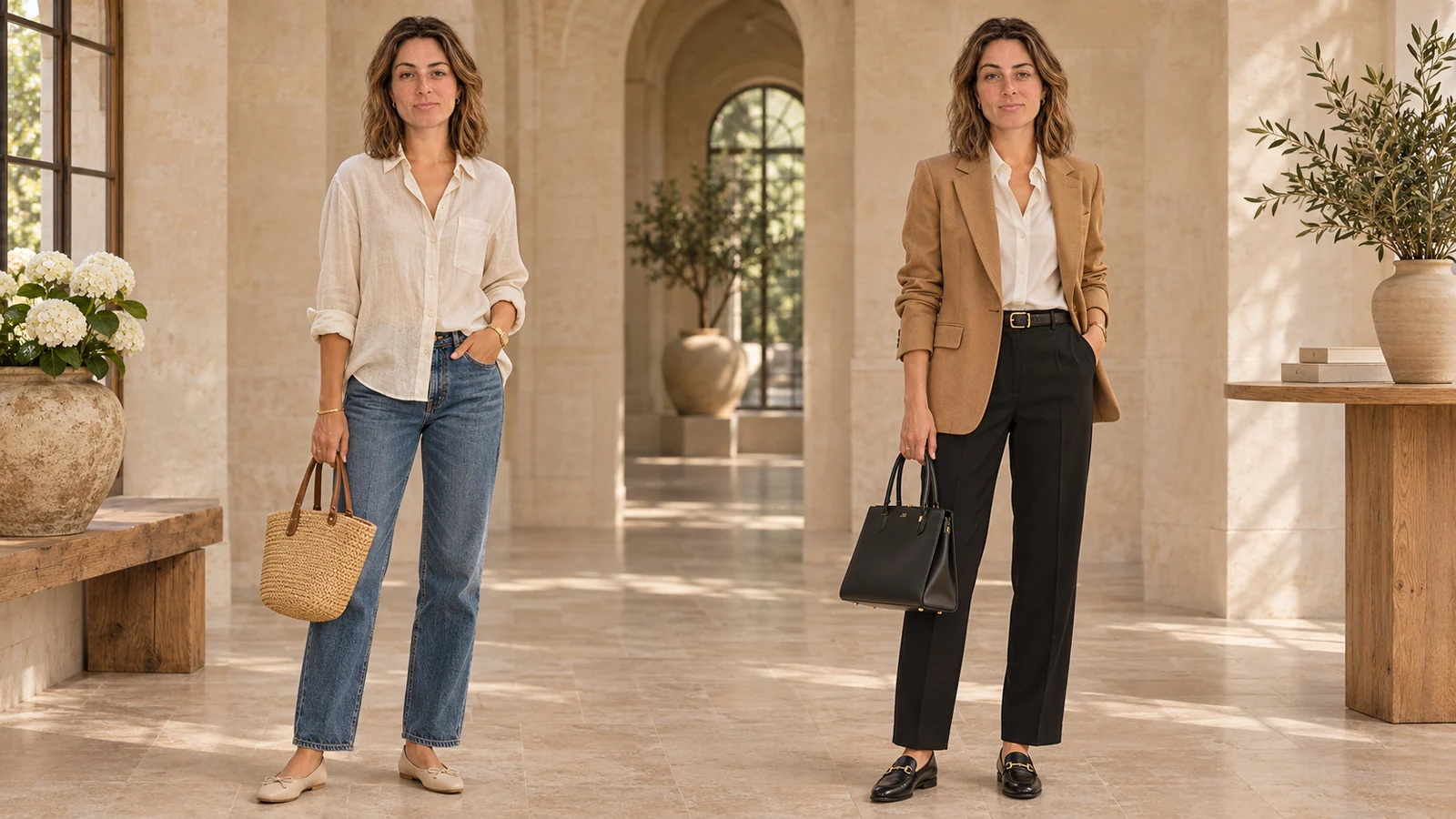
Casual Chic vs Smart Casual: What's the Difference?
Quick answer: Casual chic is usually a styling approach: comfortable everyday pieces made to feel considered through coordination, fit, condition, texture, or a useful layer. Smart casual is usually a flexible dress-code request: look relaxed but intentionally polished for a particular workplace, invitation, or venue. The same outfit can fit both, and neither term has a universal checklist—follow the actual host or employer guidance first.
Illustrative reading time: 18 minutes.
The useful distinction is purpose, not a strict formality ranking. Smart casual usually tells you what a setting expects; casual chic usually describes how you want an outfit to come together.
At a glance
| Question | Casual chic | Smart casual |
|---|---|---|
| What kind of term is it? | A flexible aesthetic or styling description. | A flexible dress-code label. |
| What is the aim? | Make relaxed clothing feel intentional and harmonious. | Balance comfort with a setting-appropriate, polished presentation. |
| Is there one official definition? | No universal definition was identified in the sources reviewed. | No universal definition; workplace and event interpretations vary. |
| Is a blazer required? | No. | No. It is one possible layer, not a requirement. |
| Can denim or sneakers work? | Often part of an everyday look. | Sometimes, if the specific dress code and venue allow them. |
| What decides suitability? | Personal preference, activity, weather, and styling. | Written instructions, event purpose, employer or venue expectations, and practical needs. |
What casual chic means
Casual chic describes a way of styling, not a formal invitation category. It can begin with jeans, a relaxed shirt, a knit, a simple dress, or a neutral T-shirt. Coordination, a useful layer, clean footwear, or an accessory you already own can make the combination feel deliberate. The goal is not to make every outfit dressy; it is to create a look that feels like you and works for the day.
Examples include straight-leg jeans with a striped shirt and flats; wide-leg denim with a fine-knit top and comfortable sneakers; or a simple midi dress with a cardigan and boots. None requires a designer label, high heels, a luxury bag, makeup, or a particular body shape.
What smart casual means
Smart casual is commonly used as a dress-code request. It often signals that everyday comfort is welcome but that the outfit should look considered for the context. A button-down with trousers, a refined knit with a skirt, or dark jeans with a polished top might work in one setting. Another employer or restaurant may exclude denim, sneakers, or T-shirts. Career-service and fashion sources describe examples, but their advice is not a universal policy 1 2 3.
Read the invitation, employee guidance, or venue policy. If the wording matters and remains unclear, ask the organizer. A blazer may add structure, but refined knitwear, coordinated separates, a blouse, a dress, or suitable trousers can also create a polished outfit.
The dress-code spectrum, with caveats
These labels are useful shorthand, not a single official ladder. Different settings use them differently.
| Common label | Typical direction | Illustrative outfit idea | Important limit |
|---|---|---|---|
| Ultra casual | Very relaxed clothing for appropriate everyday activities. | Soft tee, comfortable trousers, supportive shoes. | Not a fit for every venue or activity. |
| Everyday casual | Practical personal clothing. | Jeans, knit top, sneakers. | Weather, mobility, and local expectations matter. |
| Casual chic | Casual pieces styled intentionally. | Straight jeans, relaxed shirt, flats, coordinated layer. | Aesthetic, not usually a formal dress-code instruction. |
| Elevated casual | Casual clothing with a more refined overall presentation. | Knit top, clean dark denim where suitable, loafers. | Meanings vary by host and publisher. |
| Smart casual | Relaxed but context-appropriate polish. | Tailored trousers, refined knit, flats. | Check specific rules about denim, footwear, logos, and activity. |
| Business casual | Workplace-oriented attire, often with employer-defined boundaries. | Trousers, blouse or collared shirt, suitable shoes. | Policies vary widely; don't infer permission. |
| Business professional | More conventional, structured professional clothing. | Suit or coordinated tailored separates. | Industry, region, role, and employer expectations differ. |
| Cocktail attire | Occasion-focused evening dressing. | A dress or polished separates suitable to the event. | Invitation and venue guidance should resolve ambiguity. |
“Casual chic” and “elevated casual” are aesthetic terms rather than fixed points on an official scale. “Dressy casual” may be used similarly to smart casual by one host and differently by another. Emily Post’s attire guide emphasizes context and gives broad descriptions; it does not set a universal casual-chic/smart-casual taxonomy 1.
Casual chic, elevated casual, dressy casual, and smart casual
| Term | Common use | Outfit direction | Where it may appear |
|---|---|---|---|
| Casual chic | Styling aesthetic | Relaxed garments with intentional coordination | Everyday outings, personal style boards |
| Elevated casual | Styling description | Familiar casual pieces with a refined finish | Lunch, travel, informal gatherings |
| Dressy casual | Invitation wording | A step more considered than everyday casual, interpreted by the host | Parties, dinners, social occasions |
| Smart casual | Dress-code request | Comfortable pieces arranged for polished, context-aware presentation | Workplaces, restaurants, networking, events |
Examples using similar garments:
- Casual chic: wide-leg jeans, cotton tee, relaxed jacket, clean sneakers.
- Elevated casual: the same jeans with a fine knit, belt, and loafers.
- Dressy casual: a midi dress, comfortable flats, and a suitable outer layer.
- Smart casual: tailored trousers, button-down, and loafers—if those fit the stated venue or workplace expectations.
These are illustrations, not entry guarantees. A restaurant's written policy or an event host's clarification outranks a general style article.
Smart casual, business casual, and business professional
| Garment | Smart casual | Business casual | Business professional |
|---|---|---|---|
| Blazer | Common option, not required | Common in many settings | Often part of coordinated tailoring |
| Button-down shirt | Commonly adaptable | Commonly suitable | Commonly suitable |
| T-shirt | Context dependent | Check policy | Often outside conventional expectations |
| Fine-knit sweater | Often suitable | Often suitable | Depends on workplace convention and styling |
| Denim | Only where permitted | Check the specific policy | Often outside conventional expectations |
| Tailored trousers | Commonly suitable | Commonly suitable | Commonly suitable |
| Dress or skirt | Often suitable | Workplace dependent | Usually more structured/conventional |
| Sneakers | Context dependent | Check policy | Often outside conventional expectations |
| Loafers or flats | Often suitable | Often suitable | Suitable options may depend on the setting |
| Accessories | Personal and context dependent | Keep within policy and practical needs | Often restrained by convention, not universal law |
For a first day, interview, client meeting, networking event, business trip, or casual Friday, check the organization’s own guidance. When no clear rule is available, asking a recruiter or supervisor is more reliable than assuming that another workplace’s policy applies. USF Career Services advises checking an employer’s expectations for interviews; Texas Workforce Commission guidance notes that workplace norms vary 2 4. For workplace accommodation questions, consult the relevant employer process and applicable official guidance; the EEOC's religious-garb guidance addresses a specific accommodation area and is not a general outfit rule 5.
Twelve things that can change an outfit's presentation
None of these is a numerical formality score or a universal rule. Consider the whole outfit and situation.
- Construction: A lined jacket may hold a different shape from a soft cardigan. Casual chic: denim jacket over a dress. Smart-casual option: a refined cardigan over trousers. No-cost idea: try an existing layer; keep the one that suits the activity.
- Tailoring: Darts, seams, closures, and shaping affect how a garment hangs. Tailoring is optional. A clean, comfortable fit can be intentional without bespoke work.
- Fabric appearance: Jersey, poplin, denim, knitwear, linen, and blends move and reflect light differently. Fiber alone does not determine formality. Assess the finished cloth and care label 6 7.
- Fit and ease: Clothing should allow the movement you need. Relaxed or oversized pieces can be intentional; check that length, shoulder, sleeve, and volume work for your body and activity rather than following a body-type rule.
- Condition: Stains, broken closures, or unwanted damage can distract in settings where a neat appearance matters. Repair, lint removal, or a clean alternative may help; normal wrinkles in linen are not a character flaw.
- Footwear: Shoes influence the visual balance and must also work for walking, standing, mobility, weather, and pain management. Heels are not required.
- Color: Repeating a color or using a tonal palette can connect pieces. Bright color can be polished; neutrals are a preference, not a rule.
- Pattern: A print is not inherently casual. Scale, contrast, garment structure, and surroundings affect the overall read.
- Accessories: A belt, bag, scarf, or jewelry can add function or a point of coordination. Expensive pieces are unnecessary.
- Layering: A coat, blazer, shirt, or cardigan changes warmth and silhouette. Use layers that are practical for the destination.
- Details: Collar, cuff, pocket, hem, button, logo, and decoration can affect the overall impression. No single detail guarantees acceptance.
- Occasion and environment: The same outfit may work for a café and not a client meeting, or suit one restaurant and not another. The written requirements come first.
A five-step wardrobe-first transformation
- Start with an existing comfortable outfit you like.
- Check whether the garments are clean, functional, and comfortable for the activity.
- If useful, try one available layer or more structured piece; a blazer is only one option.
- Review footwear and accessories against walking, weather, and any stated restrictions.
- Compare the whole outfit with the invitation or workplace guidance. Keep it unchanged if it already works.
Small changes can be enough: tee + jeans + clean sneakers can remain casual chic. If denim and sneakers are allowed for the occasion, a suitable layer or alternative shoes might make the same base read more polished. If denim is excluded, a blazer does not override that rule—choose trousers or another permitted bottom.
Twenty controlled outfit transformations
Each “after” is conditional on the venue or workplace allowing the listed pieces. The casual version is not intentionally untidy.
| # | Casual chic | Possible smart-casual variation | Changed variables and caveat |
|---|---|---|---|
| 1 | White tee + straight jeans + clean sneakers | Same tee/jeans + suitable blazer + loafers | Layer and shoes change; denim must be allowed. |
| 2 | Wide-leg jeans + relaxed knit + sneakers | Same jeans + refined knit + flats | Knit texture and shoes change; check denim rule. |
| 3 | Relaxed button-down + denim + flats | Button-down + tailored trousers + loafers | Bottom and shoes change. |
| 4 | Sweater + jeans + sneakers | Sweater + tailored trousers + flats | Bottom and footwear change. |
| 5 | Oversized blazer + tee + jeans | Blazer + fine knit + trousers | Top and bottom change; oversized volume can stay. |
| 6 | Cardigan + tee + jeans | Cardigan + refined top + skirt or trousers | Base top/bottom vary. |
| 7 | Midi dress + sneakers + denim jacket | Same dress + flats + structured layer | Layer and footwear change; dress code still governs. |
| 8 | Midi skirt + tee + sneakers | Same skirt + fine knit + loafers | Top and shoes change. |
| 9 | Relaxed tonal layers + sneakers | Tonal structured separates + flats | Structure changes, not a requirement to wear neutrals. |
| 10 | Linen shirt + relaxed trousers + sandals | Same shirt + tailored trousers + suitable flats | Fabric and shoe choices suit climate and venue. |
| 11 | Black jeans + knit + sneakers | Black jeans + blouse + loafers | Top and shoes change; only where denim is permitted. |
| 12 | Striped tee + denim + flats | Same tee + trousers + refined cardigan | Bottom/layer change. |
| 13 | Oversized shirt + jeans | Shirt styled with trousers and appropriate shoes | Styling and bottom change; retain relaxed fit if desired. |
| 14 | Wide-leg trousers + tee + sneakers | Same trousers + blouse + loafers | Top and shoes change. |
| 15 | Trench + tee + jeans + sneakers | Trench + knit + tailored trousers + flats | Base garments change; coat remains. |
| 16 | Knit dress + boots | Same dress + polished flats + optional cardigan | Footwear and layer change. |
| 17 | Denim jacket + skirt + tee | Alternative suitable jacket + refined top + skirt | Layer and top; dress restrictions control. |
| 18 | Comfortable flats + jeans + knit | Same flats + trousers + button-down | Clothing changes while supportive flat shoe remains. |
| 19 | Minimal sneakers + midi dress | Same dress + loafers, if sneakers are restricted | Change only shoe type; respect mobility needs. |
| 20 | Existing capsule: tee + jeans + cardigan + sneakers | Same capsule: button-down + trousers + cardigan + loafers | Use owned alternatives; no new purchase implied. |
Can jeans be smart casual?
Sometimes, if the specific dress code permits denim. A dark or black wash, intact fabric, and a deliberate overall combination are common styling conventions—not a guarantee. Medium, light, white, relaxed, straight, and wide-leg denim can each look intentional, but the garment and setting matter. Distressed denim may be unsuitable in a venue that asks for a neat or formal presentation. A blazer cannot cancel an explicit “no jeans” rule.
| Denim | Possible casual-chic pairing | Conditional smart-casual pairing |
|---|---|---|
| Straight-leg, dark wash | Tee + sneakers | Button-down + loafers, where denim is permitted |
| Wide-leg, medium wash | Knit + flats | Refined top + suitable jacket |
| Slim-straight, black | Cardigan + boots | Blouse + flats, if allowed |
| Relaxed, light wash | Striped tee + sneakers | Only where the setting accepts light denim |
| White jeans | Linen shirt + sandals | Refined knit + appropriate flats, climate/venue permitting |
| Distressed | Casual shirt + comfortable shoes | Often conflicts with a neat-dress expectation; check policy |
A dozen useful tests: dark straight denim with a shirt; black denim with a knit; wide-leg jeans with a fine knit; white jeans with a blouse; medium denim with a blazer; clean denim with a polo; denim with a structured cardigan; denim with a midi-length layer; denim and loafers; denim and clean minimalist sneakers; light denim with a refined top; or no-denim trousers when the policy excludes jeans. They are styling options, not venue permissions.
Can sneakers be smart casual?
Sometimes. Clean minimalist sneakers may suit an informal office or event that permits them; athletic running shoes are designed for sport and may read differently. Classic canvas, retro, chunky, leather-look, and supportive everyday shoes also vary in appearance and function. The organizer’s restrictions decide whether sneakers are acceptable.
| Keep the clothes the same; change only shoes | Possible effect | Practical check |
|---|---|---|
| Tailored trousers + knit + running shoes | Sport-oriented | Are athletic shoes allowed and suitable for the task? |
| Same outfit + clean minimalist sneakers | More streamlined casual | Check venue rule and condition. |
| Same outfit + loafers | More conventional polish | Ensure comfort and fit. |
| Same outfit + ballet or pointed flats | Refined without heels | Check walking and support needs. |
| Same outfit + ankle/Chelsea boots | Weather-ready structure | Consider sole grip and climate. |
| Same outfit + flat sandals | Ventilated, relaxed | Venue and weather dependent. |
| Same outfit + heeled shoes | Different visual line | Optional; comfort and mobility first. |
Supportive or medically appropriate shoes take priority over a style convention. A polished outfit does not require heels.
Smart casual without a blazer
A blazer is optional. Try: fine-knit sweater + trousers; structured cardigan + button-down + chinos; blouse + midi skirt; midi dress + suitable flats; refined polo + tailored trousers; lightweight jacket + knit; coordinated separates; a clean shirt with trousers; a trench over a simple dress; or a refined knit dress with comfortable boots. What is appropriate depends on the setting.
Tops, bottoms, fabric, and color
Tops and tucks
A T-shirt can look intentional with intact fabric, a neckline and fit you like, and a suitable bottom or layer. Button-downs, Oxford-style shirts, blouses, polos, fine knits, cardigans, and sleeveless tops all have relaxed and more polished uses. Consider opacity, texture, collar, sleeve, print, and care. Full tuck, French tuck, and untucked styling are options, not body rules; choose the one that stays comfortable and works with the garment.
Trousers, skirts, and dresses
Straight jeans, wide-leg trousers, chinos, midi/maxi skirts, shirt dresses, knit dresses, and tailored shorts can all be styled in different directions. Consider waistband comfort, rise, hem clearance, drape, movement, footwear, and the expected activity. There is no universal hem length or silhouette rule for a body type.
Oversized pieces
Oversized clothing can look intentional. Check shoulder placement, sleeve length, construction, fabric structure, and movement. Volume can be balanced with another piece—or repeated across the outfit. A fitted bottom or visible waist is not mandatory. If a garment catches, restricts movement, or drags where you walk, adjust it for function rather than to satisfy a rigid aesthetic rule.
Fabric notes
Cotton jersey is a common soft knit; poplin often holds a crisper shape; Oxford cloth has a textured weave; linen often wrinkles; denim varies by weight and finish; fine and chunky knits behave differently; viscose, satin, crepe, wool blends, and synthetics vary by weave, finish, and construction. These are broad tendencies, not guarantees. Natural fibers are not automatically more durable, luxurious, or suitable. Check the actual garment label and care instructions 6 7.
| Material or fabric construction | General styling observation | Care/limitation |
|---|---|---|
| Cotton jersey | Soft, flexible surface; common in tees | Shape and weight vary; follow label |
| Cotton poplin | Often crisp and smooth | Wrinkling and opacity vary |
| Oxford-style cotton | Textured, shirt-weight cloth | Texture is not a dress-code category |
| Linen | Airy appearance and characteristic creasing | Wrinkles are normal; care label controls |
| Denim | Woven cotton or blends; wash/weight vary | Denim acceptance is context dependent |
| Fine knit | Smooth, easy to layer | Fiber and gauge change drape/care |
| Chunky knit | Visible texture and volume | May need room under outerwear |
| Wool blend | Warmth and structure vary by blend | Care varies; do not assume dry-cleaning |
| Viscose | Can drape softly depending on construction | Shrinkage/care can vary substantially |
| Satin | Smooth, reflective surface | Satin describes a weave/finish, not necessarily fiber |
| Crepe | Textured surface and varied drape | Fiber content and care differ |
| Synthetic blend | Performance and texture vary | “Synthetic” is not a quality verdict |
Eight color palettes
HEX values are illustrative swatches, not skin-tone rules. Use accessible names as well as color, and wear colors you enjoy.
| Palette | Colors |
|---|---|
| Classic casual chic | Denim #52789A, white #F7F5EF, navy #1E2D43, camel #B88A5A, soft gray #A7A9AC |
| Warm quiet luxury | Ivory #F3EBDD, taupe #A58E78, camel #B78352, chocolate #4B3025, olive #68704A |
| Cool minimalist | White #FAFAF7, charcoal #34383D, cool gray #A7ABB0, navy #21314A, muted blue #809CAF |
| Modern office | Deep navy #172A46, soft white #F8F7F2, slate #687482, burgundy #713746, taupe #9A8877 |
| Scandinavian everyday | Cream #F2E9D7, beige #D2BE9F, sage #9BA68D, denim blue #52789A, brown #70533F |
| Soft feminine | Dusty rose #C68D98, lavender #A69ABF, ivory #F6F0E4, taupe #A58E78, muted blue #829CAF |
| Refined monochrome | Black #171717, white #FAFAF7, charcoal #414348, mid-gray #888B90, pale gray #D7D8D5 |
| Contemporary colorful | Cobalt #2856C7, burgundy #713746, olive #68704A, cream #F2E9D7, dark denim #304F6C |
Accessories, care, and presentation
A bag, belt, scarf, watch, jewelry, or eyewear accessory can add function, repeat a color, or create a focal point. Try no accessories, one practical piece, a few coordinated pieces, or one statement piece. A tote or crossbody may be the most useful choice for a given day. Expensive jewelry and designer handbags are not prerequisites.
Before leaving, check closures, pockets, stains, and shoe function. Steam or iron only when suitable for the fabric and care label. Removing lint can help on some fabrics; it is optional. Makeup, elaborate hair, manicures, or physical characteristics are not requirements for professional presentation. Dress-code compliance concerns applicable clothing expectations, not a person's value.
Forty everyday outfit formulas
These are copyable starting points. “Smart casual” formulas are conditional on the occasion’s rules, climate, comfort, and personal preference.
Casual chic
- White tee + straight-leg jeans + clean sneakers.
- Striped shirt + wide-leg jeans + ballet flats.
- Relaxed button-down + denim + loafers.
- Fine-knit sweater + straight-leg jeans + comfortable flats.
- Cardigan + neutral top + wide-leg denim.
- Oversized blazer + T-shirt + casual jeans.
- Denim jacket + midi dress + sneakers.
- Linen-blend shirt + relaxed trousers + sandals.
- Black tee + dark denim + flats.
- Casual sweater + tailored wide-leg trousers + sneakers.
- Trench coat + simple top + jeans + practical shoes.
- Relaxed knit dress + comfortable boots.
- Lightweight blouse + denim + flat sandals.
- Oversized shirt + straight-leg trousers + loafers.
- Neutral cardigan + midi skirt + flats.
- Tonal beige layers + comfortable shoes.
- Striped knit + medium-wash denim + sneakers.
- Relaxed sweatshirt + wide-leg trousers + flats.
- Casual jacket + monochrome base layers.
- Simple midi dress + relaxed cardigan + boots.
Smart casual, where permitted
- Button-down shirt + tailored trousers + loafers.
- Fine-knit sweater + wide-leg trousers + flats.
- Structured blazer + refined T-shirt + dark jeans, only where denim is permitted.
- Blouse + tailored trousers + comfortable flats.
- Midi dress + suitable structured jacket.
- Cardigan + button-down + chinos.
- Navy blazer + ivory top + tailored trousers.
- Fine-knit top + midi skirt + loafers.
- Tonal trousers + coordinated top.
- Trench + refined knit + dark trousers.
- Structured cardigan + straight-leg trousers.
- Button-down + black jeans, only where permitted.
- Refined polo + tailored trousers.
- Soft blouse + midi skirt.
- Relaxed tailored blazer + wide-leg trousers.
- Knit dress + comfortable ankle boots.
- Ivory blouse + charcoal trousers.
- Fine-knit sweater + structured midi skirt.
- Neutral shirt + trousers + clean minimalist sneakers, only where allowed.
- Tonal navy outfit + practical coordinated accessories.
For any formula, alternatives include existing items with a similar role: a cardigan instead of a blazer, flats instead of heels, trousers instead of denim, or supportive everyday shoes instead of fashion footwear. The setting and policy still decide suitability.
Fifteen occasions: choose for the actual activity
| Occasion | Casual-chic starting point | More polished alternative | Verify/consider |
|---|---|---|---|
| Coffee date | Jeans, knit, sneakers | Trousers, blouse, flats | Walking, weather, venue |
| Errands | Relaxed pants, tee, supportive shoes | Coordinated knit set and practical shoes | Mobility and carrying needs |
| Casual lunch | Shirt, denim, flats | Midi dress, cardigan | Venue and plans after lunch |
| Casual dinner | Dark jeans, refined top | Trousers, knit, loafers | Restaurant guidance |
| Smart-casual restaurant | Refined top, permitted denim | Tailored separates or dress | Check the official policy if available |
| Casual office | Shirt, trousers, cardigan | Fine knit, tailored trousers | Employer rules; don't infer denim permission |
| First day at work | Adapt to the employer's published norms | Choose a slightly more polished familiar outfit | Ask recruiter/supervisor if unclear |
| Networking | Comfortable trousers, polished top | Coordinated separates and suitable shoes | Invitation, industry, walking/standing |
| Client meeting | Familiar polished outfit | Tailored separates if suitable | Employer, client, industry norms |
| Business travel | Stretch trousers, layers, supportive shoes | Knit + coordinated jacket + trousers | Travel duration, weather, meeting details |
| Airport/travel | Soft layers, easy closures, supportive shoes | Coordinated knit and relaxed trousers | Security, temperature, mobility |
| Family gathering | Comfortable jeans, knit | Dress or coordinated separates | Host, activities, cultural expectations |
| Birthday | Personal-style outfit and comfortable shoes | Midi dress or polished separates | Venue and event details |
| Museum/gallery | Comfortable trousers, layers, walking shoes | Shirt + trousers + flats | Walking, seating, weather |
| Weekend shopping | Flexible layers, comfortable footwear | Coordinated casual outfit | Mobility, bags, climate |
Seasonal formulas (32)
Use local weather, indoor temperatures, and activity rather than assuming a season means one climate.
| Season | Casual chic (4) | Smart casual options (4, where suitable) |
|---|---|---|
| Spring | 1) Tee + jeans + light jacket. 2) Shirt + trousers + flats. 3) Midi dress + cardigan + sneakers. 4) Fine knit + denim + boots. | 1) Button-down + trousers + loafers. 2) Blouse + skirt + flats. 3) Knit + dark denim where allowed + loafers. 4) Dress + lightweight jacket. |
| Summer | 1) Linen shirt + relaxed trousers. 2) Tee + skirt + sandals. 3) Simple dress + sneakers. 4) Polo + light jeans. | 1) Refined sleeveless top + trousers. 2) Midi dress + flats. 3) Lightweight blouse + skirt. 4) Linen-blend shirt + tailored trousers. |
| Fall | 1) Knit + jeans + boots. 2) Shirt + cardigan + trousers. 3) Midi skirt + sweater. 4) Trench + tee + denim. | 1) Fine knit + tailored trousers. 2) Button-down + cardigan + chinos. 3) Blouse + skirt + boots. 4) Dress + structured layer. |
| Winter | 1) Sweater + warm trousers + weather-ready boots. 2) Base layer + jeans + coat. 3) Knit dress + tights if preferred + boots. 4) Cardigan + trousers + warm outerwear. | 1) Fine knit + lined trousers + suitable boots. 2) Button-down + sweater + trousers. 3) Midi skirt + warm layers + boots. 4) Dress + coat + comfortable closed shoes. |
Fifteen-piece illustrative capsule
This is a planning framework, not a shopping list. Substitute garments according to what you own, your climate, budget, identity, sensory needs, and mobility.
- Tops (5): neutral tee; patterned/striped top; button-down; fine-knit sweater; blouse or preferred refined top.
- Bottoms (4): straight-leg jeans; wide-leg jeans or trousers; tailored trousers; midi skirt or preferred bottom.
- Layers (3): blazer if owned; cardigan; versatile jacket/coat.
- Footwear (2): comfortable everyday shoes; loafers or polished/supportive flats.
- One versatile garment: simple dress or another item that suits your wardrobe.
The combinations can yield many looks, but an actual outfit count depends on the reader's garments and restrictions. The capsule data file offers 40 distinct formulas; it does not imply every person needs all 15 pieces.
One garment, five ways (30 ideas)
Button-down: (1) jeans + sneakers; (2) trousers + loafers; (3) skirt + flats; (4) open over a tee + denim; (5) layered under a sweater.
Straight-leg jeans: (6) tee + sneakers; (7) blouse + flats where allowed; (8) knit + loafers where allowed; (9) shirt + cardigan; (10) sweater + boots.
Tailored trousers: (11) tee + sneakers for relaxed settings; (12) blouse + flats; (13) knit + loafers; (14) polo + casual shoes; (15) button-down + cardigan.
Neutral blazer: (16) tee + denim where permitted; (17) knit + trousers; (18) dress + flats; (19) striped top + chinos; (20) over a refined sleeveless top.
Fine-knit sweater: (21) jeans + sneakers; (22) trousers + loafers; (23) skirt + flats; (24) over a collared shirt; (25) with relaxed trousers and boots.
Midi dress: (26) sneakers + denim jacket; (27) flats + cardigan; (28) boots + coat; (29) sandals + light layer; (30) loafers + structured outerwear.
No-cost styling, preparation, and budget
Useful no-cost experiments: check the actual occasion; use shirt tucks only if comfortable; repeat a color; try an existing layer; compare two available shoes; adjust sleeves; use an existing belt or scarf; check closures and condition; remove lint if the fabric tolerates it; follow care labels; try a different jacket length; plan for weather; save successful combinations. No outfit needs all these adjustments.
Five-minute checklist (illustrative timing): 1) What is the activity and written dress code? 2) Which comfortable base do I already own? 3) Is a layer useful? 4) Are the shoes practical and allowed? 5) Does anything need repair, weather protection, or a clarification? Take more time or assistance whenever useful.
Budget scenarios: At $0, restyle existing clothing. Under $50, first identify a real gap; consider repair or secondhand options where practical. At $50–$100, compare actual needs, fit, care, and compatibility instead of buying a predetermined list. With a flexible budget, a higher budget still does not make an unnecessary purchase worthwhile. No live retail prices are quoted here.
Cost per wear = total acquisition cost ÷ estimated wears. Hypothetically, a $48 shirt worn 40 times costs $1.20 per estimated wear; a $120 jacket worn 60 times costs $2. These are arithmetic examples, not forecasts. Taxes, shipping, alterations, care, and real future use can change the calculation. A low estimate does not by itself justify a purchase.
Seven-day wardrobe experiment
Day 1: list existing useful items. Day 2: build one casual-chic outfit. Day 3: try one context-appropriate variation. Day 4: compare practical footwear. Day 5: test a color combination. Day 6: prepare for a real upcoming occasion. Day 7: note formulas you liked. Skip any step that is not useful; there is no shopping, body photography, or daily completion requirement.
Common mistakes and myths
- Treating the terms as identical. They overlap, but one usually describes a styling aim and the other often a dress-code request. Compare purpose and context.
- Assuming a universal smart-casual definition. Sources vary; check the invitation or policy.
- Assuming denim is always allowed—or never allowed. Ask or read the actual rule.
- Assuming sneakers are always or never suitable. Distinguish footwear type and respect venue restrictions.
- Thinking a blazer overrides a restriction. It does not; choose an allowed alternative.
- Buying a new wardrobe before checking existing clothes. Start with combinations and actual gaps.
- Choosing painful shoes for appearance. Comfort, mobility, and medical needs come first.
- Treating oversized garments as automatically sloppy. Assess construction and function, not a fitted-body rule.
- Treating natural fibers as automatically superior. Fiber, weave, finish, care, and garment design all matter 6 7.
- Assuming a dress code requires heels, makeup, neutral colors, or designer accessories. None is universal.
- Using an outfit formula as a guarantee. The host or employer has the relevant specific expectations.
- Ignoring comfort, sensory, or accessibility needs. Choose the garment and shoe that works for the wearer.
- Using a psychology study to promise a social outcome. Clothing perceptions are context-sensitive; research on formality does not validate these two labels 8 9.
- Assuming every workplace interprets business casual alike. Employer policies and industry norms differ.
- Failing to clarify an ambiguous invitation. Ask a practical, neutral question.
Invitation clarification scripts
- “Would dark jeans with a polished top be appropriate, or would you recommend trousers?”
- “Are clean minimalist sneakers acceptable under the venue’s smart-casual dress code?”
- “Could you share a few examples of clothing that fits the office’s smart-casual policy?”
- “I noticed the invitation says smart casual. Is there anything specific guests should keep in mind?”
Checklist: Read the whole invitation; check any official venue/employer page; identify activities and weather; note footwear or garment restrictions; ask the organizer if a meaningful uncertainty remains; choose a comfortable outfit you can move in.
Inclusive and accessible styling
Use personal fit preferences rather than rules for petite, tall, fuller-bust, hip, shoulder, or torso proportions. Measurements, wearing ease, hem clearance, closures, fabric feel, seated movement, and layer weight may help someone find a workable garment. Adaptations such as easier fastenings or seated-friendly cuts may support dressing and comfort 10 11. Sensory preferences vary from person to person; one small exploratory study cannot prescribe a universal fabric 12. Supportive footwear can look intentional. Follow applicable accommodation processes for workplace-specific concerns 5.
Frequently asked questions
What is the difference between casual chic and smart casual?
Casual chic is usually a styling aesthetic; smart casual is commonly a flexible dress-code label. They overlap, and context decides what works.
What does casual chic mean?
It means styling comfortable, everyday garments intentionally—through coordination, fit, condition, proportion, texture, or a layer.
What does smart casual mean?
Usually, a setting asks for relaxed clothing with a polished, appropriate overall presentation. The exact meaning varies.
Is casual chic an official dress code?
No universal official definition was identified. It is generally used as an aesthetic description.
Is smart casual more formal than casual chic?
Not in a universal ranking. Smart casual is more often phrased as an explicit dress-code request; casual chic as a styling goal.
Can an outfit be both?
Yes. For example, a coordinated knit-and-trouser outfit may feel casual chic and meet a particular smart-casual request.
What is elevated casual?
A flexible phrase for everyday garments styled with a more refined overall effect. Ask the host if the distinction matters.
What is dressy casual?
A variable event phrase that usually asks for more consideration than everyday casual. The host's interpretation takes precedence.
How does smart casual differ from business casual?
Smart casual may allow more casual pieces in some workplaces or events. Business casual is workplace-oriented, but both vary by employer.
Can jeans be smart casual?
Sometimes, where denim is permitted. A blazer does not override a no-denim rule.
Can wide-leg jeans work?
Possibly, if the venue permits denim and the full outfit suits the event.
Are dark jeans acceptable at a casual office?
Only if the employer's policy permits them. Ask rather than assume.
Are sneakers smart casual?
Sometimes, depending on shoe type, condition, venue, and explicit rules. Supportive shoes take priority when needed.
Are white sneakers appropriate for restaurants?
Some restaurants may accept them; others may have different expectations. Check the actual policy.
Does smart casual require a blazer?
No. Refined knits, shirts, dresses, trousers, cardigans, and coordinated separates are alternatives.
Can a T-shirt be smart casual?
In some contexts, yes, if the setting allows it and the complete outfit is suitable.
Can oversized clothing look smart casual?
Yes. Intentional volume can work; check movement, construction, and context. A fitted bottom is not mandatory.
Are leggings casual chic?
They can be part of a casual outfit if suitable for the activity and comfortable. They may not meet a particular dress code.
Do women need heels?
No. Flats, loafers, boots, sneakers where permitted, and supportive footwear can all be appropriate options.
What shoes work with smart casual?
The venue decides. Loafers, flats, boots, or clean sneakers may work in some settings; no style is universally accepted.
What should I wear to a smart-casual restaurant?
Check the restaurant's guidance. If none exists, choose a comfortable, neat outfit and ask if you need certainty.
What should I wear on the first day at a casual office?
Review the employer's guidance or ask your contact. An adaptable outfit using familiar, comfortable pieces reduces guesswork.
What is a smart-casual summer outfit?
A breathable blouse or knit with trousers, skirt, or a suitable dress and comfortable shoes—subject to the venue.
How can I dress smart casual in winter?
Use comfortable layers and weather-ready footwear while checking the event or workplace requirements.
Can bright colors work?
Yes. Color is a personal choice, not a universal formality restriction.
How can I make jeans look more polished?
If denim is allowed, try an intact pair, a coordinated top, and suitable footwear. No single detail guarantees acceptance.
How can I transform casual clothes without spending?
Start with what you own; try a different layer, tuck, shoe, or color combination only if useful.
Can dresses work for both styles?
Yes. Footwear, layering, fabric, occasion, and dress-code rules influence the outfit.
How can I build a capsule wardrobe?
Begin with garments already in rotation and build combinations around your real occasions, climate, comfort, and restrictions.
Can I dress smart casual without spending money?
Often, by recombining existing clothes. If the actual policy requires a garment you do not own, clarify options rather than assuming a purchase is compulsory.
Which pieces are versatile?
That depends on use. Shirts, knits, trousers, jeans, layers, dresses, and comfortable shoes can be versatile when they coordinate with your existing wardrobe.
Are designer accessories necessary?
No. Useful existing accessories are enough.
Can comfortable shoes look polished?
Yes. Comfort and polish are compatible; choose footwear that suits both the wearer and the occasion.
What if the invitation only says smart casual?
Read the whole invitation, check the venue, consider the activity, then ask the organizer if the remaining uncertainty matters.
How do I judge whether my outfit fits?
Compare it with explicit requirements, the activity, weather, comfort, and the host/employer's guidance—not a universal list.
Final takeaway
Casual chic usually describes an intentional way to style relaxed clothing. Smart casual usually describes a context-sensitive request for comfortable but polished presentation. The same outfit can do both, but venue and workplace instructions take precedence. Garment construction, fabric, fit, condition, color, layers, footwear, and accessories can influence how a look comes together; none creates universal permission. Start with your existing wardrobe, choose comfortable and accessible pieces, and make only the changes the actual occasion calls for.
Educational fashion guidance only. It cannot override a venue policy, employer rule, event requirement, applicable accommodation, weather condition, or a person's accessibility and comfort needs.
References
Build an outfit from what you already own
These local tools provide illustrative combinations; they do not verify a venue policy or store selections.
Interactive guide · no sign-in
Personalized Dress Code Finder
Get ideas from clothes you select. This tool cannot verify a particular venue’s or employer’s policy; “no known restrictions” is not confirmed permission.
Interactive guide · change one thing at a time
Casual Chic to Smart Casual Transformer
Choose an outfit and context. Styling feedback describes possibilities, not a score or guarantee.
Outfit A · casual chic
Basic T-shirt + Straight-leg jeans + casual jacket + Sneakers
Outfit B · possible variation
Basic T-shirt + Straight-leg jeans + optional layer + Sneakers
The current combination may already work for both styles. No changes are required.
Palette: Classic casual chic. Illustrative outfit comparison; actual fabric, fit, and suitability depend on the garment and circumstances.
Interactive guide · starts with what you own
Occasion-Based Capsule Wardrobe Builder
Choose available pieces. The builder will not fill gaps or suggest purchases to meet an item count.
CURATED SMART CASUAL CAPSULE
Recommended Tailored Staples & Polished Footwear
As an Amazon Associate I earn from qualifying purchases. Versatile blazers, tailored trousers, and polished footwear to bridge everyday comfort and refined dress codes.
The Drop Women's Blake Long Relaxed Blazer
Versatile neutral structured blazer
Big Dart Women's Long Sleeve Button Down Shirt
Classic crisp button-down shirt
Tronjori Women's High Waist Casual Tailored Trousers
Neutral tailored pleat trousers
DREAM PAIRS Women's Casual Classic Slip-on Loafers
Comfortable slip-on polished loafers
Amazon Essentials Women's Lightweight Crewneck Sweater
Fine-knit lightweight crewneck
BOSTANTEN Women's Leather Shoulder Work Tote Bag
Practical structured work tote bag
About this guide
This is general fashion education, not a venue-policy checker or substitute for employer requirements, accommodations, weather guidance, or personal comfort needs. The outfit formulas are examples, not guarantees. Affiliate links are active and provide optional product suggestions.
Authorship is attributed to the Hailey Morgan brand supplied in the brief; no professional qualification or stylist credential is claimed.