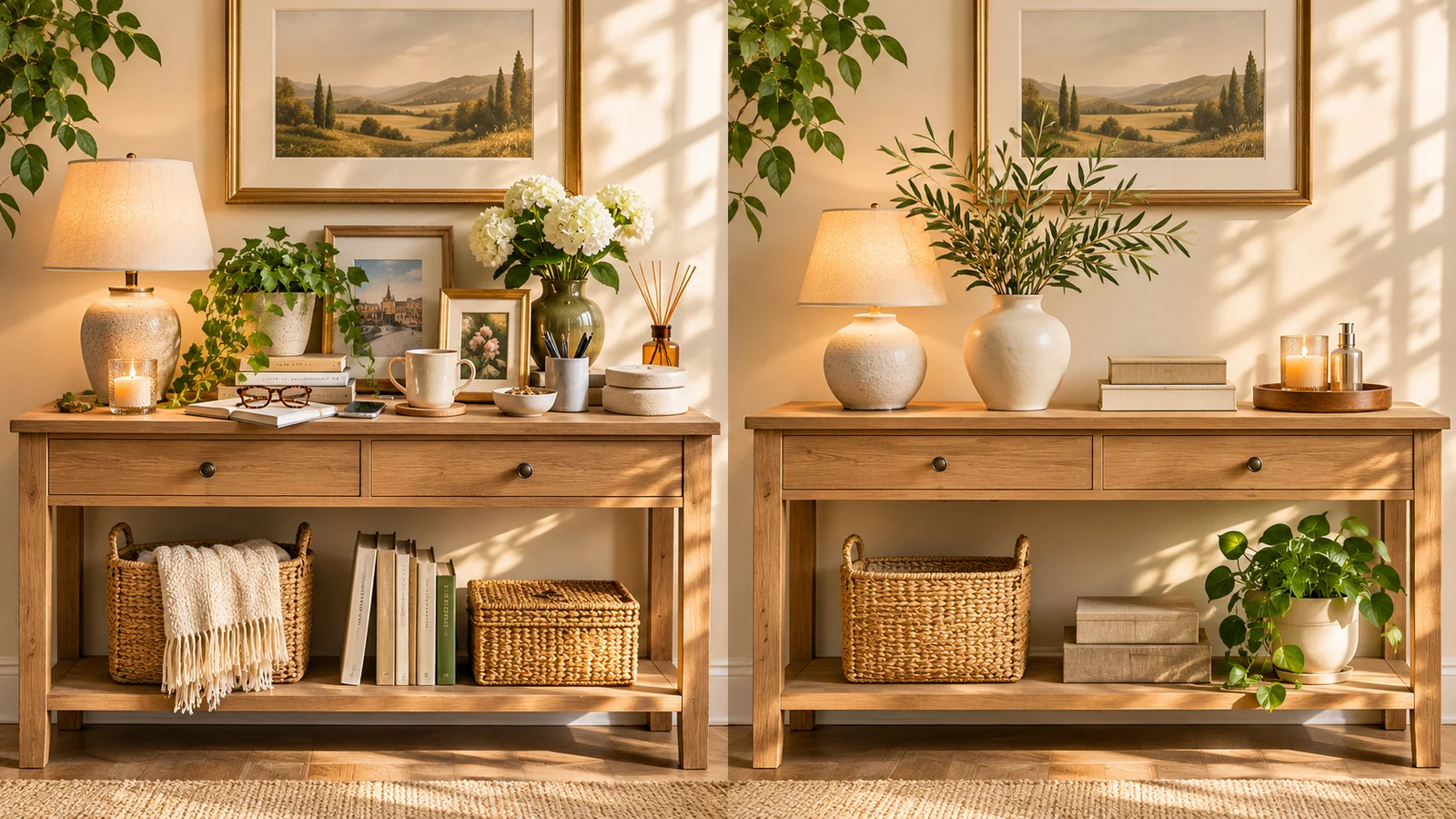
01 / BEGIN WITH COMPOSITION
Why some rooms feel settled—and others feel busy
The difference is rarely just “too many things.” It is whether your belongings have a clear relationship to one another and to the way you use the room.
A tidy room may still feel visually busy when color, scale, patterns, and focal points compete. A room full of collections may feel cohesive when it repeats a few visual ideas. Intentional styling is not minimalism; it is making choices about attention, function, and personal meaning.
Visual clutter can feel like…
Several disconnected details demand attention, obscure a surface’s function, or interrupt the appearance you want. That response varies by person and context; it is not a clinical diagnosis.
Intentional decor can feel like…
Objects relate through grouping, hierarchy, color, material, proportion, or personal story. There may be many objects, but they serve the room and the people in it.
A SIDE-BY-SIDE REFERENCE
Visual clutter vs intentional decor
| Consideration | May feel visually cluttered | May feel intentional |
|---|---|---|
| Hierarchy | Several details compete equally | A lead element has supporting pieces |
| Placement | Objects scattered independently | Related items grouped by use, story, or material |
| Color | Accents appear once without a link | Colors or finishes repeat, or a deliberate mix is sustained |
| Negative space | Every surface area is interrupted | Open areas separate groups and preserve use |
| Scale | Accessories feel out of proportion to furniture | Sizes relate to the surface and each other |
| Function | Decor blocks access or daily activity | Surfaces work for the people using them |
| Personal belongings | Meaningful objects dispersed everywhere | Collections have a chosen display or rotation |
| Preference | Arrangement conflicts with household needs | Arrangement reflects taste, culture, and routine |
The same vase, books, candle, photo, and bowl may look scattered when spread evenly across a table. Group the books, gather smaller pieces, and keep a clear area for a mug: the belongings remain the same while their relationships change.
02 / EXPERIMENT BEFORE YOU REARRANGE
TRY THE COMPOSITION
Interior styling simulator
Experiment with the objects you already own. This tool offers options, not a score for your taste.
Illustrative arrangement
Coffee tableDecor object library
Selected objects
- Books
- Ceramic vase
- Personal keepsake
Your group related objects keeps 3 selected objects in view. Check that everyday space remains usable. Consider preserving clear functional space and the items that matter to you.
Quiet luxury coffee table — $0 — rearrange existing belongings\nGoal: Reduce visual complexity\nPalette direction: Warm quiet luxury. Try grouping related objects and keeping practical space clear. Repeat an existing color or material. Keep essentials reachable and heavy items stable. Rearrange existing belongings before considering purchases.
Illustrative styling preview. Actual appearance depends on furniture dimensions, object sizes, room lighting, materials, accessibility needs, and personal preferences.
03 / WHAT RESEARCH CAN TELL US
Visual perception is not a decorating verdict
Controlled studies show that clutter measures can relate to visual-search performance in particular displays, and that attention interacts with figure-ground perception under experimental conditions [1] [2] [3] [4]. They do not demonstrate that a decorated home causes anxiety, illness, or any universal psychological outcome.
Home-environment research measures different things: preference, attachment, satisfaction, perceived control, and well-being. One study of student ratings found a positive association between visual complexity and preference for interior images [5]. Other work involving older adults, care facilities, and people seeking help for clutter is observational and population-specific [6] [7] [8]. Meaningful possessions can be part of a person’s sense of home; no one needs to remove sentimental belongings to follow a style trend.
04 / A FLEXIBLE DESIGN TOOLKIT
Ten principles of intentional styling
Visual hierarchy
Let one feature lead while others support. Move one competing object before adding another.
Focal points
Art, a lamp, a fireplace, or a meaningful object can anchor a view; rooms may have more than one.
Negative space
Open areas help distinguish groups and preserve practical use. No universal empty-space percentage applies.
Balance
Symmetry mirrors; asymmetry balances different pieces through size, contrast, and placement.
Scale
Consider an object relative to furniture, room dimensions, and the people using it.
Proportion
Look at size relationships within a composition; no single ratio suits every arrangement.
Visual weight
Size, dark color, contrast, pattern, texture, shape, position, and light may affect prominence.
Repetition & rhythm
Repeat a color, form, or material to create continuity without requiring matching sets.
Contrast
Differences in finish, scale, shape, or color can create interest; many high-contrast details may compete.
Unity & meaning
A shared theme or personal story can connect objects even when they do not match.
Visual weight is perceived prominence
A large neutral vase may feel prominent because of its size; several small colorful objects may attract attention through contrast. A dark object on a pale shelf may stand out more than a similarly sized light object. A bold cushion can lead a seating arrangement, while a sculptural lamp may anchor a table more clearly than several small accessories. These comparisons depend on lighting, background, and personal preference—visual weight is not a measurable score.
Lamp · frame · bowl arranged in mirrored positions.
One lamp balanced by a larger frame and lower group.
Gestalt principles: perception tendencies, not rules
| Principle | Perceptual idea | Try it at home |
|---|---|---|
| Proximity | Nearby elements may group | Place keys and a mail tray in one entryway zone. |
| Similarity | Shared features can connect items | Repeat a frame finish or color across shelves. |
| Figure and ground | An object stands against its surroundings | Give a keepsake visual separation from a busy pattern. |
| Continuity | The eye follows aligned or flowing forms | Align frame edges or repeat vertical shapes. |
| Closure | People may perceive an incomplete form as whole | Arrange frames around an implied shape, if it suits you. |
| Common region | Items within a boundary may group | Use a tray or shelf bay for related small items. |
A broad review of Gestalt grouping also describes context and limits; empirical tendencies are not a guarantee that an arrangement will feel beautiful [9].
COLOR · TEXTURE · PATTERN
Make a visual connection with what you own
Repeat one existing color or material across a room, or build a richer palette around a shared story. Base, supporting, and accent colors—and the familiar 60-30-10 split—are flexible planning devices, not scientific formulas [11]. Check fabric or paint samples in the actual room light: digital color is only an approximation.
Warm quiet luxury
#F5F0E7 · #B7A89A · #D8C2A0 · #5A4232 · #34312F
Scandinavian simplicity
#F7F6F0 · #C6A77B · #A9A69C · #9BAA95 · #D8C9B3
Cozy cottage
#F5EBDD · #C98F91 · #72784F · #B86F52 · #6A4937
Refined modern
#F4F2ED · #33373A · #A6A9A8 · #9A7759 · #B19A69
Earthy organic
#D9C5A5 · #B66E51 · #697451 · #E7DFCF · #46372F
Intentional maximalist
#1F5960 · #783F4A · #C1933D · #F2E9D8 · #3E2E27
Texture adds variation without more objects: contrast linen with ceramic, wood with glass, or wool with metal. For patterns, try different scales and repeat colors. A floral, stripe, and geometric print can coexist when the combination feels deliberate to you; patterned rooms are not automatically cluttered.
05 / THE SURFACE MASTERCLASS
Style around the surface’s real job
Coffee table
Group books, a bowl, or a vase; preserve room for drinks and daily activities. No-cost: use an existing tray.
Bookshelf
Mix vertical and horizontal books with meaningful objects; keep reading material findable. Avoid overloading shelves.
Console table
Let art or a mirror anchor the view; keep keys accessible in a bowl or tray.
Nightstand
Prioritize lamp, water, book, medication, or device as needed. Keep essentials within reach.
Kitchen counter
Protect food-preparation space; keep frequently used tools near their use.
Bathroom vanity
Group everyday products in a washable container and leave room for cleaning.
Fireplace mantel
Scale decor around the focal point; keep burnable objects at least 3 feet from heat sources [10].
Dining table
Choose a low or removable centerpiece so meals, conversation, and access remain comfortable.
Home-office desk
Keep work tools reachable and cords safe; replace damaged cords and never run them under rugs [12].
Entryway
Create accessible places for keys, shoes, and bags without narrowing exits or walking routes.
SAME OBJECTS, NEW RELATIONSHIPS
Eight illustrative before-and-after ideas
These are hypothetical examples, not client transformations. They use the same belongings; only grouping, orientation, and spacing change.
- Coffee table
Scattered books, bowl, vase, candle, and remote → stack the books, group small pieces on a tray, and retain a drink area.
- Bookshelf
Disconnected items → group keepsakes, vary book orientation, and repeat one material.
- Nightstand
Souvenirs covering the top → keep essentials accessible and move keepsakes to a shelf.
- Console
Mirror, lamp, frame, and vase all lead → let one anchor the view and the others support it.
- Kitchen counter
Equipment and mail spread around → keep active tools near use and send mail to its destination.
- Living-room shelves
Unrelated groups → repeat existing wood or olive tones and group by meaning.
- Gallery wall
Frames without a relationship → try a shared edge or implied shape, and mount safely.
- Sentimental collection
Souvenirs across surfaces → dedicate a display area or rotate items without discarding them.
BUDGET-CONSCIOUS EDIT
Twenty refinements that cost nothing
- 01Remove unrelated packaging from a frequently used surface.
- 02Group objects by material, color, use, or story.
- 03Repeat an existing accent color in another part of the room.
- 04Rearrange only lightweight furniture; ask for help with heavy pieces.
- 05Reposition an existing lamp safely.
- 06Coordinate cushions and throws you own.
- 07Create a clearer focal point by moving one competitor.
- 08Give a meaningful object room to be seen.
- 09Route cables away from walkways without hiding damaged cords.
- 10Rearrange books without making them hard to find.
- 11Reposition mirrors only when they can be handled safely.
- 12Adjust artwork only with suitable secure mounting.
- 13Rotate seasonal decorations.
- 14Repurpose a tray or bowl to group smaller objects.
- 15Try an accessory on a different surface before replacing it.
- 16Vary object heights with sturdy existing items.
- 17Give a personal collection one considered display area.
- 18Let in daylight when privacy and glare needs allow.
- 19Clean and maintain existing surfaces.
- 20Repair or repurpose belongings only when safe.
“Expensive-looking” is subjective; it does not measure the worth of a home or the people who live there.
FIVE STYLING TEMPLATES
Copy a starting point, then make it yours
01Minimalist coffee table
One focal object · functional open space · optional books or tray. No-cost: use a bowl you own. Keep fragile objects away from traffic.
02Intentional bookshelf
Accessible book grouping · meaningful objects · repeated material · flexible spacing. Do not overload shelves.
03Quiet-luxury console
Existing art or mirror · suitable lamp · practical key storage · restrained repeated finish. No costly replacement required.
04Cozy personalized living room
Comfortable seating · tactile textiles · repeated colors · meaningful collections. Preserve accessible routes.
05Intentional maximalist display
Chosen theme · layered colors and patterns · grouped keepsakes · clear functional zones. Richness is not the same as disorganization.
A GENTLE SEVEN-DAY RESET
Small changes, no shopping required
Fifteen-minute reset
Choose one manageable surface. Identify essential items, group related belongings, consider prominence and spacing, then restore everyday function. Five-minute version: return misplaced items, gather small objects in an existing container, and clear the next activity’s workspace. This is an example, not a schedule you must keep.
Before purchasing, ask
- Where will this go, and what purpose will it serve?
- Do I already own something similar? Is its scale right for the surface?
- Does it relate to materials or colors I have? Will it interrupt daily use?
- Can an existing object do the same job? Will it be safe and practical to maintain?
Consider family access and mobility, safe walking routes, furniture stability, children, and pets. CPSC advises anchoring furniture or TVs where appropriate and following manufacturers’ instructions; no universal shelf load rating or one-size installation recipe is provided here [13] [14]. USFA recommends clearance from heat and safe candle practice; use flameless candles when appropriate [10] [15].
A FEW USEFUL REMINDERS
Common styling myths, reconsidered
Every empty surface needs decor.
Open space can support daily use and visual separation.
A beautiful home must be minimalist.
Complexity and preference vary across people and contexts.
Maximalism is always cluttered.
Repeated themes and grouping can support layered interiors.
The rule of three is scientific.
It is a convention; even-number groupings may work too.
Objects must match.
Color, material, shape, use, or personal story can connect them.
Clutter always harms mental health.
Research does not support a universal causal claim.
COMMON QUESTIONS
Visual clutter & intentional decor FAQs
What is visual clutter?
A subjective experience of visual elements competing for attention or interfering with a room’s intended appearance or use.
What is intentional decor?
A considered arrangement using visual relationships such as hierarchy, grouping, scale, color and spacing.
Why does my clean room still look cluttered?
Cleanliness and visual organization differ; competing details, mixed scale, scattered objects or many focal points can make a tidy room feel busy.
How many decorative objects should I use?
There is no universal number. Surface size, function, object scale and personal preference matter.
What is negative space in interior design?
The open area around and between objects; it can help distinguish groups and preserve practical access.
What is the rule of three in decorating?
A common styling convention for grouping objects, not a scientific requirement or universal optimum.
Can maximalist interiors look organized?
Yes. Repeated themes, grouped collections, related colors and functional zones can support a richly layered look.
How can I improve home decor without spending money?
Rearrange existing objects, group them, repeat a color, preserve functional space, reposition a lamp or rotate a collection.
A LASTING TAKEAWAY
Your home does not need to look like anyone else’s
Visual complexity is not automatically clutter. Grouping, hierarchy, scale, color and texture relationships, appropriate negative space, functional surfaces, personal meaning, and realistic maintenance can help create a room that suits you. Intentional decoration does not mean owning less or buying expensive replacements. It means arranging belongings in a way that supports your life and preferences.
Educational note: General design education only; not psychological, medical, fire-safety, electrical, or structural advice. Follow product instructions and official guidance for your situation.
Related reading (planned article links): Cozy Home vs Cluttered Home · Warm Lighting vs Cool Lighting · Slow Living vs Lazy Living.