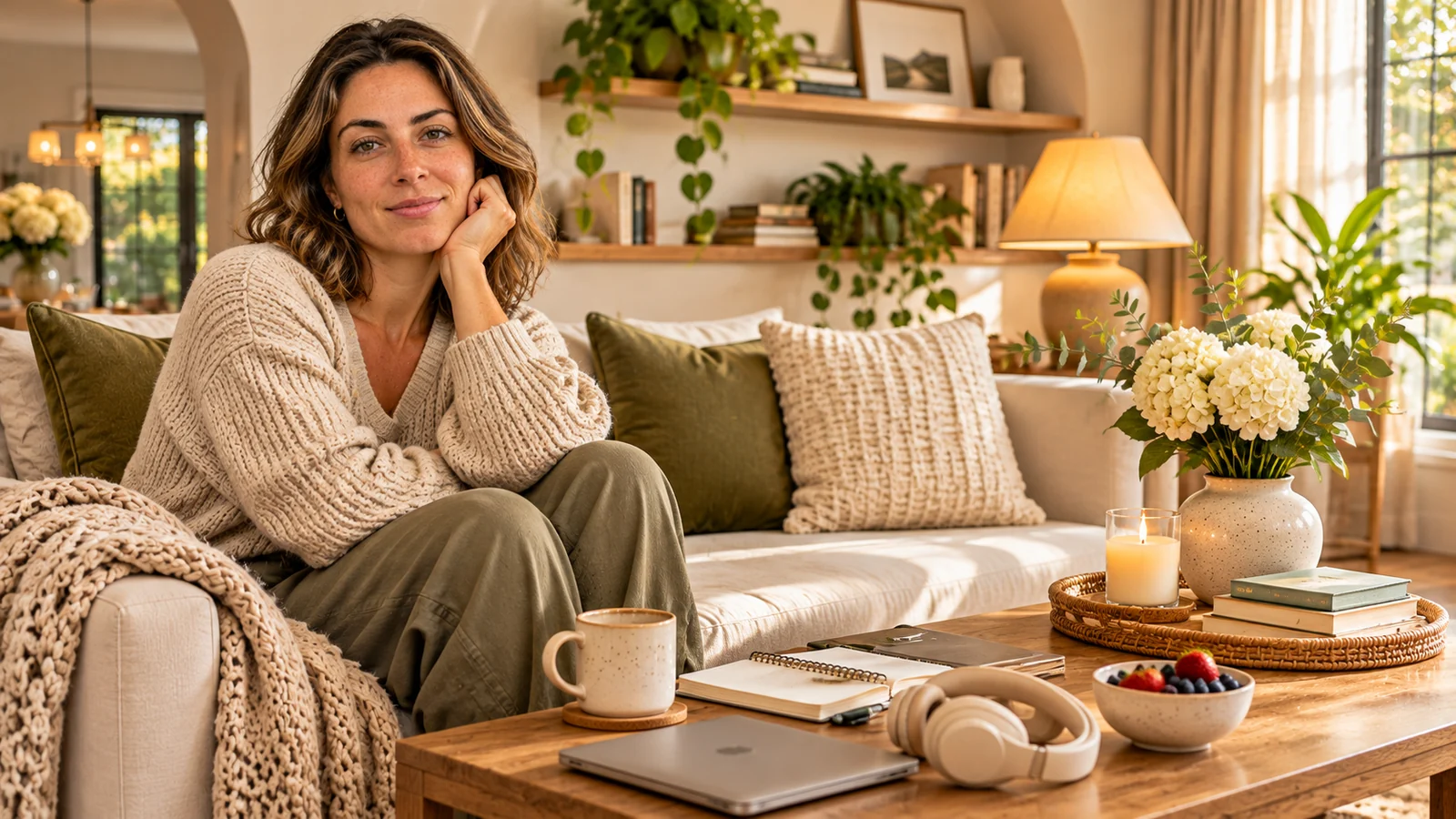
A room can hold books, family photographs, blankets, collections and daily necessities and still feel inviting. Problems tend to show up when the arrangement makes ordinary activities harder: a table is unusable, the usual route is blocked, or needed items have no convenient home. There is no universal object count or perfect level of visual simplicity.
What makes a home feel cozy?
“Cozy” is personal. For one household it may mean a clear sofa, a favorite reading lamp and a wool throw. For another it may mean shelves of books, patterned textiles and family photos. Culture, household routines, sensory preferences, mobility and available space all influence what feels comfortable.
Common ingredients include seating that suits its use, light that works for different tasks, textures that feel pleasant, colors the occupants enjoy, personal objects with meaning, useful storage and movement that feels comfortable. Natural daylight, wood or other materials may be appealing, but no single material or décor choice guarantees wellbeing. [1] [2]
What makes a home feel cluttered?
Ordinary belongings and temporary mess are part of living. A room may feel persistently cluttered when objects repeatedly crowd useful surfaces, prevent movement, make essentials hard to find, or interfere with the activity the room is meant to support. Furniture that is too large for a space, storage that does not match habits, unnecessary duplicates or a tangle of cords can add friction.
A richly decorated or maximalist room is not automatically disorganized. Collections may be intentionally displayed and easy to care for. Likewise, a minimal room can be uncomfortable if seating, lighting or storage do not meet household needs.
Cozy home vs cluttered home: practical comparison
| Dimension | Cozy & functional | May feel cluttered |
|---|---|---|
| Appearance | Personal, intentional, comfortable for occupants | Elements compete or obscure use; not defined by item count |
| Furniture | Supports activities and clear routes | Crowds routes or is out of scale for use/space |
| Lighting | Useful layers adapted to tasks and preference | Glare, shadows or reliance on one unsuitable source |
| Surfaces | Everyday items have workable homes | Needed areas are hard to use |
| Storage | Matches habits; accessible and maintainable | Containers overflow or hide hard-to-find items |
| Decoration | Meaningful and arranged intentionally | Objects may compete, but maximalism is not inherently clutter |
| Open space | Breathing room where useful | Movement or function feels compromised |
| Accessibility | Clear paths and reachable essentials | Obstructions or unsafe reach |
| Maintenance | Fits available time and energy | Needs more effort than household wants |
| Budget | Can use existing belongings | No purchase is required to improve function |
These are practical distinctions, not a psychological assessment. A richly decorated room can be organized and comfortable.
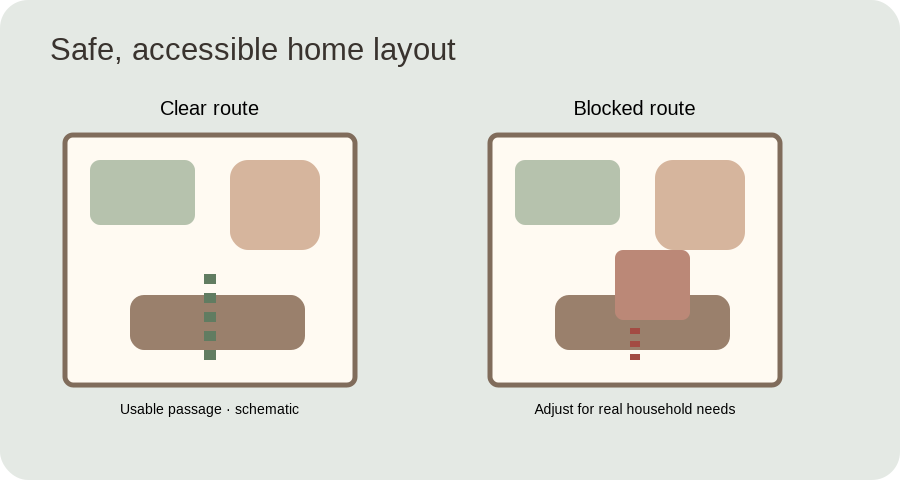
Imagine the same sofa, lamp, books and blanket. If the lamp serves a reading seat, the books are reachable and a route stays clear, the room can feel warm and usable. If the same pieces obstruct a doorway and cover the only place to set a cup, the arrangement—not the objects’ worth—may need to change.
The psychology of home: what research can and cannot tell us
Homes carry meaning and identity. People arrange belongings to support routines, express taste, remember relationships or make a place feel like their own. A 2025 cross-sectional survey of 501 adults found associations between self-rated home clutter and wellbeing measures; perceived home beauty partly mediated some observed relationships. Because it was a one-time survey, it cannot show that clutter caused changes in wellbeing. Participants were mostly UK-based and surveyed during the COVID period, which also limits generalization. [1]
An earlier study of 60 dual-income spouses linked descriptions of homes with later daily mood and cortisol patterns for women in that sample. It was small and correlational; it does not establish that clutter causes stress or illness, or that decluttering treats anxiety, depression, ADHD or any other condition. [2]
Visual complexity, perceived control and personal standards may help explain why the same room feels calm to one person and busy to another. Research on home environments remains varied. Treat these findings as context, not an instruction to pursue a spotless or minimalist home.
Cozy does not mean minimalist
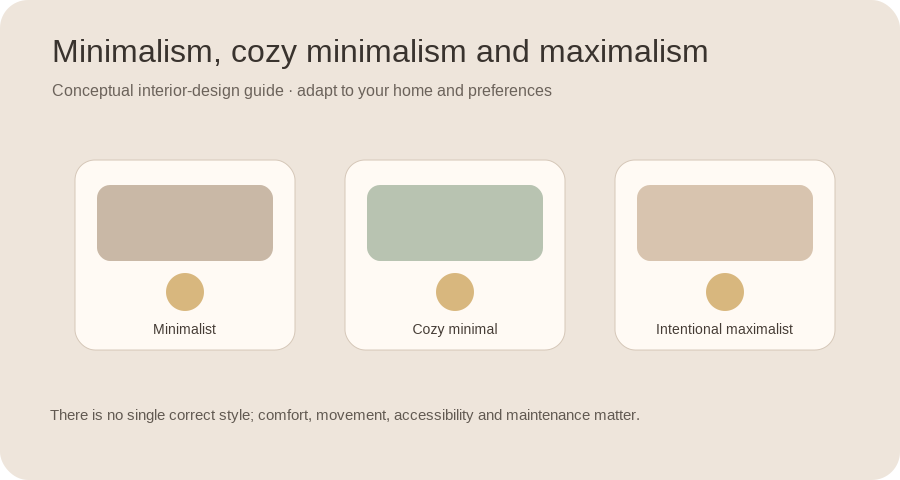
Minimalist rooms may use few objects and restrained colors. Cozy minimalism adds tactile comfort and personal warmth. Scandinavian-inspired rooms often use light woods and simple forms; cottage-inspired and traditional rooms may use layered textiles or collected objects. Intentional maximalism can combine abundant pattern, color and display while keeping belongings accessible and routes functional. These are flexible style descriptions, not regulated categories.
12 signs a room may feel more cluttered than cozy
- Frequently used surfaces are hard to access. This may add friction—for example, clearing a counter before every meal. Try moving or grouping what is in the way using items already owned. A sign is a practical prompt, not a psychological assessment or a reason to discard meaningful belongings.
- Furniture interrupts a usual route. This may add friction—for example, clearing a counter before every meal. Try moving or grouping what is in the way using items already owned. A sign is a practical prompt, not a psychological assessment or a reason to discard meaningful belongings.
- Everyday belongings have no convenient home. This may add friction—for example, clearing a counter before every meal. Try moving or grouping what is in the way using items already owned. A sign is a practical prompt, not a psychological assessment or a reason to discard meaningful belongings.
- Decorative items compete for attention. This may add friction—for example, clearing a counter before every meal. Try moving or grouping what is in the way using items already owned. A sign is a practical prompt, not a psychological assessment or a reason to discard meaningful belongings.
- Important objects are difficult to find. This may add friction—for example, clearing a counter before every meal. Try moving or grouping what is in the way using items already owned. A sign is a practical prompt, not a psychological assessment or a reason to discard meaningful belongings.
- Displays lack an arrangement that feels intentional to you. This may add friction—for example, clearing a counter before every meal. Try moving or grouping what is in the way using items already owned. A sign is a practical prompt, not a psychological assessment or a reason to discard meaningful belongings.
- Storage containers overflow. This may add friction—for example, clearing a counter before every meal. Try moving or grouping what is in the way using items already owned. A sign is a practical prompt, not a psychological assessment or a reason to discard meaningful belongings.
- Furniture feels disproportionate to the room. This may add friction—for example, clearing a counter before every meal. Try moving or grouping what is in the way using items already owned. A sign is a practical prompt, not a psychological assessment or a reason to discard meaningful belongings.
- Cables create unnecessary tangles or trip hazards. This may add friction—for example, clearing a counter before every meal. Try moving or grouping what is in the way using items already owned. A sign is a practical prompt, not a psychological assessment or a reason to discard meaningful belongings.
- Maintaining the room takes more effort than you want. This may add friction—for example, clearing a counter before every meal. Try moving or grouping what is in the way using items already owned. A sign is a practical prompt, not a psychological assessment or a reason to discard meaningful belongings.
- Unused belongings occupy needed activity space. This may add friction—for example, clearing a counter before every meal. Try moving or grouping what is in the way using items already owned. A sign is a practical prompt, not a psychological assessment or a reason to discard meaningful belongings.
- The room no longer supports its intended activities. This may add friction—for example, clearing a counter before every meal. Try moving or grouping what is in the way using items already owned. A sign is a practical prompt, not a psychological assessment or a reason to discard meaningful belongings.
Seven principles for a cozy but organized home
1. Put function and movement first
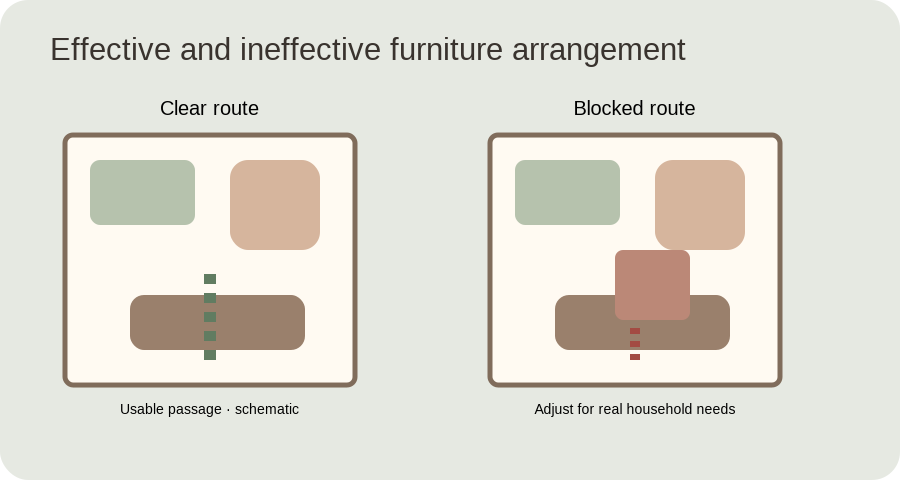
Arrange furniture around activities: conversation, reading, play, work or rest. Check door swings and the routes people actually use. Leave clear paths suited to the people who live there and do not obstruct exits or accessibility needs. A simple floor plan can help test an arrangement before moving heavy furniture.
2. Give visual attention an anchor
A window, artwork, bookcase or conversation area can be a focal point. Several competing displays may feel busy to some people, but there is no requirement to choose only one. Organize the room around the activity that matters most.
3. Leave useful breathing room
Open surfaces and unobstructed areas can make furniture easier to use and clean. There is no scientifically established universal percentage of empty space; leave the amount that suits your activities and preference.
4. Layer texture selectively
Existing cotton, linen, wool, knit textiles, wood, woven baskets or ceramics can add tactile variety without a shopping trip. A blanket over a chair may do more than several new accessories. Consider cleaning, allergies, pets and how much upkeep you want.
5. Coordinate color flexibly
Choose a base color already present in a large piece, then repeat a supporting or accent tone if it appeals to you. Warm neutrals, cool neutrals, natural tones and seasonal accents are options, not rules. Room light and finishes alter color appearance.
6. Match lighting to the activity
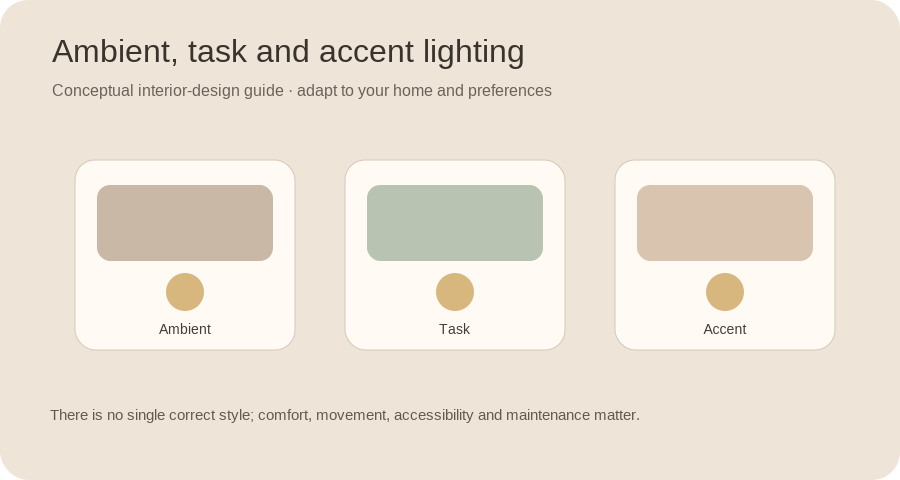
Ambient light gives general illumination; task light supports reading, food preparation or desk work; accent light highlights selected details. Daylight is useful when available, but privacy, glare and temperature matter. The Department of Energy describes correlated color temperature (CCT) as a light-color appearance measure; lower values tend to appear warmer. Its table gives 2,700 K as warm and 4,100 K as cool examples, not as a universal prescription. Choose enough light for safe movement and the task. [3]
Related: Warm Lighting vs Cool Lighting: Which Makes Your Home Feel Cozier?
| Layer | Purpose | Examples |
|---|---|---|
| Ambient | General room illumination and safe orientation | Ceiling fixture, bounced lamp, daylight |
| Task | Light directed to an activity | Reading lamp, under-cabinet work light, desk lamp |
| Accent | Highlights an object or architectural detail | Small picture or shelf light |
Choose brightness for the task and the people using the room. A lower correlated color temperature (CCT) appears warmer; DOE gives 2,700 K as a typical warm example and 4,100 K as a cool example. These are choices, not universal comfort rules. Reduce glare and provide adequate light for safe movement; check lamp compatibility and instructions. [3]
7. Give everyday objects practical homes
Store frequently used belongings near where they are used. Open storage supports visibility; closed storage can reduce visual complexity. Existing bowls, trays, baskets or drawers may work—buying a labeled organizer is not a requirement.
Room-by-room cozy home guide
Living room
Arrange seating for conversation or the household’s usual activities. Keep a practical walking route, a useful lamp and one working surface; store everyday items near where they are used.
No-cost: reset one surface and move items to where they are used. Optional: only measure first and buy if an actual need remains.
Bedroom
Keep bedside essentials reachable, use lighting for reading and movement, and choose clothing storage that matches habits. Bedding and decorative layers are optional; this is not a sleep treatment.
No-cost: reset one surface and move items to where they are used. Optional: only measure first and buy if an actual need remains.
Kitchen
Keep a usable food-preparation area and store frequently used tools near the task. Keep heat, water and cords in mind; do not block appliances or exits.
No-cost: reset one surface and move items to where they are used. Optional: only measure first and buy if an actual need remains.
Bathroom
Use moisture-appropriate storage and ventilation; keep essentials accessible and surfaces easy to clean. Avoid décor that interferes with hygiene or movement.
No-cost: reset one surface and move items to where they are used. Optional: only measure first and buy if an actual need remains.
Home office
Set desk, task light and cables to support the actual work; add personal items if useful. Ergonomic needs vary; organization does not guarantee productivity.
No-cost: reset one surface and move items to where they are used. Optional: only measure first and buy if an actual need remains.
Entryway
Give keys, shoes, coats and bags practical landing places without blocking the door, stairs or exit path.
No-cost: reset one surface and move items to where they are used. Optional: only measure first and buy if an actual need remains.
15 ways to make your home cozier without buying anything
- Rearrange existing furniture around your usual activities. The point is to make existing belongings more useful or enjoyable, not to meet a styling rule. Move carefully, keep routes clear and use only safe, suitable lighting and storage.
- Clear one frequently used surface. The point is to make existing belongings more useful or enjoyable, not to meet a styling rule. Move carefully, keep routes clear and use only safe, suitable lighting and storage.
- Move a decorative object to a different room. The point is to make existing belongings more useful or enjoyable, not to meet a styling rule. Move carefully, keep routes clear and use only safe, suitable lighting and storage.
- Fold or regroup blankets and pillows you already own. The point is to make existing belongings more useful or enjoyable, not to meet a styling rule. Move carefully, keep routes clear and use only safe, suitable lighting and storage.
- Create a reading spot with an existing chair and lamp. The point is to make existing belongings more useful or enjoyable, not to meet a styling rule. Move carefully, keep routes clear and use only safe, suitable lighting and storage.
- Open curtains when privacy and conditions allow. The point is to make existing belongings more useful or enjoyable, not to meet a styling rule. Move carefully, keep routes clear and use only safe, suitable lighting and storage.
- Move a lamp to a place where its light supports a task. The point is to make existing belongings more useful or enjoyable, not to meet a styling rule. Move carefully, keep routes clear and use only safe, suitable lighting and storage.
- Group meaningful objects in a display you enjoy. The point is to make existing belongings more useful or enjoyable, not to meet a styling rule. Move carefully, keep routes clear and use only safe, suitable lighting and storage.
- Select a few photographs or artworks already owned. The point is to make existing belongings more useful or enjoyable, not to meet a styling rule. Move carefully, keep routes clear and use only safe, suitable lighting and storage.
- Arrange books by use, size or a grouping that suits you. The point is to make existing belongings more useful or enjoyable, not to meet a styling rule. Move carefully, keep routes clear and use only safe, suitable lighting and storage.
- Reuse baskets and containers you already have. The point is to make existing belongings more useful or enjoyable, not to meet a styling rule. Move carefully, keep routes clear and use only safe, suitable lighting and storage.
- Simplify the bedside surface to the items you use. The point is to make existing belongings more useful or enjoyable, not to meet a styling rule. Move carefully, keep routes clear and use only safe, suitable lighting and storage.
- Organize cables with a suitable existing clip or tie; do not damage cords. The point is to make existing belongings more useful or enjoyable, not to meet a styling rule. Move carefully, keep routes clear and use only safe, suitable lighting and storage.
- Rotate seasonal decorations into storage instead of adding more. The point is to make existing belongings more useful or enjoyable, not to meet a styling rule. Move carefully, keep routes clear and use only safe, suitable lighting and storage.
- Choose convenient homes for keys, bags or other daily essentials. The point is to make existing belongings more useful or enjoyable, not to meet a styling rule. Move carefully, keep routes clear and use only safe, suitable lighting and storage.
Make a small apartment feel cozy without feeling crowded
In a studio, compact living room or small bedroom, measure the room and furniture before rearranging. Keep circulation and exit routes clear. Multifunctional furniture can help when it meets a real need, but it is not automatically better. Use vertical shelves only when installed safely and allowed by the lease; consider freestanding alternatives. Under-bed storage should not block ventilation or emergency access. Mirrors can reflect light but placement is personal. For rentals, check lease terms before drilling, repainting or making structural changes.
For shared apartments, agree on shared storage and landing areas. Store frequently used items where the users can reach them. In rooms used by children or pets, check stability and hazards. Do not trade clear exits or accessibility for a more polished look.
Style shelves, coffee tables and everyday surfaces
Coffee table
Leave usable space for cups, games or current activities. A tray can corral small items if one is already available; it is not a must-buy styling object.
Bookshelf
Mix books, useful storage and meaningful display in a way that remains reachable. You can arrange vertically, horizontally or by topic; “rule of three” is an optional aesthetic technique, not a scientific law.
Nightstand
Prioritize a reachable lamp and items you use. Keep the surface available for its practical role.
Kitchen counter
Keep necessary equipment near its task while preserving food-preparation space and safe distance from heat and water.
Entryway console
Designate a place for keys or mail only if it does not interfere with door operation or an exit route.
Open vs closed storage
| System | Advantages and trade-offs | Examples |
|---|---|---|
| Open | Visible and easy to reach; offers display. Can look busier and requires accessible arrangement/dusting. | Frequently used books or well-organized everyday items |
| Closed | Reduces what is visible and may shield contents from dust. Can conceal disorder or make access difficult. | Items used less often or visual calm preference |
| Mixed | Display selected useful or meaningful belongings; store the rest in reachable closed space. | Many households and changing needs |
Choose a storage system based on what you need to see, reach, protect or maintain. Closed storage can look calmer while still hiding items that are hard to find; open storage can make daily objects visible but needs a workable arrangement. A mixed approach is common. Measure first before buying any storage unit.
Keep sentimental belongings without losing personal character
You do not have to discard photographs, letters, books, souvenirs or collections to make a home functional. Create a display that you enjoy, rotate pieces seasonally, organize family photographs, or keep letters in a labeled memory box if that helps. Separate storage for functional and sentimental items can make retrieval easier. Choose the approach that respects your attachment and available space.
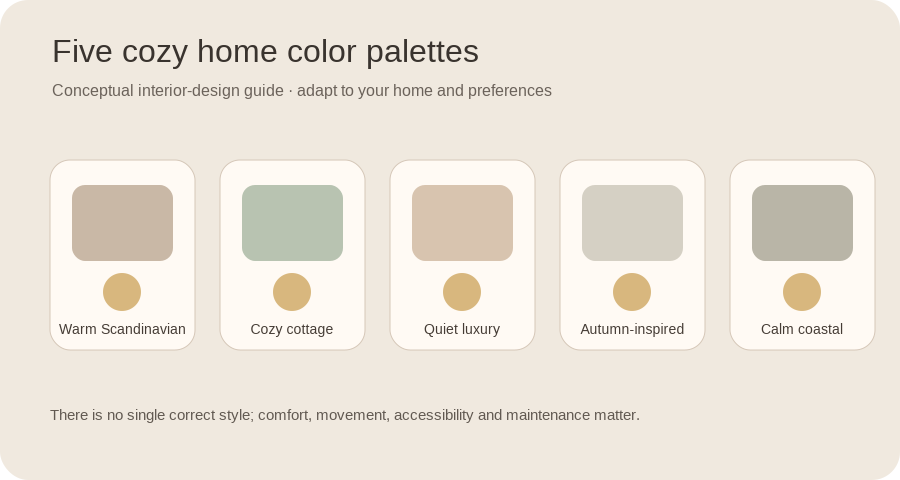
Five flexible home color palettes
These HEX values are digital approximations for exploration. Real paint, textiles and screen color vary with light and material. Adapt or ignore any palette; no hue has a guaranteed psychological effect.
Warm Scandinavian
#F4EFE6#C5A982#D9CCBA#A7B29D#45433FColor appearance changes with light, materials and screens. Adapt freely; no palette has guaranteed psychological effects.
Five ready-to-use cozy home styling templates
Cozy minimalist living room
Keep seating, useful lamp and a clear path; choose a small number of meaningful objects. No-cost: edit and regroup existing items.
Check clear routes, stability, household access and a maintenance plan that fits your energy.
Small-apartment corner
Use a compact chair or existing seat, lamp, vertical storage if safe, and a flexible side surface. Keep routes clear.
Check clear routes, stability, household access and a maintenance plan that fits your energy.
Warm bedroom
Prioritize usable bedside surface, suitable lighting and bedding already owned; storage should be accessible.
Check clear routes, stability, household access and a maintenance plan that fits your energy.
Functional family home
Put shared-use items near the activities; select child-safe storage and anchor furniture as appropriate.
Check clear routes, stability, household access and a maintenance plan that fits your energy.
Budget-friendly home
Rearrange, clean, repair and reuse before buying. If purchasing later, prioritize a specific practical need and measure.
Check clear routes, stability, household access and a maintenance plan that fits your energy.
Templates are starting points. Adjust for the actual room, budget, household access needs, child and pet safety, and maintenance preferences.
The seven-day cozy home reset
Do one small step per day, combine days, take breaks or move at your own pace. A five-minute version is still useful if it improves something that matters to you.
- Day 1 · Observe: Notice one area that makes an everyday activity harder. No need to tackle a whole home.
- Day 2 · Surfaces: Reset one frequently used surface; relocate items to their likely homes.
- Day 3 · Layout: Check walking routes and furniture use; move only what is safe and practical.
- Day 4 · Storage: Give one frequently used item a convenient location using storage already owned.
- Day 5 · Lighting: Try an existing lamp or open blinds if privacy and temperature allow.
- Day 6 · Style with what you own: Group a few meaningful objects, books or textiles; stop when it feels right.
- Day 7 · Maintain: Choose a short reset you can realistically repeat, or do none if it does not help.
Copyable home reset checklist
Printing opens your browser’s print dialog. Checkboxes are not saved.
20 common decorating mistakes and practical fixes
- Buying décor before reviewing existing items. It may add cost or make daily use harder. First try a no-cost adjustment: edit placement, reuse what you own, preserve routes and tailor the space to actual routines. Check safety before changing furniture or lighting.
- Filling every surface. It may add cost or make daily use harder. First try a no-cost adjustment: edit placement, reuse what you own, preserve routes and tailor the space to actual routines. Check safety before changing furniture or lighting.
- Choosing furniture too large for the room. It may add cost or make daily use harder. First try a no-cost adjustment: edit placement, reuse what you own, preserve routes and tailor the space to actual routines. Check safety before changing furniture or lighting.
- Keeping more pillows than the seating needs. It may add cost or make daily use harder. First try a no-cost adjustment: edit placement, reuse what you own, preserve routes and tailor the space to actual routines. Check safety before changing furniture or lighting.
- Obstructing walking routes. It may add cost or make daily use harder. First try a no-cost adjustment: edit placement, reuse what you own, preserve routes and tailor the space to actual routines. Check safety before changing furniture or lighting.
- Relying on one unsuitable overhead light. It may add cost or make daily use harder. First try a no-cost adjustment: edit placement, reuse what you own, preserve routes and tailor the space to actual routines. Check safety before changing furniture or lighting.
- Ignoring task lighting. It may add cost or make daily use harder. First try a no-cost adjustment: edit placement, reuse what you own, preserve routes and tailor the space to actual routines. Check safety before changing furniture or lighting.
- Decorating without considering activities. It may add cost or make daily use harder. First try a no-cost adjustment: edit placement, reuse what you own, preserve routes and tailor the space to actual routines. Check safety before changing furniture or lighting.
- Buying organizers before planning what they hold. It may add cost or make daily use harder. First try a no-cost adjustment: edit placement, reuse what you own, preserve routes and tailor the space to actual routines. Check safety before changing furniture or lighting.
- Putting frequently accessed items in awkward storage. It may add cost or make daily use harder. First try a no-cost adjustment: edit placement, reuse what you own, preserve routes and tailor the space to actual routines. Check safety before changing furniture or lighting.
- Creating too many competing focal points. It may add cost or make daily use harder. First try a no-cost adjustment: edit placement, reuse what you own, preserve routes and tailor the space to actual routines. Check safety before changing furniture or lighting.
- Repeating objects without a purpose that matters to you. It may add cost or make daily use harder. First try a no-cost adjustment: edit placement, reuse what you own, preserve routes and tailor the space to actual routines. Check safety before changing furniture or lighting.
- Buying accessories only because they are trendy. It may add cost or make daily use harder. First try a no-cost adjustment: edit placement, reuse what you own, preserve routes and tailor the space to actual routines. Check safety before changing furniture or lighting.
- Ignoring furniture stability. It may add cost or make daily use harder. First try a no-cost adjustment: edit placement, reuse what you own, preserve routes and tailor the space to actual routines. Check safety before changing furniture or lighting.
- Concealing belongings without improving access. It may add cost or make daily use harder. First try a no-cost adjustment: edit placement, reuse what you own, preserve routes and tailor the space to actual routines. Check safety before changing furniture or lighting.
- Feeling pressured to discard every sentimental item. It may add cost or make daily use harder. First try a no-cost adjustment: edit placement, reuse what you own, preserve routes and tailor the space to actual routines. Check safety before changing furniture or lighting.
- Copying a large luxury room into a small home. It may add cost or make daily use harder. First try a no-cost adjustment: edit placement, reuse what you own, preserve routes and tailor the space to actual routines. Check safety before changing furniture or lighting.
- Keeping décor that makes cleaning difficult. It may add cost or make daily use harder. First try a no-cost adjustment: edit placement, reuse what you own, preserve routes and tailor the space to actual routines. Check safety before changing furniture or lighting.
- Ignoring children, pets or accessibility needs. It may add cost or make daily use harder. First try a no-cost adjustment: edit placement, reuse what you own, preserve routes and tailor the space to actual routines. Check safety before changing furniture or lighting.
- Expecting a perfectly styled home every day. It may add cost or make daily use harder. First try a no-cost adjustment: edit placement, reuse what you own, preserve routes and tailor the space to actual routines. Check safety before changing furniture or lighting.
Cozy home myths vs reality
Cozy requires expensive furniture.
Reality: No. Layout, comfort and use of existing belongings can matter more than price.
Minimalism cannot feel cozy.
Reality: It can; styles are personal.
More decor means more warmth.
Reality: Not always. Placement, meaning and usability matter.
Every surface needs objects.
Reality: Open space can support practical use.
Only neutrals feel cozy.
Reality: Color preference is subjective; no palette guarantees a mood.
Small apartments cannot feel inviting.
Reality: Scale, routes, light and flexible storage can help.
Open shelving is always cluttered.
Reality: It depends on what is stored and household habits.
Furniture must match.
Reality: A coherent room need not use matching sets.
Trends improve every room.
Reality: A trend is optional; function and preference take priority.
A comfortable home must be perfect.
Reality: Homes are used. Temporary mess is part of everyday life.
Six hypothetical styling scenarios
Hypothetical scenario 1: Overdecorated living room
Challenge: Group selected favorites, move the rest to other rooms or storage, and keep the surfaces needed for daily use. No-cost first.
Upkeep: choose a small habit that fits the household’s schedule and energy. These are examples, not client projects.
Hypothetical scenario 2: Small rental
Challenge: Rearrange movable furniture, use existing textiles and check the lease before mounting anything.
Upkeep: choose a small habit that fits the household’s schedule and energy. These are examples, not client projects.
Hypothetical scenario 3: Family home with children
Challenge: Create reachable toy homes, keep routes open and anchor furniture as advised.
Upkeep: choose a small habit that fits the household’s schedule and energy. These are examples, not client projects.
Hypothetical scenario 4: Bedroom with limited storage
Challenge: Simplify bedside essentials and use existing under-bed/closet space if safe and accessible.
Upkeep: choose a small habit that fits the household’s schedule and energy. These are examples, not client projects.
Hypothetical scenario 5: Sentimental collection
Challenge: Display a rotating selection; retain what matters in suitable storage without a discard quota.
Upkeep: choose a small habit that fits the household’s schedule and energy. These are examples, not client projects.
Hypothetical scenario 6: Tight budget
Challenge: Rearrange, clean, repair and repurpose before considering one measured practical purchase.
Upkeep: choose a small habit that fits the household’s schedule and energy. These are examples, not client projects.
Maintain comfort without constant cleaning
Daily, optional · five minutes
Return a few frequently used items, clear a small preparation/working surface, check an exit route. Skip or adapt when needed.
Weekly, optional · fifteen minutes
Reset one high-use area, empty or reassign an overflowing basket, check frequently used items are reachable.
Monthly or seasonally
Review whether storage still matches habits; rotate decor only if enjoyable; repair/reuse before replacing.
A home maintenance plan can be flexible. If a five-minute reset is not realistic or useful on a particular day, skip it or adapt. Systems should accommodate work, care duties, disability, changing energy and ordinary mess.
Safety and accessibility before styling
- Keep exits, door swings, stairs and walking routes unobstructed.
- Place candles on stable surfaces away from fabrics, children and pets; consider flameless lights as an alternative and follow product instructions.
- Route electrical cords to reduce trip risk; do not run cords under rugs or use damaged cables. Follow product and official safety guidance.
- Anchor furniture with drawers, doors or shelves to the wall, especially where children may be present; follow CPSC Anchor It! guidance and product instructions. [4]
- Install shelving according to manufacturer/landlord rules; use appropriate hardware and do not overload.
- Choose lighting that supports visibility in passages and at stairs. Safety and access come before an aesthetic arrangement.
The CPSC recommends anchoring furniture with drawers, doors and shelves to prevent tip-over injuries. The U.S. Fire Administration provides home fire-prevention and escape-planning resources. Local building, electrical and rental rules may differ; consult qualified help for installation questions. [4] [5]
Cozy Home Styling & Organization Planner
This planner runs in your browser. Answers are not saved, transmitted or tracked.
Optional product categories
None are required. Consider purchasing only after rearranging, reusing or repairing what you own, and measuring available space. Your selected budget should determine whether shopping appears in a plan.
Medium Woven Cotton Rope Basket, Empty Gift Basket for Burr
Quality home essential to add warmth, comfort, and functional storage without clutter.
View on Amazon ↗Bedside Table Lamp for Bedroom - Dimmable Touch, USB A+C, AC Outlet
Quality home essential to add warmth, comfort, and functional storage without clutter.
View on Amazon ↗Round Decorative Tray Coffee Table Tray - Resin Circle Tray Decor
Quality home essential to add warmth, comfort, and functional storage without clutter.
View on Amazon ↗Knitted Waffle Throw Blanket , Camel Tan Throw Blanket for Couch 50"x60"
Quality home essential to add warmth, comfort, and functional storage without clutter.
View on Amazon ↗Vtopmart 44 PCS Clear Plastic Drawer Organizers Set, Vanity Organizer Trays
Quality home essential to add warmth, comfort, and functional storage without clutter.
View on Amazon ↗Flameless Candles with Remote, Battery Operated Flickering Flameless Candles, LED Candles with Timer 2/4/6/8H, with Realistic LED Candles Set of 9 (D3 x H 3" 4" 5" 6" 7") (Ivory)
Quality home essential to add warmth, comfort, and functional storage without clutter.
View on Amazon ↗Affiliate disclosure: Some links may be affiliate links. As an Amazon Associate I earn from qualifying purchases. All product recommendations are independently selected and compliant with FTC guidelines.
Frequently asked questions
What is the difference between a cozy and cluttered home?
Cozy supports comfort, use and personal preference; clutter may interfere with access, movement, finding items or intended activities. The number of possessions alone does not decide it.
How can I make my home cozy without buying anything?
Rearrange existing furniture, reset a useful surface, redistribute decor, use an existing lamp and give everyday items convenient homes.
Can a minimalist home feel cozy?
Yes. Soft light, comfortable seating, meaningful items and suitable textures can work in a minimalist space.
How can a small apartment feel cozy?
Use appropriately scaled furniture, keep routes open, use safe vertical storage and make lighting serve activities.
What colors make a room look warm?
Warm neutrals, wood tones and muted accents are common options, but light and personal taste change how colors appear.
Does warm lighting make a home cozier?
A lower CCT looks warmer, but task and safety lighting still need enough brightness. Match lighting to use and preference.
How do I decorate without spending money?
Edit or regroup items you own, rotate objects between rooms, clean lampshades and move a lamp where it helps.
How many decorative objects should I use?
There is no universal count. Keep what supports your use and preference without crowding needed surfaces.
How can I organize a coffee table?
Keep useful space for current activities; place a few frequently used or meaningful items where they do not block use.
How can I style shelves without clutter?
Mix accessible books or storage with selected display items; leave space wherever it helps use and preference.
Are baskets useful for organizing?
They can group items if size, access and contents fit. Use existing containers first and avoid hiding items you need to find.
Is open or closed storage better?
Neither is universally best. Open storage improves visibility; closed storage reduces visible objects. Mixed systems work for many homes.
How can I keep sentimental belongings?
Use intentional displays, rotate collections or store letters and photos in labeled memory boxes; there is no requirement to discard.
What makes a living room feel crowded?
Furniture blocking activity/routes, overloaded surfaces, or items without practical homes may contribute. Preferences vary.
How can I make a rental feel more inviting?
Rearrange movable furnishings, use existing textiles and lamps, and check lease rules before mounting or modifying anything.
Can maximalist decor be organized?
Yes. Intentional display and practical storage can support abundant decor. Maximalism is not the same as disorder.
How can I organize with children?
Use reachable, age-appropriate systems and secure furniture as recommended. The layout should support the family, not a showroom.
What are common decorating mistakes?
Buying before assessing, blocking routes, using oversized furniture, ignoring task light and expecting a perfect room.
How do I maintain a cozy home without constant cleaning?
Choose one small reset that fits your schedule and energy; it is fine to adapt or skip it.
Can clutter cause anxiety or depression?
The evidence does not establish that ordinary clutter causes a mental health disorder. A 2025 cross-sectional survey found associations, not proof of cause.
Key takeaway
The most useful difference between cozy and cluttered is often whether a room supports the people and activities it is meant for. Consider layout, safe movement, lighting, storage and personal meaning before buying décor. A cozy home can be minimal, richly decorated or somewhere between. It does not need to be expensive or perfect.
Related reading
Visual Clutter vs Intentional Decor: How to Tell the Difference · Warm Lighting vs Cool Lighting · Slow Living vs Lazy Living · Screen-Free Evenings vs Scrolling Evenings. Self-care guides: Rest vs Sleep · Self-Care vs Self-Indulgence · High- vs Low-Energy Days · Physical Tiredness vs Mental Exhaustion · Stress vs Burnout.
References
- Quinn F. Home clutter and mental well-being: Exploring moderators and the mediating role of home beauty. Journal of Environmental Psychology. 2025;105:102672. Cross-sectional survey, n=501; associations, not causation. doi:10.1016/j.jenvp.2025.102672
- Saxbe DE, Repetti R. No Place Like Home: Home Tours Correlate With Daily Patterns of Mood and Cortisol. Personality and Social Psychology Bulletin. 2010;36(1). Small correlational study of 60 dual-income spouses; limited generalizability. doi:10.1177/0146167209352864
- US Department of Energy, Federal Energy Management Program. Purchasing Energy-Efficient Light Bulbs. Defines CCT and provides typical examples; preferences and actual visual needs vary.
- US Consumer Product Safety Commission. Tipover Information Center / Anchor It!. Furniture anchoring guidance; follow product-specific instructions.
- US Fire Administration. Home Fires: prevention and preparedness resources. General public safety resources; follow local fire authority advice.
- Shen T, Wang J, Fu Y. Exploring the relationship between home environmental characteristics and restorative effect through neural activities. Frontiers in Human Neuroscience. 2023;17:1201559. Exploratory VR/neuroarchitecture study; not evidence that a decor choice treats a health condition. doi:10.3389/fnhum.2023.1201559
Educational note
This article offers general home-styling and household-safety information, not professional interior-design, accessibility, electrical or fire-code advice. Adapt to your household and local requirements. Research on home environments is limited and does not establish that decluttering treats or prevents mental health conditions.