
The question usually comes from a sincere place: “I want my days to feel less rushed, but I’m afraid that slowing down means I’ll fall behind.” Intentional living does not ask you to abandon ambition or important commitments. It asks you to notice which pace, priorities, and pauses fit the life you actually have.
What is slow living?
Slow living is a flexible lifestyle philosophy centered on intention rather than speed. It can mean noticing what deserves your time, reducing avoidable hurry, being present for ordinary moments, consuming thoughtfully, and choosing rhythms that are workable for your circumstances. It does not require a particular home, income, schedule, or aesthetic.
The Slow Food movement began in Italy in 1986 in response to fast food arriving near Rome’s Spanish Steps; that movement is an influence on contemporary “slow” ideas, not evidence that slow living is a clinical treatment. Cultures, occupations, finances, health, and household circumstances shape what intentionality can look like.
“Slow” is not a speed limit. It is a question of whether your attention and effort are going where you want them to go.
What is the difference between slow living and “lazy living”?
“Lazy living” is an informal, often judgmental expression—not a recognized psychological diagnosis. People use it for repeatedly putting off responsibilities or disengaging despite unwanted consequences. But the label does not explain the reason. Similar patterns can relate to exhaustion, illness, disability, depression, burnout, executive-function difficulties, fear, perfectionism, unclear tasks, or inadequate support.
Instead of judging a person, look at intention, context, capacity, and consequences. Reading an afternoon away can be restorative leisure, a chosen priority, or a way of avoiding a time-sensitive task. The activity alone cannot tell you which.
| Lens | Intentional slow living | Possible avoidance pattern |
|---|---|---|
| Intention | Chosen pace, values, capacity | Repeated escape despite unwanted effects |
| Responsibilities | Acknowledge, simplify, share, or complete | Important matters may remain unaddressed |
| Rest | Valid in itself; no productivity test | Distraction may bring brief relief but not resolve concern |
| Technology | Used for a chosen purpose | Automatic use crowds out desired activity |
| Flexibility | Adapt to health, time, work, and care | All-or-nothing plans may make restarting harder |
| Work | Efficient when useful; recovery matters | Unwanted delay or disengagement may build consequences |
The psychology behind intentional living
Mindfulness and present attention
Mindfulness involves attending to present experience with awareness and less automatic judgment. A meta-analysis reported a positive association between mindfulness and intrinsic motivation, but its estimated intervention effect on motivation was small and studies varied. This evidence does not show that a lifestyle routine treats anxiety, depression, ADHD, or burnout.
Recovery and psychological detachment
A systematic review of 159 empirical studies examined factors related to mentally detaching from work during nonwork time. Detachment can be an important recovery experience, but job demands, technology, and control over boundaries affect whether it is possible.
Motivation, autonomy, and procrastination
Self-determination theory studies link self-endorsed motivation and psychological need satisfaction with several positive workplace outcomes, though a conceptual review cautions that much evidence is correlational. Procrastination research also points to short-term emotion regulation: avoiding a difficult task may briefly relieve discomfort while leaving the task unresolved. These are useful lenses, not universal explanations.
Attention and decision overload
Interruptions and task switching can make focused work harder in some contexts. Popular claims about “decision fatigue” are less settled; treat them cautiously, not as a fixed willpower meter. You might still simplify repeated choices if that makes your day easier.
Intentional rest
Chosen for enjoyment, recovery, or pause. It need not improve productivity.
Possible next step: Let the break be a break.
Procrastination
An intended task is delayed, often despite expected costs.
Possible next step: Name the first small action; check what makes it hard.
Habitual avoidance
A recurring pattern of withdrawing from concerns or commitments.
Possible next step: Explore barriers, consequences, and support without labeling yourself.
Eight principles of intentional slow living
Identify what matters most
Name one priority that is yours, not only an outside expectation.
Try: Write one responsibility and one relationship you value.
No-cost: Use a scrap of paper.
Avoid: Not every preference is an obligation.
Choose an appropriate pace
Move quickly where needed and give attention where useful.
Try: Do one routine task efficiently, then pause.
No-cost: No-cost and time neutral.
Avoid: Slow is not always better.
Make room for recovery
Rest and leisure matter in themselves.
Try: Protect a realistic pause.
No-cost: Sit, listen to music, or do nothing.
Avoid: Rest need not be earned.
Reduce digital distraction
Keep useful technology; adjust interruptive defaults.
Try: Silence one nonessential alert.
No-cost: Move an app off the home screen.
Avoid: A total detox is not required.
Consume thoughtfully
Use existing resources and pause before a nonessential purchase.
Try: Borrow a book or use an existing cup.
No-cost: Use what you own.
Avoid: Aesthetic purchases do not prove intention.
Create sustainable routines
Fit habits to your actual schedule, energy, and responsibilities.
Try: Attach one small habit to an existing cue.
No-cost: Skip buying tools.
Avoid: Rigid streaks are not required.
Protect relationships
Attentive communication and ordinary time count.
Try: Send a thoughtful message.
No-cost: A voice note or shared meal.
Avoid: Connection need not be elaborate.
Accept imperfection
Do not turn slow living into a performance standard.
Try: Pick a minimum version for hard days.
No-cost: No-cost.
Avoid: There is no universally correct routine.
Can slow living and ambition coexist?
Yes. A student can study in planned sessions and rest. A professional can pursue a promotion while protecting a realistic stopping point. A caregiver can keep a meaningful family ritual small. Intentionality is not an income or career strategy and does not guarantee success. It can clarify priorities and make tradeoffs visible.
A slower approach within hustle culture
Hard work is not inherently unhealthy, and many people cannot freely reduce their workload because of money, caregiving, education, or employment conditions. Focus on choices that are genuinely available: simplify a routine, ask which task is most urgent, take an available break, or set a boundary that is safe in your role. Rest is not a prize that must be earned.
Slow living in a digital world
Scrolling can be chosen entertainment, while automatic scrolling can crowd out things you wanted to do. Before opening an app, name the purpose. Turn off nonessential alerts while keeping urgent contacts reachable. Try an optional phone-free meal or a ten-minute wind-down; a complete digital detox is not required.
How to practice with a busy schedule
Full-time employees
Choose one priority, take realistic breaks when available, and use a transition cue at the end of work. Boundaries depend on the role.
Parents and caregivers
Use flexible routines, share household work where possible, accept imperfect schedules, and ask for practical support. Small moments count; so does resting while someone else takes responsibility.
Students
Make a vague assignment concrete: open the document, identify the first question, or write a rough sentence. Ask an instructor or support service if you need clarification or accommodations.
Freelancers and entrepreneurs
Choose a modest definition of done, state communication windows where possible, and create a stopping cue.
Limited energy, disability, or chronic illness
Adapt activities to capacity, use accessible alternatives, and seek appropriate support. Low energy is not a moral failure.
25 no-cost ways to practice slow living
Use what is already around you; every idea can be shortened, adapted, or skipped. Accessibility, safety, weather, time, and energy matter.
- 01Enjoy one meal with fewer distractions (about 10 minutes; adapt for your needs).
- 02Notice daylight from a window (1 minute; outdoor access is not needed).
- 03Read a book you own or listen to an audiobook (5 minutes).
- 04Borrow a print or digital book from a public library (availability varies).
- 05Prepare a simple meal from available food (10–30 minutes; convenience foods are valid).
- 06Clear one frequently used surface (2 minutes; stop when useful).
- 07Sip a drink attentively (2 minutes; use any cup).
- 08Write a reflection on scrap paper (2 minutes; no journal required).
- 09Turn off one nonessential notification (1 minute; retain critical alerts).
- 10Take a comfortable walk or seated stretch (5 minutes; adapt or skip movement).
- 11Listen to one song without multitasking (3–5 minutes).
- 12Message someone you care about (2 minutes; a voice note works).
- 13Revisit a hobby with supplies you already have (10 minutes).
- 14Write three priorities, including what can wait (3 minutes).
- 15Use an item you own instead of shopping (no added time).
- 16Repair or repurpose an item if safe and practical (10 minutes).
- 17Watch a favorite film or scene without multitasking (any duration).
- 18Sit near a window or available daylight (2 minutes; skip if uncomfortable).
- 19Make an existing seat comfortable with what you have (2 minutes).
- 20Take a short pause during a demanding task (1–5 minutes, as feasible).
- 21Decline or renegotiate an optional commitment when possible (context matters).
- 22Put tomorrow’s essentials together (3 minutes, only if helpful).
- 23Choose a simple cue to mark the end of work (1 minute).
- 24Create with materials already available (10 minutes; digital creativity counts).
- 25Allow unstructured leisure if circumstances permit (any length).
Five flexible daily routine templates
Ten-minute intentional morning
Orient to the day (1 min); handle essentials (6 min); choose a comfortable transition (3 min).
Essential / optional: Essential: necessary preparation and one priority. Optional: a quiet minute, drink, window view.
Short version: Choose your priority while getting ready. No early waking required.
Adapt timing, accessibility, and steps to your circumstances.Full-time workday
Prepare essentials; name one priority; take available breaks; use a transition cue; choose a flexible evening activity or rest.
Essential / optional: Optional: note tomorrow’s first task. Boundaries depend on role.
Short version: Close one work tab and take a breath at shift end.
Adapt timing, accessibility, and steps to your circumstances.Gentle weekend
Wake when realistic; eat if possible without rushing; do one needed task; make room for leisure or connection.
Essential / optional: Optional: short weekly review or preparation.
Short version: One enjoyable moment and one practical task; rest may replace activity.
Adapt timing, accessibility, and steps to your circumstances.Low-energy day
Meet immediate needs as able; identify time-sensitive responsibilities; rest; ask for support if useful.
Essential / optional: No steps mandatory; defer what safely can wait.
Short version: Choose an accessible activity or quiet pause; follow appropriate medical advice.
Adapt timing, accessibility, and steps to your circumstances.Ambitious professional
Choose one meaningful outcome; focus where possible; set a safe communication boundary; recover; define “done for today.”
Essential / optional: Optional end-of-day reflection.
Short version: A single next action and realistic stopping point.
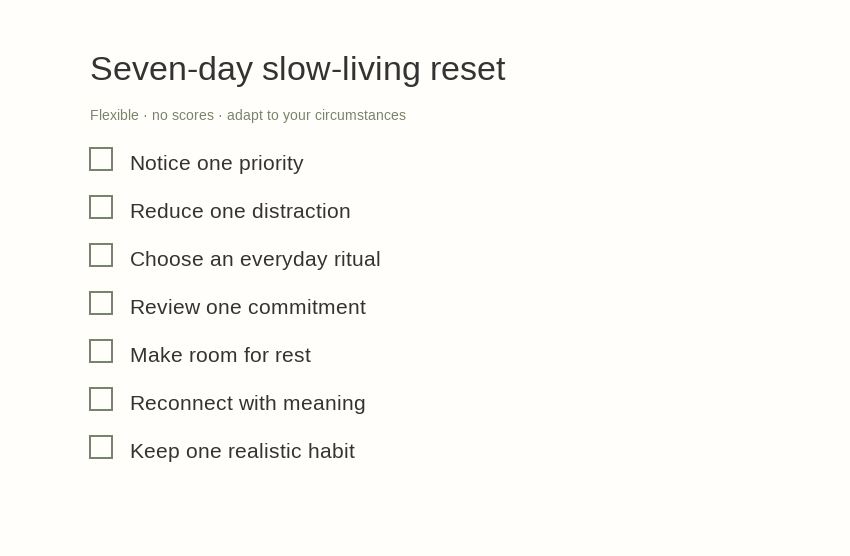
Adapt timing, accessibility, and steps to your circumstances.The seven-day slow-living reset
Print-friendly version: Seven-day reset checklist (SVG)
A flexible 30-day intentional-living experiment
Week 1 · Awareness
Notice routines and priorities without judgment.
Week 2 · Simplification
Test one small change to a commitment, device, or routine.
Week 3 · Engagement
Make room for valued activity, connection, or rest when possible.
Week 4 · Integration
Keep, adapt, or stop what you tested; review optionally on the last two days.
How to work with productivity guilt
Work identity, perfectionism, comparison, and unstructured time can make rest uncomfortable. Define a meaningful day in terms of your real circumstances. Separate important responsibilities from rules you inherited. Choose flexible goals with a minimum version. Self-compassion does not mean ignoring a commitment; it can help you look at the situation without shame. Reflection is not a substitute for care when distress persists.
Gentle daily reflection
Date: __________ Meaningful activity: __________________
Enjoyable moment: __________________ Rest or leisure: __________________
Distraction noticed: __________________ One thing to simplify: __________________
Optional reflection: __________________________________________________________
No scores, streaks, or completion targets. Skip any prompt.Personal priority planner
What matters to me today? _________________________________________________
One responsibility / next step: ______________________________________________
What can wait, be shared, or be simplified? ____________________________________
What support or accommodation could help? __________________________________
Cozy slow living without consumerism
Online images often make slow living look like a shopping list: luxury coffee tools, expensive journals, coordinated décor, and a flawless morning. Useful items can be enjoyable, but they are optional. Try an existing cup, a library book, ordinary daylight, a sheet of paper, or a pause. Optional items below are paired with no-cost everyday alternatives.
Curated recommendations for intentional living. As an Amazon Associate I earn from qualifying purchases. Product prices and availability are subject to change on Amazon.
Simple Reflection Journal
Daily gratitude, mindfulness, and gentle reflection without pressure.
Free alternative: Use an existing notebook; paper can be reused.Undated Daily Goal Planner
Structured schedule and priority organization to reduce mental friction.
Free alternative: Use a free calendar or sheet.Amber Blue-Light Blocking Reading Lamp
Gentle, warm 1600K amber lighting for relaxed evening reading.
Free alternative: Reposition a suitable lamp you own.Insulated Daily Tumbler with Straw
Comfortable hydration companion for mindful daily rhythms.
Free alternative: Use a cup already at home.Mindful Drawing & Sketching Set
Unplugged creative expression to decompress away from screens.
Free alternative: Use accessible digital or no-material options.Waffle Knit Cozy Throw Blanket
Lightweight textured comfort for reading or quiet rest.
Free alternative: Use an existing chair or cushion.20 common mistakes and more useful alternatives
- 01
Mistaking avoidance for intention: identify an important consequence and take one small action.
- 02
Thinking ambition conflicts with intention: keep a meaningful goal and reduce optional overload.
- 03
Copying influencer routines: borrow a useful idea, not someone else’s schedule.
- 04
Buying accessories first: test a no-cost version.
- 05
Overbuilding mornings: keep essentials and one helpful action.
- 06
Making rest earned: let leisure be a normal human activity.
- 07
Guilting yourself for busy days: notice one choice within your control.
- 08
Ignoring finances: include real obligations in planning.
- 09
Ignoring deadlines: check consequences and communicate early when possible.
- 10
Comparing with online homes: remember content is curated.
- 11
Expecting daily peace: plan for ordinary disruptions.
- 12
Eliminating all tech: keep useful tools and adjust unwanted patterns.
- 13
Rejecting productivity tools: use a calendar if it reduces friction.
- 14
Calling recovery procrastination: account for health and energy.
- 15
Ignoring why you avoid a task: check clarity, support, and scale.
- 16
Expecting instant change: lifestyle practice is not guaranteed treatment.
- 17
Turning values into strict tracking: remove rules that create pressure.
- 18
Changing all habits together: experiment with one adjustment.
- 19
Ignoring access needs: adapt, accommodate, or ask for help.
- 20
Seeking one correct slow life: shape the approach to your actual context.
Eight realistic hypothetical scenarios
Overworked professional
Rest feels uncomfortable after a demanding shift. Try a transition cue and real leisure; seek more support if distress persists.
Not a clinical case or research outcome.Busy parent
Uninterrupted time is scarce. Try a shared five-minute ritual, task-sharing, or practical help.
Not a clinical case or research outcome.Student delaying an assignment
Clarify requirements, write a rough first line, contact the instructor, or ask about support.
Not a clinical case or research outcome.Ambitious entrepreneur
Work expands into all hours. Define a weekly priority and stopping cue that fit business realities.
Not a clinical case or research outcome.Social media comparison
A styled home creates inadequacy. Mute triggering accounts and choose one useful change in your actual space.
Not a clinical case or research outcome.Low-energy reader
Plans exceed capacity. Choose seated or shorter alternatives; seek evaluation for persistent severe changes.
Not a clinical case or research outcome.Lifestyle shopper
Accessories seem necessary for calm. Pause purchases and use existing resources while reflecting on the need.
Not a clinical case or research outcome.Weekend scroller
Entertainment crowds out intended time. Choose a viewing window and one optional alternative; no total ban needed.
Not a clinical case or research outcome.When slow living is not the complete answer
Persistent or severe exhaustion, loss of interest, significant sleep changes, difficulty with essential activities, concentration problems, or ongoing distress can have physical, psychological, social, or environmental causes. Consider a qualified professional if symptoms persist or interfere with everyday life. A lifestyle philosophy is not medical care, workplace accommodation, or practical assistance.
Frequently asked questions
What is the difference between slow living and lazy living?
Slow living means intentional choices about pace, attention, responsibilities, and rest. “Lazy” is informal; look at context and impact instead of moral labels.
What does slow living actually mean?
A flexible philosophy centered on intention and meaningful priorities, not one prescribed routine.
Can slow living make me less productive?
It does not prescribe output. Work efficiently and choose appropriate boundaries; results depend on circumstances.
Can ambitious people practice slow living?
Yes. Goals can coexist with planning and rest; success is not guaranteed.
How can I live slowly while working full-time?
Try one transition ritual, a realistic priority, or an available break; adapt boundaries to your role.
Is slow living possible with children?
Use flexible routines, share responsibilities where possible, and count small moments.
Can I practice slow living without spending money?
Yes. Use existing belongings, library resources, ordinary meals, or unstructured rest.
What is the difference between rest and procrastination?
Rest may be chosen for enjoyment or recovery; procrastination delays an intended task despite expected costs. Context matters.
Why do I feel guilty when resting?
Expectations, perfectionism, work identity, or comparison may contribute. Seek support if guilt persists.
Does slow living require waking early?
No. Fit routines to your schedule and sleep needs.
Is slow living the same as minimalism?
No. They may overlap, but slow living emphasizes intention and pace.
Can I practice in a small apartment?
Yes; no particular home or aesthetic is required.
Do I need to stop using social media?
No. Try purpose-based use or flexible boundaries.
What are simple habits for beginners?
Choose one priority, enjoy a meal with fewer distractions, or take a short pause.
How do I make an intentional morning?
Handle essentials and choose one meaningful action; it need not start early.
What should I do on low-energy days?
Adapt expectations, rest, and ask for support. Seek evaluation if changes persist or impair daily life.
Can slow living manage everyday stress?
Some choices may feel supportive, but it is not a proven treatment or guarantee.
How do I balance slow living with financial responsibilities?
Do not assume reducing work or spending is possible; focus on feasible choices and seek qualified advice for financial concerns.
What are common slow-living mistakes?
Treating it as an aesthetic, buying unnecessary goods, ignoring obligations, or expecting perfect calm.
When should persistent exhaustion be evaluated?
When severe, persistent, or interfering with daily functioning, speak with an appropriate professional.
Your next small step
Slow living is not doing as little as possible. It is making thoughtful choices about what deserves your time, energy, and attention while acknowledging real responsibilities, health, finances, and caregiving. Choose one realistic adjustment, use what you already have, and let your routine fit your life rather than an idealized image.
Research and further reading
- Slow Food. Our History.
- Li et al. (2023). A meta-analysis of the association between mindfulness and motivation. Frontiers in Public Health, 11, 1159902.
- Agolli & Holtz (2023). Facilitating detachment from work: A systematic review. Journal of Occupational Health Psychology, 28(3), 129–159.
- McAnally & Hagger (2024). Self-Determination Theory and Workplace Outcomes. Behavioral Sciences, 14(6), 428.
- Sirois & Pychyl (2013). Procrastination and the Priority of Short-Term Mood Regulation. Social and Personality Psychology Compass, 7(2), 115–127.