
Quick answer
Blackheads are a form of acne (open comedones); sebaceous filaments are normal follicle structures that help move sebum to the skin’s surface. They may look similar, especially on the nose, and appearance alone cannot always tell them apart. Gentle care can help manage acne or temporarily soften the look of pores, but normal filaments and pores cannot be permanently removed or closed. [1] [5]
Takeaway: visible pores are normal skin texture. A small dot is not evidence of poor hygiene, and extracting it is not required for healthy skin.
What are blackheads?
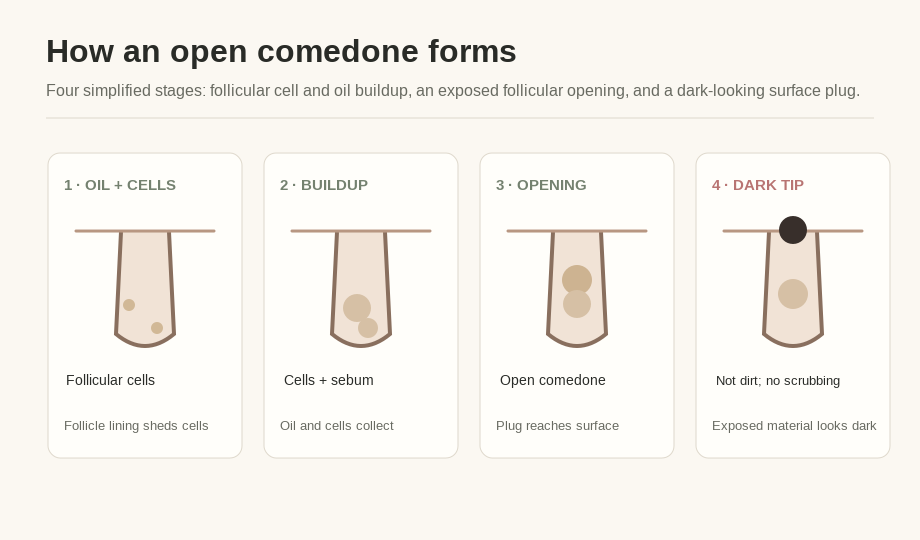
A blackhead is an open comedone, a non-inflammatory acne lesion that forms when material builds up in a hair follicle connected to a sebaceous gland. Sebum (skin oil) and keratinized cells can accumulate and plug the follicle. The opening stays exposed at the surface, unlike a whitehead, whose opening is covered. [2] [4]
The dark tip is not a speck of dirt. Air exposure changes the appearance of the exposed plug; clinical explanations mention oxidation and pigment in the surface material. The precise contribution is not identical across every source, but the practical point is clear: vigorous washing cannot scrub a blackhead away and may irritate the skin. [1] [3] [4]
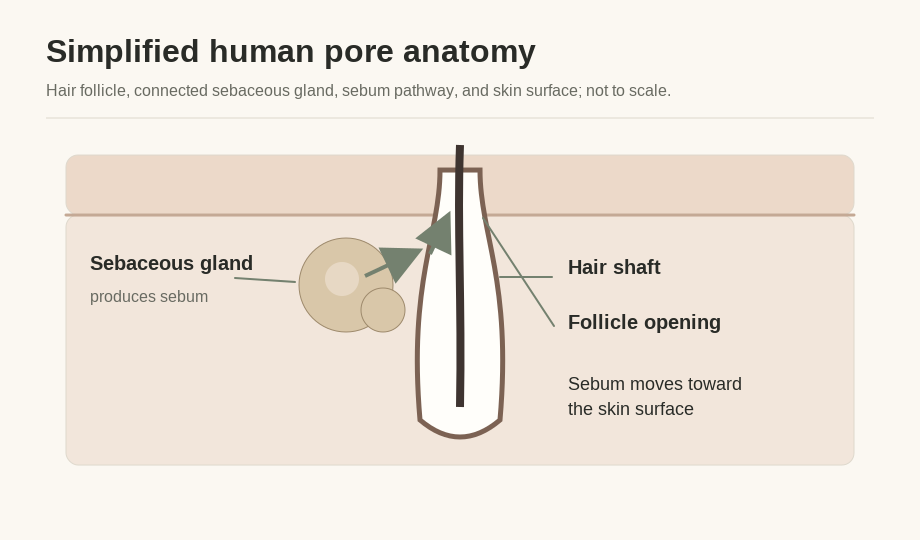
Comedones often appear on the nose, forehead, and chin, but can occur on the chest or back. Acne develops within pilosebaceous units—the hair follicle and its connected oil gland—not because the skin is unclean. Hormones, individual follicle behavior, and other factors influence acne. [3]
What are sebaceous filaments?
Sebaceous filaments are normal structures associated with the passage of sebum through follicles. They help oil reach the skin surface, where sebum contributes to skin and hair lubrication. They are not a type of acne and do not need to be extracted. [5]
They are often most noticeable on the nose and other oilier facial areas. Many appear as tiny, fairly even dots that may look pale gray, yellowish, tan, or skin-toned. Visibility varies with oil production, follicle characteristics, skin tone, lighting, and age. A close-up photograph cannot reliably distinguish every filament from a comedone or another skin change. [5]
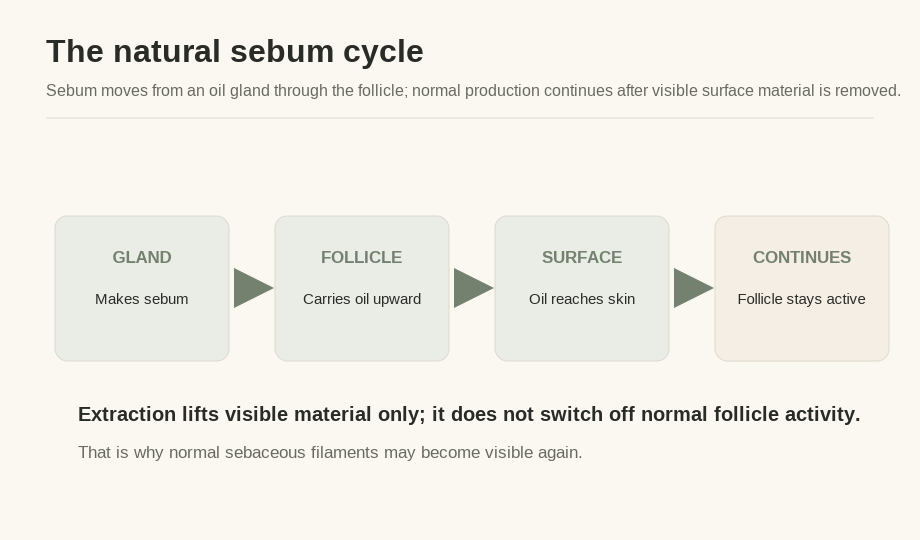
Because follicles continue their ordinary activity, visible contents may return after a strip or extraction. That recurrence is not a sign that skin is dirty or that a routine failed. Permanently removing normal filaments is neither a realistic target nor a health requirement. [5]
Blackheads vs sebaceous filaments: a detailed comparison
These are useful patterns, not at-home diagnostic rules. A single pore can be difficult to classify without an examination.
| Clue | Sebaceous filaments | Blackheads |
|---|---|---|
| What it is | A normal part of the follicle associated with sebum moving toward the surface. | An open comedone: a follicle blocked by sebum and keratinized cells. |
| Typical look | Many small, fairly even dots; often flat and pale gray, tan, or yellowish. | A more distinct dark plug; may look larger or more raised, though not always. |
| Color | Often skin-toned, light gray, cream, or yellow; appearance varies. | Often brown or black at the exposed opening; the color is not proof of dirt. |
| Pattern and place | Commonly evenly distributed where oil production is higher, especially the nose. | May be scattered or clustered on the nose, chin, forehead, chest, or back. |
| Surface | Usually subtle and level with nearby skin. | Can have a visible, individual open plug; appearance alone is not definitive. |
| Acne relationship | Normal structure; not itself acne. | A non-inflammatory acne lesion (open comedone). |
| Natural role | Part of normal follicular oil flow; no need to remove it for skin health. | No beneficial “cleaning” role; it is a clogged follicle. |
| Why it returns | The follicle and sebaceous gland continue their normal activity. | New plugs can form while follicles keep producing cells and sebum. |
| Care options | Often no treatment needed. Gentle cleansing and optional low-irritation care may make them less noticeable temporarily. | Evidence-based acne care may include a topical retinoid or salicylic acid; clinician guidance can help select one. |
| What to expect | Visibility can fluctuate; permanent removal or permanently poreless skin is not realistic. | Improvement usually takes consistent care over weeks; irritation is not a sign of progress. |
| When to ask for help | Seek advice if the change is unusual, persistent, painful, or unclear. | Seek advice for painful/inflamed acne, scarring, ongoing irritation, or inadequate response. |
Seven visual clues that may help you tell the difference
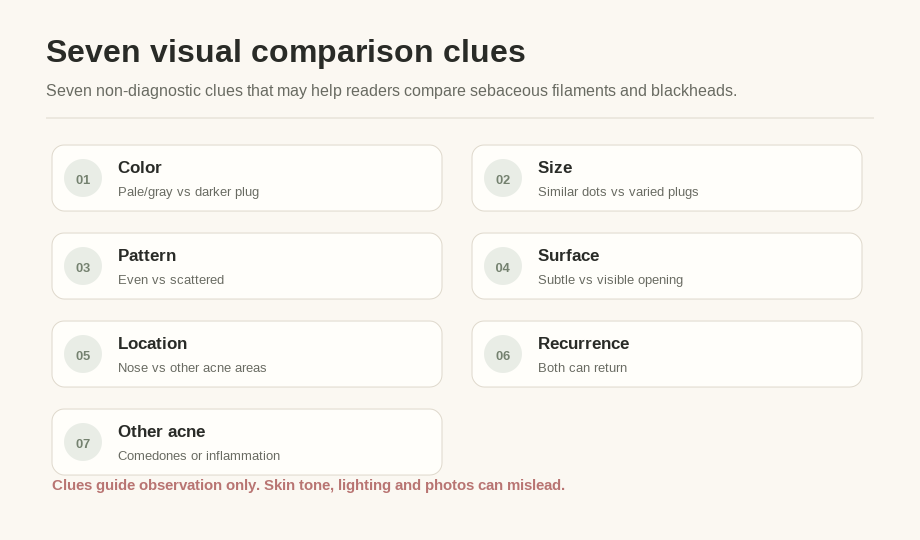
Look for a pattern rather than relying on one dot. Differences in lighting and skin tone can change what appears dark or raised.
- Color: filaments are often pale, gray, yellowish, or close to the surrounding skin; blackheads may have a more distinct brown or dark opening. Color alone is not decisive.
- Size: filaments often look similarly tiny across an area; blackheads can look like more individual plugs of varying size.
- Distribution: an even sprinkling across the nose is common with filaments; discrete irregular plugs can be more consistent with comedones.
- Surface appearance: filaments are often flat and subtle. A visibly open plug may be a comedone, but mirrors and magnifiers exaggerate texture.
- Location: filaments are frequently noticed on the nose; blackheads may occur on other acne-prone areas too.
- Recurrence: both may reappear, for different reasons. Recurrence does not identify the cause by itself.
- Other acne symptoms: accompanying whiteheads or inflamed acne make acne management worth discussing; painful lesions or scarring need professional advice.
Skin appearance differs across skin tones and lighting. Redness can be less obvious in darker skin, and post-inflammatory color changes can be more prominent. Avoid harsh close-up inspection or squeezing to identify a pore. [14]
Why do the dots on your nose keep coming back?
Sebaceous glands continue to produce sebum, and the follicle continues its normal cell-renewal and oil-flow activity. Removing what you can see at the opening does not stop those processes. That is why visible filaments can become noticeable again, sometimes quickly. [5]
Blackheads can also recur because the follicle can form another plug. A long-term acne plan aims to reduce new comedones and irritation—not to empty every pore. A temporary clean-looking surface after extraction is a cosmetic change, not proof that the underlying tendency has been changed.
A pore is not a door that opens and closes. It is a normal follicular opening whose appearance can change.
Repeated extraction may produce more redness and texture contrast, drawing attention to pores rather than making them less visible.
Can you permanently remove sebaceous filaments?
No. Filaments are part of normal follicular anatomy. You may temporarily reduce how noticeable surface oil or pore contents look, but no cleanser or mask can permanently remove the structures or create permanently poreless skin. “Instant pore closure,” “complete pore detox,” and permanent pore-shrinking claims overstate what skincare can do.
Likewise, pores do not permanently open or close on command. Their visible appearance may shift with oil, dehydration, age, lighting, and treatments. The realistic goal is comfortable, healthy skin and—if acne is present—evidence-based control of acne, not elimination of natural texture.
Best skincare ingredients for blackheads and visible pores
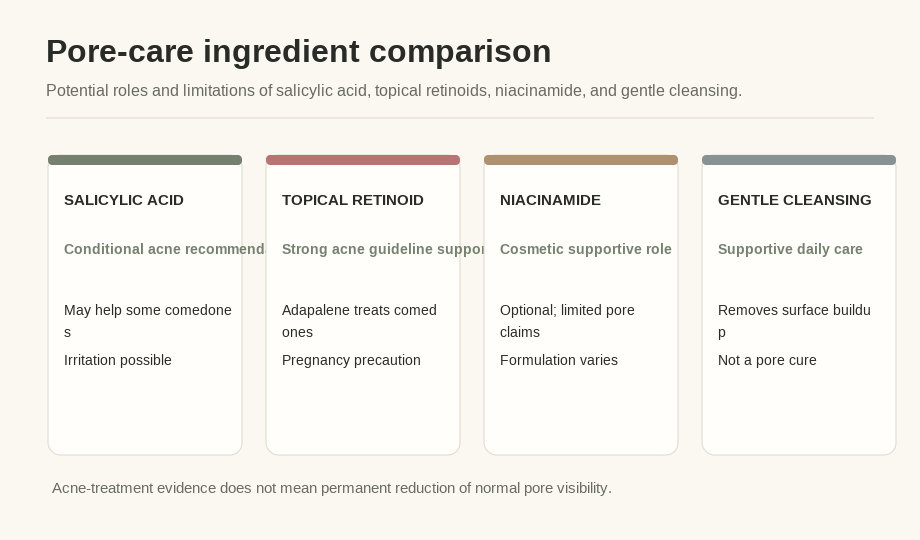
Evidence for treating acne is not the same as evidence for permanently reducing the look of normal filaments. In the American Academy of Dermatology guideline, topical retinoids receive a strong recommendation for acne, while salicylic acid receives a conditional recommendation. Many cosmetic pore claims are less certain or depend on a specific product. [6]
Ingredient / routine step
Salicylic acid (BHA)
Role: Helps loosen dead skin cells in follicles; AAD gives it a conditional recommendation for acne.
When it may fit: May be considered for blackhead-prone areas if skin tolerates it.
Evidence: Guideline-supported option, but lower-certainty than topical retinoids in the AAD guideline.
Limit / safety: Start with one product and follow its label. Dryness, stinging, or peeling means reduce or pause. Ask a clinician during pregnancy.
Ingredient / routine step
Adapalene / topical retinoids
Role: Normalize follicular cell turnover and help prevent comedones.
When it may fit: A clinician/pharmacist can help select an acne retinoid and strength.
Evidence: Strong recommendation for acne in the AAD guideline.
Limit / safety: May irritate. Avoid topical retinoids during pregnancy as a precaution; discuss breastfeeding and use with a clinician.
Ingredient / routine step
Niacinamide
Role: A cosmetic ingredient that may support the skin barrier and help with oiliness or redness for some users.
When it may fit: Optional, not required for visible sebaceous filaments.
Evidence: Evidence for cosmetic pore-size or acne claims is limited and formulation-specific.
Limit / safety: Patch-test if reactive; irritation or allergy can occur. It does not permanently shrink pores.
Ingredient / routine step
Alpha hydroxy acids
Role: Surface exfoliation; glycolic or lactic acid may smooth some superficial roughness.
When it may fit: Optional cosmetic choice, not a first step for sensitive or irritated skin.
Evidence: Evidence for treating acne/filaments is less established than guideline acne medicines.
Limit / safety: Can sting, dry, or increase sun sensitivity; do not stack several exfoliants.
Ingredient / routine step
Gentle cleanser
Role: Removes surface oil, sunscreen, and debris without scrubbing.
When it may fit: A basic routine step for most skin types.
Evidence: Recommended as supportive acne skin care; not a pore-clearing cure.
Limit / safety: Use fingertips, lukewarm water, and avoid harsh scrubs or repeated washing.
Ingredient / routine step
Clay mask
Role: May temporarily absorb some surface oil.
When it may fit: Optional for people who enjoy masks and tolerate them.
Evidence: One short study tested a specific formulation; it does not prove all clay masks work.
Limit / safety: Limit use if dry or sensitive; stop if tight, burning, or flaky. No permanent pore effect.
Ingredient / routine step
Cleansing oil or balm
Role: Can dissolve makeup and water-resistant sunscreen as a first cleanse.
When it may fit: Use as directed, then rinse and follow with a gentle cleanser if needed.
Evidence: Not established as a treatment that removes blackheads or permanently clears filaments.
Limit / safety: Choose a product that rinses clean and suits your skin; prolonged massage may irritate.
Ingredient / routine step
Moisturizer + SPF
Role: Support comfort and skin-barrier care; sunscreen protects from UV exposure.
When it may fit: Choose a comfortable moisturizer; use broad-spectrum SPF 30+ when outdoors.
Evidence: Supportive care, not acne medication or pore shrinking.
Limit / safety: Look for “non-comedogenic” if concerned about clogged pores; labels do not guarantee every person’s response.
Retinoid safety: avoid topical retinoids such as adapalene during pregnancy as a precaution and consult a clinician about acne treatments if pregnant or planning pregnancy. Breastfeeding recommendations vary by product and application site; ask a clinician and prevent an infant from contacting treated skin. [7] [8]
Do pore strips really work?
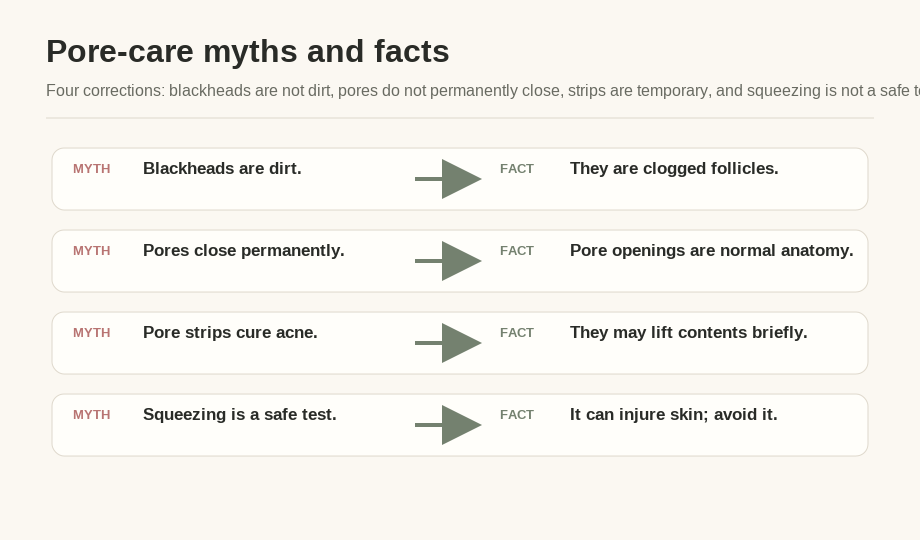
Pore strips stick to material at the opening and lift some of it when removed. This can make the surface look clearer for a short time. The strip does not stop sebum production, prevent new comedones, or permanently remove sebaceous filaments. Strips may irritate, dry, or pull at sensitive skin, particularly with repeated use. [11]
If your skin is already sore, sensitized, flaky, or broken, skip the strip. For recurring blackheads, consider evidence-based acne care rather than repeated temporary extraction.
Does oil cleansing remove sebaceous filaments?
A rinse-off cleansing oil or balm can dissolve makeup, sunscreen, and some surface buildup. It can be a useful cleanser step if you like it and your skin tolerates it. However, evidence does not establish that prolonged facial massage “rolls out” every blackhead or permanently removes filaments.
Use the product as directed and avoid vigorous rubbing. Long sessions and repeated friction can irritate the skin barrier; a cleanser should not need to be massaged for many minutes to be effective. A gentle second cleanse is optional, not a rule for every skin type. [10]
Can clay masks help visible pores?
Clay can temporarily absorb some surface oil, so a mask may briefly make an oily area look less shiny. This does not change pore anatomy or permanently remove filament contents. One short study examined a particular clay-mask formulation; it cannot establish that all clay products treat blackheads. [16]
If you use a mask, follow its instructions and stop if it burns, cracks, or leaves persistent tightness or redness. Dry and sensitive skin may prefer to skip it. Clay is optional, not essential acne treatment.
Should you squeeze blackheads or sebaceous filaments?
Repeated squeezing can irritate or injure the skin, push material deeper, increase inflammation, and raise the risk of infection or scarring. Inflammation or picking can also leave post-inflammatory hyperpigmentation, which may be more persistent or noticeable in darker skin tones. [12] [14]
Professional extraction by a dermatologist uses sterile instruments and may be considered in selected cases. It is not the same as digging, scraping, or squeezing at home, and even professional removal may not prevent lesions from returning. [12]
Safer alternatives include hands-off observation for filaments, gentle cleansing, moisturizer, sun protection, and a single evidence-informed acne treatment if blackheads are a concern. Do not use needles or extraction tools at home.
A gentle skincare approach for visible pores
Build the simplest routine you can comfortably keep. Cleanse gently, moisturize when needed, and protect skin from the sun. Add an acne active only if there is a reason, and introduce one product at a time.
For beginners with visible filaments
Start simple: visible sebaceous filaments
Morning
- Rinse or use a gentle cleanser if needed
- Lightweight moisturizer if your skin feels dry
- Broad-spectrum SPF 30+ when outdoors
Evening
- Remove sunscreen/makeup with a gentle cleanser
- Apply a comfortable moisturizer
Optional: One low-irritation product may make oiliness less noticeable, but treatment is not necessary for normal filaments.
Keep expectations cosmetic and temporary. Skip extraction and pore strips if they irritate.
For oily, blackhead-prone skin
Comedone-conscious routine
Morning
- Gentle non-abrasive cleanser
- Moisturizer if needed
- Broad-spectrum SPF 30+
Evening
- Gentle cleanser
- If appropriate, one acne active such as salicylic acid or adapalene, introduced according to its label or a clinician’s advice
- Moisturizer
Optional: Ask a pharmacist/clinician before combining acne medicines or if you have pregnancy, breastfeeding, or medication questions.
Do not start multiple actives at once. Reduce or pause for persistent burning, redness, swelling, or painful peeling.
For combination skin
Balanced routine for combination skin
Morning
- Gentle cleanser or water rinse
- Moisturizer applied where needed
- Broad-spectrum SPF 30+
Evening
- Gentle cleanser
- Use any chosen active only on the area and schedule advised by its label or clinician
- Moisturizer
Optional: A light lotion may feel comfortable on oily areas while a richer cream suits dry patches.
Different areas can need different amounts of moisturizer. Avoid aggressively drying the T-zone.
For sensitive skin with visible pores
Low-irritation routine
Morning
- Rinse or use a fragrance-free gentle cleanser
- Plain moisturizer
- Broad-spectrum SPF 30+ that your skin tolerates
Evening
- Gentle cleanser
- Moisturizer
Optional: Consider an active only after the skin is comfortable and with professional guidance if you have a skin condition.
Pause exfoliants if they sting or leave persistent redness. A simple routine is a valid goal.
For dry or dehydrated skin with visible pores
Comfort-first routine
Morning
- Rinse or use a mild cleanser
- Moisturizer while skin is slightly damp
- Broad-spectrum SPF 30+
Evening
- Gentle cleanser, especially to remove sunscreen
- Moisturizer; a richer texture is fine if comfortable
Optional: Avoid adding an exfoliant solely to make normal pores disappear.
Dry skin can still show follicles and filaments. Persistent tightness, cracking, or burning calls for a routine pause and professional advice.
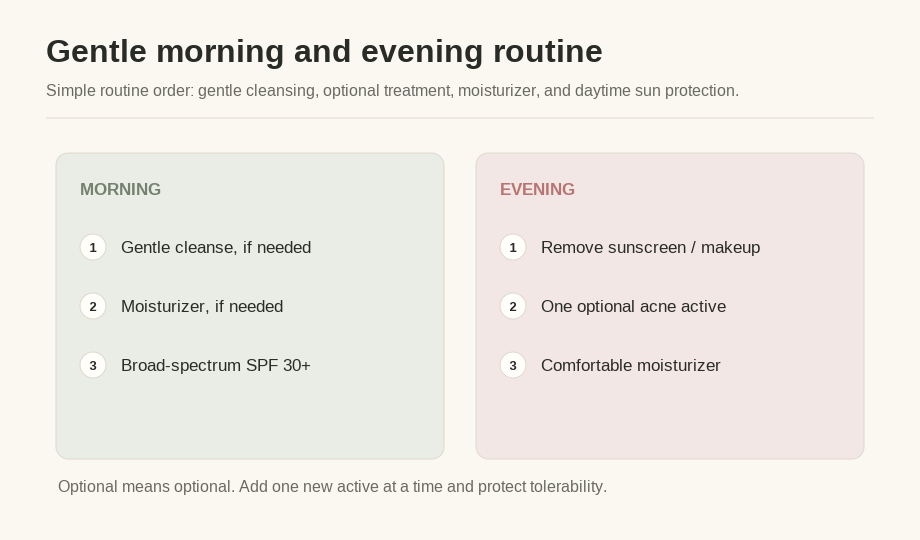
Across all skin types, reduce or stop a new active if you develop ongoing burning, marked redness, swelling, painful cracks, or escalating peeling. If the reaction persists, ask a clinician. Products that cause stinging are not “detoxing” the pores.
A gentle four-week introduction plan
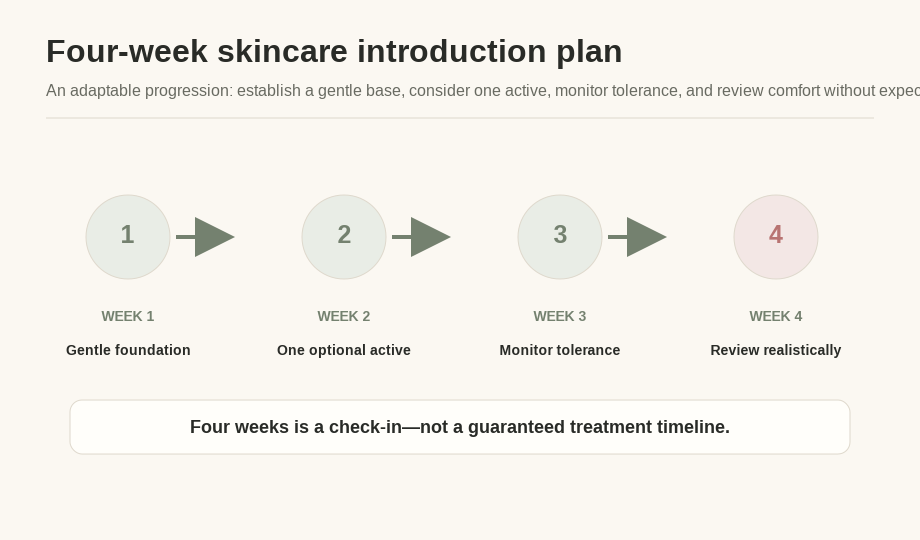
This is a routine-building framework, not a guaranteed treatment timeline. If your skin is already irritated, start by simplifying and restoring comfort rather than adding an active.
Week 1 · Build the base
Use a gentle cleanser as needed, a moisturizer that feels comfortable, and broad-spectrum SPF 30+ outdoors. Avoid strips, squeezing, scrubs, and new acids. Note baseline irritation and take no close-up diagnosis photos.
Week 2 · Consider one optional active
If skin is comfortable and acne is a concern, consider one ingredient such as salicylic acid or adapalene after checking the label and relevant pregnancy/medication precautions. Start at the lowest directed frequency; do not begin both. Filaments do not require treatment.
Week 3 · Keep it steady
Continue only if tolerated. Do not increase frequency just because the dots remain. Persistent stinging, swelling, painful cracking, or worsening redness means stop or reduce the new active and seek advice if symptoms continue.
Week 4 · Review comfort, not porelessness
Check for tolerability and changes in acne over time. Four weeks is not a guaranteed result period; comedonal acne often needs longer. If there is no concern beyond normal filaments, it is reasonable to keep the simple routine.
Copy-and-use check-in
Skin-response tracker
Use a simple note to track comfort and routine consistency—not to diagnose a condition or pursue porelessness. This tool does not collect or save entries.
SKIN RESPONSE CHECK-IN (educational self-observation, not diagnosis)
Date / week: ____________________
Routine used (products and frequency): ____________________
Comfort today (comfortable / dry / tight / stinging / other): ____________________
Any persistent redness, swelling, painful cracking, or worsening peeling? ____________________
What changed since the last check-in? ____________________
Next gentle step: keep routine / reduce active / pause active / ask a clinician
Reminder: one observation is not a diagnosis. Seek advice for persistent or severe symptoms.
Comedonal acne may take longer than four weeks to improve. Avoid making a conclusion from daily close-up checks; compare comfort and acne trends over time instead. [2]
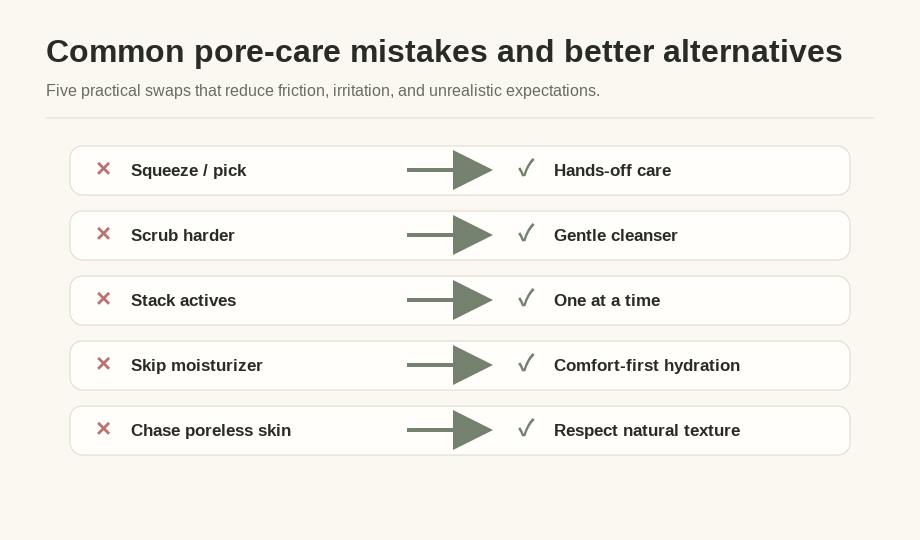
Common pore-care mistakes—and better alternatives
Squeezing repeatedly
Why it can backfire: Injury and inflammation can make texture more noticeable.
Try instead: Leave normal filaments alone; ask a dermatologist about persistent comedones.
Using harsh facial scrubs
Why it can backfire: Friction can irritate skin and worsen acne.
Try instead: Use fingertips and a gentle cleanser.
Stacking exfoliants
Why it can backfire: Too many actives can undermine tolerability.
Try instead: Choose one optional active and introduce it slowly.
Assuming pores mean dirt
Why it can backfire: Blackheads are follicular plugs, not grime.
Try instead: Wash gently; acne is not caused by poor hygiene.
Expecting permanent removal
Why it can backfire: Normal follicles keep functioning.
Try instead: Aim for comfort and realistic appearance goals.
Washing too often
Why it can backfire: Repeated cleansing can dry and irritate skin.
Try instead: Cleanse gently as needed, usually up to twice daily and after sweating.
Skipping moisturizer because skin is oily
Why it can backfire: Dryness from treatment can become harder to tolerate.
Try instead: Try a light, non-comedogenic moisturizer if needed.
Using DIY lemon, baking soda, or toothpaste
Why it can backfire: These can irritate and are not established pore treatments.
Try instead: Use products intended for facial skin; avoid caustic experiments.
Changing products every few days
Why it can backfire: Frequent changes make it hard to judge tolerance.
Try instead: Keep a simple routine long enough to assess it.
Comparing with filtered close-ups
Why it can backfire: Filters and magnification distort ordinary skin texture.
Try instead: Judge skin in normal lighting and from a normal distance.
Five realistic reader scenarios
These hypothetical examples illustrate questions to consider; none is a diagnosis.
- Evenly spaced gray dots around the nose: this pattern is commonly associated with visible sebaceous filaments. A gentle routine and hands-off approach may be reasonable; seek advice if the appearance changes or remains concerning.
- Persistent dark, raised clogged pores: open comedones are one possibility. Avoid squeezing and consider discussing a single acne treatment with a pharmacist or clinician, especially if lesions persist.
- Red, tight skin after frequent pore strips: irritation may be contributing. Stop the strips and other irritating actives while the skin settles; seek help if symptoms are severe or continue.
- Oily skin with no moisturizer: oiliness does not mean the skin cannot feel dry or irritated. A light, comfortable moisturizer may support tolerability; choose based on personal response.
- Sensitive skin using several exfoliants: simplify the routine and pause products that sting. Reintroduce nothing until comfortable, and ask a clinician about persistent symptoms.
Try the pore appearance and routine finder
Use the questions to organize observations—not to label your skin. Your answers stay in this browser session and are not sent or saved.
Educational tool · no data saved or sent
Blackheads or Sebaceous Filaments? — Pore Appearance & Skincare Routine Finder
This seven-question guide offers general clues and a gentle routine framework. It cannot identify or diagnose a skin condition.
Question 1 of 7
No diagnosis, prediction, medical advice, data storage, or transmission. If you are pregnant, breastfeeding, using prescription medicines, or have persistent skin symptoms, ask a qualified clinician before starting active treatments.
When to see a dermatologist
Professional advice may be useful when acne is persistent or worsening; spots are painful, inflamed, or scarring; irritation continues despite simplifying; you are uncertain about a change; or an appropriate routine has not helped. A clinician can assess whether visible dots are comedones, normal filaments, or another condition and discuss options suited to your health context. [13]
Seek timely care for severe pain, rapidly worsening inflammation, signs of infection, or an allergic reaction. Over-the-counter cosmetic care cannot resolve every skin condition.
Frequently asked questions
Are sebaceous filaments normal?
Yes. They are normal features associated with sebum moving through hair follicles. They may be visible, especially on the nose, and do not mean skin is dirty.
Are sebaceous filaments a form of acne?
No. Sebaceous filaments are normal follicular structures. Blackheads are open comedones, a non-inflammatory type of acne lesion.
Why are sebaceous filaments common on the nose?
The nose has many visible oil-producing follicles, so their contents can be easier to notice. Oiliness, skin tone, lighting, and pore characteristics affect visibility.
Do blackheads and sebaceous filaments always look different?
They can differ in color, size, and distribution, but there is overlap. Mirrors and photos are not diagnostic tests; a clinician can assess uncertain or changing spots.
Why do sebaceous filaments keep returning?
Follicles continue to produce and move sebum as part of normal skin function. Extraction removes visible contents temporarily but does not switch off that process.
Can salicylic acid help visible pores?
Salicylic acid has a conditional recommendation in acne guidance and may help some people with blackhead-prone skin. It cannot permanently remove normal filaments or shrink pores.
Can niacinamide make pores less noticeable?
Some products may alter the appearance of oiliness, but evidence for permanent pore-size changes is limited. Results depend on the formulation and individual response.
Does retinol or adapalene help blackheads?
Topical retinoids, including adapalene, are guideline-supported acne treatments that can help comedones. They can irritate and should be introduced according to product/professional advice. Avoid topical retinoids during pregnancy as a precaution.
Can oil cleansing permanently remove sebaceous filaments?
No. A rinse-off cleansing oil can help dissolve makeup or sunscreen, but massage has not been shown to permanently change normal follicles or eliminate filaments.
Should I use pore strips?
They may temporarily lift some visible surface material, but results are short-lived and strips can irritate or dry skin. They are not long-term acne treatment.
Is squeezing blackheads safe?
Repeated home squeezing can injure skin, worsen inflammation, cause pigment change, or scar. A dermatologist may perform sterile extraction when appropriate.
Can pores permanently shrink or close?
No skincare product permanently closes pores. Their appearance can vary, and treatments may reduce the look of some clogged pores without changing normal anatomy.
Does moisturizer clog pores?
Not necessarily. If concerned, choose a product labelled non-comedogenic or oil-free, but no label guarantees how every individual will respond.
Can dry skin have visible sebaceous filaments?
Yes. Overall dryness does not remove follicles or filaments. Dryness can coexist with visible pores; avoid over-exfoliating to chase a poreless look.
When should I seek professional help?
Ask a dermatologist or clinician for persistent/worsening acne, painful or inflamed lesions, scarring, ongoing irritation, uncertainty about a skin change, or inadequate response to an appropriate routine.
This FAQ summarizes educational points grounded in clinical dermatological guidelines.
Final takeaway
Blackheads are acne-related open comedones; sebaceous filaments are normal parts of how sebum moves through follicles. They can look similar, but repeated extraction is not a reliable way to tell them apart—and normal filaments are not a defect that needs removal. Choose gentle care, introduce at most one active carefully if acne is a concern, and ask a dermatologist when symptoms persist or cause pain, irritation, or scarring.
Healthy skin has texture. Pores are part of it.
Educational disclaimer: This article is general information, not medical advice or diagnosis. Skincare reactions and treatment suitability vary. Consult a qualified clinician for individual concerns, especially during pregnancy or breastfeeding.
Optional product categories
Affiliate disclosure: If you buy through qualifying links, Hailey Morgan may earn a commission at no extra cost to you. As an Amazon Associate, the publisher earns from qualifying purchases. Carefully selected gentle non-comedogenic essentials for oily, combination, and filament-prone skin. As an Amazon Associate, Hailey Morgan earns from qualifying purchases (paid links).
Products are optional; no purchase is needed to care for normal sebaceous filaments.
CeraVe Hydrating Facial Cleanser
Why it may help: A gentle, non-foaming wash that removes excess sebum and sunscreen without disrupting the epidermal barrier.
Use case: Daily morning and evening wash for normal to dry or sensitive skin.
Precaution: A cleanser alone will not extract established comedones; individual skin tolerance varies.
View on Amazon ↗Paula's Choice Skin Perfecting 2% BHA Liquid Exfoliant
Why it may help: Lipophilic salicylic acid penetrates deep into pore linings to dissolve built-up sebum and dead skin cells.
Use case: Targeted application on blackheads and congested areas 2-3 nights weekly.
Precaution: Introduce slowly to prevent irritation; always follow with daily broad-spectrum SPF.
View on Amazon ↗La Roche-Posay Toleriane Double Repair Face Moisturizer
Why it may help: Formulated with prebiotic thermal water, ceramide-3, and niacinamide to restore barrier comfort without heaviness.
Use case: Essential barrier hydration after cleansing or using exfoliating actives.
Precaution: Check formula suitability if extremely prone to specific cosmetic sensitivities.
View on Amazon ↗The Ordinary Niacinamide 10% + Zinc 1% Serum
Why it may help: Helps regulate surface sebum production and visibly minimizes the look of enlarged pores.
Use case: Apply 2-3 drops to clean skin before heavier creams.
Precaution: High-concentration active; reduce frequency if transient tingling occurs.
View on Amazon ↗DHC Deep Cleansing Oil
Why it may help: Olive oil-based botanical cleanser that binds to sebaceous plugs and rinses away cleanly with warm water.
Use case: First step in an evening double-cleanse routine to loosen stubborn nose plugs.
Precaution: Always follow with water and rinse thoroughly; never scrub abrasively.
View on Amazon ↗EltaMD UV Clear Broad-Spectrum SPF 46
Why it may help: Transparent, oil-free zinc oxide sunscreen with niacinamide that protects pores from UV oxidation without clogging.
Use case: Every morning as the final skincare layer.
Precaution: Reapply every 2 hours when exposed to direct sunlight outdoors.
View on Amazon ↗References
- American Academy of Dermatology. Acne: Signs and symptoms.
- Cleveland Clinic. Comedonal Acne.
- Mayo Clinic. Acne: Symptoms and causes.
- DermNet. Comedonal acne.
- Cleveland Clinic. Sebaceous Filaments: Difference From Blackheads & Treatment.
- American Academy of Dermatology. Acne clinical guideline.
- American Academy of Dermatology. Is any acne treatment safe to use during pregnancy?
- DermNet. Acne in pregnancy.
- American Academy of Dermatology. Acne: Tips for managing.
- NICE. Skin care advice for people with acne vulgaris: evidence review.
- Cleveland Clinic Health Essentials. How To Get Rid of Blackheads.
- American Academy of Dermatology. Pimple popping: Why only a dermatologist should do it.
- National Health Service. Acne.
- DermNet. Acne scarring.
- American Academy of Dermatology. Moisturizer: Why you may need it if you have acne.
- Skin Research and Technology. Comprehensive assessment of the efficacy and safety of a clay mask in oily and acne skin (2023).
- Plewig G, Kligman AM. Acne and Rosacea. Springer-Verlag. Pathogenesis of Follicular Casts and Sebaceous Filaments.
- Kligman AM. The follicular anatomy of human sebaceous glands. J Invest Dermatol.
- Zaenglein AL, et al. Guidelines of care for the management of acne vulgaris. J Am Acad Dermatol (2024 update).