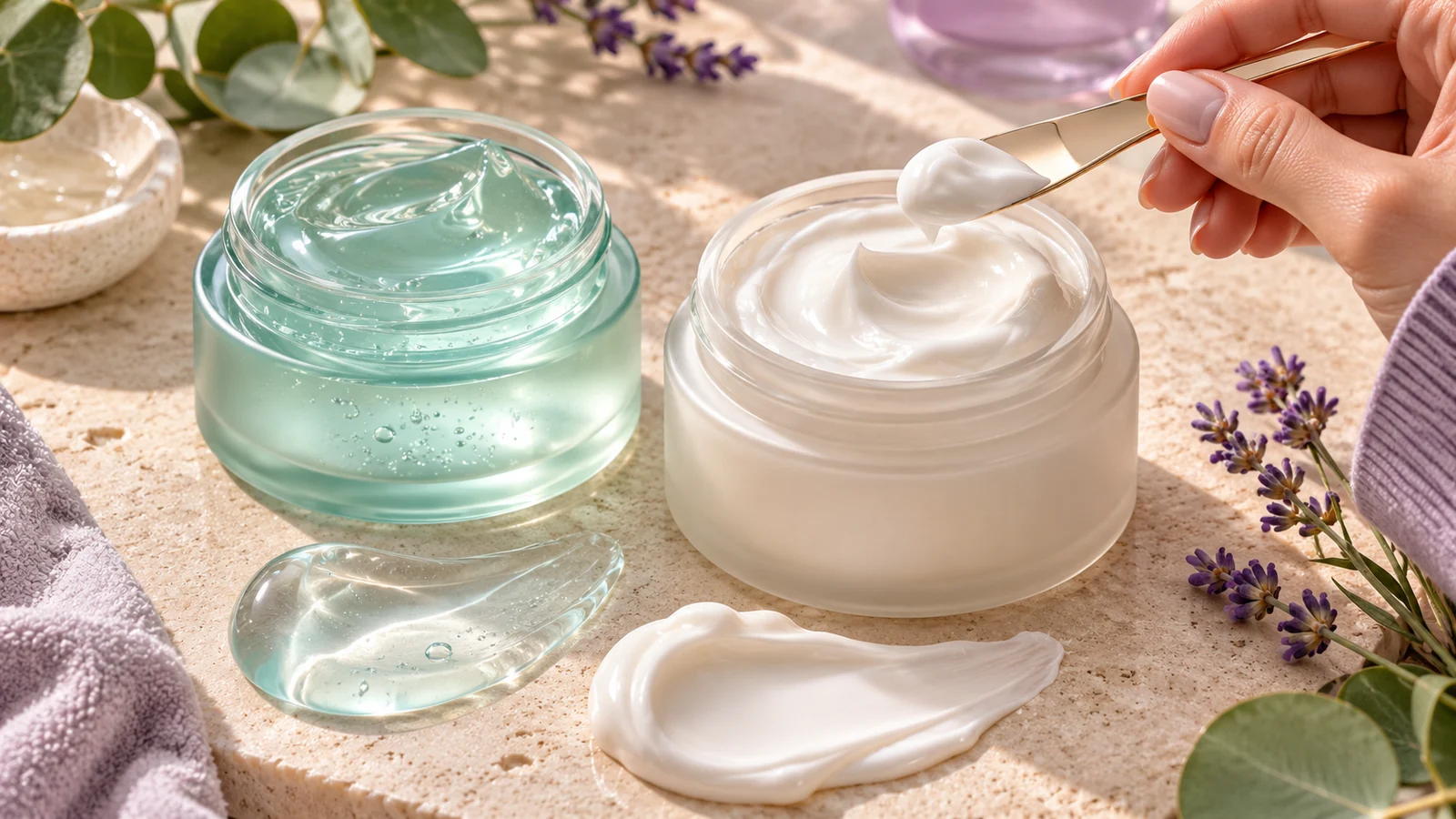
Gel Moisturizer vs Cream Moisturizer: Which Suits Your Skin Type?
By Hailey Morgan
Category: Skincare Routine & Beauty Tips
Primary audience: United States; applicable with local-label differences in the UK, Canada, and Australia
Medical and educational note: This article explains cosmetic formulation science and general skin-care principles. It cannot diagnose dehydration, acne, eczema, allergy, barrier impairment, or any other condition. Product texture alone cannot predict hydration, occlusivity, tolerability, pore behavior, or barrier recovery. Follow the label of the product you own and seek professional care for persistent, painful, rapidly changing, or severe symptoms.
Quick answer
A gel moisturizer usually feels lighter because it often relies more heavily on an aqueous phase, humectants, and a polymer network. A cream often contains a more substantial emollient or occlusive phase, but creams range from light lotions to rich emulsions. Neither format is universally better: the right choice is the complete formulation that leaves your skin comfortable, meets your climate and cosmetic needs, and can be used consistently.
If your current moisturizer is comfortable and your skin is doing well, there is no scientific reason to replace it simply because “gel” or “cream” is trending. If skin feels tight, flaky, or persistently irritated, change one variable at a time—and consider whether the problem needs medical assessment rather than another product.
What “gel” and “cream” actually mean
“Gel” and “cream” are formulation and sensory descriptions, not standardized clinical effectiveness categories. A gel can be a water-rich polymer network, a hydroalcoholic system, a silicone gel, or an emulsion that has been thickened until it feels gel-like. A cream is usually an emulsion containing water and an oil-compatible phase, but its feel depends on the selected emollients, waxes, fatty alcohols, silicones, polymers, emulsifiers, and the structure of the emulsion.
The familiar rule—gel for oily skin, cream for dry skin—can be a useful starting hypothesis, but it is not a diagnosis or a guarantee. The American Academy of Dermatology describes gels as often lighter than lotions and creams, while noting that choices should reflect skin type and the severity of dryness. 1 DermNet similarly lists gels, lotions, creams, oils, and ointments as different options and emphasizes that the preferred product is often the one a person can tolerate and use regularly. 2
A short vocabulary guide
| Format or term | What it usually describes | Typical feel or use | What it does not prove |
|---|---|---|---|
| Aqueous gel | Water-continuous system structured by polymers or other gelling agents | Light, fresh, sometimes tacky | That it is oil-free, non-comedogenic, or deeply penetrating |
| Hydrogel | A water-swollen three-dimensional network | Cushiony or jelly-like | That it provides stronger hydration than every cream |
| Gel-cream | A marketing or sensory category combining gel-like spread with emollient/emulsion behavior | Middle ground between gel and cream | A universal technical composition |
| Water cream | Usually a marketing term for a water-forward cream or gel-cream | Light, bouncy, quick-spreading | That it contains no oils or lipids |
| Lotion | Usually a lower-viscosity emulsion or dispersion | Spreadable and relatively light | A fixed oil percentage or a fixed clinical effect |
| Cream | Usually a higher-viscosity emulsion | Medium to rich, depending on formula | That it is greasy, pore-clogging, or better for everyone |
| Balm | Often anhydrous or wax-rich, sometimes an occlusive semi-solid | Protective, rich, persistent | That it is suitable for acne-prone or inflamed skin |
| Ointment | Usually a very oil-dominant, semi-solid vehicle | Most persistent and occlusive of common leave-on formats | That it should be used on every dry patch or every rash |
| Oil-in-water emulsion | Oil droplets dispersed through a continuous water phase | Often lighter and easier to rinse than water-in-oil systems | Exact occlusivity or clinical superiority |
| Water-in-oil emulsion | Water droplets dispersed through a continuous oil phase | Often richer and more water-resistant-feeling | That the product will suit every dry or sensitive person |
These are tendencies, not rules. Packaging language is not a laboratory characterization. An ordinary ingredient list cannot reliably reveal the exact emulsion orientation, viscosity, yield stress, oil-to-water ratio, or clinical performance.
How moisturizers work: the skin biology first
The outermost layer of the epidermis, the stratum corneum, contains flattened corneocytes surrounded by organized lipid structures. Its job is not to make skin completely impermeable. It regulates water movement and helps limit entry of irritants and allergens. Ceramides, cholesterol, and free fatty acids are important parts of the intercellular lipid environment, while natural moisturizing factors inside corneocytes help bind water. 3
When the stratum corneum loses water too quickly, skin can feel tight, rough, flaky, or itchy. Transepidermal water loss (TEWL) is a measurement of water moving through and out of the skin. A moisturizer may reduce this loss by adding a surface film, improving flexibility, filling microscopic surface irregularities, or supporting water association in the outer skin. TEWL is a research measurement—not a personal score that can be inferred from how quickly a product disappears.
A useful moisturizer often combines three overlapping functions:
- Humectants attract and associate with water in the outer skin.
- Emollients soften and smooth the surface by improving lubrication and filling irregularities.
- Occlusives slow evaporative water loss by forming a more water-resistant film.
The categories overlap. Glycerin is primarily a humectant, but the finished formula containing it can also influence feel and water retention. Dimethicone can provide slip and a protective film. Petrolatum is strongly occlusive but also changes the sensory experience and surface flexibility. The finished product matters more than the label applied to one ingredient.
Humectants, emollients, and occlusives
| Function | Examples | Main contribution | Limitations |
|---|---|---|---|
| Humectant | Glycerin, urea, panthenol, sodium PCA, hyaluronic acid | Water association and outer-skin hydration | Can feel sticky; performance depends on the whole formula and environment |
| Emollient | Squalane, triglycerides, shea butter, fatty alcohols, esters | Smoothing, lubrication, reduced roughness, comfortable slip | Can feel heavy or shiny to some people |
| Occlusive | Petrolatum, mineral oil, dimethicone, waxes | Slower evaporative water loss and greater film persistence | May feel greasy; can aggravate some follicular or perioral concerns in some users |
A gel can contain all three functions. A cream can contain mostly humectants with a modest lipid phase. “Hydrating” and “moisturizing” are often used loosely in consumer language; do not assume that a gel only adds water or that a cream only seals it in.
Gel, gel-cream, lotion, cream, balm, and ointment: a practical comparison
| Characteristic | Gel | Gel-cream | Lotion | Cream | Balm | Ointment |
|---|---|---|---|---|---|---|
| Architecture | Often polymer-structured aqueous system; may also be an emulsion | Gel-like network and/or emulsion | Usually lower-viscosity emulsion | Usually more structured emulsion | Often waxy or anhydrous | Oil-dominant or anhydrous vehicle |
| Typical spread | Fast and light | Fast to moderate | Easy over broad areas | Moderate; varies greatly | Slower and more persistent | Very persistent |
| Common finish | Fresh, natural, sometimes matte or tacky | Cushioned, dewy, flexible | Light to medium | Medium to rich | Protective or glossy | Occlusive, glossy, greasy |
| Lipid phase | None, low, or meaningful depending on formula | Variable | Variable | Often more substantial, not always | Often high | Usually very high |
| Water retention | Depends on humectants and film | Often balanced | Moderate and variable | Often stronger than a very light gel, but not guaranteed | Often strong | Often strongest as a barrier film |
| Dry-skin usefulness | Can work if complete formula is comfortable | Often useful compromise | Useful for mild or broad-area dryness | Often useful for dryness | Useful for localized roughness | Useful for very dry, thick, scaly areas when tolerated |
| Oily-skin usefulness | Often cosmetically preferred | Often useful | Frequently practical | Can work if light and tolerated | Often too rich for the face | Usually unnecessarily heavy for the face |
| Sensitive-skin usefulness | Depends on fragrance, alcohol, preservatives, and active ingredients | Depends on formula | Depends on formula | Depends on formula | Depends on formula | Depends on formula and skin site |
| Makeup/sunscreen layering | Often easy, but pilling is possible | Often comfortable | Often practical | May be excellent or heavy | May interfere | Usually least compatible cosmetically |
| Evidence | Evidence applies to formulas and conditions, not the word “gel” | Marketing category is not standardized | Vehicle studies vary | Many clinical uses, but no universal winner | Formula-specific | Strong occlusive logic; clinical choice depends on context |
Why a high-water product can feel thick
Water content and viscosity are different properties. A polymer can create a network that resists flow even when the continuous phase is mostly water. Suspended droplets, wax crystals, fatty alcohol structures, and emulsifier arrangements can also produce a thick product. A product in a jar may feel firm at rest and spread easily once shear is applied by fingers.
Why “absorption” is an unreliable shortcut
A product can become less visible because it spreads into a thin film, water or volatile components evaporate, or the remaining film has a refractive index close to skin. That is cosmetic dry-down. It is not proof that the whole product or its ingredients traveled into the dermis. Ingredient penetration depends on molecular properties, vehicle, concentration, skin condition, contact time, and the specific ingredient. Systemic absorption is a separate question.
Gel networks, emulsions, viscosity, and rheology
A hydrogel is a water-swollen network. The network can be built by polymers such as carbomer, hydroxyethylcellulose, xanthan gum, or crosslinked acrylates. These ingredients influence yield stress, spread, stringiness, slip, and after-feel. They do not independently determine whether the product is safe, effective, irritating, or pore-clogging.
A cream emulsion contains at least two phases that do not naturally mix, commonly an aqueous phase and an oil-compatible phase. An emulsifier helps organize the interface between droplets and continuous phase. Stabilizers, thickeners, and processing conditions affect droplet size and long-term stability.
CONCEPTUAL FORMULATION ILLUSTRATION

Hydrogel                         Oil-in-water emulsion
┌───────────────────────┐        ┌───────────────────────┐
│  water  water  water  │        │ water continuous phase │
│   ╲  polymer network ╱ │        │   ○ oil droplet  ○    │
│  water—water—water     │        │ ○  emulsifier rim  ○  │
└───────────────────────┘        └───────────────────────┘

Water-in-oil emulsion             Anhydrous balm/ointment
┌───────────────────────┐        ┌───────────────────────┐
│ oil continuous phase   │        │ oil/wax continuous     │
│  • water droplet  •    │        │ lubricating film        │
│ • emulsifier interface │        │         █████           │
└───────────────────────┘        └───────────────────────┘

Conceptual only: a commercial product cannot be classified from appearance alone.
Viscosity describes resistance to flow under specified conditions. Rheology describes how a material flows and deforms. A product that becomes easier to spread as shear increases is showing shear-thinning behavior. Yield stress is the stress needed to initiate flow in a structured material. Sensory terms such as “silky,” “draggy,” “cushiony,” and “greasy” are related to, but not interchangeable with, instrument measurements.
Viscosity is not a direct measurement of hydration, TEWL reduction, pore clogging, or clinical benefit. Two products with similar viscosity can behave differently on skin; two products with different viscosity can provide similar comfort.
Oil-in-water versus water-in-oil
In an oil-in-water (O/W) emulsion, oil droplets are dispersed through a continuous aqueous phase. These systems can feel lighter and are often versatile for facial products. In a water-in-oil (W/O) emulsion, aqueous droplets are dispersed through a continuous oil phase. These systems can feel richer and may form a more persistent surface film. However, the emulsion orientation alone does not establish exact occlusivity, tolerability, or clinical performance. Do not infer orientation from color, package language, or ingredient order alone.
Ingredient reference: 16 moisturizing ingredients
| Ingredient | Class | Main functions | Practical notes and limitations |
|---|---|---|---|
| Glycerin | Polyol humectant | Binds water; supports a smooth, flexible feel | Can feel tacky at some levels; formula and humidity matter |
| Hyaluronic acid | High-molecular-weight glycosaminoglycan | Water association and film-forming feel | “Hyaluronic acid” is not one single molecular size; does not replace all lipid or occlusive functions |
| Sodium hyaluronate | Salt form of hyaluronic acid | Humectant and film-forming support | The name does not reveal the product’s complete behavior |
| Urea | Natural moisturizing factor analogue/humectant | Water association; at higher strengths, keratolytic effects | May sting fissured or irritated skin; strength and site matter |
| Panthenol | Provitamin B5; humectant/conditioning ingredient | Humectant and skin-conditioning support | Tolerance is formula-specific |
| Sodium PCA | Natural-moisturizing-factor-related humectant | Water association | A useful function does not guarantee a preferred finish |
| Squalane | Lightweight emollient hydrocarbon | Slip, softness, reduced roughness | “Lightweight” is sensory, not a guarantee of acne compatibility |
| Caprylic/capric triglyceride | Emollient ester | Spread, lubrication, conditioning | Finished-product behavior cannot be predicted from this ingredient alone |
| Cetearyl alcohol | Fatty alcohol | Thickening, co-emulsification, emollience | Chemically unlike ethanol; it is not the same type of “alcohol” as a volatile solvent |
| Shea butter | Lipid-rich emollient | Softening and richer sensory feel | May be too rich for some; formula and skin site matter |
| Petrolatum | Occlusive hydrocarbon mixture | Strong reduction of evaporative water loss | Persistent and greasy for some; use care on acne- or folliculitis-prone areas |
| Mineral oil | Purified hydrocarbon emollient/occlusive | Lubrication and water-loss reduction | Purity and finished formula matter; “oil” does not automatically mean pore clogging |
| Dimethicone | Silicone polymer | Slip, smoothing, protective film | Can feel elegant or too occlusive depending on formula |
| Ceramides | Intercellular skin lipids | Barrier-supportive lipid replenishment in selected formulations | A ceramide claim does not reveal identity, level, ratio, or clinical outcome |
| Cholesterol | Skin lipid | Part of barrier-lipid systems | Relevant in complete lipid systems; one ingredient alone is not a repair guarantee |
| Free fatty acids | Skin lipid class | Barrier-lipid organization and emollience | Chain length and formulation context matter |
Ceramides, cholesterol, and free fatty acids are often discussed together because skin-barrier lipid organization depends on the system, not a single hero ingredient. A label can support informed comparison, but it cannot establish that a product will “repair” every barrier problem.
Texture and structure ingredients
| Ingredient | Typical formulation role | What to understand |
|---|---|---|
| Carbomer | Gel-forming polymer and rheology modifier | Neutralization and formula context affect gel structure |
| Hydroxyethylcellulose | Water-soluble thickener | Can adjust viscosity and spread without defining clinical effect |
| Xanthan gum | Biopolymer thickener/stabilizer | May contribute to body or stringiness |
| Acrylates/C10-30 alkyl acrylate crosspolymer | Crosslinked thickener/emulsion stabilizer | Supports texture and suspension; not a moisturizer by itself |
| Glyceryl stearate | Emollient, co-emulsifier, texture contributor | Helps create a cream structure in suitable systems |
| Polysorbate 60 | Nonionic emulsifier/surfactant | Supports emulsion formation; does not prove performance |
| Cetearyl glucoside | Emulsifier | Helps organize oil and water phases |
| Cetyl alcohol | Fatty alcohol, thickener, co-emollient | Unlike ethanol; contributes to cream body and glide |
Preservatives are important because water-containing products can support microbial growth. They can also cause irritation or allergic contact dermatitis in sensitized people. Fragrance, botanical extracts, essential oils, solvents, exfoliating acids, and active drugs can matter more to tolerability than whether the base is called a gel or cream. 2
Which format suits which skin circumstance?
Oily-feeling skin
Many people with oily skin prefer gel or light gel-cream textures because they reduce perceived shine and feel comfortable under sunscreen or makeup. That is a cosmetic preference, not proof that the skin needs no moisturizer. Dermatologists advise maintaining a balance between surface oil and skin hydration and commonly suggest non-comedogenic products for people concerned about breakouts. 4
A light lotion or cream can work if it is comfortable and does not worsen the individual’s concerns. “Oil-free” is optional information, not a guarantee of acne prevention. Avoid aggressive cleansing or scrubbing to compensate for a heavy product; irritation can make a routine harder to tolerate.
Naturally dry-feeling skin
Dryness often reflects reduced flexibility, roughness, scaling, or increased water loss. Creams, ointments, and some balms can feel more comfortable because their emollient and occlusive phases persist longer. A gel-cream can also work if it combines humectants with enough emollient or film-forming support.
If skin is painful, cracked, bleeding, intensely itchy, or stinging with ordinary products, do not keep escalating cosmetic products indefinitely. Dryness can accompany dermatitis, psoriasis, medication effects, or other conditions. 5
Combination skin
Combination skin is a distribution problem, not a command to buy two moisturizers. Try one suitable product over the whole face first. If the cheeks feel dry and the central face feels comfortable or shiny, use less product on the T-zone and more on the cheeks. If you already own a gel and a cream, targeted use may be reasonable. A gel-cream can be a practical compromise.
Dehydrated-feeling skin
“Dehydrated skin” is commonly used to describe a feeling or appearance of low surface hydration. It is not always a medical diagnosis. Tightness can coexist with surface shine. A water-based serum alone may add a temporary humectant film without providing enough water-retention support. Consider the complete formula, cleansing habits, environmental dryness, and whether the product is comfortable.
Sensitive-feeling skin
Neither gels nor creams are universally gentler. Fragrance, preservatives, alcohols, acids, retinoids, essential oils, and a compromised barrier can all affect stinging. “Natural,” “hypoallergenic,” and “dermatologist tested” are not guarantees of zero reaction. Choose a simple, fragrance-free formula if that suits you, introduce one change at a time, and stop a product that causes persistent burning, worsening rash, swelling, or other concerning symptoms.
Acne-prone skin
A cream is not automatically comedogenic, and a gel is not automatically acne-safe. Comedogenicity ratings from individual ingredients or old animal models have limited ability to predict the behavior of a finished product on every person. The vehicle, amount applied, area, climate, other products, and individual response all matter.
A product labeled “non-comedogenic” can be a reasonable option, but the claim is not a guarantee. Moisturizers can support comfort during acne treatment; they are not universal acne treatments. Persistent or painful acne deserves professional evaluation.
Mature skin
Age-related changes can include more dryness and a different feel of the surface barrier, but mature skin does not automatically require the heaviest cream available. Choose the lightest or richest formula that provides comfort and supports adherence. A moisturizer can temporarily soften the look of fine lines by changing surface hydration; it does not reverse ordinary aging.
Eczema-prone or barrier-impaired skin
For eczema, moisturizer is part of supportive care, not a replacement for prescribed treatment. The National Eczema Association advises frequent moisturizing, including after bathing, because the skin barrier loses water more readily when impaired. 6 Creams and ointments may be useful for some people, but an individual may prefer a lotion or gel on hairy or weeping areas. Irritating ingredients, product stinging, folliculitis, or contact dermatitis can change the decision.
Climate and season
Climate changes preference and evaporation conditions; it does not dictate a universal product.
| Environment | What may influence comfort | What to try before buying something new |
|---|---|---|
| Hot and humid | Sweat, shine, slower dry-down, makeup slippage | Use less of an existing suitable product; choose a lighter layer on comfortable areas |
| Hot and dry | Faster evaporation and wind exposure | Apply a comfortable moisturizer after cleansing; consider more emollient support if tightness persists |
| Cold and dry | Low outdoor humidity, wind, indoor heating | Use a cream or ointment where needed; reduce hot water and harsh cleansing |
| Temperate | Variable humidity and personal preference | Keep one suitable product and adjust quantity or frequency |
| Air conditioning | Repeated low-humidity indoor exposure | Review whether tightness is environmental before adding multiple layers |
| Heated indoor environment | Dry air and warmth | Use an existing suitable moisturizer and consider room humidity; avoid over-cleansing |
You do not need a mandatory summer moisturizer and winter moisturizer. If the same product works year-round, keep it. If skin comfort changes, first adjust application quantity, cleansing intensity, timing, and area of use.
How to choose from the label
Read the ingredient list for patterns rather than hunting for one magic ingredient.
- Identify the base. Water near the beginning is common in emulsions and gels, but it does not reveal the exact water percentage.
- Look for functions. Humectants, emollients, occlusives, barrier-related lipids, polymers, emulsifiers, preservatives, fragrance, and active ingredients each contribute differently.
- Check the claims carefully. “Oil-free,” “water-based,” “lightweight,” and “non-comedogenic” describe selected characteristics or marketing claims, not a complete clinical profile.
- Read directions and warnings. The intended use and application area matter.
- Check packaging and storage. A pump can reduce repeated jar contact, but packaging does not prove superior efficacy. Follow expiration and storage instructions.
- Remember label order limits. U.S. cosmetic ingredients are generally listed in descending order of predominance, with exceptions; the list does not reveal every concentration or technical property. 7
FDA explains that cosmetic claims must be truthful and not misleading, and claims intended to treat disease or affect body structure or function can make a product a drug under U.S. law. 8 Terms such as “hypoallergenic” do not mean a product cannot cause an allergy. Fragrance-free and unscented are also different: unscented products may use odor-masking ingredients.
Product compatibility
Moisturizer plus hyaluronic acid
Usually compatible. A separate serum is not necessary if the moisturizer already contains humectants. If a serum leaves skin sticky or tight, reduce layers rather than automatically adding more moisturizer.
Moisturizer plus ceramides, niacinamide, or vitamin C
These can be used in the same routine when the products are tolerated and directions allow it. More layers do not guarantee more benefit. If stinging begins, simplify and identify the likely contributor.
Moisturizer plus retinol or retinal
A moisturizer can support comfort around a retinoid routine. It cannot guarantee that a retinoid will not irritate skin, and it should not be used to independently change a prescribed schedule. Use the medication label or prescriber’s instructions.
Moisturizer plus AHA, BHA, or PHA
A moisturizer may reduce the feeling of dryness but does not cancel the potential irritation of an exfoliating acid. Avoid stacking multiple irritating products when skin is already burning, peeling, or inflamed.
Moisturizer plus benzoyl peroxide
Moisturizer can make an acne routine more tolerable. Use the treatment as directed. If severe irritation, swelling, blistering, or persistent burning occurs, stop and seek medical guidance.
Moisturizer plus sunscreen
A moisturizing sunscreen may make a separate morning moisturizer unnecessary for some people. Sunscreen must be a product labeled for sun protection and used according to its directions. Ordinary moisturizer without verified SPF labeling is not a sunscreen. Do not mix sunscreen into moisturizer, because dilution and uneven application can reduce protection.
Moisturizer plus makeup
Pilling can result from too much product, rubbing, polymer films, incompatibility, or insufficient dry-down. Apply thinner layers, allow reasonable settling, and change one variable at a time. Do not reduce sunscreen below its appropriate application amount to solve pilling.
Should moisturizer go on damp skin?
Often, yes. Applying a suitable moisturizer after cleansing while skin is slightly damp can help reduce the time available for surface water to evaporate and can improve spreadability. It does not require soaking the face, waiting a universal number of minutes, or buying a mist. Follow the product directions, and be cautious if damp application increases stinging.
Can gel and cream be layered?
Layering is optional. Compare these four approaches:
- Gel alone: fewer layers and often a lighter finish.
- Cream alone: one formula may already supply humectant, emollient, and occlusive functions.
- Gel followed by cream: may help when the gel is comfortable but insufficiently persistent, although it can feel heavy or pill.
- Gel-cream: may provide a compromise without duplicating products.
Layering does not automatically double hydration. If one suitable moisturizer works, more products add cost and potential irritation without a clear reason.
Morning and evening templates
These are copyable frameworks, not prescriptions.
Routine A: oily-feeling skin and lightweight preference
Morning: gentle cleanse if needed; gel, gel-cream, or light lotion if comfortable; broad-spectrum sunscreen.
Evening: remove sunscreen and makeup; gentle cleanse; use the same moisturizer if tolerated.
Avoid: harsh scrubbing and skipping moisturizer solely because skin is shiny.
Routine B: naturally dry-feeling skin
Morning: gentle cleanse or rinse; cream or gel-cream; sunscreen.
Evening: gentle cleanse; cream, balm, or ointment on the driest areas if tolerated.
Adjust: quantity and area before purchasing multiple products.
Routine C: combination skin
Morning: use a light layer over the whole face or less on the T-zone; sunscreen.
Evening: apply more to cheeks than central face if useful.
Option: one gel-cream may replace two products.
Routine D: sensitive-feeling skin
Morning and evening: use a simple, fragrance-free product already tolerated; introduce no more than one new product at a time.
Safety: persistent burning, rash, swelling, or blistering requires stopping the suspected product and seeking guidance.
Routine E: acne-prone skin
Use a tolerated, non-comedogenic-labeled moisturizer if helpful, especially when acne treatment dries skin. Keep the rest of the routine simple. A moisturizer is supportive care, not a substitute for acne treatment.
Routine F: dehydrated-feeling skin
Review cleanser, water temperature, product layers, environment, and application timing. A humectant-rich gel may be useful, but add emollient or occlusive support if tightness continues.
Routine G: hot and humid climate
Use the smallest comfortable amount and let layers settle. A gel or lotion may feel better, but moisturization can still be useful.
Routine H: cold and dry climate
Use a richer existing product on exposed or dry areas. Apply after washing and reduce hot-water exposure.
Routine I: makeup-wearing workday
Choose a layer that spreads evenly and does not pill with your sunscreen. Use less product rather than abandoning a suitable formula, but preserve appropriate sunscreen application.
Routine J: retinoid-related dryness
Use the moisturizer recommended or tolerated with the retinoid and do not alter a prescription schedule independently. Persistent burning or dermatitis deserves professional advice.
Routine K: one-moisturizer minimalist routine
Use one suitable moisturizer after cleansing as needed, then use daytime sunscreen. Remove redundant serums and duplicate creams if they do not serve a clear purpose.
Routine L: zero-dollar existing-product routine
Review what you already own. Keep the product that is comfortable, in date, and appropriate for the area. Adjust quantity, timing, and cleansing before buying another formula.
A minimal three-step foundation
- Appropriate cleansing: enough to remove sunscreen, makeup, sweat, and dirt without repeated aggressive scrubbing.
- Suitable moisturization: one product that improves comfort and can be used consistently.
- Daytime sun protection: a suitable broad-spectrum sunscreen used according to its label.
Not everyone needs a toner, mist, hydrating serum, gel, cream, oil, sleeping mask, or balm. Optional cosmetics can be enjoyable, but they are not automatically necessary.
Pilling, stickiness, greasiness, and tightness
Why moisturizer pills
Pilling is often a physical interaction rather than proof that the product is ineffective. Common contributors include too much product, several polymer-rich layers, rubbing, sunscreen incompatibility, incomplete settling, or makeup application. Test one change at a time: reduce the moisturizer amount, pat rather than rub, allow layers to settle, or remove a redundant step. Keep sunscreen quantity appropriate.
Why moisturizer feels sticky
Humectants, polymers, high application quantity, and slow dry-down can create tack. Try less product, fewer layers, or a different existing formula. Sticky does not mean ineffective.
Why moisturizer feels greasy
Emollient and occlusive films can remain visible. If the formula is otherwise suitable, use less on oily-feeling areas or reserve the richer product for evening or dry zones.
Why moisturizer feels tight
Tightness can reflect evaporation, an insufficiently persistent formula, cleanser irritation, an active ingredient, or an underlying condition. Do not diagnose hydration from the sensation alone.
A seven-day suitability review
This is an observation framework, not a treatment challenge.
- Day 1: read the product label, directions, date, and current comfort.
- Day 2: review whether cleansing is excessive or too hot.
- Day 3: review quantity and whether application after cleansing helps.
- Day 4: note finish, stickiness, heaviness, and makeup compatibility.
- Day 5: consider climate, air conditioning, heating, wind, and sweating.
- Day 6: identify duplicate serums, gels, creams, and occlusive steps.
- Day 7: keep suitable products and remove unnecessary steps. Stop a product that is clearly irritating.
A low-pressure 30-day comfort observation
You do not need daily photographs, numerical skin scores, repeated inspection, or laboratory measurements. Once or twice a week, reflect on comfort, tightness, flaking, heaviness, tolerance, makeup compatibility, seasonal change, convenience, product use, and unnecessary spending. This cannot prove clinical improvement in 30 days; it simply helps you decide whether a routine is practical and tolerable.
Twenty no-cost improvements
- Read the moisturizer you already own before shopping.
- Remove duplicate moisturizing layers that serve the same purpose.
- Continue a suitable product rather than chasing a trend.
- Follow the product’s actual directions.
- Avoid unnecessary aggressive cleansing.
- Use warm rather than very hot water.
- Stop physical scrubbing of flaky skin.
- Review whether you are applying too much.
- Apply after cleansing if that improves comfort.
- Change one variable at a time.
- Troubleshoot pilling systematically.
- Avoid automatic seasonal repurchasing.
- Review whether acids or retinoids are contributing to discomfort.
- Do not exfoliate significantly irritated skin.
- Keep using an appropriate existing sunscreen.
- Check expiration and storage.
- Notice dry indoor air, wind, and heating.
- Treat persistent symptoms as a reason for evaluation, not endless shopping.
- Simplify when product interactions are confusing.
- Choose the routine you can sustain.
Pregnancy and breastfeeding
Texture does not determine pregnancy or breastfeeding suitability. A basic moisturizer with humectants, emollients, and occlusives is a different question from a product containing retinoids, strong exfoliants, prescription drugs, or other actives. Check the complete ingredient list, the label for your country, and guidance from your obstetric clinician or dermatologist. Do not independently stop or continue a prescription based only on a blog article. Consider application area and whether an infant could contact the product.
When to see a dermatologist
Arrange routine evaluation for persistent dryness, recurrent rash, repeated cosmetic reactions, ongoing burning, painful acne, or symptoms that do not improve with a gentle routine. Seek prompt evaluation for severe itching, painful cracks, bleeding, significant inflammation, blistering, oozing, crusting, possible infection, widespread unexplained changes, or dryness affecting sleep.
Seek emergency help for rapidly developing facial, lip, tongue, or throat swelling, breathing difficulty, faintness, or symptoms suggesting a severe allergic reaction. A moisturizer-selection guide must never delay urgent care.
Thirty common mistakes—and the correction
- Assuming every gel is oil-free. Check the full label.
- Assuming every cream is greasy. Cream viscosity and finish vary.
- Choosing only by skin-type label. Include comfort, climate, and formula.
- Skipping moisturizer because skin is oily. Hydration and surface oil are different.
- Assuming every dry patch needs ointment. Try the least heavy suitable option first.
- Calling dry-down deep penetration. Visibility is not a penetration measurement.
- Ignoring the complete formula. One ingredient rarely predicts the result.
- Equating water content with effectiveness. Hydration also depends on retention and application.
- Equating viscosity with occlusivity. Flow resistance is not TEWL testing.
- Assuming richer is always better. Richness is sensory and context-dependent.
- Calling every cream pore-clogging. Evaluate the finished product and personal response.
- Treating comedogenicity scores as definitive. They are limited predictors.
- Assuming non-comedogenic means acne-proof. It is not a guarantee.
- Ignoring tolerance. Stinging is information.
- Continuing an irritating product unnecessarily. Stop and reassess.
- Buying several overlapping products. One suitable product may be enough.
- Assuming separate day and night creams are mandatory. They are optional.
- Buying a new formula every season. Adjust quantity and timing first.
- Using excessive layers. More is not automatically better.
- Ignoring directions. Follow the actual product label.
- Treating pilling as product failure. Troubleshoot the interaction.
- Reducing sunscreen to stop pilling. Preserve appropriate protection.
- Mixing sunscreen into moisturizer. Apply sunscreen as directed.
- Expecting moisturizer to cancel retinoid irritation. It cannot guarantee tolerability.
- Exfoliating inflamed skin. Simplify and seek care when needed.
- Assuming fragrance-free means allergy-free. Reactions remain possible.
- Equating price with efficacy. Compare formula, tolerance, and value.
- Expecting overnight barrier repair. Skin comfort is not a guaranteed timeline.
- Delaying evaluation of painful or infected-looking skin. Seek care.
- Buying for marketing language alone. Match the formula to a real need.
Thirty myths versus evidence-informed facts
- Gel is always better. No; it often feels lighter, but complete formula matters.
- Cream is always better. No; a richer vehicle can be uncomfortable or unnecessary.
- Every gel is oil-free. No; some gels are emulsions or contain lipids.
- Every cream has more oil than every gel. No; categories overlap.
- Gel penetrates deeper. Faster dry-down does not prove deeper penetration.
- Cream only sits on the surface. Surface films can be useful; penetration is not the same as efficacy.
- Gel only hydrates. A gel may also emolliate and occlude.
- Cream only prevents evaporation. Creams can contain humectants and emollients.
- Thicker means more hydration. Thickness is not a hydration measurement.
- Thin products cannot support the barrier. Some light formulas combine useful functions.
- Oily skin must never use cream. A suitable light cream may work.
- Dry skin must never use gel. A complete gel-cream or gel may be comfortable.
- Sensitive skin always needs gel. Irritants depend on ingredients, not format.
- Every cream causes acne. Finished products and individuals vary.
- Oil-free guarantees acne prevention. It does not.
- Gel-cream is identical to gel. The marketing categories can overlap but are not identical.
- Water cream has no lipid. “Water” is not a zero-lipid guarantee.
- Cooling proves better hydration. Cooling may reflect evaporation or sensory agents.
- Sticky means ineffective. It may reflect humectants or polymers.
- Greasy means damaging. A film can be useful, though not preferred by everyone.
- Everyone needs seasonal products. Some people use one product year-round.
- Humid weather eliminates moisturization. Humidity does not remove every source of water loss.
- Everyone needs separate day and night creams. Optional.
- Layering doubles hydration. No universal doubling effect exists.
- Moisturizer must be applied to wet skin. Slightly damp can help; it is not mandatory for everyone.
- Expensive means more effective. Price is not clinical evidence.
- Fragrance-free cannot cause reactions. It reduces one exposure but not every risk.
- Moisturizer guarantees safety with actives. It cannot cancel irritation.
- Ordinary moisturizer replaces sunscreen. Only an appropriately labeled sunscreen addresses sun protection.
- Healthy skin needs many specialized products. A simple routine may be sufficient.
Twelve hypothetical case scenarios
1. Oily skin with a light-texture preference
A gel or lotion may improve cosmetic comfort. If a comfortable cream already works, switching is optional. Use less on shiny areas and avoid harsh cleansing.
2. Dry skin using an unsatisfactory gel
Review whether the gel has enough emollient or film-forming support. A gel-cream or cream may be worth comparing. If skin is painful or cracked, prioritize evaluation.
3. Combination skin with different regional needs
Try one moisturizer with area-specific quantity. Use an existing cream on cheeks and lighter product on the T-zone only if necessary.
4. Humid climate and surface shine
A lighter finish may be comfortable, but humidity does not eliminate water loss. Use a manageable amount and preserve sunscreen.
5. Winter dryness
Check hot water, indoor heating, and cleansing. Use an existing cream more strategically before buying a new seasonal product.
6. Retinol-related dryness
Use supportive moisturization and follow the retinoid label or prescriber. Persistent burning, swelling, or dermatitis warrants clinical guidance.
7. Belief that every cream causes acne
Explain that the finished formulation and individual response matter. Consider non-comedogenic labeling without treating it as a guarantee.
8. Pilling under sunscreen
Reduce redundant layers, use less moisturizer, allow settling, or change one product. Do not reduce sunscreen amount.
9. Four moisturizing products
Map each product’s functions. Keep the ones that add distinct value and tolerate well; remove duplicate layers.
10. Expensive versus affordable moisturizer
Compare ingredient functions, tolerance, amount, packaging, and unit cost. Price does not establish superior clinical performance.
11. Persistent painful cracked skin
This is not a texture-shopping problem. Seek medical evaluation, especially if bleeding, oozing, crusting, or infection is possible.
12. Zero-dollar budget
Use a suitable, in-date product already owned. Optimize cleansing, quantity, timing, and layering before considering a purchase.
Forty frequently asked questions
1. What is the difference between gel and cream moisturizer?
A gel often feels lighter and uses a gel network or water-forward system. A cream is usually a structured emulsion with a more substantial emollient phase, but categories overlap.
2. Which moisturizer is better?
The one that is comfortable, suitable for your needs, tolerated, and used consistently.
3. Is gel moisturizer better for oily skin?
It may feel better cosmetically, but a light lotion or cream can also work.
4. Is cream better for dry skin?
Creams often provide more emollient or occlusive support, but the complete formula and severity of dryness matter.
5. Can dry skin use gel?
Yes, if it provides enough comfort and water-retention support.
6. Can oily skin use cream?
Yes, if the finished product is comfortable and does not worsen the person’s concerns.
7. What suits combination skin?
One suitable formula, adjusted quantity by area, or a gel-cream can all be reasonable.
8. What suits sensitive skin?
Neither format is universally best. Focus on tolerance, fragrance, preservatives, actives, and simplicity.
9. What suits acne-prone skin?
A tolerated, non-comedogenic-labeled formula may be useful, but no label guarantees acne prevention.
10. What is a gel-cream?
A sensory or marketing category combining gel-like spread with cream-like emollient or emulsion features.
11. What is a water cream?
Usually a water-forward cream or gel-cream; it is not a universally standardized technical term.
12. Lotion versus cream?
Lotions are often lower-viscosity and spread easily; creams are often more structured and richer, but there is overlap.
13. Cream versus ointment?
Ointments are generally more oil-dominant and persistent; creams are usually emulsions and often feel lighter.
14. Are gels always oil-free?
No.
15. Do creams clog pores?
Not universally. Individual and finished-formula responses vary.
16. Does gel absorb faster?
It may become less visible faster, but that does not prove deeper penetration.
17. Does fast absorption mean deeper penetration?
No. Cosmetic dry-down and biological penetration are different.
18. Can a gel support the skin barrier?
Yes, if the complete formula improves comfort, hydration, and water retention; texture alone cannot establish this.
19. Do creams provide longer-lasting hydration?
Some do because of persistent films, but it is formula-specific.
20. What are humectants?
Ingredients that associate with water in the outer skin, such as glycerin or urea.
21. What are emollients and occlusives?
Emollients smooth and lubricate; occlusives slow evaporative water loss.
22. What is an O/W emulsion?
Oil droplets dispersed through a continuous water phase.
23. What is a W/O emulsion?
Water droplets dispersed through a continuous oil phase.
24. Why can gel feel cooling?
Evaporation, heat exchange, product temperature, and volatile or sensory ingredients can contribute.
25. Why is moisturizer sticky?
Humectants, polymers, quantity, and slow dry-down may contribute.
26. Why does moisturizer pill?
Quantity, rubbing, polymer films, incomplete settling, or product incompatibility may contribute.
27. What suits humid weather?
Often a lighter finish, but keep the formula that maintains comfort.
28. What suits winter?
Some people prefer a cream or ointment, but adjust an existing suitable formula first.
29. Should texture change seasonally?
Only if your comfort or practical needs change.
30. Can gel and cream be used together?
Yes, if useful and tolerated; layering is optional.
31. Should moisturizer go on damp skin?
Often it can help, but no universal waiting time or mist is required.
32. Can the same moisturizer be used morning and night?
Yes, if it is suitable and compatible with sunscreen or other routine steps.
33. Which moisturizer works with retinol?
A tolerated, simple moisturizer can support comfort; follow treatment directions.
34. Can moisturizer be used with acids?
Usually, but it cannot eliminate acid irritation.
35. Can moisturizing sunscreen replace morning moisturizer?
For some people, yes. It must still be an appropriately labeled sunscreen.
36. Is expensive better?
Not automatically. Evaluate formula, tolerance, amount, and cost.
37. What does non-comedogenic mean?
It is a product claim intended to indicate lower likelihood of clogging pores, but it is not a guarantee for every user.
38. How do I know whether my moisturizer suits me?
Look for sustained comfort, acceptable finish, no worsening irritation, and practical compatibility with your routine.
39. Can comfort improve without buying another product?
Often: simplify, change quantity, reduce harsh cleansing, apply at a useful time, and remove redundant layers.
40. When should I see a dermatologist?
For persistent, painful, inflamed, cracked, bleeding, blistered, oozing, infected-looking, or repeatedly reactive skin—and urgently for breathing difficulty or rapid facial/throat swelling.
Final takeaway
Gel and cream describe how a moisturizer is structured and experienced, not which product wins in every clinical situation. Hydrogels use networks that structure water; creams usually use emulsion architecture; lotions, balms, and ointments occupy other points on a continuum of viscosity, lipid content, persistence, and sensory feel. Humectants associate with water, emollients smooth, and occlusives slow water loss. Rheology explains how a product flows, but viscosity is not a hydration score.
For oily skin, a gel may be comfortable. For dry skin, a cream or ointment may be more persistent. Yet dry skin can use gel, oily skin can use cream, and sensitive skin can react to either. Climate, cleansing, active ingredients, packaging, quantity, and personal tolerance can matter as much as the front-label category.
The best moisturizer is not necessarily the lightest, richest, newest, most expensive, or most heavily marketed. It is a suitable formulation that supports meaningful comfort, meets practical needs, and can be used consistently.