THE SKIN SCIENCE EDIT NO. 32
Dry skin vs
dehydrated skin: How to tell the difference
They can feel surprisingly similar. Understanding the difference starts with looking beyond oil and water.
 UNDERSTAND YOUR SKIN 01 / 03
Let’s clear
things up.
A simple distinction, with a little more to the story.
THE QUICK ANSWER ✳
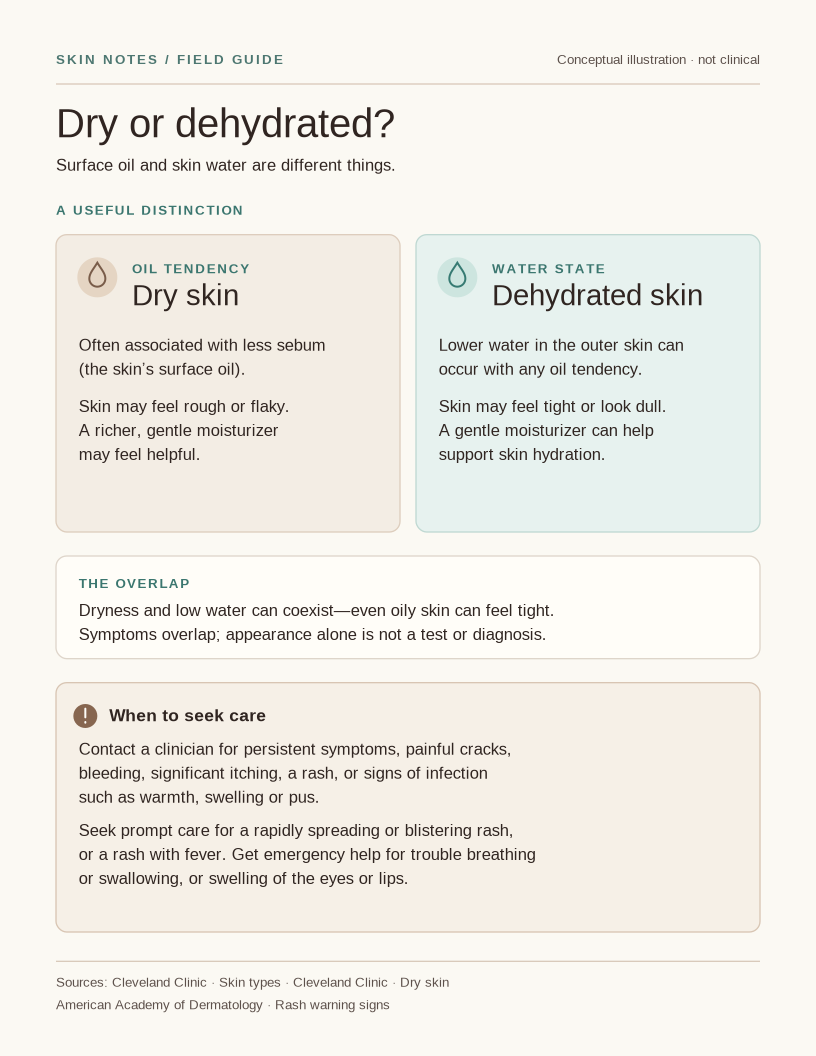
Dry skin, including clinical xerosis, can involve reduced water in the outer skin and changes in barrier lipids or function. “Dehydrated skin” is a common cosmetic description for skin with insufficient water content.
They can overlap, and even oily-looking skin may experience reduced hydration or irritation. Skin appearance alone cannot tell you exactly what is happening.
MEET YOUR SKIN BARRIERMore than
a lack of oil.
Dry-feeling skin may be rough or flaky. Clinical xerosis can involve both reduced outer-layer hydration and changes in barrier function.
WATER + BARRIER FUNCTIONA water-related
description.
“Dehydrated” often describes skin that appears or feels as though its outer layer has less water. Tightness is a clue, not a test.
OUTER-SKIN WATER CONTENTIt can be
both.
Oiliness, hydration and barrier function are separate characteristics. A shiny complexion can still feel tight or irritated.
SEPARATE ≠ MUTUALLY EXCLUSIVEOIL + WATER / FOUR POSSIBILITIES
Two different characteristics.
More than one combination.
A conceptual framework, not a way to diagnose or measure your skin at home.
May feel dry or tight. A comfortable, more protective moisturizer may help.
May feel comfortable with little visible shine. A simple routine may already suffice.
May look shiny yet feel tight; irritation is another possible explanation.
May be shiny and comfortable. Texture preference remains individual.
A gentle reminder. Visible texture, pores and fine lines are normal. This guide is educational, not a diagnosis or a reason to buy a new routine.
IMPORTANT SAFETY NOTE
When comfort needs care.
For persistent or worsening dryness, severe itching, painful cracks, burning, or recurrent rashes, seek professional advice. Blistering, a rapidly spreading rash, oozing or suspected infection may need prompt evaluation. For trouble breathing or rapidly developing facial or throat swelling, call emergency services immediately.
Do not delay medical care to finish a questionnaire or try a product. Do not change prescribed treatment without speaking with your clinician.
02 / THE AWARENESS GUIDE
Understand the clues.
Skip the guesswork.
A little observation can help you make thoughtful, practical choices. This guide cannot measure hydration or diagnose your skin.
Skin awareness
Dry or dehydrated skin: an awareness guide
Explore what you notice and make a gentle plan using what you have. Every question is optional.
It offers possibilities, not medical advice or a substitute for professional care.
When to seek help
Emergency: Call emergency services immediately for trouble breathing or rapid swelling of the throat or face.
Urgent: Seek urgent medical evaluation for a rapidly spreading rash, oozing or signs of possible infection, or blistering.
Professional assessment: See a healthcare professional for persistent severe symptoms.
Do not change prescribed treatment without speaking to your prescriber. This guidance is available even if you do not answer the questions.
Answers stay in this page's memory and are not stored or sent by this guide. Copying or printing uses your device's clipboard or print service.
Interactive controls require JavaScript. The educational and safety information remains available above.
03 / THE SCIENCE
What your skin
is telling you.
The outermost layer holds water in and helps protect against irritants. Surface oil is only one part of the picture.
Dry skin and dehydrated skin: what’s the difference?
Dry skin and “dehydrated skin” overlap. In dermatology, dry skin—also called xerosis—is skin that feels dry and may look rough or scaly. It commonly involves too little moisture in the outermost skin layer and changes in how that layer holds water. In skin-care marketing, “dehydrated skin” usually means skin with less water than it needs. That is a useful description, not a separate diagnosis with an agreed-upon home test. The American Academy of Dermatology even describes excessively dry skin as dehydrated. 1 2
You may hear that dry skin is a permanent lack of oil while dehydrated skin is a temporary lack of water. That shortcut is too neat. Surface oil and skin water are different things, but xerosis itself is not simply an oil deficiency. Dryness can be long-standing or temporary, and oily skin can still feel dry or tight. A person can have low oil, low surface hydration, both, or neither. 1 3
The practical question is not “Which label am I?” It is “What is my skin doing, what might be contributing, and is there a rash or another reason to seek care?” The clues below are not a diagnosis.
A side-by-side comparison
| Question | Dry skin or xerosis | “Dehydrated skin” in skin-care use |
|---|---|---|
| What does it describe? | A clinical description of skin that feels dry and often looks rough or scaly. 1 | Usually a description of reduced water in the outer skin layer, not a distinct medical diagnosis. 1 2 |
| Is it about oil or water? | Often involves low outer-layer water and altered barrier properties; sebum can be low but need not be. 1 4 | The emphasis is on water content. It does not tell you how much oil your glands make. 4 |
| What might you notice? | Roughness, flakes, itch or cracks; severe dryness can sting or bleed. 2 | Tightness, roughness, visible fine lines or flakes may be described this way, but none confirms it. 2 |
| How long does it last? | It may be persistent, seasonal or caused by a change in exposures or health. 1 3 | Often used for a changeable state, but the word alone does not establish duration or cause. |
| Can it occur with oiliness? | Yes. An oily area can also be rough, irritated or scaly; another skin condition may be involved. 8 12 | Yes. Oil and water are not interchangeable measures. 8 |
| What is a sensible first step? | Use gentle cleansing and a moisturizer that feels comfortable. Seek care if severe, persistent or inflamed. 22 | The same gentle approach is reasonable; look for a possible trigger rather than treating the label as a diagnosis. 22 |
A clinical examination can identify a pattern and consider other causes. It is normal for one area of the face to look different from another, or for the same area to change with the weather, bathing, products or treatment. 1 3
What the skin barrier actually does
Epidermis, stratum corneum and dermis
The epidermis is the outer layer of skin. Its outermost part, the stratum corneum, helps limit water loss and the entry of irritants and microbes. It contains flattened, nonliving cells called corneocytes, which develop from living epidermal cells and are eventually shed. The cells are surrounded by organized lipids that contribute to the barrier. 4 6
Below the epidermis is the dermis, a supportive layer containing collagen, elastic fibers, blood vessels and nerves. Hair follicles and oil glands are associated with deeper structures. The dermis and underlying tissue affect how skin moves and springs back; the stratum corneum is especially important when discussing surface water and the permeability barrier. They are connected parts of the same skin, not competing explanations. 6
Sebum is not the same as barrier lipids
Sebum is an oily mixture made by sebaceous glands and delivered to the skin surface, mostly through hair follicles. It contributes to the surface film and softness. Barrier lipids are produced as epidermal cells mature and are organized between corneocytes. Their major components include ceramides, cholesterol and free fatty acids. Both matter, but an oily surface is not proof that the intercellular barrier is working well. Likewise, low visible shine does not measure the quantity or organization of barrier lipids. 5 6
The natural moisturizing factor, or NMF, is another part of the picture. It is a mixture of water-attracting substances within corneocytes, including amino acids, their derivatives, urea and lactate. Breakdown of the skin protein filaggrin supplies many of the amino acids and derivatives. These compounds help hold water; they are not the same thing as sebum or the lipid layers between cells. Genes and skin conditions can affect NMF, but you cannot determine your NMF level by looking in a mirror. 7
Water content is not water loss
Stratum-corneum hydration describes how much water is present in the outer skin. Transepidermal water loss, or TEWL, is the rate at which water passes through the skin and evaporates into the air. Think of a measurement of amount versus a measurement of flow: they answer different questions. 14 16
Some water loss is normal. A higher TEWL reading can indicate reduced barrier function in the right context, but it is affected by the test site, temperature, humidity, sweat and recent products. Low surface hydration does not automatically prove high TEWL, and a single reading does not diagnose a “damaged barrier.” 16
The oil-and-water 2-by-2
These are four conceptual combinations, not four medical diagnoses or categories you can confirm from appearance alone. “Higher” and “lower” are relative to the person and area being considered, not universal cutoffs. 8 16
| Surface oil | Outer-layer hydration | What it can look or feel like |
|---|---|---|
| Lower | Lower | Little shine plus roughness, flakes or tightness may coexist. |
| Lower | Higher | Little shine, but the skin can still feel comfortable and supple. |
| Higher | Lower | Shine can coexist with tightness or roughness. Consider irritation and skin conditions as well as hydration. |
| Higher | Higher | Shine can coexist with comfortable, adequately hydrated skin. |
In one small study of healthy Thai women, self-described oily versus dry facial skin aligned with sebum measurements, but not with pore size or the electrical hydration measurement. That finding supports keeping the measurements separate; it does not prove what causes any individual’s symptoms. 8
Why skin can be oily and tight at the same time
Your skin can produce surface oil while the outer layer is irritated or holds less water. Tightness after a strong cleanser or an acne treatment is one possible clue to irritation; it is not proof that your skin lacks water, nor a reason to assume your glands are producing too much oil. A moisturizer may still be useful on acne-prone skin. 9 20 21
Some advice claims that dry or dehydrated skin automatically makes extra sebum to compensate. That is not established well enough to use as a general explanation. Oil can become visible again after cleansing, but that observation alone does not show that the glands increased production because the skin was dry. Avoid aggressive washing or scrubbing to chase away every trace of shine; it can irritate the skin. 20
Barrier, sensitivity, dermatitis and scaling are not synonyms
A skin barrier problem describes impaired protection or water regulation; it is a functional concept, not a specific disease. Sensitive skin is a common description of symptoms such as stinging, burning or itching, sometimes with no visible rash. Sensitivity may accompany dry skin, but it can also have other causes, including rosacea or contact reactions. 4 9
Dermatitis means skin inflammation. Eczema is often used as another word for dermatitis, and atopic dermatitis is one particular type of eczema—not every instance of dryness. Irritant contact dermatitis can result from exposure to an irritating substance; allergic contact dermatitis involves an immune response to a particular substance and may appear after a delay. Both can cause dryness, discomfort and a rash. Dry skin does not inevitably mean eczema, and a rash deserves more attention than a cosmetic label. 9 10 11
Scale and flakes are visible accumulations of outer skin cells. Simple dryness can cause them, but so can eczema, psoriasis or seborrheic dermatitis. Seborrheic dermatitis can cause a scaly rash on the scalp, eyebrows or sides of the nose, including in oily areas. Persistent or well-defined patches, significant itch, pain, or recurrent scaling are worth a clinical assessment rather than repeated exfoliation. 1 12 13
Inflammation does not look red on every skin tone. It can appear brown, purple or gray on darker skin, and bumps or changes in texture may be easier to notice than redness. Pay attention to itch, warmth, swelling, discomfort and change from your usual skin as well as color. 11
Twelve possible contributors to dry skin
These factors can overlap. A contributor is not necessarily the cause of any one person’s dryness, and several can be present at once. This list draws on dermatology guidance about xerosis and does not imply each factor acts only through oil or only through water. 1 3
| Possible contributor | Why it is worth considering |
|---|---|
| 1. Cold, dry weather | Low outdoor humidity and cold weather can make the surface feel drier. 1 3 |
| 2. Indoor heating or air conditioning | Heated or conditioned air can create a dry environment around the skin. 1 |
| 3. Long, hot bathing | Long hot showers or baths can worsen dryness, even though a short warm wash can be comfortable. 3 22 |
| 4. Harsh soaps and detergents | Cleansers and cleaning chemicals can remove protective oils and irritate skin. 1 3 |
| 5. Frequent wet work | Repeated washing or hands-in-water work can stress the skin, especially alongside cleaning agents. 3 |
| 6. Friction | Rough clothing, scrubbing or abrasive contact can irritate already dry skin. 1 |
| 7. Aging and hormonal changes | Skin often becomes drier with age; postmenopausal changes may also play a role. 1 3 |
| 8. Inherited tendency | Some people have an inherited tendency to dry skin or a condition such as ichthyosis. 1 |
| 9. Inflammatory skin conditions | Atopic dermatitis, psoriasis and other conditions can cause dry or scaly areas. They require different assessments. 3 |
| 10. Medicines or cancer treatment | Oral retinoids, diuretics and some cancer treatments can contribute. Ask the prescriber before changing a medication. 1 3 |
| 11. Other medical conditions | Thyroid disease, diabetes or kidney disease can be associated with dry skin. Dryness alone cannot diagnose them. 1 3 |
| 12. Inadequate nutrition | Malnutrition or particular nutrient deficiencies can contribute. A clinician can assess risk; supplements are not automatically needed. 1 3 |
Twelve possible contributors to reduced outer-skin hydration
The evidence does not divide the world into separate causes of “dryness” and “dehydration.” Many items here recur because clinical dry skin often includes low water in the stratum corneum. These are possible influences, not a checklist for self-diagnosis or a guarantee that any exposure lowered a particular measurement. 1 4 16
| Possible contributor | What to know |
|---|---|
| 1. Low outdoor humidity | Dry air can favor loss of moisture from the outer layer. 1 |
| 2. Indoor heating | Heat can coincide with low indoor humidity and contribute to winter dryness. 1 22 |
| 3. Air conditioning | A dry indoor environment may make the skin feel less comfortable. 1 |
| 4. Wind and cold exposure | These environmental conditions can aggravate dryness, especially on exposed skin. 1 |
| 5. Long or hot showers | Frequent prolonged exposure can disrupt the surface; pat dry and moisturize afterward. 1 22 |
| 6. Repeated handwashing or wet work | Repeated water-and-cleanser exposure can irritate and dry the hands. Handwashing remains important; moisturize afterward. 3 22 |
| 7. Strong cleansers or solvents | Soaps, detergents and solvents can disrupt the outer layer. A gentler cleanser may be better tolerated. 1 3 |
| 8. Scrubbing and abrasion | Physical friction can irritate dry or acne-prone skin. More scrubbing is not a reliable fix for flakes. 1 20 |
| 9. Drying skin treatments | Retinoids, benzoyl peroxide and some other acne treatments can cause dryness or irritation. Discuss troublesome effects with the prescriber. 21 |
| 10. Atopic dermatitis or inherited barrier differences | Barrier and water-holding changes can be involved, but symptoms and history—not a moisturizer quiz—guide assessment. 1 4 |
| 11. Age-related skin changes | Dry skin becomes more common with age; this does not make every new or severe symptom normal. 1 3 |
| 12. Too little body fluid | Systemic dehydration can occur with insufficient intake or fluid loss. Its relationship to surface-skin measurements is imperfect, and a dry face alone is not evidence of dehydration. 23 24 |
What you might notice—and what else it could mean
No symptom on these lists establishes oil level, skin-water content or a diagnosis. A pattern over time can help you decide whether to simplify a routine or seek care. The two sets overlap because the underlying descriptions overlap. 1 2 9
Twelve observations often associated with dry skin
| Observation | Another possible explanation or useful context |
|---|---|
| 1. Rough skin to the touch | Friction, a scaly skin condition or product buildup can also affect texture. 1 12 |
| 2. Visible small flakes | Eczema or seborrheic dermatitis can flake too; location and inflammation matter. 11 12 |
| 3. A scaly patch | Psoriasis, dermatitis and other conditions can cause scale; a persistent patch needs assessment. 10 13 |
| 4. An ashy or dull-looking area | Visible scale can change appearance, including on darker skin; lighting and surface products can also affect how it looks. 1 2 |
| 5. Skin feels tight | Washing or an irritating product may be involved; tightness does not measure water or oil. 9 |
| 6. Itching | Dryness can itch, but eczema, a contact reaction and other conditions can too. 2 9 |
| 7. Fine lines look more prominent | Dryness can make fine lines more noticeable; expression, age and lighting also affect their appearance. 2 |
| 8. Cracks or splits | Severe dryness can crack; hand dermatitis is another possibility. Deep or bleeding cracks deserve care. 2 10 |
| 9. Stinging when water or products touch skin | Raw skin or contact irritation can sting; a reaction to an ingredient is another possibility. 2 10 |
| 10. Pain or tenderness | Cracks and inflammation can hurt, but infection or another condition may also cause pain. 2 31 |
| 11. Discoloration or swelling | Inflammation can occur with dermatitis; color can look different across skin tones. 10 11 |
| 12. Rough, thickened skin after repeated scratching | Eczema and ongoing rubbing can thicken skin; this is more than a simple oil reading. 10 11 |
Twelve observations people may call “dehydrated skin”
These are descriptions people use, not validated criteria for a separate condition. In particular, do not conclude that you need more drinking water from any one of them. 2 24
| Observation | Another possible explanation or useful context |
|---|---|
| 1. Tightness after cleansing | The cleanser, water temperature or friction may irritate the skin. 1 9 |
| 2. Tightness in cold weather | Cold, wind and low humidity are possible triggers; facial sensitivity can have several causes. 1 9 |
| 3. Roughness that changes with the season | Environmental dryness may play a part, but some inflammatory conditions also vary over time. 1 12 |
| 4. Fine surface flakes | Dry skin, contact dermatitis and seborrheic dermatitis can all produce flakes. 1 10 12 |
| 5. Shine alongside flakes | Oiliness does not exclude dryness or a scaly condition such as seborrheic dermatitis. 8 12 |
| 6. Shine alongside tightness | These feelings can coexist; irritation is one possibility, not proof of low water or compensatory oil production. 9 20 |
| 7. More visible fine lines | Surface dryness may make lines stand out, while normal movement and aging also affect appearance. 2 |
| 8. A dull-looking surface | Dryness is one possibility; lighting, texture and makeup can also change appearance. 1 2 |
| 9. Makeup catches on rough spots | Surface flakes may contribute, but the makeup or preparation itself can also change the finish. 2 |
| 10. Mild itch | Xerosis, dermatitis and other causes overlap; persistent or intense itch needs assessment. 2 9 |
| 11. Stinging with a normally tolerated product | Irritation or contact allergy is possible; stop a suspect cosmetic and seek advice if reactions continue. 9 10 |
| 12. Skin feels more comfortable after moisturizer | A moisturizer can improve dryness or irritation; feeling better does not identify the original cause. 1 22 |
If you want to notice a pattern, write down the area affected, when symptoms started, products used, weather, washing habits and any associated rash or itch. Avoid testing by repeatedly stripping or scrubbing your skin. A clinician can use this history along with an examination; the same clue can have several explanations. 1 9
Can the facial pinch test tell you if skin is dehydrated?
No facial pinch-and-release result is a validated way to diagnose low stratum-corneum hydration or distinguish a cosmetic “dehydrated” state from xerosis. How skin moves depends on deeper tissue as well as the surface, and age, site, elasticity and how the skin is pinched all matter. A turgor test used in a medical assessment is aimed at a different question: possible whole-body fluid loss. It should not be confused with a skin-care test. 6 18 19
A systematic review found inconsistent methods and limited reliability for turgor as a stand-alone indicator of body dehydration in adults, especially older adults. A quick return does not rule out dehydration, and a slow return does not prove it. Do not delay care for concerning symptoms because of a pinch test. 18 23
Eight ways skin properties may be assessed
Most people do not need specialized testing to begin gentle skin care. These methods assess different properties; only some measure outer-skin water directly or indirectly. A clinician may make a diagnosis from history and examination without running any device test. 1 14 16
| Method | What it can tell you—and its limit |
|---|---|
| 1. Clinical history and skin examination | A clinician looks at distribution, roughness, scale, color, cracks and symptoms, and asks about exposures and medicines. It helps assess causes but does not directly quantify skin water. 1 |
| 2. Electrical capacitance, such as a Corneometer | A probe detects electrical changes related to water in the outer skin. It gives a relative reading, not a diagnosis or a measurement of total-body hydration. 15 |
| 3. Electrical conductance or impedance | Other probes assess how skin conducts or resists a small electrical signal. Readings relate to hydration but differ by device and can be affected by conditions at the surface. 14 15 |
| 4. TEWL meter | A chamber estimates water-vapor loss from skin over time. It measures a rate, not the water currently held in the skin; conditions and sweat matter. 16 |
| 5. Sebumeter or other surface-oil collection | An oil-absorbing tape and optical reading estimate surface oil. It does not measure hydration or barrier-lipid organization, and topical oily products can affect results. 8 33 |
| 6. Confocal Raman spectroscopy | A research instrument uses light to estimate molecules, including water, at different skin depths. It requires specialized equipment and interpretation. 14 15 |
| 7. Tape stripping followed by lab analysis | Adhesive strips collect superficial skin cells; a laboratory can analyze components such as NMF markers. This is mainly a research tool, not a routine home test or stand-alone diagnosis. 17 |
| 8. Suction-based elasticity testing, such as a Cutometer | Measures how skin deforms and recovers under controlled suction. It assesses mechanical properties, not surface water alone, and is influenced by deeper skin and other factors. 15 18 |
Measurements are most meaningful when the same site, device and method are compared under similar conditions. Room temperature and humidity, recent washing and products, sweat, and instrument calibration can all affect results. A home gadget’s percentage or “skin age” should not be treated as a medical threshold unless its accuracy and interpretation for that use have been established. 16
Water, caffeine and food
Drinking water is important—but it is not a skin cure-all
Whole-body dehydration means the body has lost more fluid than it takes in. Thirst, a dry mouth, darker urine, less urination, fatigue or dizziness may be clues, but they have other possible causes. Illness, vomiting, diarrhea, sweating and some medicines can increase fluid loss. Seek medical advice if you are concerned, especially if you cannot keep fluids down. 23 32
Research on drinking extra water for skin is much less definitive than many beauty claims. A systematic review of six studies in healthy adults found weak evidence that additional intake might slightly improve measured skin hydration, particularly in people whose initial intake was low. Whether it consistently improves visible clinical dryness remained unclear. The review does not establish a universal target for clear or hydrated skin. 24
Drink enough for your own circumstances rather than forcing large quantities for cosmetic results. Needs vary with activity, weather and health. If you have been given a fluid limit—for example, with some forms of kidney or heart disease—follow your care team’s plan rather than increasing fluids for your skin. 23 27
Do you have to give up caffeine?
Usually, no. Caffeinated beverages contribute fluid, and the fluid in typical servings generally offsets caffeine’s diuretic effect. A higher dose taken at once can increase urine output, especially in someone not accustomed to caffeine. Individual tolerance and medical advice still matter. 26
In a short crossover study, habitual male coffee drinkers had similar whole-body hydration measures when they drank coffee or water under the study conditions. The study did not measure whether coffee improved or worsened facial skin hydration, and its results should not be generalized to every person or caffeine dose. 25
Diet and supplements
Adequate food and nutrients support general health and skin function. Malnutrition or certain deficiencies can contribute to skin problems, but an individual symptom does not identify a deficiency. If intake is restricted or you have unexplained symptoms, a clinician or registered dietitian can help assess your needs. 3 28
Studies of diet and the skin barrier include small trials, different doses and mixed-ingredient supplements, sometimes in people with specific skin conditions. Results do not establish a universal food, oil or supplement that reliably fixes everyday dry skin. Avoid high-dose supplements or restrictive diets as a substitute for evaluation. 28
Practical steps for uncomfortable dry or tight skin
- Clean gently. Use lukewarm rather than hot water, keep baths or showers brief, and wash with a gentle cleanser where needed. Pat rather than rub dry. 22
- Moisturize while skin is still damp. Fragrance-free creams or ointments can be useful for dry areas. Ingredients such as glycerin help attract water; petrolatum and dimethicone help reduce water loss. A product’s overall formulation and your tolerance matter more than a perfect ingredient list. 7 22
- Match the texture to the area. A lighter, noncomedogenic moisturizer may be more comfortable for acne-prone facial skin; a richer cream or ointment may suit very dry hands or body skin. “Noncomedogenic” is not a guarantee that no one will break out. 21 22
- Reduce obvious irritation. Pause a cosmetic that repeatedly stings, and avoid abrasive scrubs on sore or flaky skin. If a prescribed treatment is irritating, ask its prescriber how to adjust the plan instead of stopping it without advice. 10 20 21
- Protect the skin. Gloves can help with wet work and cold air. Consider a clean humidifier in a dry indoor environment. Use broad-spectrum sunscreen and other sun protection. 22
These steps can make skin more comfortable, but they do not replace treatment for eczema, infection or another medical condition. If a moisturizer itself causes persistent burning or stinging, tell a clinician. 22
When to get medical help
Arrange a clinician or dermatologist visit for dryness or itching that persists despite gentle care, keeps returning, disrupts sleep, is widespread, or comes with a persistent rash, thick scale, painful cracks or bleeding. New widespread dryness or itch can have many causes, including medication effects or medical conditions; an examination helps determine whether further investigation is needed. 1 2 22
Seek prompt medical advice, generally the same day, for possible infection: new or increasing pain, warmth or swelling; spreading discoloration; pus; honey-colored crusts; or rapidly worsening skin. Redness may be harder to see on darker skin, so do not rely on color alone. Fever or feeling ill with a skin infection warrants immediate medical care. 11 31
Get urgent medical attention immediately for rapidly worsening, painful eczema-like skin with clustered blisters or small open sores, especially with fever or near the eyes. These can be signs of eczema herpeticum, a potentially serious viral infection. 11 29
Call your local emergency number immediately (911 in the United States and Canada) for trouble breathing, throat or tongue swelling, fainting, or other signs of a severe allergic reaction. Use prescribed emergency epinephrine immediately if available, and do not wait to see whether symptoms improve. Call emergency services as well for unconsciousness, seizures or new confusion in someone who may be severely dehydrated. 30 32
References
04 / AN INTERACTIVE EXPLAINER
A closer look at
your skin barrier.
Explore an illustrative model of oil, water and barrier lipids. They are related, but they are not the same thing.
05 / THE INGREDIENT LIBRARY
Good skincare is
about the formula.
Ingredients play different roles, but the finished product and your own tolerance matter more than a single name on the label.
Humectants
Help bind water.
Emollients
Improve surface feel and suppleness.
Occlusives
Reduce water loss to varying degrees.
Panthenol
Classification. Panthenol is the alcohol analogue of pantothenic acid (vitamin B5), often called provitamin B5. Cosmetic Panthenol may be D-, L-, or racemic D,L-form; the D-isomer (dexpanthenol) is the biologically active form. In cosmetic-function terms, CIR reports Panthenol as a skin-conditioning agent—humectant—and solvent, and as a hair-conditioning agent. It is not the same material as pantothenic acid, although Panthenol is oxidized to pantothenic acid in cells. 1 2
Mechanism. Panthenol is highly hygroscopic, so it can bind water and increase stratum-corneum hydration. Dexpanthenol can penetrate skin, and after conversion to pantothenic acid can contribute to coenzyme A-related metabolism; coenzyme A supports fatty-acid and sphingolipid synthesis relevant to epidermal lipid bilayers. Experimental and clinical literature also reports effects on fibroblast proliferation, re-epithelialization, barrier recovery, and inflammatory erythema. These mechanistic observations do not mean that every cosmetic formula produces a wound-healing or anti-inflammatory treatment effect. 2 3
Actual strength of evidence. Evidence is moderate for short-term moisturization and barrier-support effects, not proof of a universal clinical benefit. A randomized human study summarized in a peer-reviewed review found that 2.5% dexpanthenol in a lipophilic vehicle, used twice daily for seven days, improved stratum-corneum hydration and reduced transepidermal water loss versus vehicle. A separate controlled SLS-irritation study found a dexpanthenol-containing cream superior to vehicle for barrier repair, hydration, roughness, and redness. These are useful controlled findings, but they are small, model-specific studies of particular formulations. 2 3 Older clinical literature supports improved hydration, reduced water loss, irritation relief, and wound re-epithelialization with topical dexpanthenol preparations, while the review literature also stresses that vehicle and adequate delivery matter. Evidence is weaker for extrapolating from these studies to treatment of a diagnosed dermatosis, prevention of all flares, or superiority over other well-formulated moisturizers. Panthenol should not be treated as a substitute for indicated medical therapy. 2 4
Ordinary formulation uses. It is used in leave-on and rinse-off skin products, creams, lotions, gels, ointments, hydrogels, and hair products for humectancy, skin conditioning, softness, and hair conditioning. Its water/alcohol solubility and liquid or crystalline physical forms make it convenient in aqueous and emulsion systems. CIR’s reported cosmetic-use data included Panthenol in many product categories; the highest reported leave-on concentration in that assessment was 5.3% in body and hand products. That figure is a reported use concentration, not a universal recommended level and not evidence that higher or lower levels have the same performance. 1
Sensitivity cautions. Most tested cosmetic preparations were non-irritating or non-sensitizing, and CIR concluded that Panthenol and the related ingredients assessed were safe in cosmetics under present practices of use. However, rare allergic contact dermatitis is documented. In a retrospective patch-test series cited by CIR, 23 of 3,301 patients (0.7%) reacted to D-panthenol; another cosmetic-dermatitis series reported 3 of 311 (0.96%). These are selected dermatology populations, not general-population prevalence estimates. Mild erythema or irritation has occurred in some human challenge studies, and reactions may reflect the complete product rather than Panthenol alone. People with a suspected reaction should stop the product and obtain clinician-directed patch testing; avoid assuming that “generally well tolerated” means impossible to sensitize. 1
Is it essential? No. Topical Panthenol is an optional supportive cosmetic ingredient, not an essential component of skin care. Pantothenic acid is nutritionally essential, but that nutritional fact does not make topical Panthenol necessary for healthy skin. A bland moisturizer without Panthenol can provide comparable practical moisturization, depending on its humectants, emollients, occlusives, vehicle, and use pattern.
Ingredient versus finished formulation. Evidence for a pure ingredient, a defined Panthenol solution, or a dexpanthenol cream cannot be transferred automatically to every product listing Panthenol. Results depend on stereoisomer, concentration, pH, solvent/vehicle, emulsion structure, occlusion, application frequency, skin condition, and co-ingredients. A product study demonstrates the performance and tolerability of that finished formula; it does not isolate Panthenol unless the study includes a matched vehicle control. Conversely, a well-tolerated Panthenol ingredient does not rule out allergy or irritation from preservatives, fragrance, surfactants, or the finished product’s other components.
References
Urea (carbamide)
Classification
Urea is a small, synthetic organic compound also called carbamide. In skin biology it is a component of the stratum-corneum natural moisturizing factor (NMF). In topical products it is primarily classified as a humectant/moisturizer at lower concentrations and as a keratolytic/emollient at higher concentrations. Cosmetic Ingredient Review (CIR) also describes cosmetic functions including skin-conditioning agent, humectant, and buffering agent. 1 2 3
Mechanism
Urea is hygroscopic: it binds and helps retain water in the stratum corneum, supporting hydration and flexibility. At higher concentrations it softens/disorganizes the horny layer and promotes shedding of scale, producing a keratolytic effect. Reviews also describe effects on keratinocyte differentiation/proliferation and barrier-associated antimicrobial defense, but these cellular claims should not be read as proof that every consumer formulation produces a clinical antimicrobial treatment effect. Urea can increase penetration of some co-applied topical substances, so the vehicle and co-ingredients matter. 1 2 3
The practical concentration distinction reported in a peer-reviewed review is ≤10% mainly moisturizing and >10% increasingly keratolytic. This is a useful rule of thumb, not a sharp biological cutoff: pH, vehicle, application area, occlusion, and skin condition can change the outcome. 2
Actual strength of evidence
Evidence is strongest for improving dryness, hydration, roughness, and scale in urea-containing topical preparations. A systematic clinical-literature review identified 81 included publications covering xerosis, ichthyosis, eczema/dermatitis, psoriasis/seborrheic dermatitis, pruritus, keratoses, dystrophic nails, and other indications; it characterized mild irritation as the most common adverse event. This supports broad dermatologic utility, but the evidence is heterogeneous across diseases, strengths, vehicles, comparators, and study quality. It does not establish one universal percentage or prove superiority of urea over all other moisturizers. 3
A later dermatology review reports clinical improvement across several scaly/dry dermatoses and says adverse effects are generally mild and more frequent at higher concentrations. This is review-level evidence, not a claim that urea alone treats the underlying disease. For routine cosmetic use, the best-supported expectation is moisturization and softening; disease-treatment claims require a suitable tested product and, where applicable, medical supervision. 1 2 3
Ordinary formulation uses
Urea is commonly used in creams, lotions, gels, shampoos, washes, and other leave-on or rinse-off products. Lower-strength products are used for everyday dry or rough skin and barrier-supportive moisturization. Higher-strength products are used to soften thick scale, hyperkeratotic skin, and sometimes dystrophic nails. DermNet reports preparations in roughly the 3–40% range, while the older CIR review reported cosmetic concentrations of use from 0.01–10% in FDA use data collected in 2001; these are different datasets and should not be treated as a current market-wide concentration survey. 1 4
A finished product may also use urea to improve the delivery of another active substance. That can be useful therapeutically, but it means the finished formulation cannot be judged from the urea percentage alone. A 40% urea prescription label, for example, describes a keratolytic emollient for skin/nail tissue softening, but the same label is explicitly an unapproved drug labeling record in the United States; it is not evidence that every 40% cosmetic cream has an FDA-approved indication. 5
Sensitivity and use cautions
Urea products are usually well tolerated, but transient stinging, burning, itching, irritation, or rash can occur, especially with higher strengths or compromised/inflamed skin. Avoid eyes, lips, and mucous membranes. Clinical guidance advises avoiding application to broken, cracked, bleeding, infected, or oozing skin unless directed by a clinician. Stop if persistent or significant irritation develops. 1 4 5
Urea itself is not the same ingredient as imidazolidinyl urea or diazolidinyl urea; those are different substituted preservatives and should not be conflated with plain urea. Rare sensitization is reported, but the available clinical safety record suggests it is uncommon relative to irritation. 4
Is it essential?
Urea is physiologically important because it is one component of the skin’s NMF, and dry skin conditions can show reduced urea content. It is not essential as a topical cosmetic ingredient: a finished product can moisturize through other humectants, emollients, occlusives, or combinations. Whether urea is the best choice depends on the target (hydration versus scale softening), concentration, vehicle, skin barrier status, and tolerance.
Ingredient versus finished formulation
Evidence for the molecule does not transfer unchanged to every product. The final effect depends on concentration, pH, water activity, vehicle, packaging/stability, contact time, application frequency, occlusion, treated body site, and co-ingredients. A low-strength leave-on moisturizer is not equivalent to a high-strength keratolytic cream, and a product containing urea plus a drug may alter that drug’s penetration. “Urea” on an ingredient list therefore supports a plausible moisturizing/softening function, but it does not by itself establish efficacy, safety for a particular condition, or the exact strength.
References
Sodium PCA
Classification
Sodium PCA (INCI; CAS 28874-51-3) is the sodium salt of 2-pyrrolidone-5-carboxylic acid (PCA, also called pyroglutamic acid). In cosmetics it is classified primarily as a humectant/skin-conditioning agent; it is also listed for hair conditioning. The European Commission CosIng entry identifies the INCI name and cosmetic functions, while the Cosmetic Ingredient Review (CIR) describes it as a skin-conditioning agent—humectant. 1 2
Mechanism and likely effect
The sodium salt is described as extremely hygroscopic. As a water-soluble humectant, it attracts and binds water in the superficial stratum corneum, increasing water content and improving the feel of dryness or roughness. PCA is a naturally occurring component of the epidermal natural-moisturizing-factor (NMF) pool; the CIR review states that PCA and sodium lactate make up the most hygroscopic fraction of the stratum corneum. This supports a plausible water-retention mechanism, but does not establish that topical Sodium PCA restores the whole NMF system or repairs a damaged barrier by itself. 2 3
Actual strength of evidence
Ingredient function: moderate-to-strong. Its chemical identity, hygroscopicity, and humectant/conditioning classification are well documented by authoritative sources. Evidence is strongest for short-term hydration/conditioning, not for disease treatment or durable barrier repair. 1 2
Sodium PCA-alone clinical efficacy: limited. A peer-reviewed study tested a multi-ingredient moisture-treatment cream that included Sodium PCA among NMF-supporting ingredients. The cream improved hydration in a reconstructed epidermis model and in an 8-week open-label study, but the design did not isolate Sodium PCA. The paper was funded by the product company and reported investigator/employee conflicts. Therefore, those results support the finished formulation, not a Sodium PCA-specific effect, and should not be converted into numerical claims about Sodium PCA alone. 3
Safety: moderate-to-strong for ordinary cosmetic use, not zero-risk. The 2019 CIR Expert Panel reassessment concluded that PCA and its salts, including Sodium PCA, are safe in cosmetics under the practices and concentrations described in the assessment. It summarized negative genotoxicity, dermal-irritation, ocular-irritation, and sensitization findings, including human tests of Sodium PCA-containing preparations. This is an expert safety assessment that combines published and other submitted data; it is not proof that every formulation or every user will tolerate it. 2
Ordinary formulation uses
Sodium PCA is used as a water-phase humectant and skin-conditioning ingredient in leave-on lotions and moisturizers, eye-area products, nail creams, and rinse-off skin cleansers. It is also used in hair-conditioning products and some sprays. In the CIR use survey reported in 2019, Sodium PCA was reported in 1,289 formulations, with maximum reported use concentrations of 2.5% in leave-on products and 3% in rinse-off products; these are historical reported-use data from that assessment, not a universal recommendation or a guarantee of current market practice. 2
Sensitivity and formulation cautions
The CIR review reports transient irritation/erythema in some open-patch tests at higher aqueous concentrations: two of 13 volunteers reacted at 6.25% on the back, and three developed erythema at concentrations of at least 12.5%; reactions resolved within 30 minutes. Other tests, including a 2% Sodium PCA cosmetic formulation and tests at lower concentrations, were negative. Clinical studies summarized by CIR did not identify Sodium PCA as a sensitizer, but an individual can still react to the complete product or to another ingredient. 2
The specific regulatory/safety caution is important: PCA and its salts should not be used in cosmetic products in which N-nitroso compounds can be formed, because PCA can undergo nitrosation under relevant chemical conditions. 2 Products in spray or powder formats also warrant ordinary inhalation-exposure consideration; the CIR panel did not regard the reported cosmetic uses as a significant inhalation concern, but inhalation data were limited. 2
Is it essential?
No. PCA is an endogenous NMF component and topical Sodium PCA can be useful for humectant moisturization, but Sodium PCA is not an essential skincare ingredient, and there is no evidence here that a topical product must contain it to maintain normal skin or repair a barrier. Its value is functional and formulation-dependent.
Ingredient versus finished formulation
Evidence about Sodium PCA as an ingredient mainly supports water binding and conditioning. A finished product's result depends on its Sodium PCA level, vehicle, pH, water activity, occlusion, packaging, application pattern, and the other ingredients. A multi-ingredient cream study cannot show that Sodium PCA caused the observed hydration or appearance changes. Conversely, irritation from a product cannot automatically be assigned to Sodium PCA. Judge the complete INCI list and the product's exposure pattern, not the ingredient name in isolation. 2 3
References
Betaine
Classification
Betaine here means Betaine / glycine betaine / trimethylglycine (CAS 107-43-7; PubChem CID 247), a small zwitterionic quaternary ammonium carboxylate and naturally occurring organic osmolyte. It is not the same ingredient as cocamidopropyl betaine, coco-betaine, other alkyl/amidopropyl betaines, or Betaine Salicylate. The latter is a separate reaction product of betaine and salicylic acid in the EU CosIng record. 1 4
In cosmetic-function terms, plain Betaine is ordinarily used as a humectant and skin-conditioning agent; its osmolyte activity is a mechanistic rationale for helping maintain cellular water balance under osmotic stress. “Osmolyte” describes a biological/chemical role, not proof of a particular consumer-visible result.
Mechanism and evidence strength
Betaine is highly water-compatible and can be accumulated by cells through betaine transport systems. In human keratinocyte cultures, Betaine increased tight-junction function measured by electrical resistance and tracer permeability, and the effect was abolished by transporter inhibition. An ex-vivo experiment also examined human skin from eight adults. However, the authors explicitly describe the keratinocyte model as simplified and note that it does not fully reproduce the stratified epidermis. The treatment concentration in the ex-vivo work was 35 mmol/L, so these findings should not be read as evidence that every leave-on product, at any concentration, produces the same effect. 2
A separate peer-reviewed study used rat epidermal keratinocyte organotypic cultures. It reported changes in gene expression, including increased keratin 2, and responses to an acute UVB model. This is useful mechanistic evidence, but it is not a human clinical efficacy trial and does not establish anti-aging, photoprotection, or treatment of skin disease. 3
Overall, evidence is moderate for biological plausibility and laboratory barrier/osmolyte effects, but limited for independent, real-world topical efficacy of plain Betaine in finished cosmetics. The available sources do not justify numerical claims about a standard use level, duration of moisturization, wrinkle reduction, or protection from UV damage. Claims from supplier studies or marketing pages should be treated as formulation-specific unless their protocol and controls are available.
Ordinary formulation uses
Betaine is commonly added to aqueous skin-care, cleansing, and hair-care formulas for humectancy, skin conditioning, and improved after-feel/comfort. It may also be used as a compatible solute to reduce the harsh feel of some surfactant systems. The exact sensory and hydration result depends on the full formula, including concentration, water activity, surfactants, solvents, pH, polymers, and occlusive components. Plain Betaine is therefore a supportive, optional functional ingredient, not a required component of a moisturizer or cleanser.
Sensitivity and safety cautions
Do not transfer the safety conclusion for alkyl betaines to plain Betaine without qualification. The Cosmetic Ingredient Review assessment covered 11 alkyl betaines, not plain Betaine, and concluded that those ingredients were safe in present cosmetic uses when formulated to be non-irritating. 5 Alkyl/amidopropyl betaines can have different surfactant properties and impurity profiles; reports about irritation or contact allergy to those materials do not automatically establish the same risk for plain Betaine.
For plain Betaine, the cited authoritative chemical record aggregates company hazard notifications and reports that most notifications did not classify it under GHS, but it also warns that classifications can vary with impurities, additives, and reporting. This is not a substitute for a dedicated human repeat-insult or sensitization dataset for a specific cosmetic formula. 1 A person with a history of product reactions should consider the whole product and, where appropriate, clinician-guided patch testing. Eye stinging or irritation can still arise from the finished cleanser or from other ingredients even if Betaine itself is well tolerated.
Ingredient versus finished formulation
Evidence about isolated Betaine, a cell culture exposure, an ex-vivo skin preparation, or a supplier’s test formula cannot be treated as evidence for every product listing Betaine. In a finished product, outcome depends on the delivered concentration, vehicle, pH, contact time, rinse-off versus leave-on use, packaging and stability, and co-ingredients. A product’s irritation or benefit therefore belongs to the formulation as a system, not to the INCI name alone.
Is it essential?
No. Betaine is not essential for skin-barrier function or for making an effective moisturizer. It can be a useful humectant/conditioning and sensory-support ingredient, but equivalent formulation goals can be met with other materials. Its presence is not evidence that a product is clinically superior, and its absence is not evidence that a product will be ineffective.
References
SKIN COMFORT, NOT PERFECT SKIN
A thoughtful routine
can be beautifully simple.
Use what works. Leave what doesn’t. Let your skin be skin.
BUILD A SIMPLER ROUTINE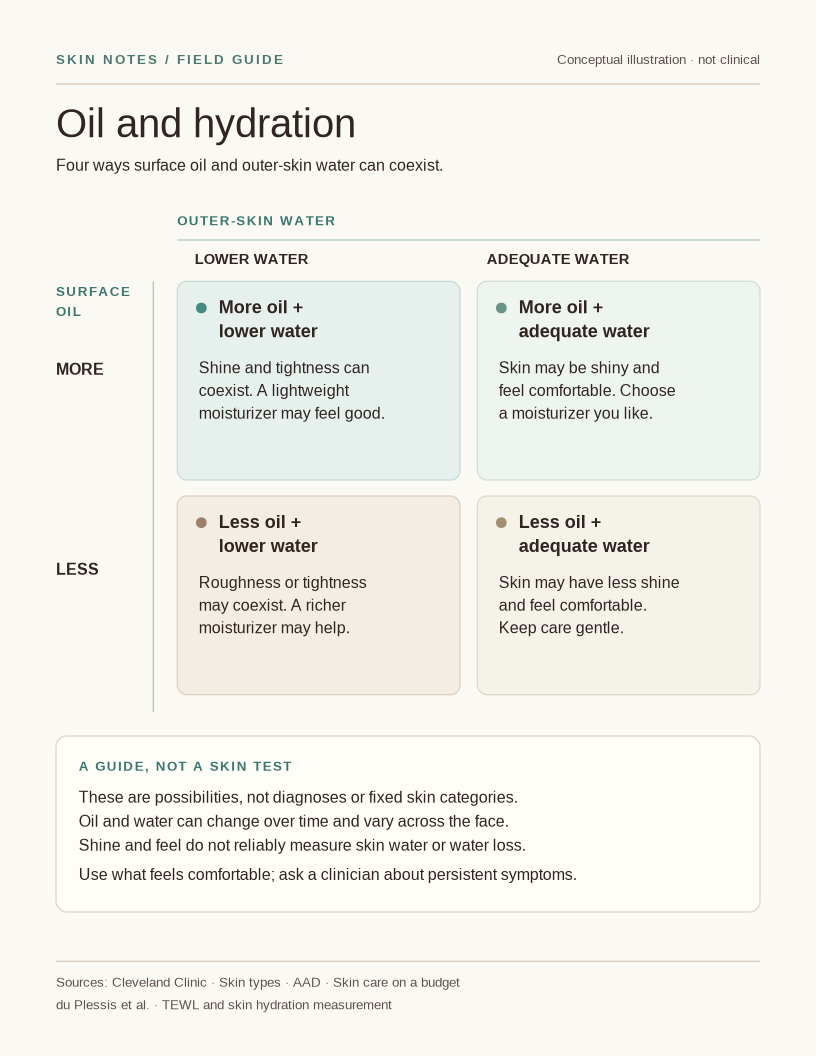
06 / EVERYDAY CARE
Less pressure.
More comfort.
Practical guidance for choosing textures, avoiding irritation and making the most of products you already own.
Start with the conditions around your skin
The useful question is not simply “dry or dehydrated?” It is “What leaves my skin uncomfortable, and what helps without creating another problem?” Skin that tends to be dry often feels rough or flaky and may benefit from richer moisturization. Skin that feels tight after washing can still look oily. Neither shine nor tightness, by itself, tells you exactly what is happening or rules out irritation. Both patterns can coexist. A routine can address water loss and comfort without making a diagnosis. DermNet’s cleanser guidance and Cleveland Clinic’s dry-skin overview describe how washing, environment, and individual factors can affect skin.
Choose one or two changes that fit your life. Keep the rest steady long enough to notice whether they help. If a non-prescribed cosmetic causes a clear reaction, stop using it rather than waiting for a review date. If a prescribed treatment seems to be causing trouble, contact the prescribing clinician promptly rather than changing the prescription on your own; severe reactions require urgent or emergency care.
Six situations, six small adjustments
- Cold weather and wind. Cover exposed skin with a scarf and gloves you already own. A cream can be more comfortable than a light lotion on consistently dry cheeks and hands. Put moisturizer on damp skin after washing, and add it again if your skin feels dry. Don’t scrub flakes off. AAD dry-skin advice
- Indoor heat and dry air. Avoid sitting directly in a stream of hot air when possible. If you already have a humidifier, use it only when needed, keep the area around it dry, and follow cleaning instructions. The EPA advises keeping indoor relative humidity at or below 50%; it recommends emptying, drying, and refilling a portable tank daily and cleaning it every third day. A humidifier is optional, not a requirement.
- A dry climate or long travel day. Pack or use a moisturizer you already tolerate; reapply to hands or other dry spots as needed. On exposed skin, use sun protection as directed. A long trip can change your routine and surroundings, so notice what helps rather than assuming that the same formula must work everywhere.
- Hot, humid weather and sweat. Humidity does not guarantee comfortable skin: sun, air conditioning, pool exposure, and frequent washing can still leave it feeling dry. A light lotion or gel may feel better than a heavy layer. Blot sweat gently, and wash after heavy sweating without scrubbing. AAD summer guidance
- Swimming. Rinse or shower with fresh, lukewarm water after the pool, using a mild cleanser as needed, then moisturize damp skin. Before outdoor swimming, use a water-resistant, broad-spectrum SPF 30 or higher sunscreen; reapply according to its water-resistance directions and after toweling. A moisturizer does not replace sunscreen. AAD summer guidance
- Frequent handwashing or wet work. Keep washing hands when hygiene calls for it. Pat them partly dry and apply a tolerable cream or ointment afterward. Use protective gloves for dishes or wet cleaning when available; let alcohol-based hand sanitizer dry before applying moisturizer. If gloves or a product irritate your skin, discuss alternatives with a clinician. AAD handwashing guidance
These adjustments are starting points, not proof that the environment is the only cause. Dryness that persists, recurs, or is painful can have several explanations and deserves a professional assessment.
Choose a moisturizer by what it does
A moisturizer is usually a combination of ingredients rather than one magical substance. Three useful jobs overlap:
- Humectants attract and hold water in the skin’s outer layer. Glycerin and hyaluronic acid are familiar examples.
- Emollients soften and smooth the skin’s surface. Examples include certain oils and fatty ingredients.
- Occlusives reduce water loss by forming a protective layer. Petrolatum, mineral oil, and dimethicone are examples.
One formula can perform all three jobs, and an ingredient may have more than one role. A cream with glycerin and petrolatum, for example, does not require a separate product for each function. A controlled crossover study of one cream and its components found hydration associated with glycerol and reduced water loss associated with petrolatum; the study tested specific formulas on volunteers’ forearms, not every product or a treatment for disease. DermNet’s moisturizer guide explains the broader categories.
Glycerin or hyaluronic acid?
Both are humectants, and both can be useful. Glycerin is common in ordinary moisturizers; hyaluronic acid often appears on serum labels as well as in creams. There is no need to buy one simply because you already use the other. In one small study of an HA-containing fluid, the formula also contained glycerin and other ingredients, so its results cannot establish which ingredient worked better on its own.
Judge the complete formula by how it feels, whether it irritates you, and whether it keeps skin comfortable. If a thin humectant serum leaves your face feeling tight, try the moisturizer you already tolerate afterward, or skip the serum. There is no good reason to assume hyaluronic acid automatically dries everyone’s skin in dry weather, or that a separate serum is essential.
Ceramides or hyaluronic acid?
Ceramides are lipids related to components of the skin’s outer barrier; hyaluronic acid is a water-binding humectant. They do different jobs and can be included in the same moisturizer. A ceramide-containing cream can be a sensible option when skin is persistently dry; a light product containing HA may suit someone who dislikes heavier textures. Neither ingredient name guarantees that a finished formula will suit you.
For perspective, a small trial of a ceramide-containing cream measured improved hydration in the tested formulation. It did not establish that ceramides alone outperform HA, or that every product labeled “ceramide” gives the same result. A plain, well-tolerated moisturizer without either name on the front can still be a good choice.
Where niacinamide fits
Niacinamide, a form of vitamin B3, appears in moisturizers and serums. A randomized study found that regimens including a niacinamide-containing body emollient improved measured outcomes in adults with mild atopic dermatitis; participants also received an oral medication. This does not prove niacinamide alone caused the improvement, or that it will treat anyone else’s condition.
If a moisturizer with niacinamide feels comfortable, it is one possible option. If it stings or produces a rash, a different formula may suit you better. More steps, a more prominent claim, or a higher price do not automatically mean better results.
Oil, emulsion, gel, lotion, cream, or ointment?
An oil can soften skin and help slow water loss, but oil alone does not add the water phase of an emulsion. A cream or lotion emulsion combines water and oils with ingredients that help keep them together; many also contain humectants. For a simple routine, use a complete moisturizer on damp skin. If you enjoy an oil you already tolerate, a little over moisturizer on a dry area is optional—not a necessary “seal” for everyone. Botanical oils and fragrances can still irritate or cause allergy.
Texture is a useful guide, not a guarantee about a particular ingredient list:
- Gel: Often light and water-based; a possible choice for oily areas or humid days. Some gels contain ingredients that sting sensitive skin.
- Lotion: Fluid and easy to spread, including on larger or hairy areas. It can suit mild dryness or daytime use.
- Cream: Usually thicker than lotion and often comfortable for persistent dryness. Apply more to dry areas and less where it feels heavy.
- Ointment: Thick and oily, usually the most occlusive of these formats. A small amount can help very dry, intact patches, although the feel is not for everyone. Avoid self-treating weeping or possibly infected skin with a thick ointment; seek advice instead.
These are general tendencies, not a ranking of every formula. See the AAD guide to moisturizer textures and NHS guidance on emollients. If thick products cause bumps, a lighter, non-comedogenic option may be more comfortable; that label lowers the chance of clogged pores, but is not a personal guarantee.
Serums, damp skin, and layering
A serum is a product format, not a required step. A hydrating serum may feel pleasant under moisturizer, but if your existing moisturizer is comfortable on its own, you can keep it simple. Serums that include exfoliating acids, retinoids, or fragrance may be harder to tolerate when skin is irritated.
For an uncomplicated moisturizer routine, wash with lukewarm water, pat gently, and apply moisturizer while skin is slightly damp, not dripping. This helps trap some of the water left on the surface. A few minutes later, apply sunscreen if it is morning; you do not need a strict waiting ritual. Repeat moisturizer on dry hands after washing or on other spots as needed. AAD guidance
Follow separate instructions for prescribed medications: some need a particular order or timing. Ask the prescriber or pharmacist rather than automatically layering everything on damp skin. The NHS notes that emollients and other skin treatments may need spacing so a medication is not diluted or spread to unintended areas.
Is slugging worth trying?
“Slugging” means applying a thin layer of an occlusive ointment, often plain petrolatum, over skin overnight. It can reduce water loss, but it is optional. If you already have a plain ointment and tolerate it, a very small amount over moisturizer on an intact dry patch may be more practical than coating your whole face.
If you are acne-prone or easily develop follicle bumps, facial slugging may not suit you; individual responses differ. Do not put a heavy occlusive layer on infected, open, or weeping skin without clinical advice. Avoid layering it over retinoids or exfoliating acids without product-specific professional guidance: occlusion may increase irritation. Petrolatum itself is not automatically a pore-clogging ingredient for every person, but heavy occlusion can aggravate some people’s acne or folliculitis. Cleveland Clinic and DermNet discuss these cautions.
Keep ointment-soaked clothing and bedding away from flames and cigarettes; residue can increase fire risk. Avoid applying slippery oils or ointments where you might fall. NHS safety advice
Cleanse enough, not aggressively
A cleanser should remove what needs removing without leaving your face feeling scrubbed. Use lukewarm water, clean fingertips, and a gentle touch; rinse as the label directs and pat dry. AAD recommends limiting face washing to twice daily and after heavy sweating. If your face is very dry, a morning water rinse rather than another cleanser wash is an option if comfortable. Water alone may not remove makeup, oily buildup, or tenacious sunscreen well, so use a suitable gentle cleanser at night when needed. AAD face-washing advice
Six cleanser formats
- Cream or cleansing milk: A low-foam option that may feel comfortable on dry or sensitive skin. Rinse or remove according to its directions; check that it removes your usual sunscreen or makeup without rubbing.
- Gentle gel: Often rinses clean and may suit combination or oily-feeling skin. “Gel” alone does not tell you whether a formula will be drying, so judge by your skin’s response.
- Foaming liquid: Can be convenient for sweat and oil. Foam is not automatically harsh, but a particular formula can leave skin tight. Use a modest amount and skip scrub tools.
- Syndet bar: A synthetic-detergent, non-soap cleansing bar can be a practical, often milder alternative to traditional alkaline soap. Check the label: a bar’s shape does not tell you its ingredients. DermNet on soaps and cleansers
- Rinse-off cleansing oil or balm: Designed to loosen makeup and oily products; many turn milky with water and rinse away. It can be useful for stubborn sunscreen, but you do not need a second cleanse if one gentle wash removes what you wore. If residue bothers you, a gentle second cleanser is an option, not a rule.
- Micellar water: A water-based cleanser with cleansing molecules that lift dirt and makeup. Use a soft touch rather than repeatedly rubbing with a pad. Some formulas are marketed as no-rinse; rinse if the product directions say to or if residue bothers you. Heavy or water-resistant makeup may need a different or additional cleanser. Cleveland Clinic on micellar water
Whichever format you choose, “fragrance-free” is generally more useful for sensitive skin than “unscented,” which can mean fragrance has been added to mask a smell. “Natural,” “hypoallergenic,” and a pleasant smell do not guarantee tolerance. A cleanser that stings, causes a rash, or makes you feel compelled to scrub is not a good fit simply because its format is fashionable. AAD product-testing advice
Make room for treatments without overwhelming skin
Exfoliating acids, scrubs, acne treatments, and retinoids can be useful for some goals, but piling them onto already uncomfortable skin can make it harder to tell what is helping. On a stinging or visibly irritated day, avoid adding a new cosmetic active or scrub. For an over-the-counter cosmetic that seems to be irritating, stop using it and return to a gentle, familiar routine. If a prescribed treatment is causing discomfort, contact the prescriber for individualized instructions; do not alter the prescription based on a generic routine.
Retinoids and retinol are related vitamin A ingredients. They can irritate, particularly when skin is already dry or inflamed. Some people tolerate a moisturizer alongside them, but the order and schedule depend on the product and the clinician’s instructions. Sun protection matters. The AAD advises against retinoids during pregnancy. If you are pregnant or planning pregnancy, do not start an over-the-counter retinoid; if one is prescribed, contact your prescriber promptly for advice. Do not put an occlusive slugging layer over it unless your clinician specifically advises it.
If acne treatment leaves skin tight, a comfortable moisturizer may make the routine easier to tolerate. Look for “non-comedogenic,” “oil-free,” or “won’t clog pores” as a starting point, and track your own response. Moisturizer is supportive care, not a substitute for an acne treatment plan. AAD acne and moisturizer guidance
Use sun protection you can apply consistently
For exposed skin, the AAD recommends broad-spectrum, water-resistant SPF 30 or higher. “Broad spectrum” means protection against both UVA and UVB; SPF chiefly indicates protection against sunburn from UVB. A moisturizer with sunscreen can count as your sunscreen if its label meets those criteria and you apply enough of it. A product merely described as a moisturizer, or an oil without an appropriate sunscreen label, does not provide verified sun protection. FDA sunscreen guidance
Apply about 15 minutes before going outdoors. Cover exposed skin generously, including ears, neck, hands, and any exposed scalp. The AAD’s application guide suggests at least a teaspoon for the face; most adults need about an ounce to cover the entire body, although the amount varies with body size and how much skin is exposed. Use SPF 30 lip balm for exposed lips if available.
When outdoors, reapply at least every two hours and after swimming, sweating, or towel-drying, following the product label. Water-resistant labels specify 40 or 80 minutes of protection while swimming or sweating; no sunscreen is waterproof. Seek shade and wear protective clothing, a broad-brimmed hat, and sunglasses as practical. These measures complement sunscreen, not extend its wear indefinitely. A mineral sunscreen containing zinc oxide and/or titanium dioxide may be worth considering if a sunscreen stings, but any formula can be irritating to an individual. AAD label guide
If you do not have sunscreen, prioritize shade and covering up until you can obtain an appropriate one. Do not rely on homemade oil mixtures or an expired sunscreen as a substitute. For an infant younger than six months, keep them out of direct sun and ask a clinician before using sunscreen. FDA guidance
Twelve adaptable morning and evening routines
These are examples for adults, not diagnoses or prescriptions. Choose the row that resembles your current needs and adapt the texture by area. SPF in the table means the broad-spectrum, water-resistant SPF 30+ routine above, applied to exposed skin; use shade and clothing too. Moisturizer means one you tolerate. A morning rinse is optional; use a gentle cleanser when needed, especially in the evening. Continue prescribed treatments only as directed, and ask your clinician about timing or irritation.
| Situation | Morning | Evening |
|---|---|---|
| Dry most days | Gentle rinse; cream on damp skin; SPF. | Gentle cleanser; cream on damp skin; optional thin ointment on intact dry patches. |
| Oily-looking but tight | Rinse or gentle cleanse; light, non-comedogenic lotion or gel; SPF. | Gentle cleanser; light moisturizer, with a little more on tight areas. |
| Combination | Rinse; light moisturizer where needed, with cream on dry cheeks; SPF. | Gentle cleanser; moisturizer by zone rather than a heavy layer everywhere. |
| Sensitive or reactive | Rinse; familiar fragrance-free moisturizer; SPF you tolerate. | Gentle fragrance-free cleanser; familiar moisturizer. Keep extras out until comfortable. |
| Recent irritation | Gentle rinse if comfortable; familiar bland moisturizer; SPF and protective clothing. | Gentle cleanse if needed; familiar moisturizer. Avoid new cosmetics and scrubs; ask the prescriber about any irritating medication. |
| Acne-prone | Gentle cleanse or rinse; light non-comedogenic moisturizer; SPF. | Gentle cleanser; prescribed or tolerated acne treatment as directed; moisturizer as directed or needed. Skip facial slugging. |
| Using a retinoid | Gentle rinse or cleanse; moisturizer if needed; SPF. | Cleanse; use the retinoid only as directed; moisturize according to its instructions or clinician’s advice. Do not slug over it. |
| Mature skin | Gentle rinse; cream if comfortable; SPF. | Gentle cleanser; cream on damp skin; optional ointment on intact dry spots. |
| Winter or windy days | Rinse; cream on dry areas; SPF; scarf or gloves outdoors. | Gentle cleanse; cream after washing; add a little ointment to intact dry patches if useful. |
| Humid weather | Rinse or gentle cleanse after sweat; light moisturizer if needed; SPF. | Gentle cleanser; light lotion or gel; add cream only where skin feels dry. |
| Minimal routine | Rinse if needed; moisturizer if needed; SPF. | Gentle cleanser; moisturizer on damp skin. |
| Zero-purchase day | Use a tolerable moisturizer and in-date SPF if already owned; otherwise seek shade and cover exposed skin with available clothing. | Use a gentle cleanser and moisturizer if already owned; otherwise a gentle water rinse is a temporary fallback, not reliable removal of heavy makeup or water-resistant sunscreen. |
The last row is about working with what is already available, not a claim that water and clothing always replace a cleanser and sunscreen. If you have no suitable products, a pharmacist or community clinic may be able to help you find affordable options. No one needs twelve different routines or products.
Twenty improvements that require no new purchase
Use the supplies and options already available to you; skip any item that does not fit your situation. These ideas adapt AAD dry-skin, face-washing, and hand-care advice. They do not replace necessary hygiene or medical care.
- Turn the shower from hot to comfortably warm.
- Keep baths and showers around five to ten minutes when practical.
- Close the bathroom door while showering if doing so is safe and comfortable.
- Use cleanser on the areas that need it, rather than lathering every dry area repeatedly.
- Wash your face with clean fingertips instead of a rough cloth or brush.
- Stop scrubbing flakes; use a moisturizer you already tolerate instead.
- Pat skin dry with a clean towel rather than rubbing.
- Apply your existing moisturizer while skin is still slightly damp.
- Move a moisturizer you already own next to the sink or shower so you remember it.
- Reapply that moisturizer to dry hands after necessary washing.
- Let hand sanitizer dry before applying moisturizer; do not skip needed hand hygiene.
- Wear existing protective gloves for dishes or wet cleaning when appropriate.
- Put a soft cotton layer you already own between skin and scratchy clothing.
- Choose looser clothes from your wardrobe when friction bothers your skin.
- Blot sweat with a clean cloth instead of rubbing it away.
- After a pool visit, rinse with fresh water and moisturize with a product you already tolerate.
- Move away from a direct heater or air-conditioning vent if that feels drying.
- If you already use a humidifier, clean it as directed and avoid making the room or nearby surfaces damp.
- Wear your existing hat or long sleeves and seek shade when outdoors; use suitable sunscreen if you have it.
- Keep a brief note of products, activities, and symptoms instead of adding several new steps at once.
Check in after seven days—not seven hours
A week is a practical time to notice a pattern, not a promised recovery period or a medical test. Take a quick baseline note on day one: where skin feels tight, itchy, rough, or comfortable; when symptoms show up; and the products and activities in your routine. If you like, take a photo in the same light, without using a filter.
On days two and three, repeat the simple routine you chose. Notice whether the feeling appears immediately after cleansing, later in the day, or after a particular exposure. Avoid adding several new products just to speed things up.
On days four and five, adjust one nonprescription variable if needed—for example, use less cleanser in the morning or put your familiar cream on damp skin. Keep a note of the change. Leave prescribed treatment decisions to the prescriber.
On days six and seven, compare your notes with day one. Is skin more comfortable for longer? Are flakes or tightness less noticeable, unchanged, or worse? Is a product repeatedly stinging? Keep what feels helpful, set aside an irritating cosmetic, and contact a clinician if symptoms persist, worsen, or concern you. Don’t wait for day seven if the reaction is significant.
If you do decide to introduce a new cosmetic later, the AAD suggests testing it on a small area twice daily for seven to ten days, using it as directed. Rinse off a cleanser after its instructed contact time. Stop and wash it off if a reaction develops. This home-use check is not the same as a dermatologist’s diagnostic patch testing and cannot guarantee you will never react.
Observe for 30 days without a deadline to “fix” your skin
If your skin is comfortable enough to continue, keep the routine steady over the next few weeks. A short note once or twice a week is enough: comfort after cleansing, itch or visible flaking, products used, relevant weather or activities, and any medication concerns. Photographing is optional. A missed day is not a setback, and there is no need to measure every pore or chase a perfectly smooth finish.
At roughly 30 days, consider whether your routine is comfortable, affordable, and realistic. If not, bring your notes to a clinician or pharmacist and discuss one change at a time. Some irritation may settle after a trigger is removed, but the cause and timeline vary. A calendar, moisturizer, or “barrier reset” cannot guarantee recovery or treat every underlying skin condition. The AAD recommends dermatology care when dryness continues despite gentle care, or when even products such as moisturizer burn or sting.
Seek care sooner for painful cracking, bleeding, persistent itching that disrupts sleep, or a spreading or worsening rash. New or increasing fluid from skin should be examined. Contact a clinician promptly for signs that may indicate infection, such as increasing pain, swelling, pus, or fever; seek urgent care for rapidly worsening symptoms or if you feel unwell. A weeping rash is not necessarily infected, but it needs assessment. AAD guidance on weeping skin
Prepare for a dermatologist appointment
Bring the products themselves or clear photos of their front labels and ingredient lists, including sunscreen, cleansers, cosmetics, and hair products that touch the affected area. List all prescription and over-the-counter treatments, when you started them, and how you use them. Note when symptoms began, where they occur, what seems to trigger them, whether they affect sleep or work, and any previous reactions. Photos can help show a flare that is quieter on appointment day.
Choose the questions that matter to you:
- What possible causes could explain my symptoms, and what else should be ruled out?
- Does the pattern suggest irritation, an allergy, a skin condition, or something else?
- Would formal patch testing or any other evaluation be useful for me?
- Which of my current products should I continue, avoid, or bring back for review?
- What cleanser and moisturizer textures are reasonable for my skin and budget?
- How should I use moisturizer alongside my prescribed treatment, including order and timing?
- What should I do if a prescribed product stings or my skin becomes more irritated?
- Is an occlusive ointment appropriate for any of my dry areas, and where should I avoid it?
- What sun-protection options are likely to be comfortable for me?
- Which changes or warning signs should prompt a follow-up, and when should I contact you sooner?
For pregnancy, breastfeeding, or pregnancy planning, mention it and ask specifically about each treatment. The goal is a plan you understand and can follow—not a perfect routine or a diagnosis assembled from product labels.
07 / THE ROUTINE BUILDER
Make it work
for you.
Organize what you own into a comfortable routine. A serum, facial oil and a dozen extra steps are not requirements.
Educational routine builder
Hydration and moisturizing routine
Build a simple AM and PM outline around products you already have. Every input is optional; selections update an existing result. This is educational, not a diagnosis or a substitute for medical care.
Inputs stay in this page’s local component state and are not saved or sent by this component. Copying sends the routine to your clipboard; the print action is designed to isolate this routine, but review your print preview before sharing.
Interactive controls require JavaScript. Safety guidance remains available on the page.
08 / THE REFERENCE DESK
Better questions.
Clearer answers.
Explore common misconceptions, practical scenarios and frequently asked questions without the skincare noise.
When to get medical help
Dryness, tightness, flakes and itching can have several causes. This reference is educational, not a diagnosis. The suggested no-cost actions are not a substitute for an examination or prescribed care.
Get urgent medical assessment today for skin that is painful, hot or swollen; suddenly worsening or spreading; blistered, crusted, leaking fluid or producing pus; or accompanied by fever or feeling unwell. A painful, hot or swollen eyelid, pain in the eye, light sensitivity or a change in vision also needs urgent assessment. On brown or Black skin, redness may be less obvious; look for warmth, tenderness, swelling and changes in the skin’s usual color as well. People with diabetes, poor circulation or reduced feeling in their feet should seek prompt assessment of a foot wound or concerning change. NHS: eczema · NHS: eyelid problems · AAD: diabetes and skin care
Call local emergency services now for sudden swelling of the lips, tongue, mouth or throat, trouble breathing or swallowing, collapse, or sudden severe confusion. Confusion, fainting or rapid breathing with a rapidly worsening skin problem or suspected severe dehydration also needs emergency care. Do not wait to see whether a skin-care change works. NHS: anaphylaxis · NHS: cellulitis · Cleveland Clinic: dehydration
Arrange a routine appointment for persistent or recurrent dryness, a rash that is not improving, itch that disrupts sleep, or a product that repeatedly causes stinging. Individual medical guidance takes priority over this reference. AAD: dry-skin relief
30 skin hydration myths, checked
“Dry” and “dehydrated” are useful descriptive words, not reliable at-home diagnoses. Skin described as dry may have reduced oil and trouble retaining water; “dehydrated skin” usually refers to low water in the outer skin. The features overlap, and skin dryness alone does not establish whole-body dehydration. DermNet: moisturizers · Cleveland Clinic: dehydration
What the symptoms mean
- Myth: Dry skin and dehydrated skin are mutually exclusive. Fact: Oil and water problems can coexist; the labels do not identify the cause on their own. AAD: moisturizer selection
- Myth: A tight face proves your whole body is dehydrated. Fact: Tightness can follow cleansing or irritation; body-fluid dehydration has other possible signs and may need assessment. AAD: dry-skin relief · Cleveland Clinic: dehydration
- Myth: Oily skin cannot also feel dry. Fact: Some people have oily areas and dry areas, or experience dryness despite oiliness. AAD: moisturizer selection
- Myth: Every flake is ordinary dryness. Fact: Eczema, contact reactions, seborrheic dermatitis and fungal conditions can also cause scaling. Appearance alone is not a diagnosis. Cleveland Clinic: dry skin
- Myth: Irritated skin always looks bright red. Fact: Depending on skin tone, inflammation may look purple, gray, lighter or darker than surrounding skin; warmth and swelling can matter too. NHS: eczema
- Myth: Dry skin is only a winter problem. Fact: Weather is one factor; frequent washing, irritants, age and health conditions can matter in any season. Cleveland Clinic: dry skin
Water, cleansing and the barrier
- Myth: The skin barrier is just a cosmetic idea. Fact: The outermost skin helps limit water loss and protect against irritants; moisturizers can support that function. DermNet: moisturizers
- Myth: A long, hot shower is the best way to hydrate skin. Fact: Long or hot bathing can worsen dryness. Short, warm showers followed by moisturizer on damp skin are gentler. AAD: dry-skin relief
- Myth: Scrubbing off flakes repairs the barrier. Fact: Exfoliating already dry, peeling skin can irritate it further; moisturizing is often a better first step. AAD: moisturizer selection
- Myth: Skin must feel squeaky-tight to be clean. Fact: Strong cleansers and excess washing can leave dry skin more uncomfortable; use a gentle approach instead. AAD: dry-skin relief
- Myth: Applying water alone keeps skin moisturized for hours. Fact: Moisturizer applied after washing helps retain water that would otherwise evaporate. AAD: moisturizer selection
- Myth: Drinking extra water always cures dry skin. Fact: A review found weak evidence that additional water slightly improves skin hydration, especially in people with previously low intake. It did not establish that extra water reliably treats dry skin. Akdeniz et al., systematic review
Ingredients and labels
- Myth: Humectants are inherently bad for dry skin. Fact: Ingredients such as glycerin attract and retain water in the outer skin; their effect depends on the whole formula and personal tolerance. DermNet: moisturizers
- Myth: Everyone needs a separate hyaluronic-acid serum. Fact: Hyaluronic acid is one moisturizing option, not a requirement. A tolerated moisturizer may already do the job. AAD: moisturizer selection
- Myth: Only a ceramide product can support the barrier. Fact: Ceramides are one useful ingredient, but different moisturizer formulations can help; no single ingredient is mandatory for everyone. AAD: moisturizer selection · Cochrane: eczema moisturizers
- Myth: Petroleum jelly prevents skin from “breathing.” Fact: It forms an occlusive layer that reduces water loss. It may, however, cause facial breakouts in some acne-prone people. DermNet: moisturizers · AAD: petroleum jelly
- Myth: Natural or botanical ingredients cannot cause a reaction. Fact: Plant-derived ingredients can irritate skin or trigger allergy; “natural” is not a safety guarantee. AAD: testing products
- Myth: Stronger exfoliating or urea products are always better. Fact: Urea and acidic preparations can sting scratched or fissured skin; the formulation and skin condition matter. DermNet: moisturizers
Products and everyday routines
- Myth: Moisturizer makes every acne-prone face worse. Fact: Tolerance differs; a lighter gel or non-comedogenic moisturizer may suit some people better than a heavy ointment. AAD: moisturizer selection
- Myth: Lotion never works for dry or eczema-prone skin. Fact: Creams and ointments are often more occlusive, but preference and tolerance matter. In one childhood eczema trial, the tested lotion, cream, gel and ointment had similar average symptom results. DermNet: moisturizers · Ridd et al., randomized trial
- Myth: The most expensive moisturizer must work best. Fact: There is no reliable evidence that one moisturizer is universally best for eczema. Choose one that feels comfortable and that you can use consistently. Cochrane: eczema moisturizers
- Myth: An elaborate routine is required to support dry skin. Fact: Gentle cleansing, a tolerated moisturizer and sun protection can form a simple routine. AAD: dry-skin relief
- Myth: “Unscented” and “fragrance-free” mean exactly the same thing. Fact: An unscented product may contain ingredients that mask a smell. Even fragrance-free products can still cause a reaction. AAD: dry-skin relief · NHS: emollients
- Myth: People with darker skin never need sun protection. Fact: Sun protection is relevant across skin tones; shade and clothing help, as does appropriately applied broad-spectrum sunscreen. AAD: moisturizer selection
Reactions and safety
- Myth: Burning means a product is working. Fact: Persistent burning, stinging or a rash can signal irritation or a reaction. Stop a suspected non-prescribed cosmetic; contact the prescriber about a prescribed treatment. Seek advice if symptoms persist or are severe. AAD: testing products
- Myth: A home product test is the same as a dermatologist’s allergy patch test. Fact: A small-area home use test can reveal some reactions but cannot identify every allergy; formal patch testing uses selected allergens and delayed readings. AAD: testing products · NHS: contact dermatitis diagnosis
- Myth: Moisturizer alone is always enough for eczema. Fact: Moisturizers help many people, but eczema can need medical evaluation and other treatment. Cochrane: eczema moisturizers · NHS: eczema
- Myth: Cracked dry skin can never become infected. Fact: Cracks can let germs in; painful, hot, swollen or rapidly worsening skin warrants urgent assessment. NHS: cellulitis
- Myth: A product labeled fragrance-free guarantees no allergy. Fact: Other ingredients, including preservatives, can still cause reactions in susceptible people. DermNet: moisturizers
- Myth: Moisturizer on clothing or bedding poses no fire risk. Fact: Residue from both paraffin-based and paraffin-free emollients can make fabrics burn more readily. Keep away from flames and smoking; washing may not remove residue completely. NHS: emollient safety
30 real-world mistakes and practical fixes
The no-cost alternatives below mean no new purchase. Where an action mentions an item already at home, use it only if it is available, clean and tolerated; otherwise choose the behavior change. These options are not guaranteed equivalents to products or medical treatment. Do not reduce handwashing when it is needed for hygiene, and do not change prescribed treatment without the prescriber’s advice. The routine advice draws on AAD dry-skin guidance, NHS emollient guidance and EPA humidifier guidance.
Washing and drying
- Turning the shower very hot. Fix: Use warm water. No-cost alternative: Turn the temperature down on your next shower.
- Lingering in the shower. Fix: Aim for about 5–10 minutes. No-cost alternative: Use a clock you already have to shorten it.
- Soaping every inch repeatedly. Fix: Apply gentle cleanser where needed, such as underarms and groin. No-cost alternative: Use less of your existing tolerated cleanser rather than buying another.
- Using a rough washcloth on flaky areas. Fix: Clean gently with your hands. No-cost alternative: Set the cloth aside for those areas.
- Rubbing hard with a towel. Fix: Pat skin gently. No-cost alternative: Use the softest clean towel you already have.
- Waiting until skin is fully dry before moisturizing. Fix: Apply a tolerated moisturizer soon after patting dry. No-cost alternative: Move the moisturizer you already own next to your towel.
- Skipping necessary handwashing to avoid dryness. Fix: Continue washing when needed and moisturize after. No-cost alternative: Pat rather than rub your hands, and use existing tolerated moisturizer if available.
- Leaving cleansers on longer than directed. Fix: Rinse a wash-off product according to its instructions. No-cost alternative: Shorten contact time rather than replacing it.
Irritation and product use
- Using a scrub on sore flakes. Fix: Pause the scrub while skin is irritated. No-cost alternative: Leave flakes alone instead of picking them off.
- Trying several new products at once. Fix: Introduce one at a time so reactions are easier to trace. No-cost alternative: Return to the few products you already know you tolerate.
- Applying a new product all over immediately. Fix: Try a small-area home use test first. No-cost alternative: Test the product you already have; do not test something that previously caused a reaction.
- Putting a tolerated moisturizer only on the driest-looking spot. Fix: Apply to the areas that routinely feel dry. No-cost alternative: Spread your existing moisturizer over those areas after bathing.
- Using a heavy ointment on a face that breaks out with it. Fix: Use a lighter tolerated moisturizer on the face. No-cost alternative: If you already have a suitable lighter product, reserve the ointment for dry body areas instead; otherwise avoid the problematic facial application.
- Putting a strong cosmetic acid on cracked skin. Fix: Pause the irritating cosmetic and allow the area to settle. No-cost alternative: Skip that step and use a previously tolerated bland moisturizer if available.
- Treating a stinging product as something to push through. Fix: Wash off a suspected non-prescribed cosmetic and stop using it; contact the prescriber if a prescribed treatment is involved. No-cost alternative: Use a clean cool damp cloth for comfort; seek care if severe or persistent.
- Digging into a shared moisturizer tub with unwashed fingers. Fix: Use a clean spoon or spatula and do not share emollients. No-cost alternative: Use a clean household spoon and keep the container for one person. NHS: emollients
- Assuming a masked scent means no fragrance ingredients. Fix: Check the label for “fragrance-free” when choosing a product. No-cost alternative: Stop using a scented product that seems to irritate you and use a tolerated product you already own.
- Changing a prescribed routine on your own because it feels drying. Fix: Tell the prescriber about the problem and ask for a plan. No-cost alternative: Write down when dryness started and bring the product list to that conversation; do not stop or change prescribed medication without advice.
Environment and protection
- Letting rough fabric rub directly on sensitive skin. Fix: Wear soft, loose fabric against the area. No-cost alternative: Turn to an already-owned soft cotton layer.
- Doing wet chores with bare, irritated hands. Fix: Protect hands with suitable gloves. No-cost alternative: Use clean, intact household gloves already available and dry hands after the chore.
- Ignoring cold wind on exposed skin. Fix: Cover exposed areas when practical. No-cost alternative: Use an existing scarf or gloves without rubbing sore skin.
- Assuming a humidifier is always harmless. Fix: If using one, follow its cleaning directions and keep indoor relative humidity at or below 50%. No-cost alternative: Turn off an unclean unit and wash it before using it again; no humidifier is required. EPA: humidifiers
- Leaving humidifier water standing for days. Fix: Empty, wipe dry and refill a portable tank daily, and clean it regularly as directed. No-cost alternative: Turn the device off until it can be maintained properly. EPA: humidifiers
- Relying on a thin morning sunscreen application all day outdoors. Fix: Use broad-spectrum, water-resistant SPF 30 or higher and reapply about every two hours outdoors and after swimming or sweating. No-cost alternative: Seek shade and use existing protective clothing and a hat; these reduce exposure but do not replace sunscreen on uncovered skin. AAD: sunscreen
- Sitting near a flame in emollient-soiled clothing. Fix: Keep treated clothing and bedding away from flames and smoking. No-cost alternative: Move away from the ignition source; laundering reduces buildup but may not remove it completely. NHS: emollient safety
Habits and help-seeking
- Trying to drink excessive water for cosmetic results. Fix: Drink according to your needs and any medical fluid guidance. No-cost alternative: Respond to thirst and have water with meals if appropriate; do not force large volumes. Cleveland Clinic: dehydration
- Using a skin pinch as a stand-alone diagnosis. Fix: Consider the whole picture and ask a clinician about concerning symptoms. No-cost alternative: Note recent fluid losses and symptoms rather than repeatedly pinching skin; no single sign rules dehydration in or out, especially in older adults. Cochrane: dehydration signs in older adults
- Scratching a recurring itchy patch until it breaks. Fix: Reduce rubbing and arrange evaluation if itch persists or interrupts sleep. No-cost alternative: Keep nails short and try a clean, cool damp cloth; do not delay care for urgent signs. NHS: eczema
- Assuming a cracked foot is only cosmetic when you have diabetes. Fix: Ask a clinician to assess a wound or concerning change promptly. No-cost alternative: Inspect feet daily, including between toes, and avoid cutting calluses yourself. AAD: diabetes and skin care
- Waiting for a new moisturizer to fix a painful, spreading or feverish rash. Fix: Get urgent medical assessment. No-cost alternative: Stop experimenting with products and call a local health service; seek emergency help for the danger signs above. NHS: eczema
12 hypothetical scenarios
These are invented examples, not real patients or diagnoses. Each includes a no-new-purchase action; an existing item is optional, and self-care must never delay urgent evaluation.
- Winter tightness after showers. A person feels tight and flaky after long hot showers, but has no pain, spreading rash or fever. This could reflect dryness or irritation; the cause is uncertain. No-cost action: Shorten the shower, use warm water and pat dry. When to seek help: Arrange an appointment if it persists, worsens or recurs. AAD: dry-skin relief
- Shiny forehead, dry cheeks. Someone has a shiny T-zone but tight cheeks. Combination skin or irritation are possible; appearance cannot confirm either. No-cost action: Apply an already-owned, tolerated moisturizer only where needed and pause extra scrubbing. When to seek help: Ask a clinician if discomfort continues or a rash develops. AAD: moisturizer selection
- Frequently washed hands. A worker’s hands become rough after many required washes. Frequent wet work may contribute, though contact allergy or eczema is also possible. No-cost action: Continue required handwashing, pat dry and use existing tolerated moisturizer after washing. When to seek help: Seek evaluation for persistent cracking; get urgent assessment if hands become hot, swollen or painful. AAD: dry-skin relief
- Itchy patch after a new cosmetic. An itchy patch appears after someone starts a new product. Irritation, allergy and unrelated causes are possible. No-cost action: Stop the suspected cosmetic, gently rinse it off and note the product name. When to seek help: See a clinician if the reaction persists or is severe; ask whether formal patch testing is useful for recurrent reactions. AAD: testing products
- A sore, swollen eyelid. Someone has a hot, tender swollen eyelid after trying a new cream. It could be a reaction or an infection; the cause cannot be determined here. No-cost action: Stop the new cosmetic and arrange urgent medical or eye-care assessment today. Escalate: Eye pain, vision changes or inability to open the eye are also urgent; use emergency services for breathing or throat symptoms. NHS: eyelid problems · NHS: anaphylaxis
- A baby with dry patches. A caregiver notices a few dry patches after bathing. Infant dryness and eczema can look similar, so the cause is uncertain. No-cost action: Use lukewarm water and avoid unnecessary extra bathing while continuing appropriate diaper-area cleaning. When to seek help: Ask the baby’s clinician about persistent or worsening patches; seek urgent assessment for blistering, oozing, fever or a baby who seems unwell. AAD: newborn bathing · NHS: eczema
- Nighttime itch in an older adult. An older person has dry, itchy legs that interrupt sleep. Dryness, eczema, medicines and other health conditions are possibilities, not conclusions. No-cost action: Avoid hot water and scratching, and note when the itching occurs. When to seek help: Arrange a medical appointment because sleep is affected; report any other symptoms. Cleveland Clinic: dry skin
- A routine during pregnancy. A pregnant person notices new sensitivity and is unsure about several products. Hormonal changes or irritation may contribute, but a description alone cannot establish the cause. No-cost action: Skip nonessential new cosmetics and make a list of ingredients and medications already in use. When to seek help: Review the list with an obstetric clinician or dermatologist; do not independently change prescribed medicines. AAD: pregnancy skin care
- Flaking between toes. An active person has persistent scaling between the toes. Fungal infection, irritation or another condition is possible; it is not necessarily dry skin. No-cost action: Gently dry between the toes after washing and avoid sharing towels. When to seek help: Ask a clinician or pharmacist about persistent symptoms; seek prompt assessment of any foot wound if the person has diabetes. Cleveland Clinic: dry skin · AAD: diabetes and skin care
- Cracked heel with diabetes. A person with diabetes finds a new open crack on a heel, even though it is not very painful. Reduced sensation, infection risk and other complications make the cause and seriousness uncertain. No-cost action: Look for other changes without cutting or scraping the area and contact a clinician promptly for assessment. Escalate: Seek immediate medical care if it is worsening, swollen, discolored or leaking fluid. AAD: diabetes and skin care
- A spreading painful patch and fever. Someone’s patch becomes hot, swollen and larger and they feel feverish. It could be an infection or another urgent condition. No-cost action: Seek urgent medical assessment now rather than trying another product. Escalate: If confusion, fainting or rapid breathing develops, call emergency services. NHS: eczema · NHS: cellulitis
- Sudden swelling and breathing trouble. Soon after using a product, someone develops lip swelling and difficulty breathing. A serious allergic reaction is possible, but the trigger is not established. No-cost action: Call local emergency services immediately and do not wait for the reaction to settle. Follow-up: Once safe, a clinician can investigate the cause. NHS: anaphylaxis
40 frequently asked questions
Dry versus dehydrated skin
- What is dry skin? Skin that feels rough, tight or flaky because its outer layers lack adequate moisture; reduced oils and impaired water retention may contribute. Cleveland Clinic: dry skin
- What does “dehydrated skin” mean? In skin care it usually describes low water in the outer skin. It is a descriptive term, not proof of whole-body dehydration. DermNet: moisturizers · Cleveland Clinic: dehydration
- Can I have both oily and dry areas? Yes. A shiny T-zone and dry cheeks can coexist; apply moisturizer according to how each area feels. AAD: moisturizer selection
- Is the pinch test a reliable diagnosis? No single home pinch test can establish why skin is dry or reliably rule whole-body dehydration in or out. In older adults, commonly used individual signs are especially unreliable. Seek care when concerned. Cochrane: dehydration signs in older adults
- Are flakes always caused by dryness? No. Conditions including eczema, contact dermatitis and fungal infection can also produce flakes. Cleveland Clinic: dry skin
- Why does my face feel tight after cleansing? Hot water, an irritating cleanser or over-cleansing may contribute; tightness alone does not identify the cause. AAD: dry-skin relief
- Can dry skin look different on darker skin? Yes. Inflamed patches can appear gray, purple, lighter or darker than surrounding skin; redness may be harder to see. NHS: eczema
- When might dryness need evaluation? When it persists, returns, disrupts sleep, cracks or develops a rash. Pain, heat, swelling, rapid spreading or fever calls for urgent assessment. Cleveland Clinic: dry skin · NHS: cellulitis
Hydration and the skin barrier
- What is the skin barrier? It is the protective function of the outer skin, which helps limit water loss and exposure to irritants. DermNet: moisturizers
- What is transepidermal water loss? It is water evaporating through the skin. Occlusive ingredients help reduce that loss; it is not something you can quantify accurately by looking. DermNet: moisturizers
- What can disturb the barrier? Repeated irritation, harsh cleansers, hot water and some skin conditions can contribute to dryness or impaired function. AAD: dry-skin relief · DermNet: moisturizers
- Will drinking more water fix dry skin? Not necessarily. A small, weak evidence base suggests a possible modest hydration effect, especially for people with low prior intake; it does not show a reliable cure. Akdeniz et al., systematic review
- How much water should I drink for my skin? There is no proven cosmetic target that suits everyone. Drink for your individual needs and follow medical advice if your fluids are restricted. Cleveland Clinic: dehydration
- Can I drink too much water? Yes. Do not force large volumes for cosmetic results; seek individualized advice if you have a fluid restriction or a relevant medical condition. Cleveland Clinic: water intoxication
- Should moisturizer go on damp skin? For many people, yes: apply it soon after gently patting skin dry to help retain water. AAD: dry-skin relief
- How quickly will my barrier improve? There is no universal deadline. If symptoms persist or worsen despite gentle care, seek evaluation rather than assuming a cosmetic product will repair them. AAD: dry-skin relief
Ingredients and formulations
- What is a humectant? An ingredient that attracts and retains water in the outer skin; glycerin and urea are examples. DermNet: moisturizers
- What is an occlusive? An ingredient that reduces water evaporation by forming a protective layer; petrolatum and dimethicone are examples. DermNet: moisturizers
- What is an emollient? Strictly, an ingredient that softens and smooths skin; in everyday clinical guidance, “emollient” can also mean a moisturizing product. DermNet: moisturizers
- Do I need ceramides? No single ingredient is essential for everyone. Ceramides are an option; choose a formulation you tolerate and will use. AAD: moisturizer selection
- Do I need a hyaluronic-acid serum? No. Hyaluronic acid is one moisturizing ingredient, and a separate serum is optional. AAD: moisturizer selection
- Can urea or acids sting? Yes, especially on scratched or fissured skin. Stop an irritating non-prescribed cosmetic; ask your prescriber about prescribed treatment, and seek advice if symptoms continue. DermNet: moisturizers
- Is petroleum jelly suitable for everyone’s face? No. It can be useful on dry areas, but AAD cautions that it can cause facial breakouts in some acne-prone people. Avoid applying ointment to weeping eczema without clinical advice. AAD: petroleum jelly · NHS: emollients
- Is a cream always better than a lotion? Not always. Creams and ointments are often more occlusive, but a trial in children with eczema found similar average outcomes for the tested types; preference matters. DermNet: moisturizers · Ridd et al., randomized trial
Everyday skin care
- What is a simple routine? Cleanse gently where needed, moisturize with a tolerated product and protect exposed skin from the sun. You do not need a long product list. AAD: dry-skin relief
- How should I shower if my skin is dry? Use warm rather than hot water, keep bathing to about 5–10 minutes, pat dry and moisturize while skin is damp. AAD: dry-skin relief
- How often should I moisturize? After washing and whenever skin feels dry, using a product you tolerate. People with diagnosed conditions should follow their clinician’s plan. NHS: emollients
- Should I exfoliate a flaky face? Avoid scrubbing already dry, irritated or peeling skin; gentle care is a better starting point. See a clinician if scaling persists. AAD: moisturizer selection
- How can I protect hands that need frequent washing? Keep washing when needed, pat dry and apply a tolerated moisturizer afterward; gloves can help with wet chores. AAD: dry-skin relief
- Will a humidifier help? It may make dry indoor air more comfortable, but it is optional. Keep it clean and indoor relative humidity at or below 50% to reduce mold risk. EPA: humidifiers
- Do I still need sun protection on cloudy days or darker skin? Yes. Use shade and protective clothing; for exposed skin, AAD recommends broad-spectrum, water-resistant SPF 30 or higher, reapplied about every two hours outdoors and after swimming or sweating. AAD: sunscreen
- Can I care for dry skin without buying something new? Often you can reduce hot water and friction, use shade or existing clothing, and use a tolerated moisturizer you already own. No purchase is required to use this guide. AAD: dry-skin relief
Reactions and safety
- How do I test a new cosmetic at home? On intact skin, AAD suggests applying it to a small spot twice daily for 7–10 days. Follow the label’s contact time for rinse-off products; stop and wash it off if a reaction occurs. Do not retest a known trigger. AAD: testing products
- Does a negative home test rule out allergy? No. A home use test is not a formal diagnostic patch test. Recurrent reactions may need dermatologist-led testing. NHS: contact dermatitis diagnosis
- What if moisturizer stings? Stop a non-prescribed cosmetic that causes persistent burning or a rash and gently wash it off. If it is prescribed, contact the prescriber promptly. Ask a clinician or pharmacist for advice, and seek urgent assessment for severe or worsening symptoms. NHS: emollients · AAD: testing products
- Are fragrance-free products guaranteed to be safe? No. They can still contain other ingredients that irritate or trigger allergy. “Unscented” can also include masking fragrance. DermNet: moisturizers · AAD: dry-skin relief
- What if I am pregnant or breastfeeding? Discuss your skin-care ingredients and medications with your obstetric clinician or dermatologist; do not change prescribed treatment independently. Guidance differs for pregnancy and breastfeeding. AAD: pregnancy skin care
- Can I use adult skin-care advice for a baby? Not automatically. Use age-appropriate gentle care and ask the baby’s clinician about persistent patches or product choices. AAD: newborn bathing
- Why does fire safety matter with moisturizers? Residue from emollients can build up on fabric and make it burn more readily. Keep clothing, dressings and bedding away from smoking and flames; washing may not remove all residue. NHS: emollients
- When is a skin reaction an emergency? Sudden swelling of the lips, mouth, tongue or throat, difficulty breathing or swallowing, collapse or severe confusion requires an immediate call to local emergency services. NHS: anaphylaxis
Optional soothing skin-support categories
These general categories are educational examples, not mandatory purchases. Always start with clean hands where needed, use suitable items you already have, and prioritize medical care when indicated.
- Gentle, fragrance-free cleanser — for cleansing where needed without a harsh routine.
- Fragrance-free moisturizing cream or lotion — choose a texture you tolerate; a lighter option may suit oily areas.
- Plain occlusive ointment — an optional moisture-loss barrier for suitable dry areas; consider acne and weeping-skin cautions above.
- Broad-spectrum, water-resistant SPF 30+ sunscreen — for exposed skin, alongside shade and clothing.
- Protective gloves for wet chores — an optional way to limit repeated wet-work exposure.
Affiliate Disclosure: As an Amazon Associate I earn from qualifying purchases. Optional product links below are curated for reader convenience at zero additional cost.
THE QUICK REFERENCE
Questions,
answered.
Eight essentials to return to when you need a little clarity.
01What is the difference between dry and dehydrated skin?+
Dry skin, including xerosis, can involve low water content and changes in barrier function or lipids. Dehydrated skin is a common cosmetic description for reduced water in the outer skin; the two can overlap.
02Can skin be both dry and dehydrated?+
Yes. Dry-feeling skin can also have low outer-layer water content. These descriptions are not mutually exclusive diagnoses.
03Can oily skin be dehydrated?+
Yes. Surface oil and water in the outer skin are different characteristics, and oiliness does not establish normal hydration or barrier function.
04Does drinking more water cure dry skin?+
Adequate fluid intake supports normal physiology, but extra water does not necessarily correct xerosis or a skin-barrier problem. Follow any clinician-directed fluid restrictions.
05Is a facial pinch test a reliable hydration test?+
No. Elasticity varies with age, location and other factors. A facial pinch test cannot reliably measure outer-layer hydration or tell you which product to buy.
06Do I need a separate hydrating serum?+
Not necessarily. A moisturizer can combine water-binding, smoothing and water-loss-reducing functions in one formulation.
07Should moisturizer be applied to damp skin?+
Applying a suitable moisturizer after washing or bathing may help retain surface moisture. Follow individual product directions, especially for active treatments.
08When should I see a dermatologist?+
Seek professional advice for persistent or worsening symptoms, severe itching, painful cracks, burning or recurrent rashes. Possible infection, blistering or a rapidly spreading rash may need prompt assessment.
SAVE FOR LATER
Take the essentials with you.
Print a simple reference, not a list of things to buy.


SKIN BARRIER REPLENISHMENT & HYDRATION
Recommended Ceramides, Hyaluronic Acids & Barrier Creams
As an Amazon Associate I earn from qualifying purchases. Multi-molecular humectants, ceramide moisturizers, gentle cleansers, and healing ointments to replenish lipids and lock in water.
CeraVe Hydrating Facial Cleanser with Ceramides & Hyaluronic Acid
Gentle hydrating facial cleanser
The Ordinary Hyaluronic Acid 2% + B5 Hydrating Serum
Humectant hydrating facial serum
Neutrogena Hydro Boost Water Gel Face Moisturizer with Hyaluronic Acid
Lightweight gel-cream water moisturizer
CeraVe Moisturizing Cream with Ceramides and Hyaluronic Acid
Barrier lipid-replenishing cream
Aquaphor Healing Ointment Advanced Therapy Skin Protectant
Petrolatum occlusive healing ointment
La Roche-Posay Anthelios Melt-in Milk Sunscreen SPF 60
Moisturizing broad-spectrum SPF 60
ABOUT THIS GUIDE
Evidence over noise.
Prepared for the Hailey Morgan editorial brand with research assistance. No dermatologist has reviewed this page yet. This content is educational and does not replace medical advice. Sources are linked directly with the relevant discussion. No product testing endorsement or guaranteed outcome is implied; use what suits your skin comfort and budget.