Hair shedding vs hair breakage: how to tell the difference
A calm, practical guide to what the hair cycle, hair shaft, and your everyday routine can—and cannot—tell you.

Shedding releases a hair from its follicle; breakage fractures the visible shaft.
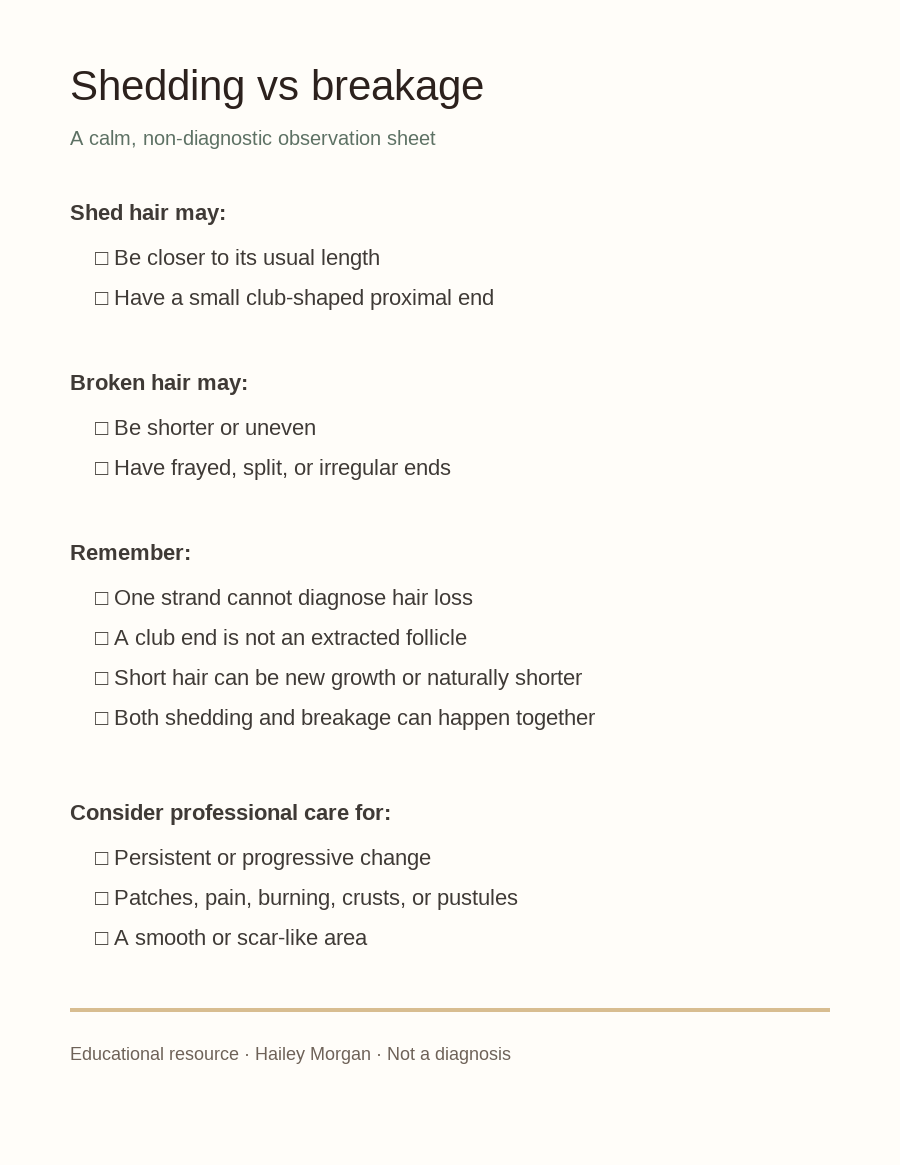
A shed hair may be close to its former full length and may have a small club-shaped proximal end. A broken hair is often shorter or uneven and may have a frayed, split, or irregularly fractured end. These are clues, not a diagnosis, and both processes can happen at the same time.
The useful distinction: follicle release versus shaft fracture
The visible fiber and the follicle are related, but they are not the same structure. A follicle is a living mini-organ in the skin. It contains the bulb, matrix, dermal papilla, and signaling environment that produce a growing fiber. The hair you can touch above the skin is mostly keratinized, nonliving material. It can be conditioned and protected, but it cannot biologically repair a fracture the way living tissue repairs itself.
Shedding
Shedding is the release of a hair fiber from its follicle as part of the hair cycle. Normal shedding is expected. A noticeable change from your own usual pattern can also reflect a temporary cycle shift or a follicular disorder.
Common clue: many naturally released hairs are close to their former length and may have a small pale club-shaped proximal end.
Breakage
Breakage is a fracture somewhere along the shaft. It can happen at the ends, in the middle, or close to the scalp. The follicle may be functioning normally even while the visible lengths become shorter, rougher, or more uneven.
Common clue: short fragments, frayed ends, split ends, and a cluster of uneven lengths after heat, chemical, friction, or tension exposure.
| Feature | Shedding | Breakage | Thinning or hair loss |
|---|---|---|---|
| Primary process | Fiber released from follicle | Visible shaft fractures | Reduced density or growth from several possible processes |
| Follicle involvement | Cycle and release are involved; follicle usually remains | May be unaffected | May involve miniaturization, inflammation, traction, autoimmune disease, or scarring |
| Strand clue | Often full length; club-shaped end may be present | Short/uneven, frayed, split, or irregular end | Visual pattern matters more than one strand |
| Timing | Can be daily or delayed after a trigger | Often follows cumulative handling or processing | May be gradual, patchy, sudden, or progressive |
| Reversibility | Depends on cause; excessive shedding is not automatically permanent | Existing damage cannot biologically heal; reduce new breakage | Depends on diagnosis; some follicular damage can be permanent |
| Products can do | Support comfort and fiber care; rarely address the underlying cause alone | Improve lubrication, slip, feel, or surface behavior | Medical treatment depends on diagnosis |
| When to seek care | Unexpected, persistent, marked, or distressing change | Significant unexplained breakage or scalp symptoms | Rapid thinning, patches, hairline change, pain, burning, scaling, crusts, pustules, or scarring appearance |
Hair anatomy in plain language
Follicle, bulb, matrix, and dermal papilla
The follicle is the skin structure that produces a hair shaft. The lower bulb contains the matrix, where dividing cells contribute to the growing fiber. The dermal papilla sits at the base and participates in signaling and nutrient exchange. These terms describe living follicular anatomy, not a white coating on a loose strand.
Cuticle, cortex, and medulla
The cuticle is the overlapping outer layer. The cortex provides much of the fiber's strength, shape, and pigment. A medulla may be present, absent, or discontinuous depending on the fiber. Conditioning can improve surface behavior, but it does not turn an exposed shaft back into living tissue.
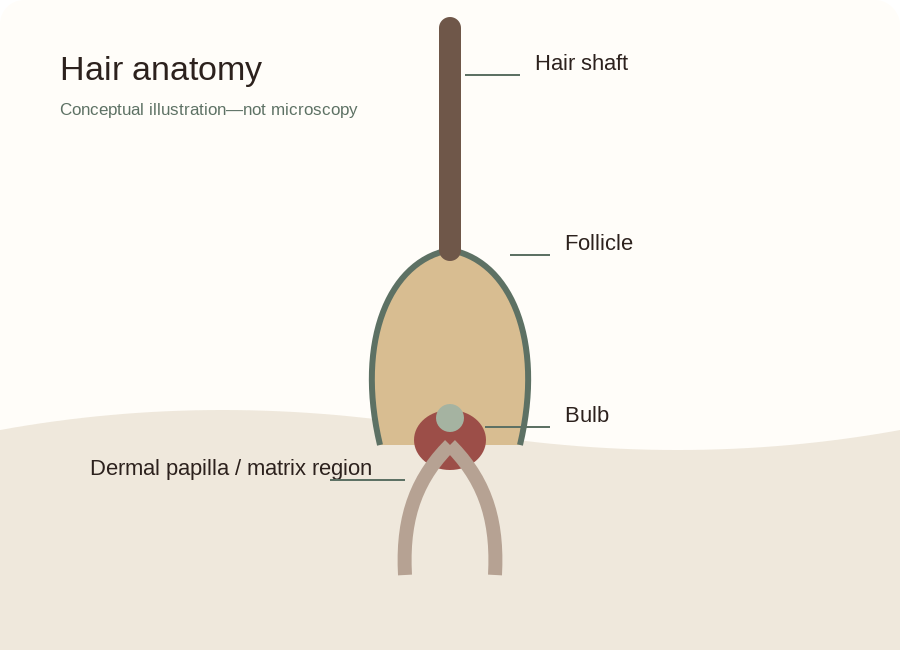
Educational illustration, not a calibrated clinical image or microscopy result.
The hair growth cycle explains why timing matters
Scalp follicles cycle independently. During anagen, matrix cells actively produce a fiber. Catagen is a short transition. During telogen, the follicle rests. Exogen describes release of the old fiber and is often discussed as part of the shedding process. The exact timing varies by person, body site, health, and hair characteristics.
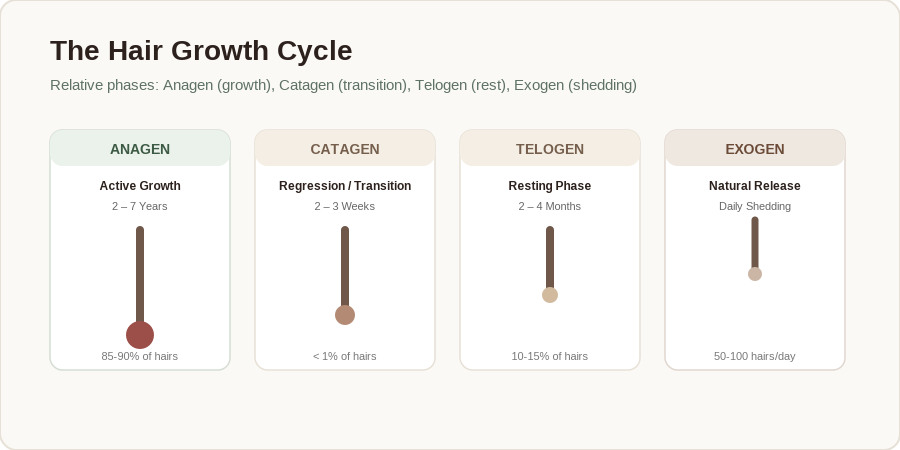
Phase lengths are intentionally shown as relative, not as a universal scale.
What the white bulb does—and does not—mean
A pale, club-shaped proximal end may be seen on a naturally shed telogen hair. It is a keratinized end of the fiber, not an entire follicle pulled from the skin. The follicle normally remains within the scalp and may produce another fiber. A club-shaped end does not prove that shedding is abnormal or guarantee regrowth. Conversely, the absence of an obvious club does not prove breakage.
Lighting, hair color, attached sebum or product, magnification, and the way a strand lies can make ends difficult to interpret. Do not pull out hair or repeatedly inspect strands to force certainty. Use naturally released hair as a rough observation only, then pay attention to changes in density, distribution, scalp comfort, and timing.
Normal shedding, wash days, and the limits of hair counts
Approximately 50–100 scalp hairs per day is often cited as a broad educational estimate, not a diagnostic cutoff. The visible amount changes with hair density, length, curl pattern, washing and detangling frequency, protective styles, and how many days' worth of already-released fibers remain caught in the hair. A large wash-day clump may therefore reflect collection timing rather than a single day's biological change.
Meaningful changes from your usual pattern matter more than compulsive counting. Repeated pulling, daily counting, and home microscope diagnosis can increase anxiety without clarifying the cause.
Sixteen possibilities behind increased shedding or hair loss
These are educational categories, not a consumer questionnaire or a self-diagnosis tool.
Telogen effluvium after illness, fever, surgery, childbirth, or another major physiological change
Observation alone cannot reliably separate this possibility from other causes. A clinician may consider history, distribution, scalp examination, medication review, and selected tests.
Medication changes or medical conditions, including thyroid disorders, when clinically relevant
Observation alone cannot reliably separate this possibility from other causes. A clinician may consider history, distribution, scalp examination, medication review, and selected tests.
Iron or other nutrient deficiency when confirmed or strongly suspected by a clinician
Observation alone cannot reliably separate this possibility from other causes. A clinician may consider history, distribution, scalp examination, medication review, and selected tests.
Pattern hair loss, which often reflects follicle miniaturization rather than a sudden wave of shedding
Observation alone cannot reliably separate this possibility from other causes. A clinician may consider history, distribution, scalp examination, medication review, and selected tests.
Alopecia areata, traction alopecia, inflammatory scalp disease, or scarring alopecia
Observation alone cannot reliably separate this possibility from other causes. A clinician may consider history, distribution, scalp examination, medication review, and selected tests.
Other clinically relevant categories include chronic telogen effluvium, anagen effluvium, hormonal changes, inflammatory or infectious scalp conditions, and scarring alopecias. Scarring disorders can damage follicles permanently, so a painful, burning, crusted, pustular, or unusually smooth area merits timely assessment.
Sixteen possibilities behind hair breakage
Bleaching, repeated oxidative coloring, relaxing, or straightening, especially when processing overlaps
Risk depends on the condition of the fiber, formulation, exposure, frequency, overlap with prior processing, and individual handling. No single product erases every risk.
High heat, long exposure, repeated passes, or styling wet hair with inappropriate tools
Risk depends on the condition of the fiber, formulation, exposure, frequency, overlap with prior processing, and individual handling. No single product erases every risk.
Friction from rough towels, tight elastics, extensions, sleep, clothing, or repeated manipulation
Risk depends on the condition of the fiber, formulation, exposure, frequency, overlap with prior processing, and individual handling. No single product erases every risk.
Forceful detangling through knots, particularly when the fiber is already weathered or chemically treated
Risk depends on the condition of the fiber, formulation, exposure, frequency, overlap with prior processing, and individual handling. No single product erases every risk.
Inherited or acquired shaft disorders, which require professional assessment rather than a product diagnosis
Risk depends on the condition of the fiber, formulation, exposure, frequency, overlap with prior processing, and individual handling. No single product erases every risk.
How to reduce additional damage without buying a new routine
During cleansing and conditioning
- Cleanse the scalp according to comfort, oil, product buildup, and medical advice rather than a universal schedule.
- Use a suitable rinse-out conditioner on lengths to improve lubrication and combability.
- Detangle in the way that produces the least force for your texture; use fingers or a suitable tool and work from ends upward.
- Blot instead of rough-rubbing. Do not use a hot tool on hair that is wet unless the tool is specifically designed for that use.
During styling
- Use the lowest effective heat and fewer passes. Heat protectants may reduce selected forms of damage but do not make heat harmless.
- Space chemical processing and avoid overlapping onto already compromised lengths where possible.
- A protective style is not protective if it causes persistent pain, pulling, localized breakage, or hairline thinning.
- Reduce friction and repeated manipulation. A low-cost change can be as useful as a new product.
Texture, porosity, and product claims
Straight, wavy, curly, and coily hair are not health rankings. Curvature, diameter, tangling, friction, styling practices, and prior processing can change how a fiber behaves. Common porosity labels are useful consumer descriptions but are not the same as a validated laboratory measurement.
Conditioners, leave-ins, oils, silicones, fatty alcohols, humectants, emollients, and hydrolyzed proteins can change lubrication, friction, feel, and appearance. Coconut oil has laboratory and fiber-study evidence relevant to penetration and protein loss under particular conditions; that does not make it a treatment for follicular hair loss. Rosemary and other botanical products require formulation-specific evidence and can irritate skin. Do not apply undiluted essential oils.
Bond-building language is not a universal scientific category. Treat it as a product claim that must be evaluated formulation by formulation. A product can temporarily smooth or reinforce a damaged fiber without permanently restoring its original structure.
Nutrition, biotin, and medical treatment boundaries
Adequate energy and protein intake support general health. Iron, zinc, vitamin D, B12, folate, and other nutrients may matter when a deficiency or relevant medical condition is present. Supplements are not automatically helpful when nutritional status is adequate, and unnecessary high-dose products can cause adverse effects.
Biotin deficiency is uncommon in many populations. High-dose biotin is not an automatic answer for shedding or breakage and can interfere with selected laboratory tests. Tell a clinician about supplements before testing. Never stop a prescribed medication because an article suggests it might affect hair.
Medical treatment depends on diagnosis. Topical minoxidil has particular labeled and clinical uses, but it is not a universal treatment for unspecified shedding, breakage, or every type of hair loss. Pregnancy, breastfeeding, age, medical history, and other circumstances can change suitability.
A low-pressure observation guide
- Observe only hair that came out during ordinary grooming. Do not deliberately pull or break hair.
- Compare approximate lengths, but remember that short hair can be new growth, miniaturized, cut, naturally shorter, or broken.
- Look at ends only as clues. A club-shaped proximal end and a fractured or split end are not definitive tests.
- Review recent bleaching, coloring, heat, tight styles, extensions, friction, and detangling changes.
- Note whether the change is sudden, delayed after an event, or gradually progressive.
- Look at the overall pattern: widening part, patches, hairline change, increased fragility, pain, burning, itching, scaling, crusting, or pustules.
- Seek professional assessment when the pattern is persistent, progressive, unexplained, painful, patchy, or emotionally distressing.
A widening part, rapidly progressing thinning, bald patches, persistent scalp inflammation, possible infection, or a smooth scar-like area should not be managed with a routine-only product experiment.
What a dermatologist may consider
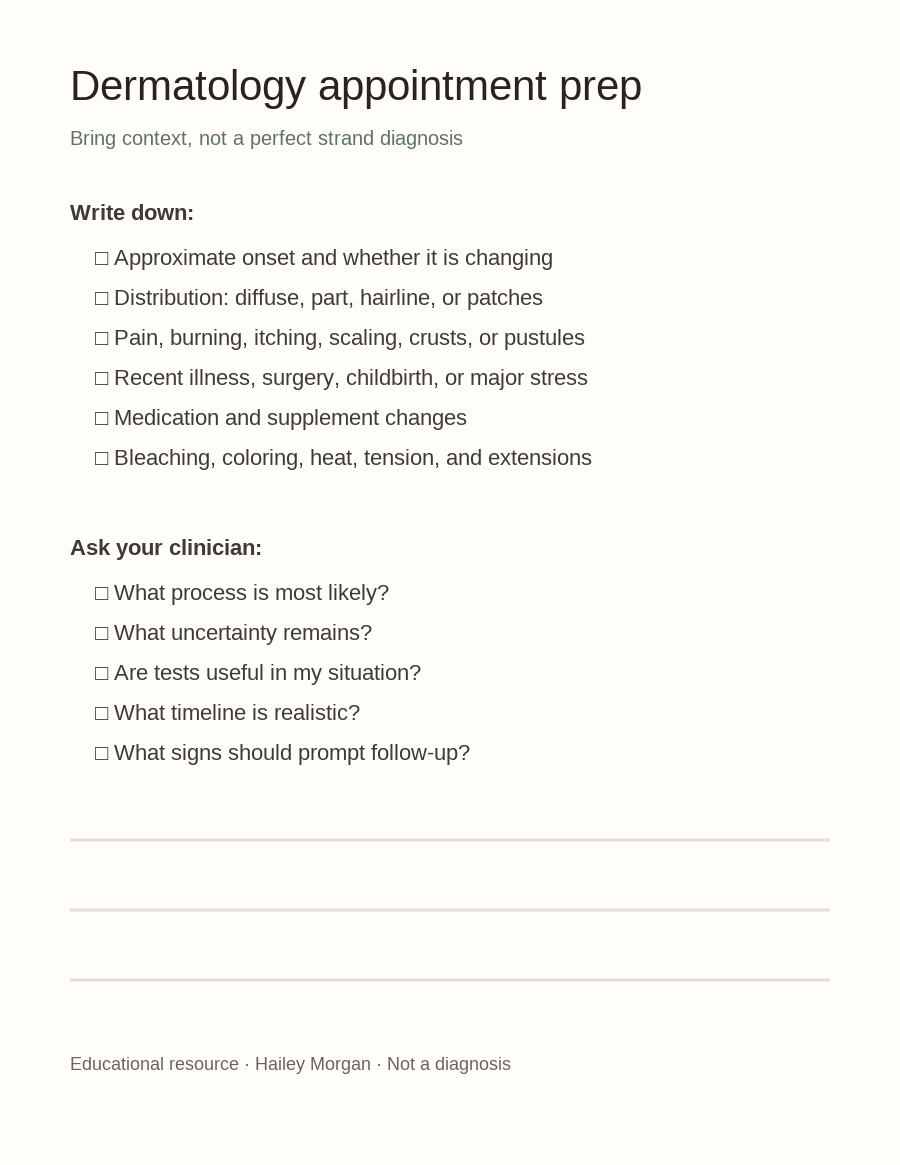
A clinician may take a detailed history, inspect the scalp and pattern of density change, examine shaft features, perform a clinician-directed hair pull test when appropriate, use trichoscopy, review medications, and order selected tests such as a complete blood count, iron status, or thyroid function when the history and examination support them. A scalp biopsy is reserved for selected situations. Not every person needs the same workup.
Bring the approximate onset, distribution, scalp symptoms, illness or surgery history, pregnancy timing when relevant, medication changes, dietary changes, chemical processing, styling habits, family history, and previous evaluations. Ask what process is most likely, what uncertainty remains, whether testing is appropriate, and what timeline is realistic.
Common mistakes worth avoiding
Treating every shed hair as permanent loss
Try a lower-risk alternative and keep the medical boundary in view.Using 50–100 as an absolute cutoff
Try a lower-risk alternative and keep the medical boundary in view.Calling every short hair breakage
Try a lower-risk alternative and keep the medical boundary in view.Mistaking a club end for a follicle
Try a lower-risk alternative and keep the medical boundary in view.Skipping scalp cleansing to “save” hair
Try a lower-risk alternative and keep the medical boundary in view.Brushing aggressively through knots
Try a lower-risk alternative and keep the medical boundary in view.Overlapping chemical treatments
Try a lower-risk alternative and keep the medical boundary in view.Using unnecessary high heat
Try a lower-risk alternative and keep the medical boundary in view.Wearing uncomfortable tight styles
Try a lower-risk alternative and keep the medical boundary in view.Assuming a conditioner treats follicular loss
Try a lower-risk alternative and keep the medical boundary in view.Treating all silicones or sulfates as harmful
Try a lower-risk alternative and keep the medical boundary in view.Using undiluted essential oils
Try a lower-risk alternative and keep the medical boundary in view.Buying supplements before confirming need
Try a lower-risk alternative and keep the medical boundary in view.Expecting split ends to biologically heal
Try a lower-risk alternative and keep the medical boundary in view.Stopping prescribed medication without advice
Try a lower-risk alternative and keep the medical boundary in view.Delaying care for rapid thinning
Try a lower-risk alternative and keep the medical boundary in view.Ignoring pain, burning, crusts, or pustules
Try a lower-risk alternative and keep the medical boundary in view.Expecting a 30-day regrowth guarantee
Try a lower-risk alternative and keep the medical boundary in view.Myths versus useful facts
A white bulb is an entire follicle. The pale club-shaped end is part of the shed fiber; the follicle normally stays in skin.
Every short hair is broken. Short hairs can be new growth, naturally shorter fibers, cut hairs, miniaturized hairs, or fragments.
Fewer washes prevent shedding. Washing may reveal hairs that had already completed their cycle; it does not create every visible shed hair.
Oil or biotin cures every form of hair loss. Cosmetic lubrication and supplementation are not substitutes for diagnosis or correction of a confirmed deficiency.
A split end can heal permanently. Products can smooth or temporarily bind the surface; trimming removes the damaged portion.
When shedding and breakage happen together
One person may have full-length shed hairs after a postpartum shift and short fragments after frequent heat styling. Someone with gradual pattern hair loss may also bleach the remaining lengths. A tight style can create shaft fracture while repeated traction affects follicles. Infrequent detangling may reveal several days of naturally shed hairs at the same time that knots increase mechanical breakage. These are hypothetical examples, not diagnoses.
Seven-day reset and thirty-day observation
Seven days
- Record your usual routine without counting strands.
- Make detangling slower and lower-force.
- Reduce unnecessary heat.
- Choose comfortable, lower-tension styles.
- Use existing suitable conditioning products.
- Notice scalp comfort without repetitive inspection.
- Keep only changes you can sustain.
Thirty days
Week 1: understand current practices. Week 2: simplify cleansing, conditioning, and handling. Week 3: adapt to texture and practical needs. Week 4: reflect on manageability, tangling, heat and tension exposure, scalp comfort, and any meaningful change from baseline.
This is not a clinical regrowth test. It does not require daily photographs, pull tests, or hair counts.
Realistic recovery timelines
Cosmetic effects such as improved slip or surface feel may be noticeable quickly. Reducing damaging exposure can reduce new damage, but existing fractures do not biologically heal. Length retention may become easier to see as new growth continues and fewer fibers break. Temporary shedding can improve when a trigger resolves, but the timeline varies. Pattern, inflammatory, traction-related, and scarring conditions may require different treatment and may not be reversible in the same way.
Final takeaway
Normal shedding is part of the hair cycle. Breakage is a structural event in the visible shaft. A pale club-shaped end is not an extracted follicle, a short hair is not automatically broken, and one strand cannot diagnose the cause of a density change. Gentle cleansing, conditioning, lower-force detangling, sensible heat and chemical practices, and comfortable styling can reduce avoidable shaft damage. Persistent, progressive, patchy, painful, inflamed, or scar-like changes deserve professional evaluation.
What are you noticing?
Select any observations that fit. This is an education aid, not a strand test or diagnosis.
Start with the overall pattern
Use naturally collected hairs only, avoid deliberate pulling, and review changes in timing, density, scalp comfort, styling, and chemical processing.
Do not pull hair repeatedly, deliberately break strands, or use a home microscope as a substitute for clinical assessment.
A lower-damage starting point
This creates a practical care checklist; it does not treat follicular hair loss or replace medical advice.
Strand clues, not diagnoses
Lighting, hair color, attached material, magnification, and individual variation can make ends difficult to interpret.
Often closer to full length with a small pale or club-shaped proximal end. The follicle remains in the skin; this appearance is only a clue.
Conceptual illustration, not microscopy. The visible shaft is made primarily of keratinized cells; the follicle is the living structure in skin.
ANTI-BREAKAGE CARE & FRICTION DEFENSE
Recommended Gentle Detanglers & Silk Protection
As an Amazon Associate I earn from qualifying purchases. Silk pillowcases, flexible detangling brushes, and leave-in shields to protect delicate hair shafts from mechanical stress and friction breakage.
Bedsure 100% Mulberry Silk Pillowcase for Hair & Skin
100% Mulberry silk pillowcase
Wet Brush Original Detangler Hair Brush Soft Bristles
Gentle detangling hair brush
Pureology Color Fanatic 21 Benefit Leave-In Conditioner
Multi-benefit leave-in treatment
YoulerTex Microfiber Hair Towel Wrap for Women Anti-Frizz
Microfiber gentle hair wrap towel
CHI 44 Iron Guard Thermal Protection Spray
Thermal heat protection spray
Kitsch 100% Mulberry Silk Hair Scrunchies Set of 3
100% Mulberry silk hair scrunchies
References and related reading
The full source list, evidence classifications, product placeholders, and integration notes are included in the downloadable package. The live page keeps the most important safety information readable without completing an interactive tool.
Further reading in the Hailey Morgan cluster
Printable resources
Save or print the lightweight SVG reference sheets included in the package.
Shedding vs breakageAppointment prep