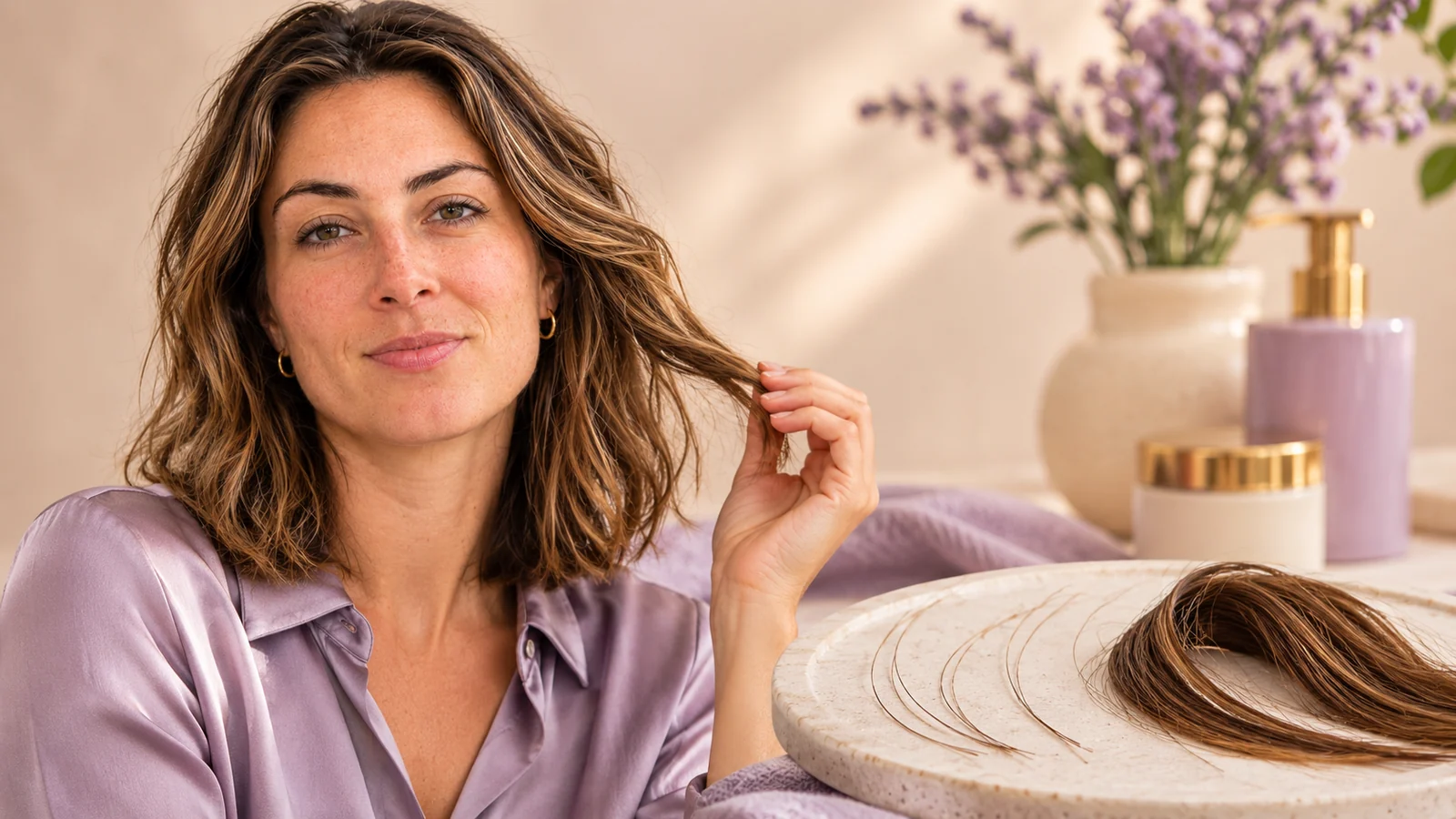
Fine Hair vs Thin Hair: Why Your Routine Should Be Different
By Hailey Morgan
Haircare education; U.S.-focused, with general guidance for readers in the UK, Canada, and Australia.
Quick answer
Fine hair describes the relatively small diameter of individual strands; thin hair is a common, nontechnical way to describe low overall hair density or a less-full-looking head of hair. You can have fine strands and high density, or coarse strands and low density. A naturally fine or low-density baseline is not, by itself, a hair-loss diagnosis; a noticeable change over time deserves more attention than a label or one photo.
Fine hair, thin hair, and thinning hair are not synonyms
Hair has several independent characteristics. Strand diameter is the width of an individual fiber. Density may refer to how many hair shafts or follicular units occupy a defined scalp area. Texture describes the fiber’s curve pattern, from straight through wavy, curly, and coily. Porosity is a popular hair-care term for how a fiber interacts with water, but it is not a simple clinical category that can be reliably assigned by a viral home test. Cosmetic volume is the visible shape and lift of a hairstyle—not a count of follicles.
In everyday conversation, people use “thin hair” to mean anything from fine strands to a flat style or a visible part. Clinicians are more precise: they describe the pattern and timing of shedding or loss, examine the scalp and hair shafts, and consider possible causes. “Thinning hair” usually means a change from someone’s own prior baseline. It may involve fewer visible shafts, finer fibers from affected follicles, shedding, breakage, or a combination. A consumer hair label cannot distinguish those causes.
| Term | What it describes | What it does not establish |
|---|---|---|
| Fine | Relatively small diameter of individual fibers | Low density, poor health, or hair loss |
| Medium-diameter | A middle range on a continuum; no universal consumer cutoff | A medical category |
| Coarse | Relatively large diameter of individual fibers | High density or strong, damage-proof hair |
| Low, medium, or high density | Relative number and distribution of visible shafts or follicular units in an area | A diagnosis without context and a defined measurement method |
| Naturally thin-looking | A longstanding appearance that may reflect low density, fine fibers, texture, length, or contrast | A disease |
| Progressive thinning | A change over time in coverage, caliber, distribution, or shedding | A specific cause by itself |
| Shedding | Release of hairs from follicles | Shaft breakage, necessarily, or a specific disease |
| Breakage | Fracture of the hair shaft | Follicle loss |
| Miniaturization | A biological change in which susceptible follicles produce progressively smaller-caliber hairs in some disorders | Something that can be confirmed by feeling one strand |
| Cosmetic volume | A styling effect from shape, lift, separation, or product | New follicles or regrowth |
“Fine,” “medium,” and “coarse” are often stylistic descriptors, not standardized diagnostic bins. There is no single consumer-grade strand diameter threshold that applies across methods, people, scalp regions, and populations. Research density numbers also depend on what was counted, where it was measured, and how. They should not be turned into universal at-home pass/fail cutoffs. 1 2 3
The nine combinations: diameter and density can mix in any direction
These are simplified educational examples, not clinical thresholds. “Density” can mean visible shafts or follicular units, and an individual’s actual scalp may vary by region. More than one hair can emerge from a follicular unit.
| Individual strand caliber | Lower relative density | Middle relative density | Higher relative density |
|---|---|---|---|
| Fine | A smaller number of fine fibers may leave more visible spaces, especially when wet or under strong light. Use enough conditioner to keep lengths manageable; apply product sparingly and focus any lift at roots. | Fine strands may feel light and respond noticeably to small amounts of product. A light conditioner can help reduce friction; hair may look airy or flatten depending on length, oil, and styling. | Many fine fibers can create substantial coverage even if each strand feels delicate. Avoid assuming “fine” means sparse; select products by how the whole style behaves. |
| Medium | Medium-caliber fibers with fewer shafts can look less full at the scalp or ends. Conditioning needs depend on damage and texture; a fuller perimeter or gentle root styling may suit some goals. | A broad middle combination. The style may be shaped by curl pattern, length, damage, and product choice as much as by the strand label. | Numerous medium-caliber fibers can create a dense-looking silhouette. Product distribution and drying time may matter; that does not imply a problem. |
| Coarse | Larger-caliber fibers can feel substantial while coverage remains relatively low. The ponytail may feel thick in the hand without indicating many follicles. Condition according to texture and damage, not the word “coarse.” | Coarse fibers with middle density may hold shape differently from fine hair, but porosity, curl, and processing still matter. | A large number of larger-caliber fibers can produce substantial visual fullness and may require more time to dry or style. The right routine is still individual. |
The matrix is why “thick hair” is ambiguous. It can mean large individual strands, high density, or an overall full appearance. Ask which of those you mean before shopping or changing a routine.
What a hair fiber is—and what it cannot tell you
The visible hair shaft is a keratin-rich fiber formed inside a follicle. At the base, matrix cells around the dermal papilla multiply and become part of the growing shaft. The shaft’s outer cuticle is made of overlapping cells; the cortex forms most of the fiber and contributes much of its strength and color. Some fibers also contain a central medulla, while others do not have a continuous one. The follicle itself is living tissue; the part of the strand extending above the skin is not living tissue and cannot biologically heal itself. Conditioners can improve surface feel and reduce friction, but “repair” claims usually refer to temporary cosmetic effects, not regeneration of a living strand. 1 4
Follicles cycle through growth (anagen), transition (catagen), rest (telogen), and release of a hair. Each follicle cycles on its own timetable. Shaft diameter can vary between people, between follicles on one scalp, and along one fiber. Age, genetics, scalp region, and some hair disorders may be relevant. A short or wispy-looking strand alone does not prove miniaturization: it could also be a new hair, a broken hair, or a fiber with a naturally different growth pattern.
In some forms of patterned hair loss, susceptible follicles progressively produce finer, shorter hairs. This is called follicular miniaturization. It differs from having naturally fine strands throughout life. A small clinical study found variation in hair-shaft diameter associated with histologic miniaturization in men with androgenetic alopecia, but the sample was small and the finding is not a stand-alone home diagnostic test or a universal rule for all people. 2
What density measures—and why scalp visibility is not a count
A follicle is a skin structure. A follicular unit is a naturally occurring group that can contain one or more hairs. A visible hair shaft is the fiber emerging from the scalp. “Density” may refer to shafts per area, follicular units per area, or follicles counted in tissue; those measures are not interchangeable. Professional measurements use a defined scalp location and method, sometimes magnified imaging. Research results cannot be translated into one universal diagnostic threshold because location, age, population, hair cycle, and technique matter. 3
A visible part or scalp does not automatically mean hair loss. Lighting, camera angle, part placement, wetness, oil, hair grouping, curl pattern, hair color and scalp contrast all affect what appears in a photo. A single image cannot establish whether density has changed. If your part is gradually widening or coverage is changing compared with your usual baseline, that trend may be worth discussing with a clinician—even though a photograph alone cannot identify its cause.
A simple illustration in words: imagine the same number of fibers at the same length. Arrange them close to the scalp and the roots look flatter; direct light along a sharply defined part and more scalp may show; lift roots and shift the part and the style may look fuller. The follicle count has not changed in any of those styling variations.
Fine hair vs naturally low density vs progressive thinning
| Pattern | What may be noticed | Helpful perspective |
|---|---|---|
| Fine strands, stable baseline | Individual fibers feel small; hair may lie close to the scalp | Fine hair can be healthy and can occur at any density or curl pattern. |
| Naturally lower density, stable baseline | Less coverage has been typical for years, perhaps with a visible scalp in certain areas | Natural variation is not automatically a medical condition. A clinician can assess concerns, but there is no need to medicalize a stable trait. |
| Increased shedding | More released hairs noticed during washing or grooming, sometimes diffuse | A rough estimate often cited for ordinary shedding is about 50–100 hairs daily, but counting is not a reliable diagnosis; wash routines and collection vary. 5 |
| Breakage | Shorter fragments, uneven lengths, frayed or split ends | Breakage reduces fullness along the lengths without necessarily reducing follicle numbers. Heat, chemical processing, friction, and tension can contribute. 6 |
| Possible progressive hair loss | Gradual change in part, temples, crown, edges, or overall coverage; sometimes no dramatic daily shed | Different causes can look similar. A medical history and scalp examination are more useful than a viral test. |
Hair shedding and hair loss are related but distinct. Telogen effluvium is a form of diffuse, non-scarring shedding that may follow childbirth, fever or illness, surgery, major weight change, a medication change, or another physiologic stress. It can become noticeable weeks or months after a trigger. That timing is a clue, not proof. Pattern hair loss, alopecia areata, thyroid disorders, clinically established nutrient deficiencies, medication effects, traction, inflammatory scalp disease, and scarring alopecias involve different mechanisms. More than one issue can occur at once. 5 7
Seek a healthcare professional’s advice for sudden or patchy loss, progressive unexplained change, persistent or substantial shedding, or loss accompanied by scalp pain, redness, scaling, inflammation, sores, or other concerning symptoms. Early assessment matters when a scarring process is possible because follicle damage can be permanent. Do not stop a prescribed medicine on your own; discuss possible effects with the prescriber. 7
Viral hair tests: what they can and cannot say
- Thread comparison: Comparing one strand with sewing thread is an informal impression, not a calibrated diameter measurement. Thread thickness varies, and hair diameter varies across the scalp.
- Feeling a strand: Touch can give a rough sensory impression of fiber size or texture, but it cannot determine density, porosity, or the cause of hair changes.
- Ponytail circumference: The result depends on length, strand diameter, curl pattern, breakage, compression, and how much hair is gathered. There is no universal circumference cutoff that diagnoses density or alopecia.
- Scalp visibility: It is influenced by part, light, wetness, styling, contrast, and distribution. Compare a meaningful trend under similar conditions, not one dramatic image.
- Part photographs: A consistent photo can help document a change if taken occasionally in similar light and with the same part. It cannot reveal the cause and is not a reason to take repeated daily photos or inspect compulsively.
- Shedding counts: Counts vary with wash intervals and collection. A count alone cannot distinguish normal variation, shedding disorders, breakage, or scalp disease.
Use home observation to decide whether something has changed and to explain that change at an appointment—not to diagnose yourself. Avoid pulling hairs out deliberately.
Fine hair is not the same as low-porosity hair
Diameter describes width. Porosity is commonly used to describe how readily a fiber takes up or loses water, influenced by the cuticle and surface condition. Damage from bleaching, heat, weathering, or friction can change surface behavior. Fine untreated hair may behave differently from fine chemically processed hair; coarse fibers can also vary in wetting and conditioning response. Curly fine hair combines small fiber diameter with a curved shape, which can change tangling and product distribution. None of these traits can be reduced to a single “float test.”
Hair texture also matters. Fine straight hair may become visibly oily or flat with relatively little product, while fine curly or coily hair may need more careful detangling and conditioning to manage dryness and friction. Those are tendencies, not rules. People within any racial or ethnic group have varied fiber diameters, curl patterns, densities, and care needs; identity is not a substitute for observing the individual hair. Dermatologists recommend texture-aware handling, especially gentle detangling and conditioning for curly or coily hair. 8
Build the routine around the scalp, fibers, and goal
Shampoo: clean the scalp, not chase a label
Shampoo surfactants help lift oil and soil so they can rinse away. Cleansing and after-feel depend on the entire formula, water, application, wash frequency, and hair condition—not simply whether a bottle says “sulfate-free.” A sulfate-free shampoo is not automatically gentler, and a sulfate-containing product is not automatically damaging. Foam volume is not a dependable measure of cleansing. Choose based on scalp comfort and how the hair feels after rinsing.
| Shampoo type | What it is for | Practical note |
|---|---|---|
| Everyday cleansing | Removes ordinary scalp oil and soil | Frequency should suit how quickly your scalp becomes oily or dirty, not a universal schedule. |
| Gentle | A milder-feeling cleansing option for some users | “Gentle” is a product claim; evaluate comfort and results. |
| Volumizing | A cosmetic formula intended to leave a lighter, fuller-looking finish | Does not add follicles or treat miniaturization. |
| Clarifying | More intensive cleansing of residue or buildup | Occasional need varies; avoid over-cleansing dry, fragile, or chemically treated hair. |
| Conditioning shampoo | Combines cleansing with conditioning deposition | May suit some routines but can feel too rich or not rich enough depending on the person. |
| Medicated scalp shampoo | Treats a specific labeled scalp condition | Follow the product label or clinician’s guidance; do not use it as a general “hair growth” shampoo. |
Conditioner belongs in many fine-hair routines
Conditioners can reduce fiber-to-fiber friction, improve combability, manage static, and make lengths easier to handle. They do not have to be eliminated because strands are fine. Try adjusting the amount, formula, and placement before giving up conditioning: a small amount on lengths and ends may suit some fine or straight hair; curly, coily, dry, or chemically treated lengths may need broader coverage. The right application depends on the product and the hair. 4 8
Volumizing, thickening, and growth shampoos
| Label | Realistic meaning | Do not infer |
|---|---|---|
| Volumizing | May leave a lighter feel or help a style hold lift | That density increased |
| Thickening | May coat fibers or change their surface feel temporarily | That the strand’s follicle permanently changed |
| Hair growth | Marketing language unless supported by an authorized drug claim and relevant evidence | That any shampoo can reverse a diagnosed cause of hair loss |
Temporary coating, fiber separation, and root lift can improve appearance. They do not prove new hair growth, new follicles, or reversal of miniaturization. Ingredient order also does not reveal exact concentrations for every ingredient; U.S. ingredient-label rules have exceptions for ingredients at 1% or less and color additives. 9
Ingredients: functions, not magic
The table describes common cosmetic functions, not guaranteed outcomes. Formula, amount, hair condition, and personal tolerance matter. Most claims about fiber body, smoothness, and deposition are cosmetic or laboratory-level findings, not clinical hair-growth evidence. 4 10
| Ingredient or category | Common cosmetic role | Fine-hair consideration |
|---|---|---|
| Panthenol | Humectant/conditioning ingredient | May change feel or manageability; not follicle activation. |
| Hydrolyzed rice protein | Film-forming/conditioning ingredient | Effect depends on formula and dose; not permanent thickening. |
| Hydrolyzed wheat protein | Conditioning/film-forming ingredient | Can alter feel; assess the finished product, not the name alone. |
| Hydrolyzed keratin | Conditioning or film-forming material | Does not replace keratin inside a living follicle. |
| PVP | Styling film former | Can support hold and body; excess may feel stiff or leave residue. |
| VP/VA copolymer | Film former in styling products | Hold depends on formula and humidity; remove as directed. |
| Selected polyquaterniums | Conditioning or styling polymers | Deposition may help manageability or may weigh down some styles. |
| Acrylates polymers | Film-forming hold and style support | Product placement and amount affect feel. |
| Silica | Absorbent or texture ingredient | May create a drier, more textured finish; avoid inhaling loose powders. |
| Starches | Oil-absorbing/texture ingredients | Useful for temporary root feel; buildup is possible. |
| Glycerin | Humectant | Humidity and formula affect feel; no ingredient works in isolation. |
| Cetrimonium chloride | Conditioning/antistatic agent | Helps detangling in some formulas; dose and rinse-off format matter. |
| Behentrimonium chloride | Conditioning/antistatic agent | Often used in rinse-off conditioning formulas; does not cause universal heaviness. |
| Cetyl alcohol | Fatty alcohol that can add emollience and structure | Not the same as drying alcohols; richer formulas may feel heavier to some. |
| Dimethicone | Silicone that lubricates and smooths fibers | Can reduce friction and add slip; buildup depends on the full routine. |
| Amodimethicone | Conditioning silicone used in some formulas | Deposition is formulation-dependent; not categorically unsuitable for fine hair. |
Silicones are not automatically bad, oils are not automatically forbidden, and fine hair does not automatically need protein. Coconut oil reduced measured protein loss in a hair-fiber study, but that laboratory result is not evidence that coconut oil grows hair or suits every scalp. 11 A product’s complete formula and your response matter more than ingredient stereotypes.
Oils, dry shampoo, and temporary concealers
Hair oils can lubricate lengths and change shine or feel. Coconut, argan, jojoba, mineral oil, squalane, and blends differ in formulation and behavior; use only as much as suits your hair, and consider keeping a rich product away from roots if it makes them lie flat. No oil has been established here as a way to create follicles.
Dry shampoo absorbs some oil temporarily; it does not wash away sebum, dead skin cells, microbes, and residue the way shampoo and water do. Follow the exact product instructions, avoid eyes and inhalation, and use ordinary cleansing as appropriate for your scalp. Stop using a product if it causes irritation. Do not assume every dry shampoo is unsafe because of a recall involving specific historical products and lots; check FDA notices against the exact product and lot when relevant. 12 13
Hair-building fibers, root powders, color sprays, toppers, and hairpieces are optional appearance tools. They provide visual coverage or a changed silhouette, not biological growth. Consider color match, transfer, comfort, removal, scalp tolerance, and package directions. No one needs to conceal a naturally visible scalp area.
Haircuts and styles: change the silhouette, not the follicle count
A haircut can redistribute length and weight. A blunt perimeter may make ends appear more substantial for some hair; layers may provide movement, shape, or curl definition for others. Extensive thinning or aggressive layering can reduce end fullness for some low-density goals, but blunt cuts are not universally superior and layers are not universally harmful. Bring pictures of your preferred shape and discuss density, strand diameter, curl pattern, styling time, maintenance, and how much length you want to preserve with a stylist.
| Cut to discuss | Possible visual effect and trade-off |
|---|---|
| Blunt bob, French-inspired bob, chin/jaw bob | Defined perimeter; can feel polished and may make ends look fuller. Styling and trim frequency vary. |
| Long bob or collarbone-length cut | Keeps versatility while limiting some length-related weight; not a guarantee of root lift. |
| Blunt medium cut or long cut with a fuller perimeter | Preserves weight at the ends; long lengths may still lie flat depending on fiber and texture. |
| Softly layered or graduated bob | Adds shape and movement; ask where weight will be removed. |
| Face-framing layers | Shapes around the face while retaining length elsewhere; may need styling. |
| Pixie or textured pixie | Shorter shape can reduce drying time and show texture; maintenance trims may be more frequent. |
| Curl-specific layered cut | Can support curl shape and distribution; cut should account for shrinkage and dry-state shape. |
| Shape-focused coily style | Prioritizes silhouette and curl geometry; choose a comfortable, texture-aware approach. |
| Lightweight fringe, curtain or side-swept bangs | Redistributes existing hair over the forehead; requires upkeep and does not create density. |
Hair color can change scalp contrast and the perception of dimension, but it does not change follicle numbers. Bleaching and repeated chemical processing can damage shafts. Color is a personal option, not a necessary response to fine or thinning hair.
Twenty-four adaptable everyday hairstyle ideas
These are styling options, not prescriptions. Keep tension comfortable; loosen or remove any style that hurts, pulls, or causes persistent scalp discomfort. Use tools you already own, and skip products if you prefer.
Low-manipulation
- Loose low ponytail: Gather gently at the nape, secure without pulling, and leave the tie comfortably loose. Straight, wavy, curly; 1–2 minutes.
- Soft low bun: Twist loosely at the nape and secure with a claw clip or soft tie. Suitable for medium-to-long hair; avoid a tight twist. 2 minutes.
- Half-up clip: Lift only the top section and clip without stretching the hairline. Works at short-to-long lengths if enough top hair is available. 1 minute.
- Loose side braid: Braid lengths without tension at the scalp; secure softly. Useful for detangling control on longer hair. 3–5 minutes.
- Two loose front twists: Twist small front sections away from the face and pin gently. Adapt pin placement to texture and comfort. 2–4 minutes.
- Natural part and air-dry shape: Set the part while damp, arrange curls or waves with fingers, then let dry without repeated handling. Time varies; minimal manipulation.
Casual and polished
- Changed-side part: Shift the part slightly while roots are damp or dry; allow the roots to settle. No tool needed. 1–2 minutes.
- Tucked-behind-one-ear style: Smooth one side loosely and tuck; avoid pulling the opposite side tight. Works on most lengths. 1 minute.
- Low pony with a soft wrap: Secure loosely and wrap a small section around the tie if comfortable, pinning without tension. 3–5 minutes.
- Loose French braid: Braid with relaxed sections rather than pulling close to the scalp; best on longer hair. 5–10 minutes.
- Half-up braid or twist: Secure a small top section and leave the rest down. Avoid taking too much hair if the goal is to preserve loose coverage. 3–5 minutes.
- Defined waves or curls: Use the existing texture, a suitable leave-in if already owned, and gentle scrunching or shaping. Avoid repeated heat as a volume requirement. 5–15 minutes plus drying.
Fullness-focused, optional
- Root-direction blow-dry: Direct modest airflow at roots while lifting gently with fingers; use the lowest effective heat and keep the dryer moving. 5–10 minutes.
- Heat-free root clips: Place a few comfortable clips at roots while hair dries, then remove without tugging. 5 minutes to set plus drying.
- Velcro or foam rollers: Use on suitable sections following the tool instructions; remove gently when set. Avoid rolling tightly. 10 minutes plus setting.
- Loose crown lift: Lift a small crown section and clip briefly while cooling or drying. Do not tease aggressively. 2–5 minutes.
- Mousse at the roots: If already available and tolerated, distribute a small amount as labeled, then dry or air-dry. Fine straight or wavy hair may prefer less. 3–10 minutes.
- Side-swept finish: Sweep the part diagonally and shape the top without pulling; a flexible hold product is optional. 2–4 minutes.
Low-tension occasion options
- Loose chignon: Gather at the nape, fold or coil loosely, and secure with pins or a clip. 5–8 minutes.
- Soft claw-clip twist: Twist lengths upward and secure with a clip sized for the hair; adjust if it pulls. 2–3 minutes.
- Low bubble ponytail: Make a comfortable low pony, add loose ties down the length, and gently expand sections without tugging. 5 minutes.
- Half-up occasion twist: Take a modest amount from each side, join at the back, and pin gently. 4–6 minutes.
- Pineapple or high loose gather for curls: Gather curls loosely at the crown with a soft tie or scarf, if comfortable and appropriate for length. 1–2 minutes.
- Decorative headband or scarf: Place over styled hair without excessive pressure or friction; check that it does not irritate the scalp. 1–3 minutes.
Times are rough styling estimates, not performance promises. Any style can be adapted or skipped. Repeated tight ponytails, braids, extensions, or buns can create traction; prolonged pulling can cause hair loss and may become permanent if follicles are damaged. 6 14
Gentle drying and handling
Wet hair can be more vulnerable to breakage for many people. Blot rather than rub vigorously with a towel. Detangle with a suitable wide-tooth comb or fingers, beginning at the ends and working upward. Dermatology guidance differs by texture: tightly curled or textured hair may be detangled wet with conditioner, while straight hair may be easier to handle after it dries somewhat. 6 8
Heat can damage the shaft. A small laboratory study of hair tresses found more cuticle damage with higher heat under its testing conditions; it cannot establish one safe temperature for every tool and person. If you use heat, choose the lowest effective setting, keep airflow moving, follow the device and product instructions, and avoid frequent high heat solely to create volume. A heat protectant may help with cosmetic protection but does not make unlimited heat harmless. 15
Hair-growth treatments and supplements: cause matters
Cosmetic products and medical treatments answer different questions. A volumizer may improve a hairstyle’s look; it does not treat a follicular disorder. Topical minoxidil has evidence and U.S. OTC labeling for particular uses and populations, including some forms of pattern hair loss. Product labels differ by concentration, formulation, intended users, application site, and safety instructions. Check the exact current Drug Facts label and discuss suitability with a qualified healthcare professional. Do not use an online article to choose medication or treat sudden, patchy, unexplained loss or an inflamed scalp. 16 17
Prescription medicines are condition-specific and require clinician assessment. Procedures such as platelet-rich plasma or low-level light devices have evidence that varies by indication and study quality; suitability, risks, cost, and regulatory status need individual review. Rosemary oil and caffeine-containing cosmetics do not have the same evidence base as an authorized treatment. Do not treat a small or preliminary study as proof of guaranteed regrowth.
Biotin is not a universal hair-growth solution. Biotin deficiency is uncommon, and evidence that supplements improve hair in people without deficiency is limited. Biotin can interfere with certain laboratory tests, potentially producing misleading results. Tell a clinician about supplements before testing. Iron, zinc, vitamin D, vitamin B12, protein, and overall energy intake matter to health, but supplementation is most appropriate when an actual deficiency or need has been assessed. Excess nutrients can also cause harm. FDA does not pre-approve dietary supplements for effectiveness in the same way as drugs. 18 19
When to seek professional advice—and how to prepare
A dermatologist or other qualified clinician can review when the change began, where it is occurring, whether there is shedding or breakage, scalp symptoms, medical history, childbirth or illness, diet changes, and medications. They may examine the scalp and hair, use magnification such as trichoscopy, perform a clinician-directed pull test, or order targeted laboratory tests. Biopsy is reserved for selected situations. Not everyone with naturally fine or low-density hair needs tests. 5 7
Before an appointment, note roughly when you first noticed a change and whether it is gradual, sudden, patchy, or diffuse. Bring a medication and supplement list and mention recent illness, major weight change, childbirth, chemical processing, heat, tight styles, and scalp symptoms. A few consistent photos may help if they already exist; you do not need to count hairs daily or repeatedly photograph your scalp.
A practical routine builder
Start with what you own. The goal is comfortable, manageable hair—not a guaranteed density increase.
- Name the goal: Is it easier detangling, less oily-feeling roots, more root lift, defined curls, or understanding a recent change? Separate appearance goals from medical concerns.
- Notice your baseline: Describe strand feel, overall coverage, texture, and what has been stable for years. Avoid assigning a diagnosis from one strand or image.
- Check the scalp: Persistent pain, itch, redness, scaling, sores, or a new pattern of loss deserves professional input rather than another styling product.
- Adjust one cosmetic variable at a time: Try a smaller amount of an existing conditioner, change placement, shift the part, or use a gentler drying method. Observe comfort and manageability.
- Keep conditioning when it helps: Fine hair can still need slip and friction reduction. Adapt amount and placement rather than applying a rigid rule.
- Avoid unnecessary purchases: A shampoo, conditioner, and a comfortable styling method may be enough. A $0 routine can mean using current products, changing part placement, air-drying or using existing tools gently, and avoiding tight styles.
- Reassess changes, not daily fluctuations: If coverage or shedding has meaningfully changed over time, seek assessment. Do not rely on a routine builder or online article to diagnose it.
Examples: fine hair with high density may benefit from a lighter-feeling finish without treating it as sparse; coarse hair with low density may still need conditioning on its lengths; fine curly or coily hair may need careful detangling and richer conditioning than fine straight hair; oily-feeling roots and dry lengths can coexist. A minimal or heat-free routine is valid. If the only products you have are shampoo and conditioner, that is a complete starting point.
The bottom line
Fine describes individual fibers; thin usually describes the amount or appearance of hair; thinning describes a change. Diameter, density, texture, porosity, and cosmetic volume are related in appearance but are not interchangeable. Choose care for the hair and scalp you have, avoid spending money to solve a medical question with a cosmetic product, and get professional advice when a real change or scalp symptom concerns you.
This educational article is not a diagnosis or personalized treatment plan. Medical decisions should be made with an appropriately qualified professional. Product formulations and regulatory labels can change; check current package instructions and official labeling.
References
Related Hailey Morgan Haircare Field Notes
- Hair Shedding vs Hair Breakage: How to Tell the Difference
- Dry Scalp vs Dandruff: Causes, Signs, and Care Guide
- Low Porosity vs High Porosity Hair: What Your Hair Needs
- Hair Oil vs Hair Serum: Differences, Uses & Benefits
WEIGHTLESS VOLUME & DENSITY SUPPORT
Recommended Volumizing Sprays & Gentle Flex Brushes
As an Amazon Associate I earn from qualifying purchases. Weightless leave-ins, root lifting sprays, and flexible detangling brushes designed specifically not to weigh down fine or low-density hair.
Biolage Volume Bloom Shampoo for Fine Hair
Volumizing weightless shampoo
It's a 10 Miracle Leave-In Lite for Fine Limp Hair
Weightless leave-in spray
Color Wow Raise the Root Thicken and Lift Spray
Volumizing root lifting spray
Moroccanoil Dry Texture Spray for Lasting Volume
Dry texturizing volume spray
Wet Brush Pro Flex Dry Hair Brush Open Vent
Flexible fine-hair detangling brush
Kitsch 100% Satin Skinny Scrunchies Set of 5
Skinny satin hair scrunchies