It can feel unfair when active acne calms down but visible marks stay behind. These marks are common, can look different across skin tones, and do not mean that skin is unhealthy. Most importantly, color and texture changes arise from different processes, so the same product is not expected to solve both.
Why acne leaves marks after healing
An inflamed acne lesion activates immune signals in and around the follicle. As the skin repairs itself, pigment cells may produce or distribute more melanin, superficial vessels may remain visibly altered, or the dermis may heal with too little or too much collagen. The outcomes can overlap: one spot can be brown and indented, or red and raised.
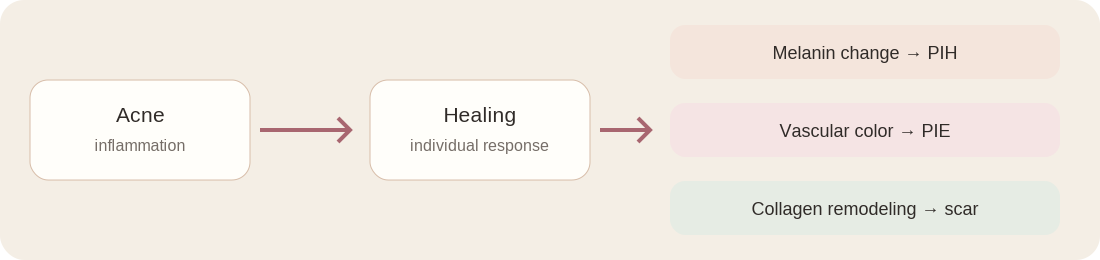
Atrophic scars reflect net tissue/collagen loss or tethering; hypertrophic scars and keloids reflect excess scar formation. Individual healing tendencies, lesion depth, duration of inflammation and picking can all contribute. No single visual clue establishes a diagnosis.
What are post-acne dark spots?
Post-inflammatory hyperpigmentation (PIH) is pigment left where inflammation or injury occurred. Inflammation can increase melanin synthesis and transfer into nearby skin cells; pigment may sit in the epidermis or, after deeper injury, in the dermis. It commonly appears as flat tan, brown, dark brown, gray or blue-gray discoloration at the site of a healed lesion. Gray tones can reflect deeper pigment. PIH changes color, not the skin’s architecture, so the surface is generally flat.
UV exposure can deepen or prolong pigment in exposed skin. Visible light can also contribute to pigmentation in some conditions and skin types; iron-oxide tinted sunscreen may add visible-light protection, but evidence and product performance vary. PIH is often gradual to improve, sometimes over months or longer, particularly when pigment is deeper or inflammation recurs. Darker skin tones are more prone to noticeable and persistent PIH on average, but individual response varies. [2] [3]
A flat mark is not automatically a scar. Treating pigment aims to reduce excess color and prevent renewed inflammation; it cannot replace lost dermal tissue.
What is post-inflammatory erythema?
Post-inflammatory erythema (PIE) describes lingering red, pink, purple or dusky color after inflammation. It is thought to involve superficial vascular changes during healing, rather than melanin alone. Redness can be harder to recognize in deeper skin tones, where it may appear violet, brownish or simply darker than baseline. PIE and PIH may coexist, and appearance alone cannot reliably distinguish them in every person. [4]
Gentle care, acne control and sun protection are sensible foundations. A clinician may discuss vascular-targeting devices for selected cases, but evidence is less robust than many marketing claims suggest, and procedures can cause irritation or pigment change. Avoid treating every red mark as a pigment spot with multiple acids.
What are true acne scars?
Structural scars alter the skin’s surface or tissue volume. Most acne scars are atrophic (depressed), reflecting collagen loss and sometimes fibrous attachment beneath the surface. Raised hypertrophic scars remain within the original injury; keloids grow beyond its borders and may continue to enlarge. A scar can coexist with color change. Topical products can support acne control and skin tone but do not reliably release tethering or rebuild deep structural defects. Scars can nevertheless be improved, often through individualized procedures. [1] [3]
Ice-pick
Narrow, deep V-shaped depression. A clinician may consider focal techniques such as TCA CROSS or punch methods; not DIY.
Schematic only; appearance cannot confirm type.Boxcar
Round/oval depression with more defined vertical edges; depth varies. Treatment choice depends on depth and surrounding skin.
Schematic only; appearance cannot confirm type.Rolling
Broad undulating depression, sometimes tethered by fibrous bands; subcision may be considered by qualified practitioners.
Schematic only; appearance cannot confirm type.Hypertrophic
Raised scar generally confined to original injury; may respond to clinician-directed scar therapies, with recurrence possible.
Schematic only; appearance cannot confirm type.Keloid
Raised overgrowth extending beyond the original injury; requires professional assessment, and treatment can recur.
Schematic only; appearance cannot confirm type.Acne scars vs dark spots vs red marks
| Feature | PIH · pigment | PIE · vascular-appearing | Structural scar |
|---|---|---|---|
| Mechanism | Melanin deposited/redistributed after inflammation | Vascular/inflammatory color change during healing | Collagen/tissue loss or excess remodeling |
| Texture | Flat | Usually flat | Depressed, tethered or raised |
| Typical appearance | Tan, brown, gray; can vary by baseline tone | Pink, red, purple or dusky | Pits, rolling depressions, sharply edged dents or raised tissue |
| Natural course | Often fades gradually; may persist | May settle gradually; variable | May soften but often persists |
| Topical skincare | May support tone; irritation can worsen it | Gentle care and acne control; pigment agents not necessarily relevant | Limited effect on established deep structural change |
| Sun protection | Helps limit UV-related darkening | Protects healing skin; not a scar correction | Supports skin health, does not fill/release scar |
| Professional options | Selected prescription topicals or carefully chosen procedures | Clinical evaluation; selected vascular treatments in some cases | Microneedling, lasers, peels, subcision, punch methods, fillers or raised-scar therapies depending on type |
| Precautions | Introduce one active; avoid unregulated lighteners | Appearance overlaps; treatment evidence varies | Procedure risks include infection, pigment change, recurrence; qualified assessment |
Color and texture can overlap. This comparison is educational and not a self-diagnosis tool.
Eight visual clues—useful, not diagnostic
- Flat versus uneven: color on a flat surface leans toward a color mark; texture change suggests structure, but overlap is common.
- Color: brown/gray can reflect melanin; pink/red/purple may reflect vascular change. Skin tone and lighting affect this.
- Depressions: visible pits may be atrophic scars; shallow shadows can also be lighting or normal pores.
- Raised areas: a persistent growing bump needs assessment; not every bump is an acne scar.
- Lighting: side lighting reveals contours, but can exaggerate ordinary texture.
- Acne history: deep, painful, prolonged lesions increase concern, but mild lesions can leave marks too.
- Change over time: fading color with stable texture suggests different process than a changing raised lesion; timelines vary.
- Active acne: recurring inflammation can create new marks while older ones fade.
These are prompts for observation—not a scoring system. Do not scrape, squeeze or aggressively stretch skin to test it.
Why post-acne marks look different across skin tones
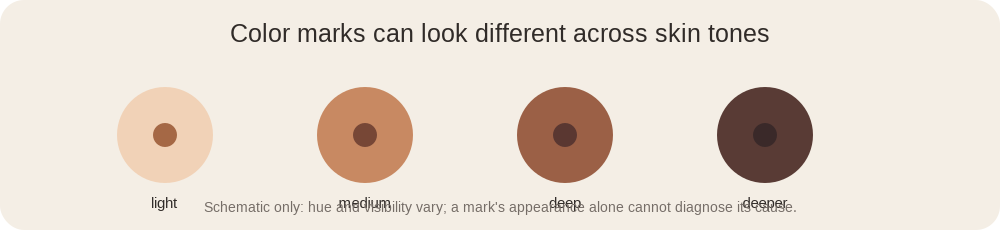
Melanin-rich skin can develop more visible or persistent PIH after inflammation, while redness may be less obviously red and may look purple, gray or brown. This is a population-level pattern, not a rule for every person. Skin tone alone cannot predict scarring or treatment response. Peels, lasers and needling can provoke post-procedure pigment changes, especially if treatment causes inflammation or is poorly matched to the individual. Seek a clinician experienced with your skin tone and the specific procedure. [2] [3] [8]
Do acne scars and dark spots fade naturally?
Flat PIH and PIE can soften over time as pigment is cleared and inflammation settles, but there is no fixed deadline. Greater depth, ongoing acne, sun exposure, irritation, treatment history and individual healing can change the course. Atrophic scars may soften somewhat, yet often remain visible without treatment. Raised scars can persist or enlarge and deserve assessment. Improvement in color does not mean the skin’s texture has been restored. [1] [2] [3]
Skincare ingredients for post-acne dark spots
Start with a tolerable routine and control active acne. Introduce only one optional active at a time, following the product label. Concentration, vehicle, stability and adherence matter; evidence for a named ingredient does not guarantee a specific cosmetic product will work. Burning or persistent irritation is not proof that a product is effective.
| Ingredient | What it may do | Evidence snapshot | Important limits |
|---|---|---|---|
| Azelaic acid | Anti-inflammatory; may help acne and pigment | Moderate, condition/formulation dependent | Irritation possible; introduce slowly |
| Vitamin C | Antioxidant; may affect pigment pathways | Limited-to-moderate; formulation-dependent | Stability and tolerability vary |
| Niacinamide | May reduce pigment transfer; barrier support | Limited-to-moderate; product data vary | Usually tolerated, but reactions occur |
| Topical retinoids | Acne control and turnover; may help PIH | Strong for acne; pigment evidence varies | Dryness/irritation; avoid during pregnancy |
| Alpha arbutin / licorice | Potential pigment-pathway effects | Limited / preliminary | Formulation-specific; avoid unsupported claims |
| Topical tranexamic acid | Pigment pathway modulation | Emerging; topical evidence limited | Discuss with clinician for persistent concerns |
| Glycolic / lactic acids | Exfoliation; may improve superficial discoloration | Some evidence, product/procedure dependent | Irritation and PIH risk if overused |
| Hydroquinone | Tyrosinase inhibition | Established prescription option in appropriate cases | US OTC skin-lightening sale not approved; clinician oversight |
| Broad-spectrum sunscreen | Limits UV-driven darkening | Strong foundation for sun protection | Find a formulation used consistently; tinted iron oxides may address visible light |
Evidence snapshot is qualitative, not a formal systematic grading. Clinical evidence varies by indication and formulation; these ingredients mainly address acne or pigment, not deep structural scars.
Prescription hydroquinone may be considered under clinician guidance. In the United States, hydroquinone skin-lightening products are not approved for over-the-counter sale; avoid unlabelled or illegally marketed lighteners and mercury-containing products. Long-term or inappropriate hydroquinone use can cause adverse effects including exogenous ochronosis. [5]
Pregnancy/breastfeeding: avoid topical retinoids during pregnancy as a precaution and discuss treatment choices with a clinician. Hydroquinone is generally avoided during pregnancy/breastfeeding due to substantial absorption and limited safety data. For prescription medicines or complex regimens, seek individualized clinical guidance; ingredient lists do not replace personalized dermatological care.
Can retinol remove acne scars?
Topical retinoids can help treat acne and may improve some post-acne pigmentation by normalizing cell turnover. Prescription retinoids have stronger evidence for acne than cosmetic retinol, and may help some superficial photoaging-related texture. They do not reliably remove deep ice-pick pits, tethered rolling scars or established raised scars. Irritation can itself worsen discoloration. Start only one retinoid product cautiously according to label or prescriber instructions; do not use topical retinoids in pregnancy without medical advice (avoid during pregnancy). Active acne treatment and structural scar treatment are related but different goals.
Why sunscreen matters
Broad-spectrum sunscreen can reduce UV-driven darkening and is a core support for managing pigment. Choose a broad-spectrum SPF 30 or higher product you can apply generously and reapply as directed, particularly outdoors. Shade, hats and clothing add protection. For visible-light-sensitive pigment concerns, a tinted product with iron oxides may help; tint is not a substitute for broad-spectrum UV protection. Sunscreen does not fill pits or release scar bands, and cannot guarantee that spots disappear. [2] [6]
What may help structural scars?
First control active acne where possible. A qualified dermatologist assesses scar type, depth, skin tone, medical history and goals. No procedure is right for everyone; combination plans may be selected. The evidence base is heterogeneous, and studies vary in methods and outcomes, so avoid guaranteed results. [1] [3] [7]
| Approach | General mechanism | Often considered for | Key limits / risks |
|---|---|---|---|
| Microneedling / RF | Controlled injury/remodeling | Some atrophic scars | Infection, irritation, pigment changes; FDA device indications are specific |
| Fractional laser | Fractional thermal remodeling | Selected atrophic scars; device-specific | Downtime, burns, PIH/hypopigmentation; skin tone and device matter |
| Chemical peels | Controlled exfoliation/resurfacing | Selected superficial scars or pigment | Irritation, burns, pigment change; clinician selection needed |
| TCA CROSS | Focal chemical remodeling | Selected narrow/deep scars | High risk if misused; must not be DIY |
| Subcision | Releases tethering bands | Selected rolling scars | Bruising, hematoma, infection, contour changes |
| Punch excision/elevation | Focal surgical revision | Selected deep or sharply defined scars | Surgical risks, wound/scar; individual assessment |
| Fillers | Temporarily adds volume | Selected atrophic scars | Vascular occlusion and other serious injection risks; licensed expert only |
| Raised-scar therapies | Silicone, injections, selected lasers or surgery | Hypertrophic/keloid scars | Recurrence, skin thinning/pigment changes; clinician-directed |
This is not a personalized recommendation or ranking. Provider qualifications, device authorization, skin tone, scar type, active acne and medical history matter.
FDA notes authorized microneedling devices have specific indications and risks, including infection and pigment changes; not every device or use is reviewed. RF microneedling has specific FDA safety communications about potential serious complications. Do not attempt home needling or use devices to deliver medicines/cosmetics into skin. [7] [8]
Why DIY scar treatments can backfire
Punctures can cause infection, pigment change and additional scarring.
Safer choice: simple barrier care, active-acne treatment and qualified assessment.Chemical burns and uncontrolled injury can leave persistent discoloration or scars.
Safer choice: simple barrier care, active-acne treatment and qualified assessment.Irritating or unsuitable pH; no reliable scar-removal evidence.
Safer choice: simple barrier care, active-acne treatment and qualified assessment.Repeated trauma can inflame skin and aggravate marks.
Safer choice: simple barrier care, active-acne treatment and qualified assessment.May conceal hydroquinone or mercury; avoid unlabeled products.
Safer choice: simple barrier care, active-acne treatment and qualified assessment.Topicals cannot reliably correct deep tissue loss; claims may be unsupported.
Safer choice: simple barrier care, active-acne treatment and qualified assessment.Gentle skincare routine templates
These are educational templates, not prescriptions. Keep the basics simple and follow product labeling.
Flat dark spots
AM: gentle cleanse or rinse; one tolerated pigment-support option; moisturizer; broad-spectrum SPF 30+. PM: cleanse; optional single active on alternate nights as tolerated; moisturizer.
Essentials: tolerate cleanser/moisturizer/sun protection. Optional actives depend on your skin and product directions.
Red marks
AM/PM: gentle cleanser, moisturizer; AM sun protection. Avoid assuming redness is pigment or adding multiple acids; seek advice if persistent.
Essentials: tolerate cleanser/moisturizer/sun protection. Optional actives depend on your skin and product directions.
Oily acne-prone + marks
AM: gentle cleanser; acne treatment only as directed; moisturizer; sunscreen. PM: cleanse; evidence-based acne treatment per label/prescriber; moisturizer. Add pigment active only when stable.
Essentials: tolerate cleanser/moisturizer/sun protection. Optional actives depend on your skin and product directions.
Sensitive skin
AM: rinse/gentle cleanser; bland moisturizer; sunscreen. PM: gentle cleanser and moisturizer. Patch-test as directed; postpone actives during irritation.
Essentials: tolerate cleanser/moisturizer/sun protection. Optional actives depend on your skin and product directions.
Established texture scars
Keep routine simple: gentle cleanser, moisturizer, sunscreen; control active acne with clinician guidance. Consult a dermatologist about texture options; serums do not replace procedures.
Essentials: tolerate cleanser/moisturizer/sun protection. Optional actives depend on your skin and product directions.
An eight-week foundation and progress-review plan
Establish gentle cleansing, moisturizer and sun protection. Pause products that sting or inflame.
If comfortable, consider one optional, appropriate active. Follow label or clinician instructions; do not add multiple actives.
Maintain consistency and review comfort, acne activity and sun habits. Simplify if irritation develops.
Review the overall trend—not daily fluctuations. Consider professional advice for persistent acne, texture change or ongoing concern.
Copyable progress-review tracker
Use occasionally if helpful; daily photos or checking are not required.
| Date | Products introduced | Skin comfort | Active acne | Pigmentation / texture | Irritation | Sun protection | Notes for clinician |
|---|---|---|---|---|---|---|---|
12 mistakes that may worsen post-acne marks
- Treating every dark spot as a structural scar. It can misclassify the concern, irritate skin, or delay useful care. Safer alternative: pause irritating products, use a sustainable routine, and seek assessment for persistent acne or texture changes.
- Expecting a serum to remove deep scars. It can misclassify the concern, irritate skin, or delay useful care. Safer alternative: pause irritating products, use a sustainable routine, and seek assessment for persistent acne or texture changes.
- Picking or squeezing acne. It can misclassify the concern, irritate skin, or delay useful care. Safer alternative: pause irritating products, use a sustainable routine, and seek assessment for persistent acne or texture changes.
- Combining several strong actives at once. It can misclassify the concern, irritate skin, or delay useful care. Safer alternative: pause irritating products, use a sustainable routine, and seek assessment for persistent acne or texture changes.
- Over-exfoliating. It can misclassify the concern, irritate skin, or delay useful care. Safer alternative: pause irritating products, use a sustainable routine, and seek assessment for persistent acne or texture changes.
- Skipping sun protection. It can misclassify the concern, irritate skin, or delay useful care. Safer alternative: pause irritating products, use a sustainable routine, and seek assessment for persistent acne or texture changes.
- Changing products every few days. It can misclassify the concern, irritate skin, or delay useful care. Safer alternative: pause irritating products, use a sustainable routine, and seek assessment for persistent acne or texture changes.
- Using harsh kitchen remedies. It can misclassify the concern, irritate skin, or delay useful care. Safer alternative: pause irritating products, use a sustainable routine, and seek assessment for persistent acne or texture changes.
- Trying invasive home treatments. It can misclassify the concern, irritate skin, or delay useful care. Safer alternative: pause irritating products, use a sustainable routine, and seek assessment for persistent acne or texture changes.
- Expecting immediate fading. It can misclassify the concern, irritate skin, or delay useful care. Safer alternative: pause irritating products, use a sustainable routine, and seek assessment for persistent acne or texture changes.
- Ignoring persistent active acne. It can misclassify the concern, irritate skin, or delay useful care. Safer alternative: pause irritating products, use a sustainable routine, and seek assessment for persistent acne or texture changes.
- Comparing real skin with filters or misleading before-and-after images. It can misclassify the concern, irritate skin, or delay useful care. Safer alternative: pause irritating products, use a sustainable routine, and seek assessment for persistent acne or texture changes.
Six hypothetical reader scenarios
PIH is one possibility. Gentle acne control, one tolerable pigment-support step and sunscreen are reasonable foundations; fading is gradual and variable.
PIE may contribute, but color alone cannot confirm it. Avoid stacking brightening acids; discuss persistent concerns with a clinician.
Ice-pick scars are one possible pattern. Topicals are unlikely to fill deep pits; dermatology assessment can review procedure options.
More than one process may coexist. Color care and scar procedures have different targets and risks.
Irritant dermatitis may be worsening the barrier and discoloration. Stop suspected irritants, simplify, and seek medical advice if severe or persistent.
Prioritize active acne care and timely evaluation; expanding raised scars may be hypertrophic or keloidal and can recur.
Post-Acne Marks & Skincare Guidance Finder
This educational guide does not diagnose skin conditions or recommend a procedure.
Choose the closest description. You may skip uncertain questions; answers stay in this browser session and are not sent or stored.
When to see a dermatologist
Consider a qualified clinician for persistent or painful/deep acne, new depressions or raised/enlarging scars, pigment that persists despite gentle care, uncertain or changing marks, severe product reactions, or interest in a procedure. Seek prompt medical assessment for a lesion that is changing, bleeding, not healing, or otherwise concerning. A clinician can help separate acne sequelae from other conditions and discuss realistic options.
- When acne and marks began, and whether lesions are painful or recurring.
- Current and recently stopped medicines, skincare products, allergies, pregnancy/breastfeeding status when relevant.
- What changes you have noticed and what outcome matters to you.
- Past procedures, pigment changes, keloids or unusual wound healing.
- Ask about diagnosis, alternatives, risks for your skin tone, recovery, number of visits, credentials, device authorization and aftercare.
Do not stop prescribed medicines without the prescriber's advice.
Frequently asked questions
What is the difference between acne scars and dark spots?
Dark spots are usually flat pigment changes; structural scars alter skin texture or volume. Red marks may involve vascular changes.
Are dark spots considered acne scars?
They are often post-inflammatory color changes rather than structural scars, though both can occur together.
What is PIH?
Post-inflammatory hyperpigmentation is increased or redistributed melanin after inflammation or injury.
What is PIE?
Post-inflammatory erythema is lingering red/pink/purple color thought to involve superficial vascular changes.
Can acne scars disappear naturally?
Color marks can fade. Structural scars may soften but often persist; improvement is possible with qualified treatment.
How long do dark spots last?
It varies with depth, skin response, sun exposure, ongoing acne and irritation; no fixed timeline applies.
Can vitamin C help post-acne marks?
Some formulations may support pigment improvement, but evidence and stability vary and it will not rebuild deep scars.
Does niacinamide help hyperpigmentation?
It may modestly support more even tone in some formulations; outcomes vary.
Can azelaic acid improve dark spots?
It may help acne and PIH for some people; use depends on tolerance and formulation.
Can retinol remove deep acne scars?
No topical retinol reliably removes deep structural scars, though retinoids can help acne and may support pigmentation.
Does sunscreen stop dark spots getting darker?
Broad-spectrum sunscreen helps limit UV-driven darkening; it cannot guarantee fading.
Can dark spots become structural scars?
Pigment itself does not turn into a scar, but the original inflammation can leave both color and structural change.
Can acne scars and dark spots coexist?
Yes. One area can have pigment plus depressed or raised texture.
Does microneedling help scars?
It may be considered for selected atrophic scars by qualified professionals; results and risks vary. FDA-authorized uses are device-specific.
Are chemical peels suitable for everyone?
No. Skin tone, scar type, medical history and peel choice affect benefit and risk, including pigment change.
Can lasers cause pigmentation changes?
Yes. Pigment changes, burns and other harms are possible; device and practitioner selection matter.
Can at-home dermarolling worsen scars?
Yes. It can cause infection, pigment changes or additional scarring. Avoid invasive home procedures.
Why do some people scar more easily?
Lesion depth, inflammation, family tendency, healing response and picking can contribute.
Can treating acne reduce future scars?
Appropriate timely acne treatment can reduce ongoing inflammation and may lower scarring risk.
When should I consult a dermatologist?
For deep/painful or persistent acne, developing scars, enlarging raised areas, persistent marks, severe reactions or procedure questions.
Final takeaway
PIH is pigment; PIE is a vascular-appearing color change; structural acne scars alter tissue texture or volume. They can occur together and call for different approaches. Gentle acne control and sun protection are useful foundations, selected ingredients may help pigment, and established structural scars may need clinician-guided procedures. No one needs perfectly smooth or mark-free skin to have healthy skin.
Medical disclaimer: This educational article is for informational purposes only and is not individualized medical advice, diagnosis, or treatment. Consult a board-certified dermatologist or licensed healthcare professional about personal symptoms, medicines, pregnancy or breastfeeding, or procedures.
References and further reading
- American Academy of Dermatology: Acne scars overview
- DermNet: Postinflammatory hyperpigmentation
- DermNet: Acne scarring
- Kalantari et al. Post-acne erythema treatment: systematic review. 2022.
- US FDA: Skin product safety
- AAD: How to decode a sunscreen label
- Cochrane: Interventions for acne scars
- US FDA: Microneedling devices
- US FDA: RF microneedling safety communication
- AAD: Skin-care habits that can help acne
- Reynolds et al. Guidelines of care for acne vulgaris. JAAD. 2024.
Evidence note: Evidence strength differs by ingredient and procedure. PIE treatment literature and comparative scar-procedure studies are limited/heterogeneous. Product-specific results cannot be inferred from ingredient names alone. Always consult a board-certified dermatologist for personalized assessment of deep or persistent scarring.
Related Hailey Morgan reading
Vitamin C vs Niacinamide. Other master guides: Skin Purging vs Breakouts, AHA vs BHA vs PHA, Mineral vs Chemical Sunscreen, and Healthy vs Damaged Skin Barrier.
Recommended Skincare Essentials
Lifts impurities without stripping vulnerable healing skin; formulated with 3 essential ceramides and hyaluronic acid.
View on Amazon ↗First-line topical active for visibly brightening post-acne dark spots (PIH) and calming vascular redness (PIE).
View on Amazon ↗Supports barrier recovery and inhibits melanosome transfer, helping reduce visible post-inflammatory marks.
View on Amazon ↗10% pure L-ascorbic acid with ceramides; helps fade uneven pigmentation and shields skin against oxidative damage.
View on Amazon ↗Non-comedogenic barrier cream with prebiotic thermal water, ceramide-3, and glycerin to comfort healing tissue.
View on Amazon ↗Zinc oxide sunscreen with niacinamide; indispensable for preventing UV light from permanently darkening post-acne marks.
View on Amazon ↗Affiliate disclosure: As an Amazon Associate I earn from qualifying purchases. Affiliate relationships do not determine medical guidance. All product links comply with FTC guidelines.