“Skin purging” is a popular label for temporary acne-like worsening after starting certain acne actives, especially topical retinoids, but timing alone cannot confirm it—and not everyone experiences it. New spots may instead be ordinary acne, product-related clogging, irritation, or an allergic reaction; burning, itch, swelling, or a rash are reasons to reassess rather than push through.
- A retinoid can cause irritation; early acne flaring is possible for some people but not inevitable.
- Usual locations and timing are clues, not diagnostic laboratory tests.
- Never add more strong actives to “compensate” for sudden worsening.
- Severe allergy symptoms—trouble breathing, faintness, or facial/throat swelling—are a medical emergency.
What is skin purging?
“Purging” is a consumer skincare term, not a formal medical diagnosis with a standard test or agreed-upon time limit. It is commonly used to describe a short-lived increase in visible acne lesions after starting a product that speeds follicular turnover or helps unclog pores. Topical retinoids normalize follicular shedding and are evidence-based acne treatments. That biological mechanism makes the idea plausible, but it does not prove that each new pimple is a hidden clog being “brought to the surface.”
Clinical evidence for a predictable purge is limited. A review of three older randomized trials involving a specific tretinoin/clindamycin formulation found early lesion increases in a subset using tretinoin alone, particularly participants with mild acne; most people did not meet the study’s flare threshold. The study measured lesion counts at two weeks and cannot predict an individual’s reaction to every modern retinoid or cosmetic product.
So treat “purging” as one possible explanation—never as a reason to ignore persistent burning, a spreading rash, or steadily worsening cystic acne.
What is an acne breakout?
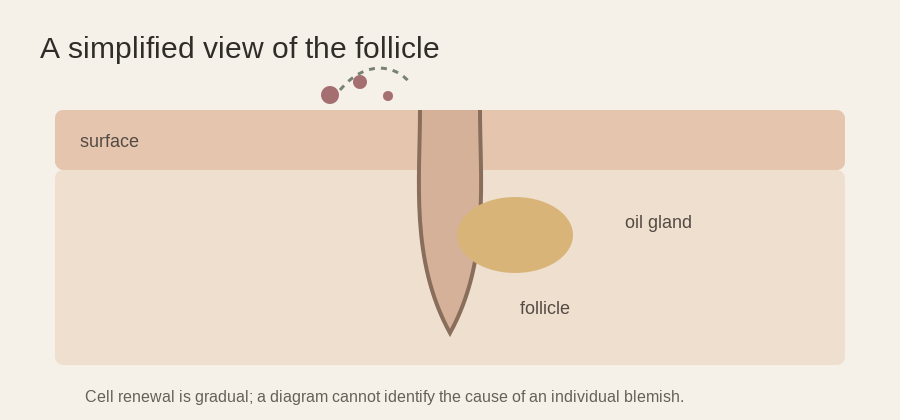
Acne develops when hair follicles become plugged with sebum and dead cells and subsequently become inflamed. Oil production, follicular shedding, Cutibacterium acnes bacteria, and immune response all contribute; hormones, some medications, occlusive products, friction, and genetics influence flares. Blackheads and whiteheads are noninflammatory comedones; papules, pustules, and deeper nodules reflect inflammation of varying depth.
A new moisturizer or sunscreen does not automatically “cause acne,” but a particular formulation may not suit your skin type. Hormonal variation and the natural waxing and waning of acne can also coincide with a new routine. No single visual clue can reliably identify the cause without considering your complete skincare history.
Skin purging vs breakouts: detailed comparison
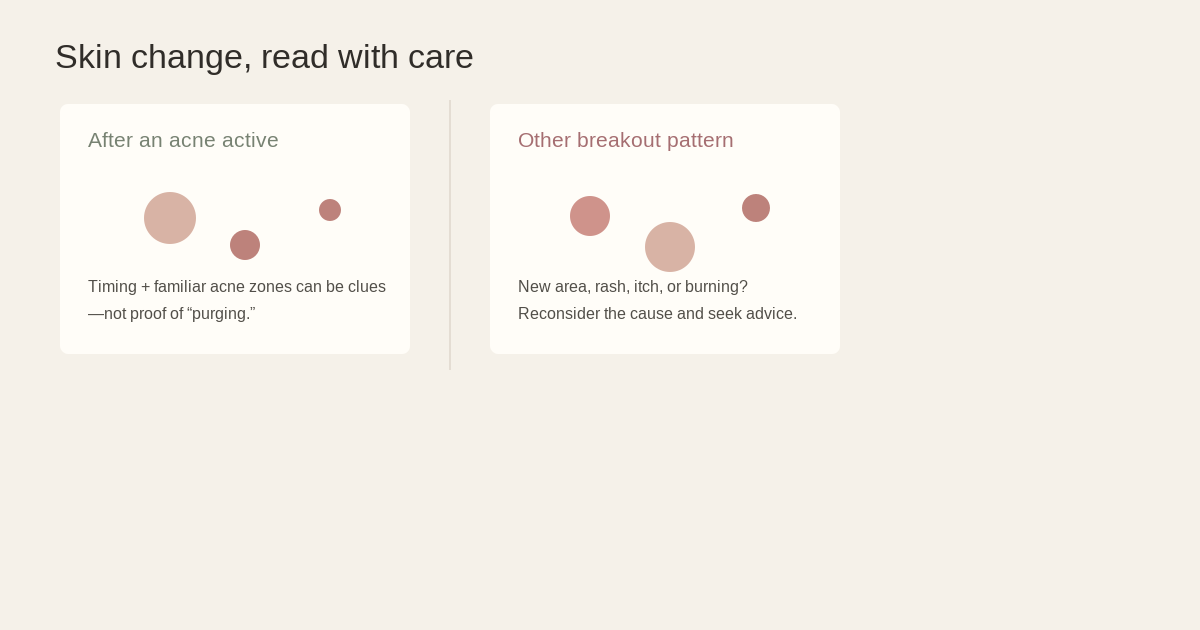
Use this as a pattern guide, not a diagnostic checklist. More than one process can happen simultaneously—for example, preexisting acne plus barrier irritation from an aggressive routine.
| Clue | Possible active-related worsening | Ordinary breakout / product trigger | Irritation or allergy |
|---|---|---|---|
| Possible cause | Acne continues to evolve while an acne active begins working; “purge” is not a formal diagnosis. | Usual acne biology, hormonal shifts, occlusion, friction, or a product that does not suit you. | Direct irritation, barrier disruption, or less commonly delayed contact allergy. |
| Timing | May follow initiation or increased use of a pore-targeting acne active; no universal clock. | Can occur at any time; timing may track hormones, stressors, or a new product. | Irritation may start quickly or accumulate; allergic contact dermatitis often appears 24–72 hours after exposure. |
| Location | Often familiar acne-prone zones, but location alone cannot confirm cause. | May appear in new or usual areas; occlusive hair or skin products can affect contact zones. | Often where product touches; may spread beyond contact area. |
| Appearance / sensation | Acne-like blackheads, whiteheads, papules or pustules; significant rash or burning is not reassuring. | Mixed acne lesions, sometimes new comedones or inflamed spots. | Dryness, scaling, redness or darker patches, burning/stinging; allergy can be itchy, swollen, blistered or weepy. |
| What next? | If mild and tolerable, follow label/prescriber directions; track the trend and avoid stacking actives. | Review the new product and other triggers; stop a nonessential suspected product and reassess gently. | Pause suspected non-prescription trigger; simplify routine; seek advice for marked/persistent symptoms. |
| Get help if | Painful deep lesions, scarring, persistent worsening, or uncertainty about prescription treatment. | Persistent, severe, painful acne or significant distress. | Blistering, facial/eye swelling, severe reaction, infection-like signs; emergency symptoms require emergency care. |
Seven clues that may help you tell the difference
1. What kind of product changed?
Beginning a retinoid or exfoliating acne treatment makes an active-related response more plausible than starting a basic humectant—but it still does not establish a purge.
2. Where are the spots?
Spots in your familiar acne zones fit an acne pattern. A brand-new distribution may point to another trigger or contact reaction. Location is only a clue.
3. Is it acne-like or rash-like?
Blackheads, whiteheads, or individual inflamed pimples look different from broad patches of scale, swelling, blisters, or weeping. Rashes deserve a different response.
4. What does it feel like?
Mild dryness can occur with actives. Persistent burning, marked stinging, itching, cracking, or pain suggests irritation or an allergic reaction—not a beneficial purge.
5. Does it match your history?
Recurring blemishes in your usual places may be your baseline acne resurfacing. First-time bumps in a contact area deserve a closer look at the whole product formula.
6. Is the trend settling or escalating?
Track weekly rather than judging each morning. A persistent climb in painful lesions or a new rash is not a signal to add more product.
7. Are there warning signs?
Deep pain, scarring, infection-like warmth and swelling, widespread blistering, or eye involvement calls for professional medical advice. Breathing symptoms are urgent.
Ingredients that may be associated with temporary worsening
Products that accelerate cell turnover or target pore clogs can coincide with early changes. They can also cause barrier irritation:
- Retinoids: retinol, retinaldehyde (retinal), adapalene, and prescription tretinoin normalize follicular shedding. Dryness, peeling, redness, and mild burning can occur. Prescription use should follow your prescriber’s guidance.
- AHAs: glycolic and lactic acids exfoliate the skin surface. They may irritate when layered or used too frequently; they are not interchangeable with prescription acne treatment.
- BHAs / salicylic acid: salicylic acid penetrates into pores to help unclog them. It can still irritate sensitive or over-exfoliated skin.
- Other exfoliants: enzyme exfoliants and physical scrubs can cause friction irritation. Scrubbing harder does not clear acne faster.
Never introduce a retinoid, chemical acid, benzoyl peroxide, and a new cleanser all at once. If pregnant or breastfeeding, check with your clinician before using acne medications; topical retinoids are generally avoided during pregnancy as a precaution.
Ingredients not usually expected to cause “purging”
Hyaluronic acid, glycerin, ceramides, and niacinamide are not cellular-turnover retinoids or exfoliating acids. They are not expected to cause a turnover-related purge. A breakout after using them usually relates to another ingredient in the vehicle, formulation incompatibility, or random chance.
Purging vs irritation vs allergic reaction
| Pattern | Common clues | Safer response |
|---|---|---|
| Acne / possible early active response | Individual comedones or pimples; may occur in usual zones. No reliable self-diagnostic rule. | Use only as directed; simplify and monitor. Discuss persistent worsening with a clinician. |
| Irritant dermatitis | Burning or stinging, dryness, scaling, tightness; often tracks dose, frequency, or combinations. | Pause non-prescription irritants, use gentle barrier care, and seek advice if severe or persistent. |
| Allergic contact dermatitis | Often itchy eczematous rash; may swell, blister, or weep. Delayed contact allergy commonly appears 24–72 hours after exposure. | Stop suspected product and seek clinical assessment, especially for facial or eye swelling. |
How long does skin purging last?
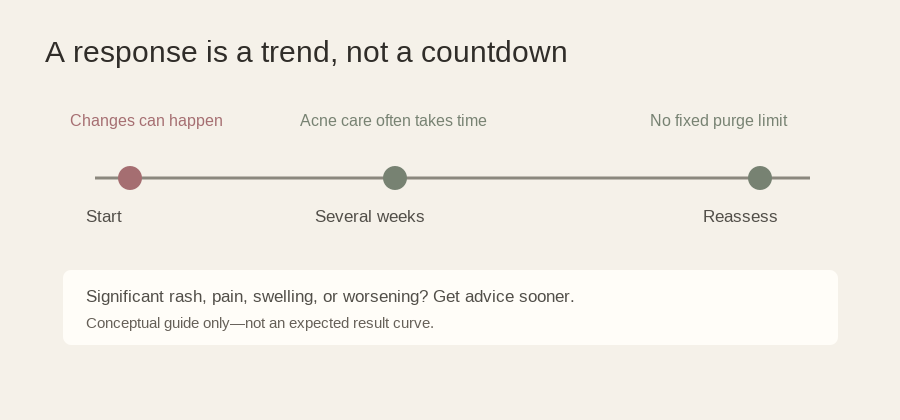
There is no verified universal duration because “purging” is not a standardized clinical diagnosis. The American Academy of Dermatology (AAD) notes that acne treatments typically take at least 4–6 weeks to show noticeable improvement and two to three months or longer to clear substantially. Those are general treatment-response timelines, not a required purge period and not a reason to tolerate escalating irritation.
Skin Purging or Breakout? — Skincare Response Checker
Choose the closest answer. Your choices stay in this browser session only; nothing is saved or sent.
Continue, reduce, stop, or get advice?
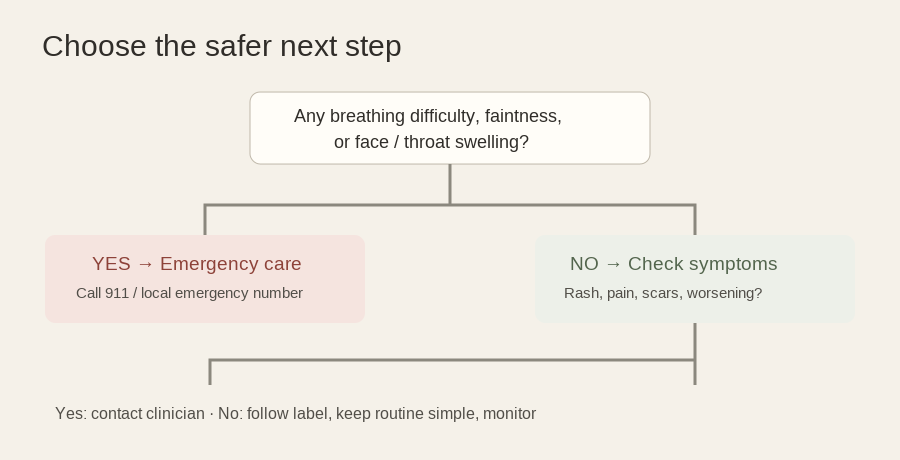
- Continue cautiously: only if symptoms are mild, the product is appropriate, and you are following directions. Do not increase frequency because results feel slow.
- Reduce or simplify: for mild dryness, simplify the routine and consider buffering with a gentle moisturizer.
- Stop a non-prescription new product: if you develop persistent burning, an itchy rash, marked swelling, or worsening irritation.
- Seek professional advice: for painful deep cystic acne, scarring, or uncertainty about a prescription.
- Emergency care: trouble breathing, faintness, throat tightness, or facial/lip/tongue swelling requires immediate emergency medical help.
A gentle routine during temporary acne worsening
The simpler your routine, the easier it is to isolate triggers. Use these copy-and-use templates as a supportive starting point:
Morning · copy-and-use template
- Gentle cleanse (or rinse with lukewarm water if cleansing leaves skin tight).
- Moisturizer suited to your skin; “non-comedogenic” is a useful label, not a guarantee for every person.
- Broad-spectrum SPF 30 or higher. Use shade and protective clothing too.
Evening · copy-and-use template
- Remove makeup and cleanse gently.
- If an active is appropriate for you, use it only as directed. Add one new active at a time.
- Apply moisturizer; do not add more exfoliants to “speed up” results.
Common mistakes that can make skin problems worse
Adding several actives at once
Fix: Introduce one new treatment at a time so you can clearly identify any irritation or allergy trigger.
Over-exfoliating
Fix: Stop the scrub-and-acid stacking; use only as labeled and protect the skin moisture barrier.
Picking or squeezing
Fix: Leave blemishes alone; picking increases deep inflammation and scarring risk. A hydrocolloid patch may protect a superficial spot.
Ignoring persistent irritation
Fix: Do not interpret burning or an itchy rash as “working.” Pause non-prescription suspects immediately.
Calling every breakout a purge
Fix: Check active ingredients, location, symptoms, and weekly trend—and accept that the cause may be regular acne.
Switching products every few days
Fix: Avoid rapid product hopping. Acne treatments require weeks to properly assess.
Four realistic scenarios
New retinoid, familiar small pimples
Jordan begins adapalene and notices a few more comedones on the forehead. There is mild dryness but no burning rash. Jordan continues moisturizing, avoids adding extra acids, and tracks progress over 6 weeks.
Breakouts after a new rich moisturizer
Riley starts a rich moisturizer and develops bumps on the cheeks where breakouts are rare. A moisturizer does not cause a retinoid-style purge. Riley pauses the new cream and returns to a lightweight lotion.
Multiple exfoliants, burning and flaking
Sam combines a retinoid, glycolic toner, and salicylic wash. The skin stings with water and peels. This is barrier disruption and irritation, not a purge. Sam pauses all non-prescription actives and focuses on barrier repair.
Swelling after a new face product
Casey develops an itchy, swollen rash around the eyes after trying a new cosmetic. Casey stops the product and seeks prompt clinical assessment for allergic contact dermatitis.
Thoughtful routine essentials
Affiliate disclosure: As an Amazon Associate, Hailey Morgan earns from qualifying purchases. The recommendations below are gentle, dermatologist-loved staples selected for simple, barrier-supportive routines.
CeraVe Hydrating Facial Cleanser
A low-fragrance, non-abrasive cleanser that supports barrier comfort without stripping moisture.
May suit: Skin that feels tight or sensitive after washing
Keep in mind: No cleanser can treat every cause of acne; stop if it stings or irritates.
La Roche-Posay Double Repair Face Moisturizer
Prebiotic thermal water + ceramide-3 help reduce dryness and peeling from active treatments.
May suit: Skin that feels dry, tight or flaky during retinoid use
Keep in mind: Formulations vary; “non-comedogenic” is not an absolute guarantee for everyone.
EltaMD UV Clear Broad-Spectrum SPF 46
Calming zinc oxide sunscreen with niacinamide that protects UV-sensitized skin without clogging pores.
May suit: Daily exposed skin; especially essential when using retinoids or AHAs/BHAs
Keep in mind: Follow label directions; reapply every 2 hours when outdoors.
Mighty Patch Original Hydrocolloid Acne Patches
Medical-grade hydrocolloid covers individual surface spots and discourages touching or picking.
May suit: A small surface blemish or whitehead
Keep in mind: Does not treat underlying acne; avoid on irritated, infected, or deep cystic lesions.
Frequently asked questions
Does skin purging actually exist?
People may notice acne lesions change after starting certain treatments, but “purging” is not a dependable diagnosis or guaranteed phase. Controlled retinoid data suggest early flaring can occur in a subset, while most participants did not flare. Irritation and ordinary acne variation are other explanations.
Which ingredients can be associated with temporary worsening?
Acne medicines that normalize follicular plugging—especially topical retinoids such as adapalene or tretinoin—are most often discussed. AHAs and BHAs can irritate, particularly when overused. Do not assume every blemish after an active is purging.
Can retinol cause purging?
Retinol is a cosmetic retinoid, but products vary in strength and formulation. Acne-like changes may coincide with use, but irritation, an unrelated breakout, or a product trigger may be responsible.
Can hyaluronic acid or niacinamide cause purging?
These are not established acne-clearing retinoids or exfoliants that would be expected to cause purging. A breakout after a product containing them may reflect another ingredient, the formulation, or coincidence.
How long should I wait?
There is no universal purging duration. AAD notes acne treatments often need at least 4–6 weeks before improvement and 2–3 months or longer for clearer skin; that is an acne-treatment response timeline, not permission to endure worsening, rash, or severe irritation.
Should I stop using a retinoid if I break out?
Do not stop or change a prescription plan without consulting the prescriber unless you suspect a serious reaction; seek prompt advice for significant symptoms. For over-the-counter products, pause if irritation is marked and use directions carefully.
Is peeling a sign of purging?
Peeling is more consistent with irritation or dryness than proof of acne “purge.” Persistent burning, rawness, cracking, swelling, itch, or rash means do not push through.
Can moisturizer cause acne?
Some skincare products can trigger breakouts in some people. Non-comedogenic or oil-free labels may help guide selection but cannot guarantee an individual response.
Can salicylic acid cause purging?
Salicylic acid is an acne treatment and can exfoliate inside pores, but evidence does not let someone diagnose a “purge” from timing alone. Irritation from too much or too frequent use can mimic worsening.
What if new spots appear somewhere I never break out?
That makes a simple active-related explanation less certain. Consider the product, contact area, friction, hair products, and other changes; seek clinical advice if it persists or is unusual.
Can I use retinoids during pregnancy?
Ask your clinician. As a precaution, avoid topical retinoids during pregnancy; prescription instructions and individual circumstances matter. Do not start or stop prescribed medicine without professional guidance.
When is an allergic reaction an emergency?
Call 911 or your local emergency number for breathing difficulty, faintness, throat tightness, or swelling of the eyes, face, lips, or tongue after using a product.
When should I see a dermatologist?
Arrange evaluation for deep painful acne, scarring, persistent worsening, acne not responding to appropriate self-care, infection-like signs, or meaningful emotional distress.
Final takeaway
A few new spots after starting a potent active do not definitively reveal why they appeared. Retinoids may coincide with early acne flaring in some individuals, but an itchy rash, persistent stinging, or steadily worsening painful cysts should never be dismissed as purging. Keep your routine simple, track changes weekly, follow instructions, and consult a dermatologist when symptoms are significant.
Medical disclaimer: This article is for general education, not diagnosis or individualized medical care. Follow product labels and your prescriber’s advice. Seek emergency care for breathing difficulty, faintness, or facial/throat swelling.
References
- Leyden JJ, et al. Retinoid-Induced Flaring in Patients with Acne Vulgaris: Does It Really Exist? J Clin Aesthet Dermatol. 2008. Full text at PubMed Central.
- American Academy of Dermatology (AAD). Acne: Diagnosis and treatment.
- DermNet. Acne vulgaris clinical presentation and pathology.
- Mayo Clinic. Acne: Symptoms, triggers, and causes.
- American Academy of Dermatology. 9 things to try when acne won’t clear.
- DermNet. Allergic contact dermatitis: Diagnosis and patch testing.
- American Academy of Dermatology. Treatment timing and acne self-care.
- Mayo Clinic. When to see a doctor and emergency allergy symptoms.
- Reynolds RV, et al. Guidelines of care for the management of acne vulgaris. J Am Acad Dermatol. 2024.
Related guides: Skin Irritation vs. Allergic Reaction · Retinol vs. Retinal · AHA vs. BHA vs. PHA