Mineral Sunscreen vs Chemical Sunscreen: What's the Difference?
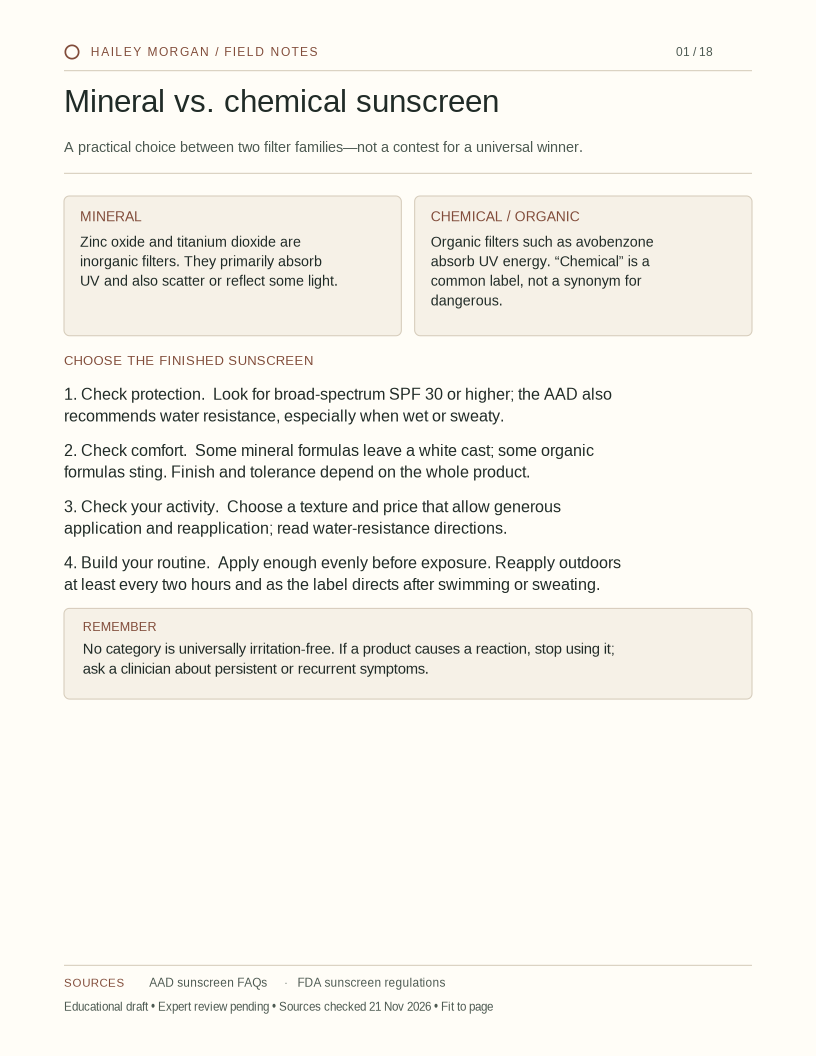
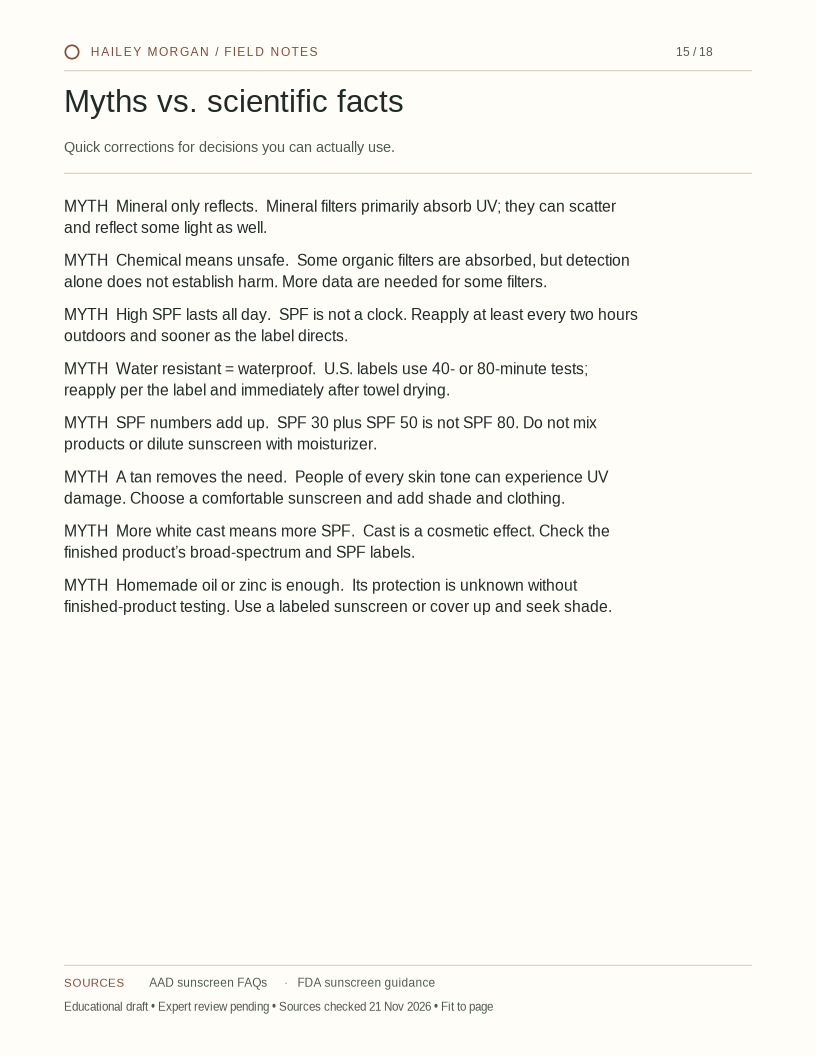
Quick answer: Mineral sunscreen uses inorganic ultraviolet (UV) filters such as zinc oxide and titanium dioxide; chemical sunscreen uses organic UV filters. Both primarily absorb UV, and mineral particles can also scatter and reflect light. An appropriately formulated, tested and consistently applied broad-spectrum sunscreen can work well in any category; choose one that fits your skin, activities and budget. AAD sunscreen FAQs 1
Mineral, chemical and hybrid: the practical comparison
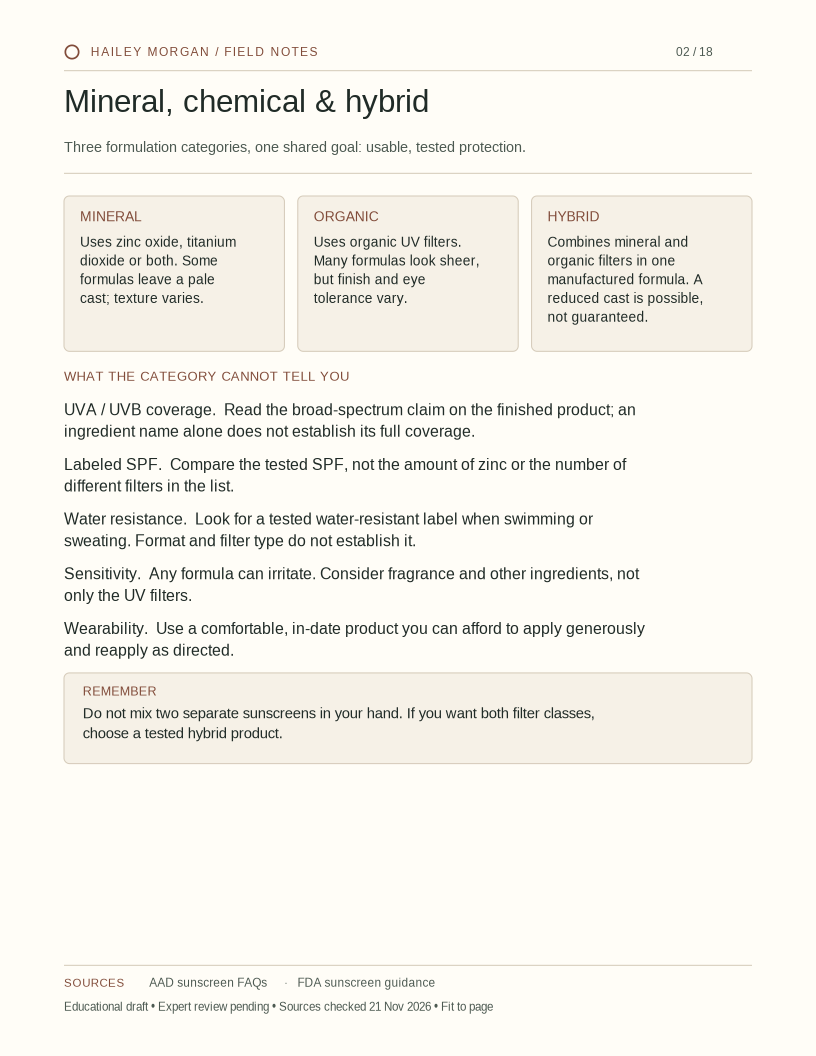
A sunscreen is not just its headline filter: the complete formula determines whether it forms a uniform film, feels comfortable, stays on during an activity and meets its labeled testing requirements. “Chemical” is a conventional marketing term for organic filters; it does not mean unsafe, and mineral ingredients are chemical substances too. A hybrid combines inorganic and organic UV filters. AAD sunscreen FAQs 1
| Question | Mineral | Chemical or organic-filter | Hybrid |
|---|---|---|---|
| Common actives | Zinc oxide, titanium dioxide | Avobenzone, octocrylene and other permitted organic filters | At least one mineral and one organic filter |
| Main mechanism | Primarily UV absorption; particles can also scatter and reflect light | Organic molecules absorb UV and dissipate the energy | Both classes contribute, according to the formulation |
| UVA and UVB | Coverage depends on the combination and finished-product test | Coverage depends on filters and finished-product test | Coverage depends on filters and finished-product test |
| Broad spectrum and SPF | Possible; verify label | Possible; verify label | Possible; verify label |
| Photostability | Depends on particles, coatings and formula | Depends on filters and stabilizing formula | Depends on the complete formula |
| Visible finish and skin tone | Some leave white cast, especially on deeper skin; tint and dispersion vary | Many are less visibly white, though finish varies | May reduce white cast, but not guaranteed |
| Sensitive skin and eyes | May suit some people; other ingredients can still irritate | Some formulas sting or irritate; others may be tolerated | Tolerance is product-specific |
| Acne-prone skin | Look at the whole vehicle and individual tolerance | Look at the whole vehicle and individual tolerance | Look at the whole vehicle and individual tolerance |
| Water resistance | Possible only when tested and labeled | Possible only when tested and labeled | Possible only when tested and labeled |
| Application | Apply enough evenly, follow directions, reapply outdoors | Same | Same |
| Environmental evidence | Not automatically harmless to aquatic life | Impact depends on ingredient, exposure and context | Impact depends on complete formulation and exposure |
| Cost | Prices vary; higher price does not prove greater protection | Same | Same |
In the United States, the AAD recommends broad-spectrum SPF 30 or higher and water resistance. Broad-spectrum labeling tells you the finished product passed the applicable UVA/UVB test; a large SPF or ingredient percentage by itself cannot tell you the complete UVA performance. AAD sunscreen FAQs 1 FDA consumer guidance 2
The evidence hierarchy matters. Randomized human trials can inform clinical outcomes; standardized tests measure labeled product performance; laboratory experiments illuminate mechanisms but may not reproduce ordinary use; and early or manufacturer-sponsored work needs careful interpretation. Claims such as “chemical-free,” “blocks 100%,” “one application lasts all day,” and “guaranteed reef-safe” are not established by those phrases alone.
How sunscreen protects your skin
Sunscreen reduces the ultraviolet radiation that reaches skin. A broad-spectrum product helps protect against both UVA and UVB, but sunscreen is only one part of sun protection. Shade, protective clothing, a wide-brimmed hat and UV-protective sunglasses matter too. The American Academy of Dermatology recommends a broad-spectrum, water-resistant sunscreen with SPF 30 or higher. 1 2
UVA, UVB and UVC
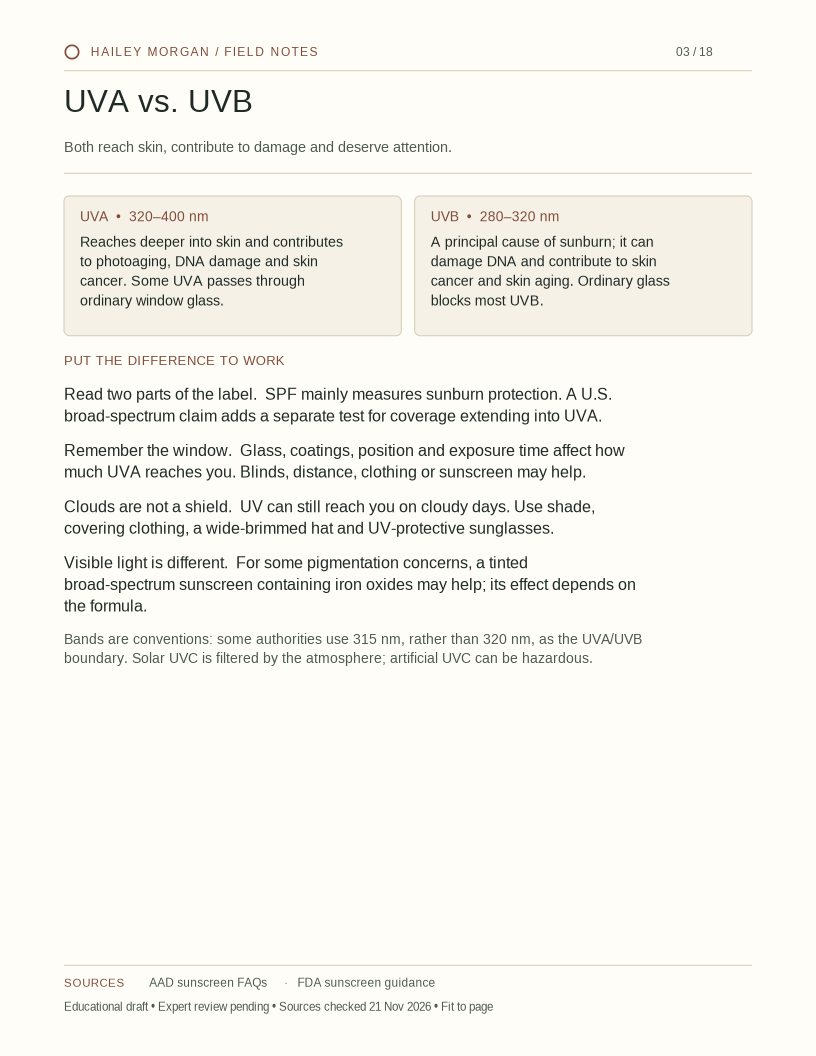
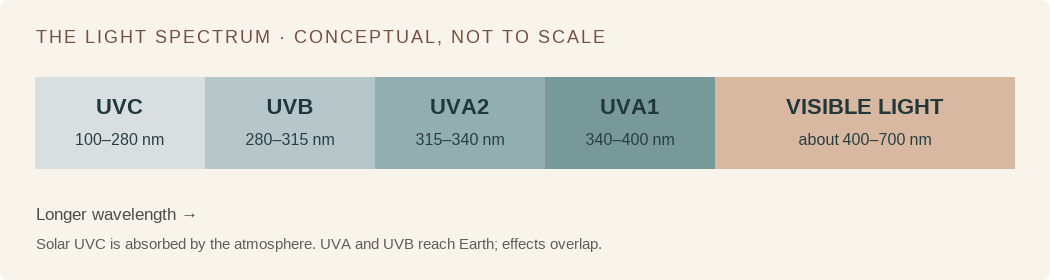
Ultraviolet radiation is divided by wavelength, measured in nanometers (nm). A commonly used dermatology convention describes the bands this way: 3 4
- UVA1: 340–400 nm. These longer UVA wavelengths reach deeper into the skin and contribute to photoaging and other damage.
- UVA2: 320–340 nm. These shorter UVA wavelengths also contribute to skin damage.
- UVB: 280–320 nm. UVB is the principal cause of sunburn and contributes to skin cancer and skin aging.
- UVC: 100–280 nm. The atmosphere filters out solar UVC before it reaches the ground. Artificial UVC sources can still be hazardous.
The boundaries are conventions, not abrupt changes in how radiation behaves. The World Health Organization uses 315 nm rather than 320 nm as the boundary between UVB and UVA; both conventions appear in scientific and health guidance. 3 5
UVB can be absorbed directly by DNA and create lesions such as cyclobutane pyrimidine dimers. If damage is not correctly repaired, mutations can result. UVA can reach deeper layers of skin and can generate reactive molecules that damage cellular components, including DNA. It can also produce DNA lesions such as pyrimidine dimers; it is misleading to say UVA causes only indirect damage or that UVB is the only cancer-relevant UV. In an experiment using reconstructed human skin, UVA1 produced both oxidative stress and detectable DNA lesions. 4 6 7
Visible light and windows
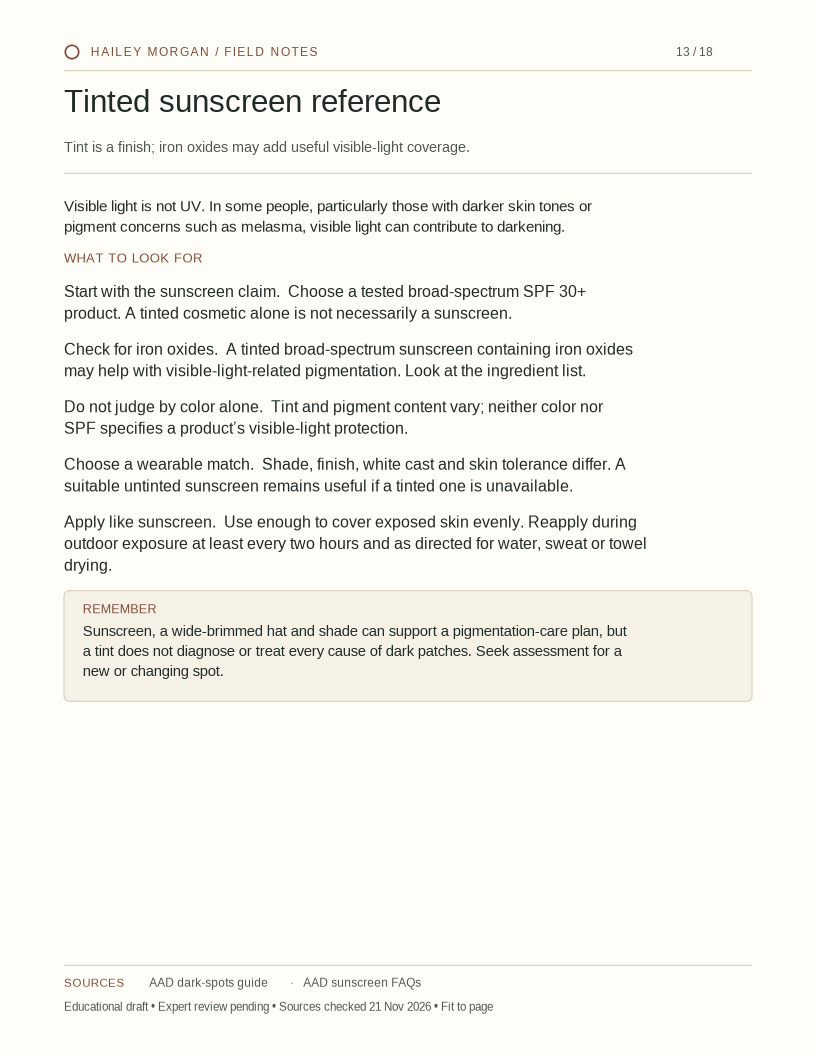
Visible light is not UV. In some people, especially those with darker skin tones or pigment conditions such as melasma, visible light can contribute to persistent darkening. If this is a concern, a tinted broad-spectrum sunscreen containing iron oxides may help, alongside shade and clothing. In a small controlled study of 10 women with Fitzpatrick skin phototype IV, two iron-oxide-containing formulations reduced visible-light-induced pigmentation more than an untinted mineral SPF 50+ comparator. Results depend on the complete product; a tint or an SPF number alone does not quantify visible-light protection. 1 8
Ordinary window glass blocks most UVB, but some UVA can pass through. The amount varies with the glass, coatings and films. Laminated windshields generally provide more UVA protection than many side windows, though individual vehicles differ. In a study of 34 vehicles, researchers found substantial differences in UVA attenuation between front windshields and side windows. Consider sun protection when spending prolonged time next to a sunny window or driving; the actual exposure depends on the situation. 9 10
How sunscreen filters work
Sunscreen spreads a layer containing UV filters over the skin. Organic filters, often called chemical filters, absorb UV energy and dissipate it through molecular processes, including release as a negligible amount of heat. Different filters cover different wavelength ranges, so formulas often combine them. Mineral filters, commonly called physical filters, include zinc oxide and titanium dioxide. They also absorb UV; their particles can scatter and reflect light as well. 1 11 12
The familiar claim that mineral filters work only by reflecting UV is inaccurate. In an optical study of zinc oxide and titanium dioxide, UV protection came primarily from absorption rather than reflection or scattering. The balance depends on the material, particle characteristics, wavelength and formula, so it should not be reduced to a universal percentage. 11 13
Zinc oxide and titanium dioxide are not interchangeable. Zinc oxide generally provides broader UVA coverage, while titanium dioxide is particularly effective in UVB and shorter-wavelength UVA. Particle size and the rest of the formulation matter. Check the finished product for a broad-spectrum claim rather than assuming a particular ingredient guarantees a particular level of protection. Some mineral formulas can leave a visible white cast; tinted or differently formulated options may be more wearable for some skin tones. 1 13
Film formation and photostability
The active ingredients work as part of a finished formulation, not as a list of isolated ingredients. When sunscreen is spread, it forms a film over an uneven skin surface. Missed patches and thin areas can let more UV through. In an experimental study on a skin-like biological surface, formulas with the same UV filters produced different film-thickness distributions and different in-vitro SPF results. Using enough product and spreading it evenly are therefore important. 14 15
Avobenzone is an organic UVA filter that can degrade when exposed to light. Formulators can improve its stability by combining ingredients and choosing an appropriate vehicle. For example, octocrylene improved avobenzone photostability in particular experimental combinations, but the behavior of the finished formula depends on the complete mixture. An ingredient list alone cannot establish a product's photostability, and the presence of avobenzone is not by itself a reason to reject a broad-spectrum sunscreen. 16 17
What SPF means
SPF is a measure of sunburn protection, not a timer. In the standard U.S. test, researchers compare the UV dose needed to produce a just-visible redness response on sunscreen-protected skin with the dose needed on unprotected skin. The product is applied as evenly as possible at 2 milligrams of finished sunscreen per square centimeter of skin, and redness is assessed 16–24 hours after exposure. Sunburn is driven mainly, but not exclusively, by UVB. 15 18
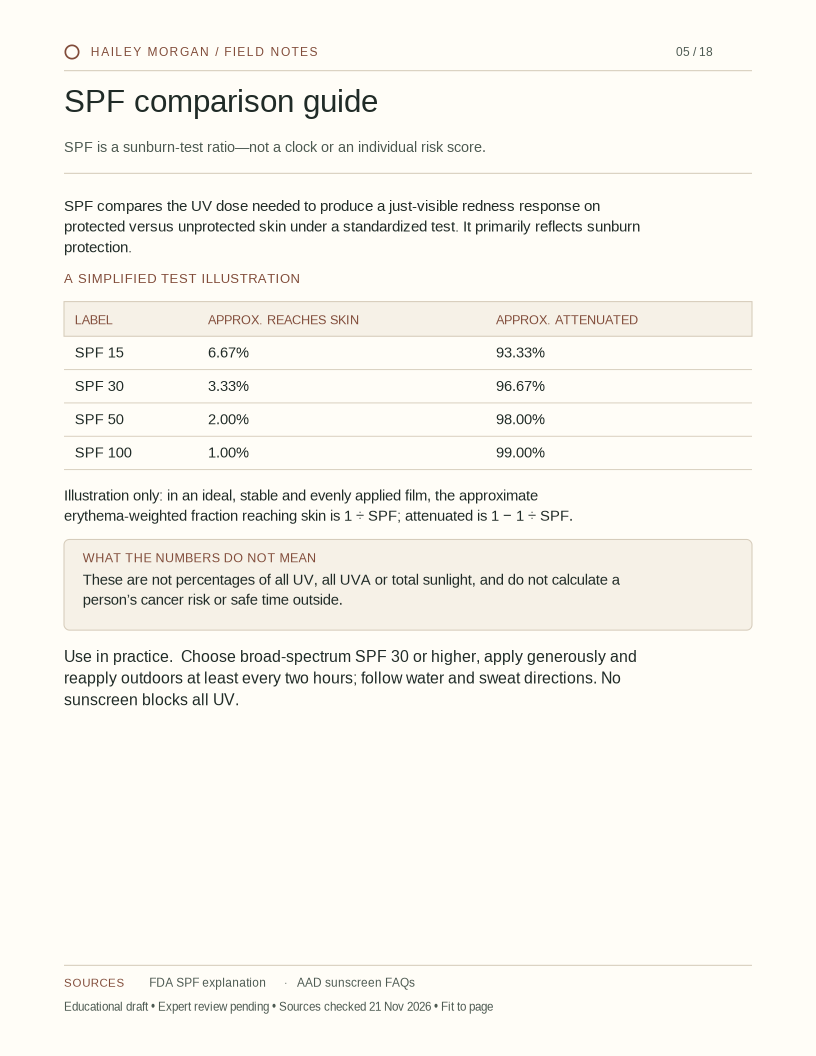
A useful approximation is to imagine a stable, evenly applied film and the same test light spectrum. In that simplified model, the fraction of erythema-weighted UV reaching the skin is approximately 1 ÷ SPF, compared with unprotected skin. The corresponding fraction attenuated is approximately 1 − 1 ÷ SPF. The following are calculated illustrations, rounded to two decimal places: 18 19
- SPF 15: approximately 6.67% reaches the skin; 93.33% is attenuated.
- SPF 30: approximately 3.33% reaches the skin; 96.67% is attenuated.
- SPF 50: approximately 2.00% reaches the skin; 98.00% is attenuated.
- SPF 70: approximately 1.43% reaches the skin; 98.57% is attenuated.
- SPF 100: approximately 1.00% reaches the skin; 99.00% is attenuated.
These are not literal percentages of every UV wavelength, all UVA, total sunlight or an individual's cancer risk. SPF is an in-vivo redness-based dose ratio, not a direct measurement of overall light transmission. The approximation assumes the relevant erythema-weighted spectrum and ideal test conditions; real protection changes with the product, coverage, wear and exposure. Under the simplified comparison, SPF 100 lets through about half as much erythema-weighted UV as SPF 50, even though the difference in the percentages attenuated is one percentage point. Neither blocks all UV. 18 19
Applying a thinner or patchy layer can lower the protection achieved. In a small study comparing application amounts, measured SPF fell when less sunscreen was applied, and the result was difficult to predict precisely. There is no reliable shortcut that turns the labeled SPF into a personal safe number of minutes outdoors: UV intensity, exposure, application and wear all vary. 15 19
What “broad spectrum” adds
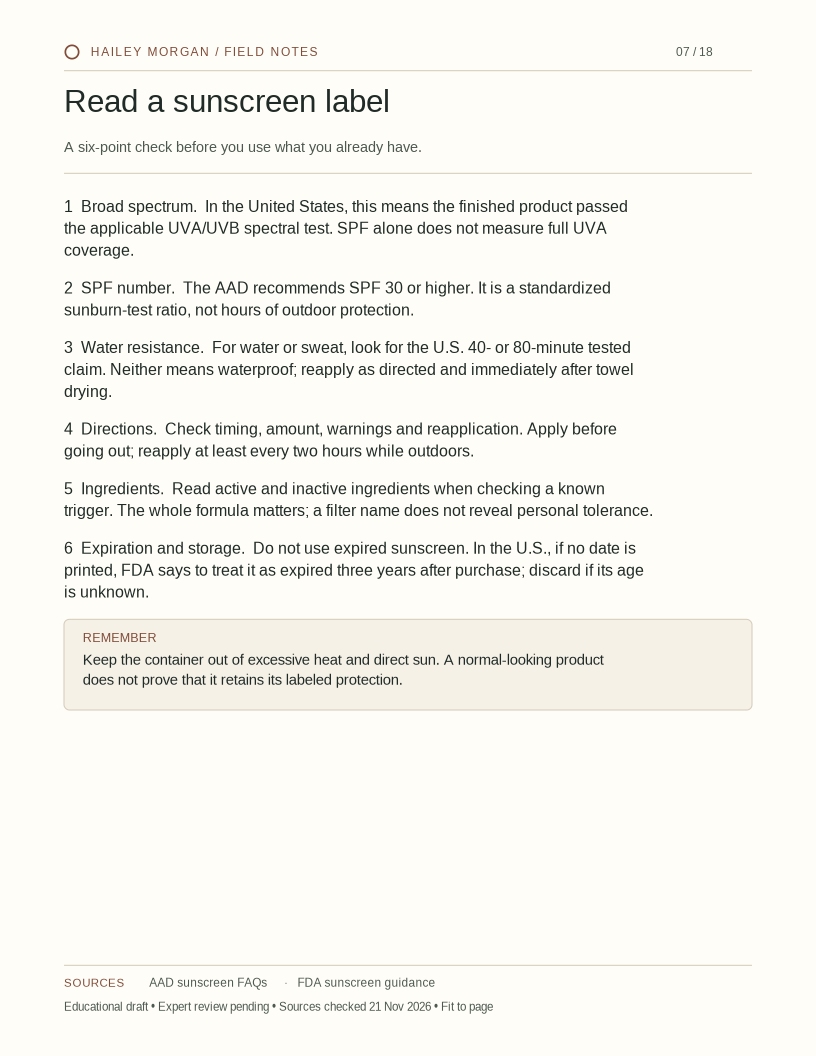
SPF alone does not tell you the amount of UVA protection. In the United States, a sunscreen labeled Broad Spectrum must pass a separate laboratory test of its UV absorbance profile. The test requires a critical wavelength of at least 370 nm. This indicates that protection extends into UVA; it is not a claim that the product blocks every wavelength or specifies a numerical UVA protection factor. Rules and labels can differ outside the United States. 2 18
U.S. broad-spectrum sunscreens with SPF 15 or higher may claim that, when used as directed with other sun-protection measures, they reduce the risk of skin cancer and early skin aging caused by the sun. The AAD's practical recommendation is SPF 30 or higher. 1 18
How to apply and reapply
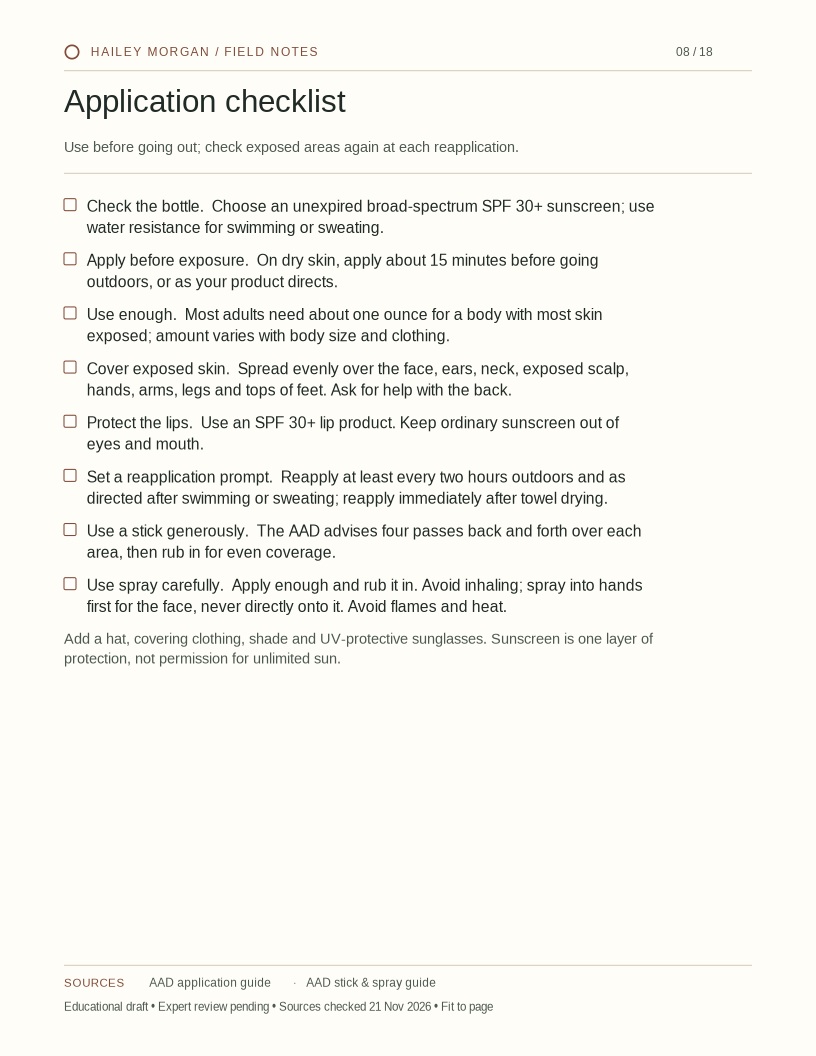
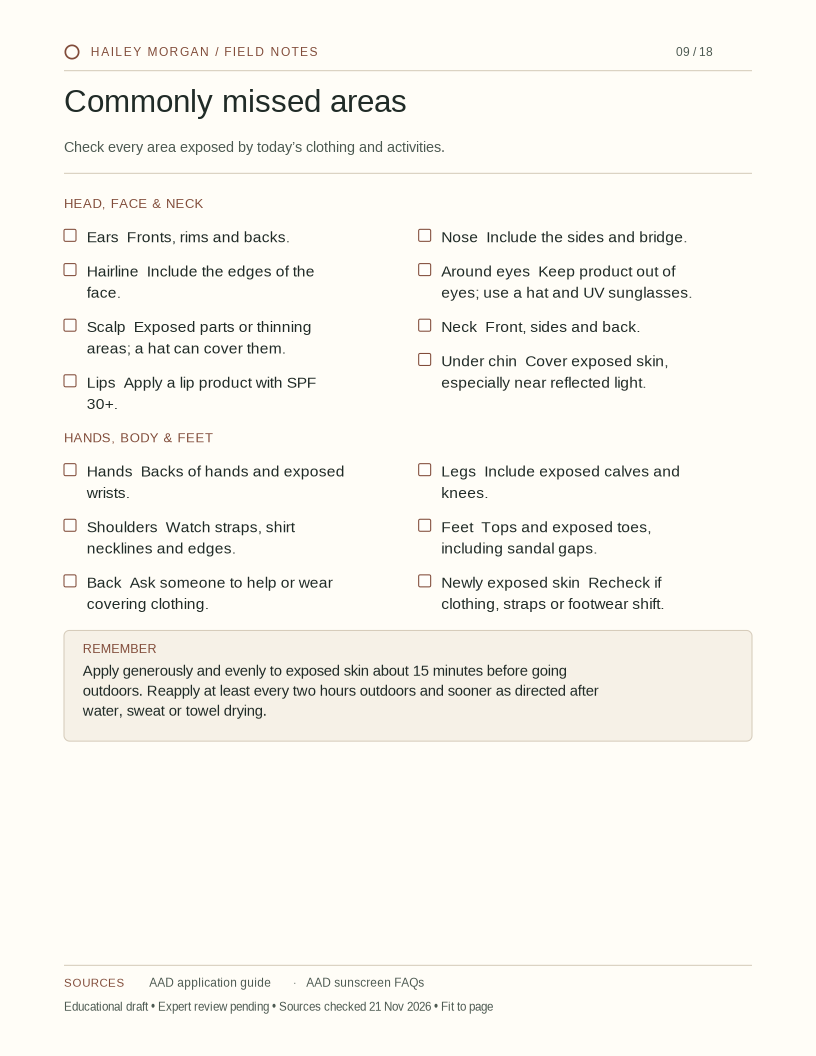
Apply to dry skin about 15 minutes before going outside, using enough to cover all exposed areas evenly. Most adults need about 1 ounce, roughly a shot-glass amount, to cover the body when most of it is exposed; the amount needed varies with body size and clothing. Remember the ears, neck, tops of feet, exposed scalp and hands. Use a lip product with SPF 30 or higher. 1 2
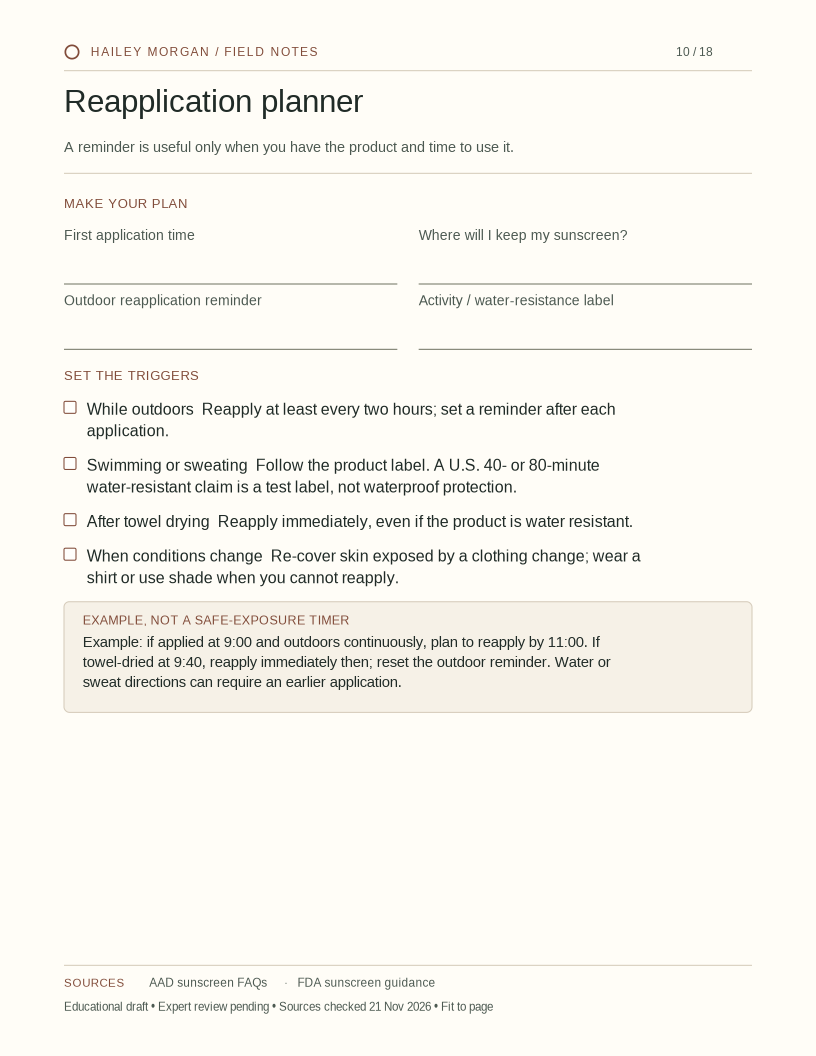
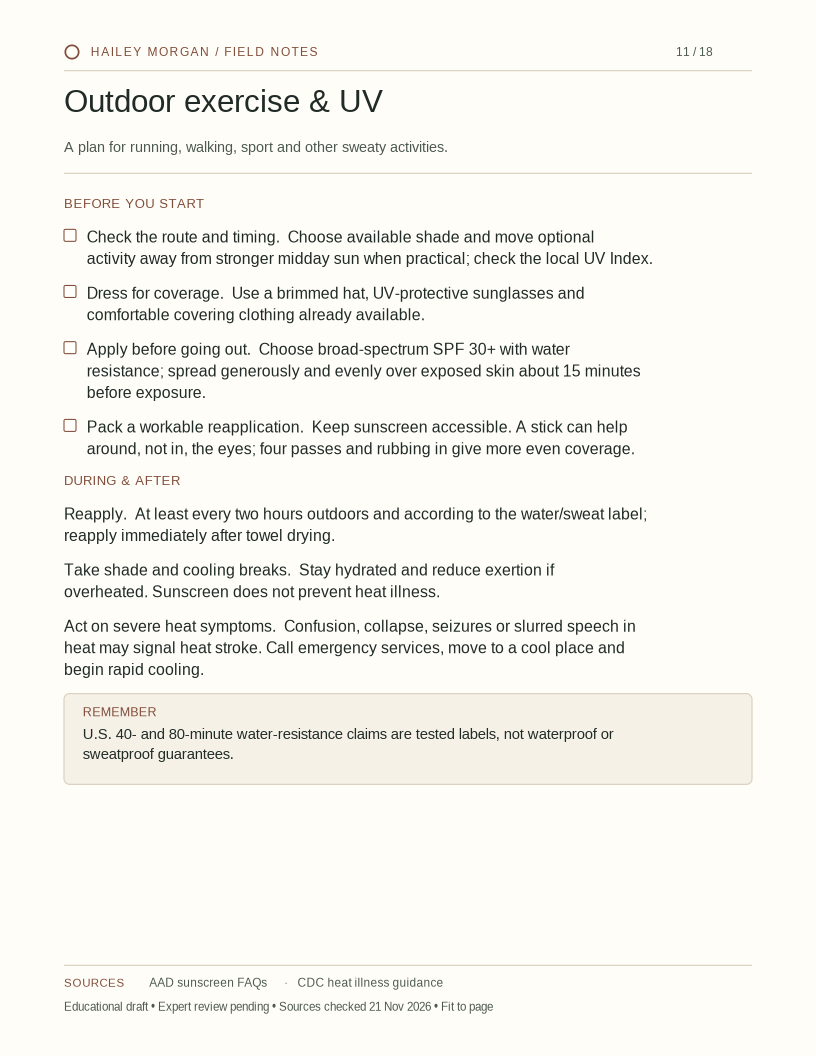
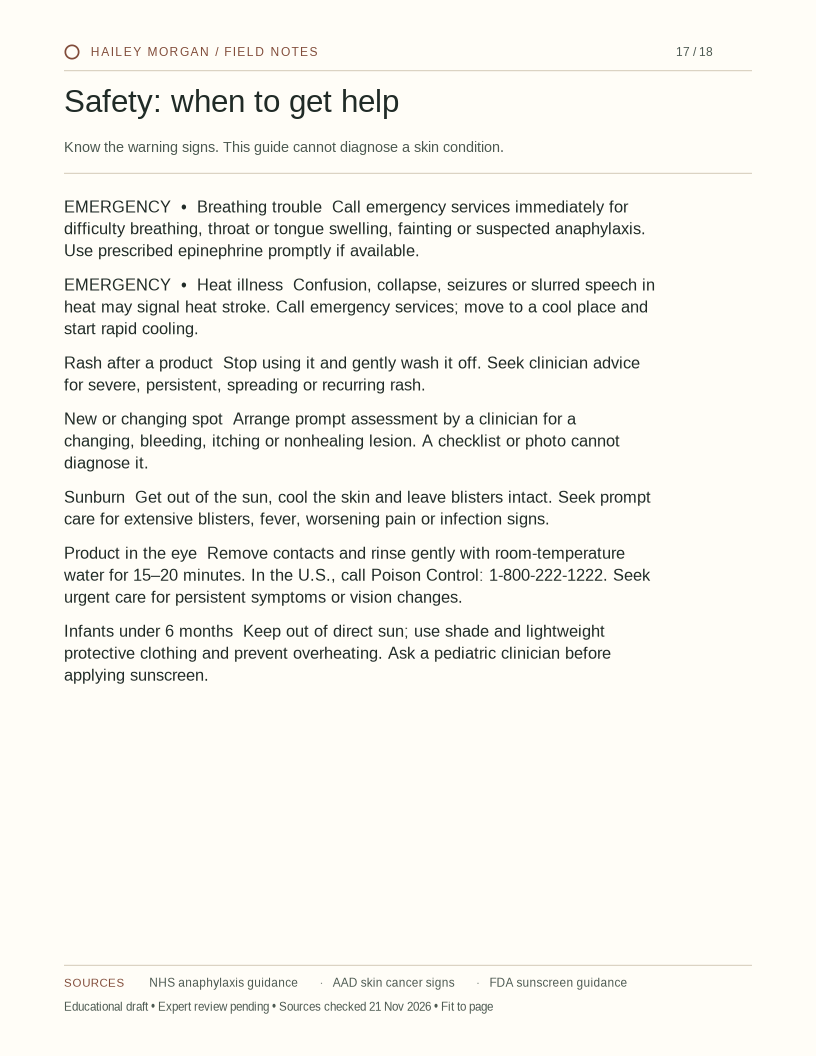
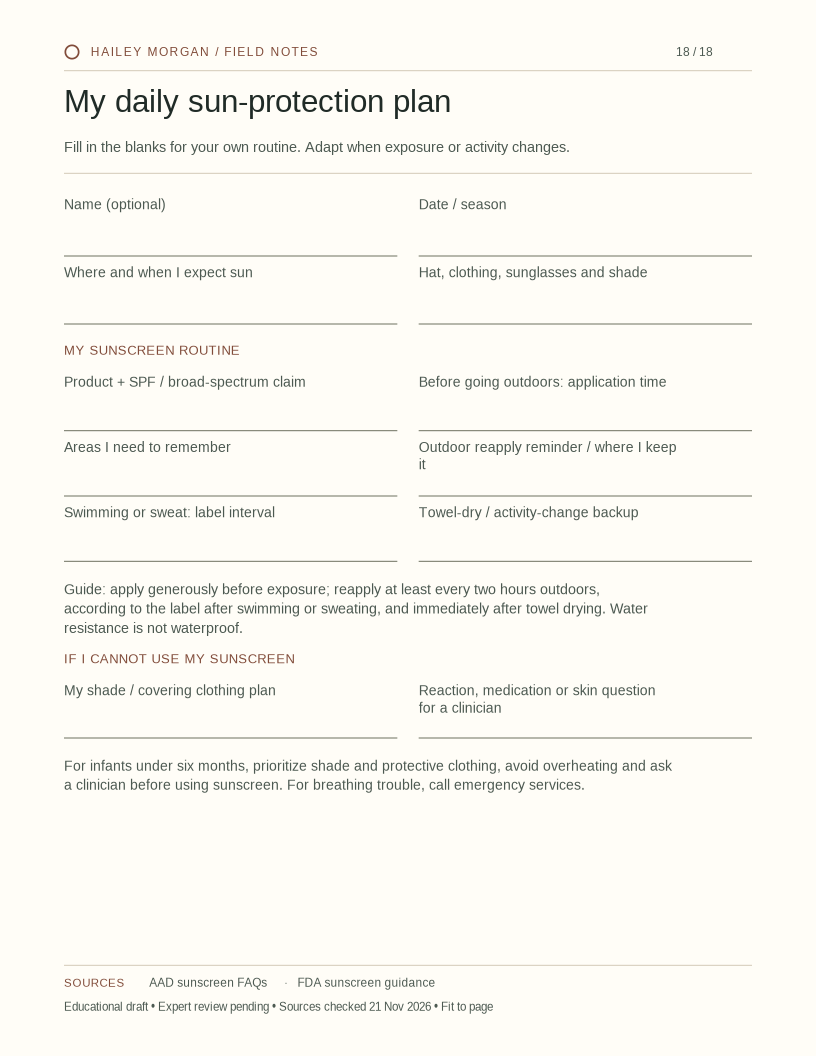
When outdoors, reapply at least every two hours. Reapply after swimming or sweating according to the product label, and immediately after towel-drying. A high SPF does not remove the need to reapply. 1 2
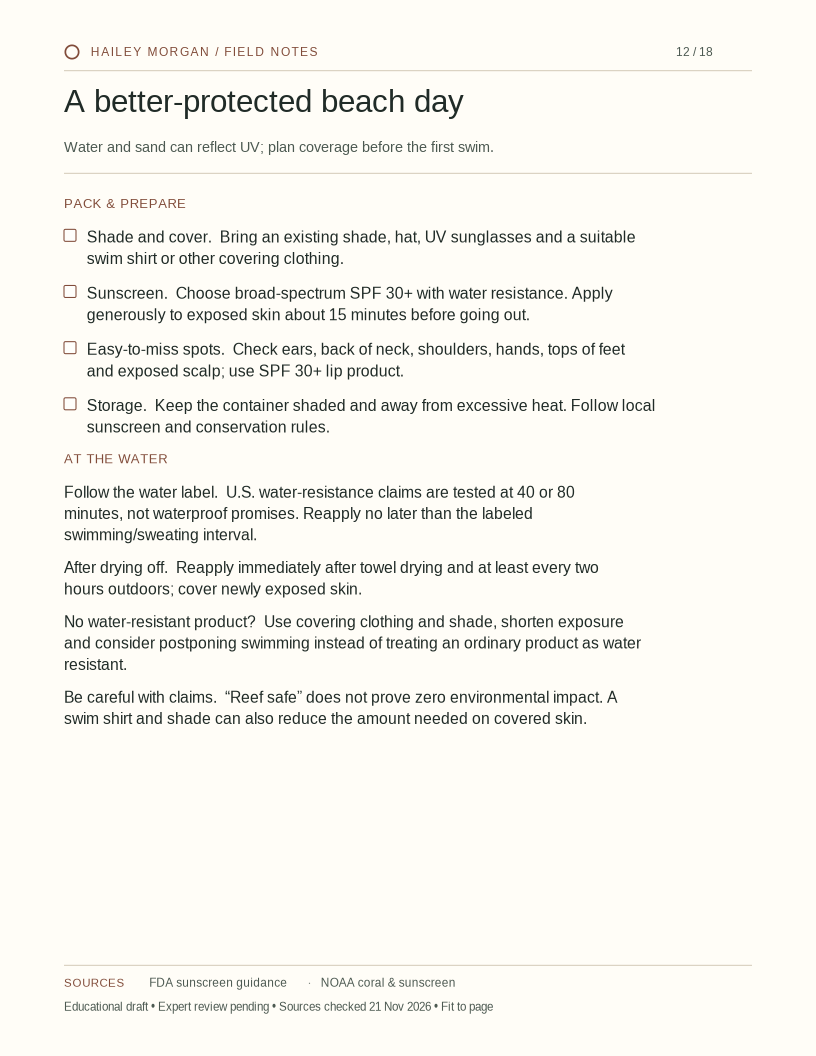
For swimming or sweating, choose a product labeled Water Resistant (40 minutes) or Water Resistant (80 minutes). In the U.S. test, the labeled SPF is measured after a specified series of water immersions totaling 40 or 80 minutes. These are test conditions, not a promise that the sunscreen will survive toweling or any activity for that long. Follow the label's water-use reapplication instructions and reapply immediately after towel-drying. No sunscreen is waterproof or sweatproof. 2 18
Choosing a format and keeping costs manageable
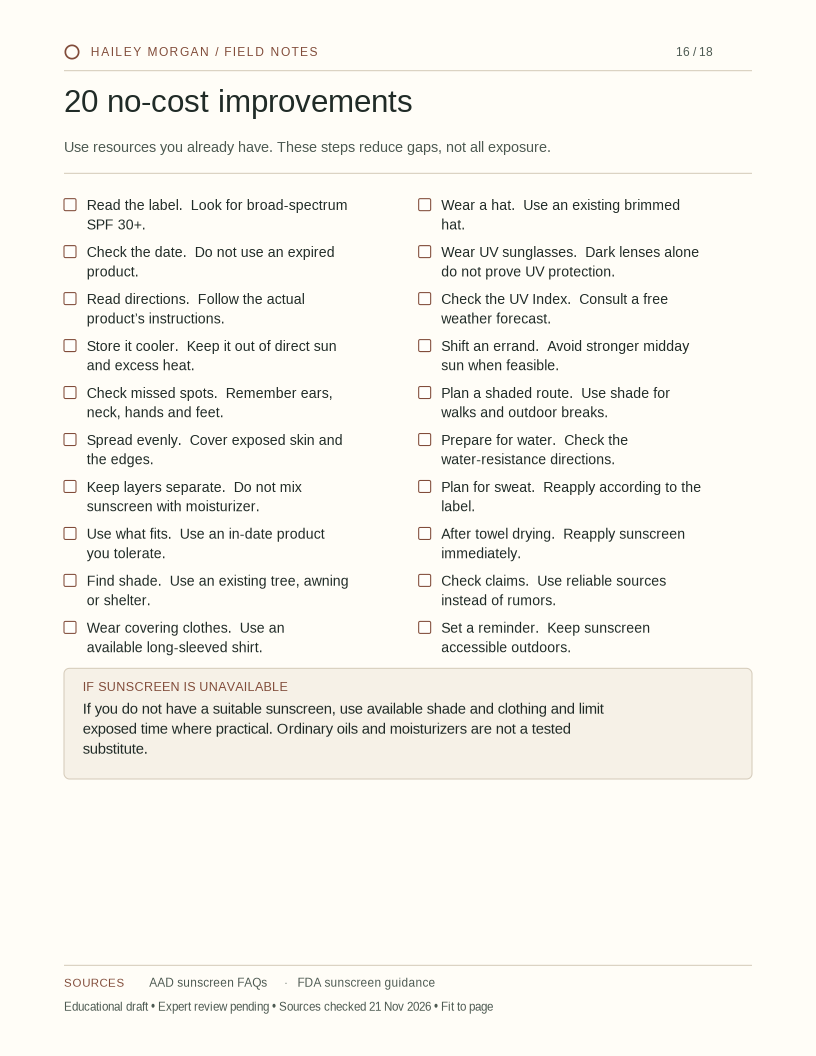
A lower-priced or store-brand sunscreen can be a sensible choice: look for broad-spectrum SPF 30 or higher, water resistance when needed, an unexpired product and a texture you will use generously. Compare the price per ounce or milliliter, not just the price per package. Protective clothing and shade can complement sunscreen, particularly when repeated applications would be difficult. 1 2
Lotions and creams make it easier to see where you have applied product; gels can be useful on hairy areas, and sticks can be convenient around the eyes. Sprays are harder to apply evenly. If using one, follow its label, spray enough to cover the area and rub it in; avoid breathing the mist. Never spray directly onto the face: spray into the hands first and apply, keeping it away from the eyes and mouth. Many sprays are flammable, so avoid flames and heat while applying and wearing a product with a flammability warning. Makeup or moisturizer with SPF still needs to be applied generously and reapplied when outdoors. 1 2
Safety and storage
FDA recommends continued sunscreen use with other sun-protection measures. Some sunscreen ingredients can be absorbed through the skin into the body; absorption does not by itself establish harm. FDA has requested more safety data for several ingredients and says that this request is not a conclusion that they are unsafe. People with sensitive skin may prefer a mineral formula or discuss reactions with a dermatologist. 1 2 20
As of November 2026, FDA's 2021 proposed order found sufficient data to support a proposal that zinc oxide and titanium dioxide are generally recognized as safe and effective under the proposed conditions; the remaining proposals await later action. Separately, in June 2026 FDA issued a final order adding the organic filter bemotrizinol to the U.S. sunscreen monograph. It is not accurate to say the FDA's newer evidence review includes only two ingredients with positive findings. 20 21
For babies younger than six months, prioritize shade and protective clothing, prevent overheating, and ask a doctor before using sunscreen. For older children, follow the product's directions. Do not use expired sunscreen. If a product has no expiration date, FDA advises treating it as expired three years after purchase; keep containers out of excessive heat and direct sun. 2
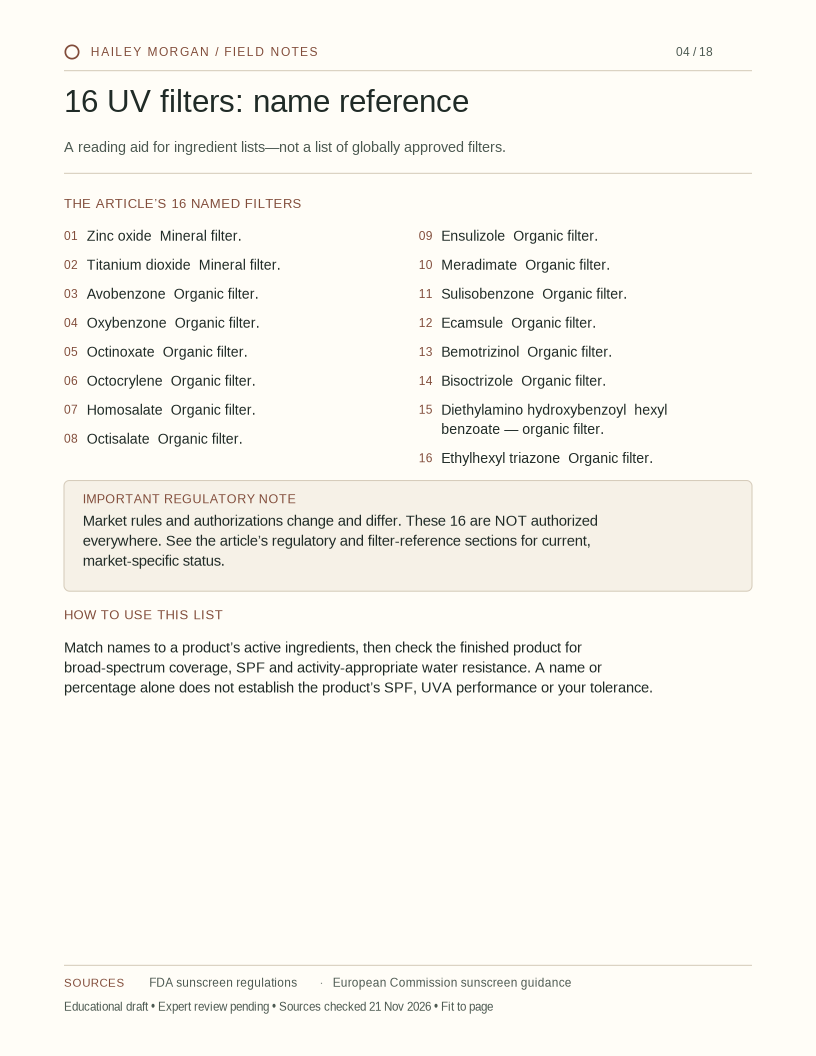
UV filter reference
Evidence accessed: 2026-11-21. This reference synthesizes all 16 supplied reports; no failures were listed.
US monograph listing is subject to all applicable conditions and is not an individual approval of every formulation. A proposed FDA insufficient-data finding is not a final finding of unsafe use or a ban. EU percentages refer to ready-for-use cosmetics unless stated otherwise; product-type, nano, purity and other conditions can apply. CosIng is informational; legislation controls. Absorption, skin-layer penetration, mechanistic activity, and individual case reports do not by themselves prove clinical harm or establish a population risk. Finished-product testing determines actual SPF, UVA protection, photostability, water resistance and labeling. All source access dates are those reported in the input notes or the targeted verification on 2026-11-21; dated or older source documents are identified in the facts where material. Regulatory status can change.
Not medical advice or a legal determination. Other-country authorizations are unverified unless expressly noted.
Numeric EU limits refer to ready-for-use cosmetics and may depend on product type or material specifications.
Zinc oxide
Aliases: ZnO, Zinc Oxide, Zinc Oxide (nano). Class: inorganic mineral. Evidence accessed: 2026-11-21.
Identity and spectrum. CAS 1314-13-2. A particulate mineral filter that absorbs and scatters UV; attenuation spans UVB through UVA1, but particle size, dispersion and the finished film affect performance. 13 22
Formulation and photostability. One microfine ZnO study reported broad attenuation and photostability. Smaller particles may reduce visible white cast; neither these findings nor an ingredient name establish the finished product’s broad-spectrum or stability claims. 13 22
Topical safety and allergy. FDA reported little skin penetration, mainly into the outer nonliving layer, folds and follicles; any systemic uptake was considered de minimis. SCCS found specified nano ZnO up to 25% acceptable for evaluated dermal use. Mineral-filter allergy appears rare but is not impossible; inhalation exposure is distinct from dermal use. 23 24 25
United States. M020 lists zinc oxide at up to 25%. FDA proposed GRASE for it in 2021; that proposal was not itself finalized in OTC000008. Monograph listing does not mean every marketed formula has individual approval. 23 26 20
European Union. Annex VI permits specified nano and non-nano ZnO, up to 25% combined. Both entries prohibit applications that may lead to lung exposure; nano use has additional particle and coating specifications. 27
Unknowns and limits. Authorizations outside the United States and EU were not assessed.
Titanium dioxide
Aliases: TiO₂, titania, titanium(IV) oxide, CI 77891. Class: inorganic mineral. Evidence accessed: 2026-11-21.
Identity and spectrum. A particulate mineral filter that attenuates UVB and shorter UVA more effectively than long-wave UVA1. Size and formulation change the balance; CI 77891 is a colorant identifier, not itself sunscreen authorization. 13 23
Formulation and photostability. Crystal form, particle coating and the vehicle affect photocatalytic behavior; anatase is more photocatalytic than rutile in reviewed research. Coatings can reduce activity, and EU nano provisions require low photocatalytic activity and final-formulation photostability. 13 28 29
Topical safety and allergy. SCCS-reviewed studies found very low or undetectable penetration beyond outer skin layers under studied conditions, while repeated use and damaged skin remained questions. Allergy is uncommon but patch testing of insoluble titanium dioxide can yield false negatives; dermal findings do not establish inhalation safety. 23 28 30
United States. The operative deemed-final monograph includes titanium dioxide up to 25%; FDA separately proposed GRASE status for it at up to 25% in 2021. The latter proposal was not itself a final titanium dioxide order. 20 23 31
European Union. Annex VI permits non-nano and specified nano titanium dioxide up to 25% combined. The nano entry has particle/coating conditions and excludes applications that may expose the lungs by inhalation. 29 32
Unknowns and limits. Authorizations outside the United States and EU were not assessed.
Avobenzone
Aliases: butyl methoxydibenzoylmethane, BMDM, Parsol 1789. Class: organic. Evidence accessed: 2026-11-21.
Identity and spectrum. An organic UVA absorber spanning approximately 320–400 nm, including long-wave UVA above 360 nm. A study reported a solvent-dependent absorption band near 355 nm; it contributes relatively little UVB protection. 33 34
Formulation and photostability. Light-induced tautomerization and photodegradation can reduce UVA absorbance. Photostabilizers and compatible co-filters can improve stability; some tested formulas maintained broad absorbance during four hours of UV exposure. 33 34
Topical safety and allergy. A 2025 review reported low clinical percutaneous absorption, generally negative irritation and sensitization tests, and rare reports suggestive of photoallergy. Some review authors had personal-care industry affiliations; an individual reaction remains possible. 35
United States. M020 lists avobenzone up to 3%. FDA’s 2021 proposed not-GRASE finding was based on insufficient data and remained unresolved as a proposal; it is not a finding that marketed products are unsafe. 26 23 20
European Union. Annex VI lists butyl methoxydibenzoylmethane up to 5% in ready-for-use cosmetics. 36
Unknowns and limits. Authorization in other jurisdictions was not verified.
Oxybenzone
Aliases: benzophenone-3, BP-3, 2-hydroxy-4-methoxybenzophenone. Class: organic. Evidence accessed: 2026-11-21.
Identity and spectrum. An organic filter absorbing UVB and short UVA. One study reported absorption around 290–360 nm, with bands at 288 and 324 nm; it does not provide full long-UVA1 coverage alone. 37 38
Formulation and photostability. Oxybenzone is used dissolved in formulations and can act as a photostabilizer. A laboratory study found no meaningful photodegradation after 24 hours of irradiation; results do not guarantee finished-product performance. 38
Topical safety and allergy. Systemic exposure after dermal application is measurable but does not itself establish harm. Contact and photoallergy are documented, with rare urticaria and anaphylaxis reports. SCCS considered evidence of endocrine activity inconclusive or equivocal. 37 23 39 40
United States. The operative M020 framework lists oxybenzone up to 6%. The 2021 proposed not-GRASE determination based on insufficient data remains a proposal, not a final ban or finding of unsafety. 23 31 20
European Union. Regulation 2022/1176 permits up to 6% in face, hand and lip products excluding sprays, up to 2.2% in body products including sprays, and up to 0.5% in other products. If 0.5% is additionally used to protect the formulation, UV-filter amounts are limited to 5.5% and 1.7% respectively for the first two categories. 41 39
Unknowns and limits. No authorizations outside the United States and EU were verified. There is no single EU maximum across all product categories.
Octinoxate
Aliases: ethylhexyl methoxycinnamate, octyl methoxycinnamate, OMC, EHMC. Class: organic. Evidence accessed: 2026-11-21.
Identity and spectrum. Oil-soluble UVB filter with an absorption maximum around 310 nm; it offers little meaningful UVA protection alone. Reported CAS numbers include 5466-77-3 and 83834-59-7 for the trans form. 42 43 44
Formulation and photostability. Photostability depends on formulation. One emulsion study found greater stability with increased concentration and a more polar oil phase; another study observed photolysis in a commercial sunscreen film. 44 45
Topical safety and allergy. Photoallergic contact dermatitis has been reported. A maximal-use trial detected plasma concentrations with tested sprays, establishing absorption under study conditions, not clinical harm. The SCCS 2025 opinion, corrected in March 2026, discussed estrogenic and weak anti-androgenic activity in vitro and in vivo while finding specified uses up to 10% safe. 46 47 48
United States. Current M020 lists octinoxate up to 7.5%. FDA proposed not-GRASE status in 2021 because additional safety data were needed; that proposed reassessment has not itself displaced the monograph entry. 49 23 20
European Union. Annex VI entry 12 allows up to 10% in ready-for-use cosmetics. The corrected SCCS opinion supports specified product uses, including sprays, at that level. 42 43 48 50
Unknowns and limits. Authorization outside the United States and EU was not verified.
Octocrylene
Aliases: Octocrilene, 2-ethylhexyl 2-cyano-3,3-diphenylacrylate, Parsol 340, Uvinul 3039. Class: organic. Evidence accessed: 2026-11-21.
Identity and spectrum. CAS 6197-30-4. An organic filter primarily absorbing UVB and short UVA2, not full long-UVA coverage. 51 52 53
Formulation and photostability. Can contribute SPF and photostabilize avobenzone in a combination, subject to finished-formula testing. 53 26
Topical safety and allergy. Contact and photoallergy have been reported; photoallergy is associated with prior topical ketoprofen photosensitization. SCCS considered endocrine indications inconclusive for deriving a specific toxicological point of departure. 51 52
United States. The June 2026 M020 final-order text lists octocrylene up to 10%. The 2021 insufficient-data not-GRASE position was proposed, not a final unsafe determination. 26 23 20
European Union. Annex VI lists a maximum of 9% in propellant sprays and 10% in other products and requires benzophenone impurity or degradation product to be kept at trace level. 36 50
Unknowns and limits. Other jurisdiction-specific authorizations were not verified. The EU maximum depends on product type.
Homosalate
Aliases: homomenthyl salicylate, 3,3,5-trimethylcyclohexyl salicylate. Class: organic salicylate. Evidence accessed: 2026-11-21.
Identity and spectrum. CAS 118-56-9. Primarily a relatively weak UVB filter, with little meaningful UVA coverage alone; commonly combined with other filters. 54 55
Formulation and photostability. Oil-soluble; may solubilize crystalline filters and contribute to water resistance. A 2022 isolated gas-phase molecular study does not establish sunscreen-film photostability. 55
Topical safety and allergy. A four-volunteer 2024 study detected homosalate and metabolites in plasma after application of 10% sunscreen; this did not establish clinical harm. SCCS considered endocrine evidence inconclusive or equivocal. Patch-test inclusion does not establish that allergy is common. 56 57 58
United States. M020 lists homosalate up to 15%; FDA’s 2021 proposed not-GRASE classification cited insufficient data and remains unresolved as a final order. 54 20 23
European Union. Regulation 2022/2195 permits use as a UV filter only in face products, excluding propellant sprays, up to 7.34%. This superseded the former 10% limit. 59 60
Unknowns and limits. Real-world finished-product photostability is not established by the cited mechanistic experiment. Other jurisdictions were not assessed.
Octisalate
Aliases: ethylhexyl salicylate, 2-ethylhexyl salicylate, octyl salicylate. Class: organic salicylate. Evidence accessed: 2026-11-21.
Identity and spectrum. CAS 118-60-5. An oil-soluble, predominantly UVB filter with little meaningful UVA coverage; commonly used with other filters. 61 36
Formulation and photostability. A review describes salicylate filters as photostable and used with photolabile UVA filters, but class-level behavior does not guarantee the stability of a finished sunscreen. 61
Topical safety and allergy. A 2006 case report confirmed allergy in one patient. In a 48-person maximal-use study, geometric-mean maximum plasma concentrations were 4.6–5.8 ng/mL across tested spray/pump products; measured absorption did not demonstrate toxicity. 62 47
United States. M020 lists octisalate up to 5%. The 2021 not-GRASE proposal cited insufficient data and had not been finalized as to octisalate. 31 23 20 26
European Union. Annex VI allows ethylhexyl salicylate up to 5% in ready-for-use products. 36 50
Unknowns and limits. Other jurisdiction-specific authorization was not verified.
Ensulizole
Aliases: 2-phenylbenzimidazole-5-sulfonic acid, phenylbenzimidazole sulfonic acid, PBSA. Class: organic. Evidence accessed: 2026-11-21.
Identity and spectrum. Primarily UVB protection with reported maximum near 310 nm; little meaningful UVA coverage alone. The free acid is poorly water-soluble, while sodium, potassium and triethanolamine salts allow aqueous formulations. 31 61
Formulation and photostability. A review describes photochemical vulnerability; a cell experiment showed UVB protection against cyclobutane pyrimidine dimers but also UV-induced oxidized guanine. This mechanism alone does not establish clinical harm. 61 63 64
Topical safety and allergy. A 2025 review reported mostly occasional local effects, negative standard photosensitization and phototoxicity testing, and no identified systemic toxicity signal at permitted levels. It identified no in-vivo genotoxicity or long-term carcinogenicity studies; individual reactions remain possible. 63
United States. M020 lists ensulizole up to 4%. FDA proposed that further data were needed for a positive GRASE assessment; the proposal is not a final ban or a finding of unsafe use. 31 20 65
European Union. Annex VI entry 6 lists the acid and specified salts at up to 8%, expressed as acid. The consolidation checked here is dated 1 May 2026; a later amendment is not excluded. 66 50
Unknowns and limits. Individual-country authorizations beyond the United States and EU were not established. The cited 2025 review identified no in-vivo genotoxicity or long-term carcinogenicity studies.
Meradimate
Aliases: menthyl anthranilate, menthyl 2-aminobenzoate. Class: organic. Evidence accessed: 2026-11-21.
Identity and spectrum. CAS 134-09-8. A relatively narrow UVA/near-UVA filter with reported absorption maximum near 335–336 nm; not a stand-alone broad-spectrum filter. 26 54 67 68
Formulation and photostability. Anthranilates are sometimes described as photostable, but studies also report photochemical pathways including singlet-oxygen formation in solvents. Finished-product photostability evidence is limited. 67 68
Topical safety and allergy. The reviewed sources did not establish a meradimate-specific allergy rate or strong clinical allergy signal. Laboratory singlet-oxygen formation does not itself establish clinical phototoxicity. 67 68 23
United States. Current M020 lists meradimate up to 5%. FDA’s 2021 insufficient-data not-GRASE proposal has not been finalized for this ingredient; monograph listing is not individual product approval. 26 23 20
European Union. EU authorization of menthyl anthranilate was not verified. Methyl-N-methylanthranilate is a distinct substance and its record is not evidence of authorization for meradimate. 69 70
Unknowns and limits. EU authorization and a meradimate-specific SCCS opinion were not verified. A meradimate-specific allergy rate, and authorization in other jurisdictions, are unknown.
Sulisobenzone
Aliases: benzophenone-4, BP-4. Class: organic. Evidence accessed: 2026-11-21.
Identity and spectrum. Benzophenone-4 is an organic, water-soluble sulfonic-acid derivative of oxybenzone; its sodium salt is benzophenone-5. It mainly absorbs UVB and shorter UVA rather than providing full UVA1 coverage. 71 61 72
Formulation and photostability. Used in aqueous or oil-in-water formulations; pH, counterion and vehicle matter. It can also act as a product UV absorber or stabilizer; no blanket finished-product photostability is established. 61 72
Topical safety and allergy. In a referred patch-test cohort from 2013–2020, 323 of 19,618 patients (1.6%) reacted to BP-4, and 65.8% of positive reactions were judged currently clinically relevant. These figures are not general-population incidence. SCCS found up to 5% safe for the assessed uses and exposures. 72 73
United States. The operative M020 framework lists sulisobenzone up to 10%. FDA’s 2021 proposal explicitly included sulisobenzone among 12 actives proposed not GRASE because more data were needed; FDA says the remaining proposals will be addressed in future orders. The proposal is not a finalized safety finding. 31 20
European Union. Annex VI entry 22 allows benzophenone-4 up to 5% expressed as acid; SCCS’s 2024 opinion addresses specific use and exposure patterns. 71 72 50
Unknowns and limits. Other-country authorization was not assessed. The patch-test figures are not a general-population allergy rate.
Ecamsule
Aliases: Mexoryl SX, terephthalylidene dicamphor sulfonic acid, TDSA. Class: organic. Evidence accessed: 2026-11-21.
Identity and spectrum. CAS 92761-26-7. A water-soluble, predominantly UVA filter with a peak around 344–345 nm; FDA’s review reports absorption from approximately 290 to 400 nm. Sunscreens often combine it with UVB filters. 74 75
Formulation and photostability. Generally described as photostable; the FDA NDA review evaluated a product also containing avobenzone and octocrylene, not ecamsule alone as a complete broad-spectrum sunscreen. 74 75
Topical safety and allergy. FDA’s 2006 product review found relatively low systemic absorption in the studied cream and no sensitization in guinea-pig testing, while noting reproductive-study findings and impurities or degradants. These product- and study-specific findings do not prove zero individual risk. 74
United States. FDA approved Anthelios SX in a product-specific NDA in 2006, with 2% ecamsule in the original formulation. In 2015 FDA proposed that up to 10% was not shown GRASE for general OTC monograph use because data were insufficient. Ecamsule was not verified as added to M020; do not conflate an individual NDA with monograph listing or an ingredient-wide ban. 74 76 49
European Union. Annex VI entry 7 allows ecamsule and its salts up to 10% expressed as acid. 43 50
Unknowns and limits. A current ecamsule-specific SCCS opinion and country-specific rules beyond the United States and EU were not verified.
Bemotrizinol
Aliases: BEMT, bis-ethylhexyloxyphenol methoxyphenyl triazine, Tinosorb S, Parsol Shield. Class: organic triazine. Evidence accessed: 2026-11-21.
Identity and spectrum. CAS 187393-00-6. Broad UVB and UVA absorber, including UVA1, with reported peaks near 310 and 340 nm. 26 77 78
Formulation and photostability. Photostable and lipophilic; commonly incorporated into the oil phase. FDA-reviewed material reports compatibility with other filters and avobenzone stabilization in combinations, not an automatic guarantee for every formula. 77 78
Topical safety and allergy. FDA-reviewed adult human repeat-insult patch testing showed no irritation or sensitization among completers and photoallergy/phototoxicity tests found no reactions. FDA found limited systemic exposure under its reviewed conditions. Individual allergy and effects in unstudied populations cannot be ruled out. 26 79 77
United States. Final order OTC000039, issued June 10, 2026 and effective August 9, 2026 as stated, added bemotrizinol up to 6% to M020 under specified dosage-form and combination conditions, for qualifying products for adults and children 6 months and older. PABA and trolamine salicylate combinations are excluded; monograph status is not approval of every product. 26 77
European Union. Annex VI lists bemotrizinol up to 10% as an allowed cosmetic UV filter. 80 81 50
Unknowns and limits. Country-specific authorization beyond the United States and EU was not verified. A bemotrizinol-specific SCCS opinion was not verified; an MBBT opinion concerns a different filter.
Bisoctrizole
Aliases: methylene bis-benzotriazolyl tetramethylbutylphenol, MBBT, Tinosorb M. Class: organic particulate benzotriazole. Evidence accessed: 2026-11-21.
Identity and spectrum. An organic, often particulate filter, not an inorganic mineral. It absorbs UVB and UVA including UVA1 and is described as photostable. 82 83 84
Formulation and photostability. Sparingly water-soluble and commonly supplied as an aqueous particle dispersion; dispersant, dispersion and uniform film formation matter to performance. 82 84
Topical safety and allergy. SCCS found assessed nano-MBBT up to 10% acceptable for specified dermal uses, with very low skin absorption; inhalation exposure was outside that assessment. An allergic contact dermatitis case has been reported, but does not establish frequency. 82 85
United States. Bisoctrizole is absent from current M020. The 2026 final order added bemotrizinol, not bisoctrizole; FDA’s 2014 feedback sought more data. Absence from the monograph is not a determination that it is unsafe. 49 26 86
European Union. Annex VI permits nano and non-nano MBBT up to 10% combined. The nano entry has specified particle requirements and excludes uses that may expose lungs by inhalation. 83
Unknowns and limits. A U.S. individual-product approval beyond the records searched was not established. Other-country authorization was not assessed.
Diethylamino hydroxybenzoyl hexyl benzoate
Aliases: DHHB, Uvinul A Plus. Class: organic. Evidence accessed: 2026-11-21.
Identity and spectrum. CAS 302776-68-7. An oil-soluble UVA filter including long-wave UVA; DHHB and bemotrizinol are distinct ingredients. DHHB alone is not a UVB/broad-spectrum solution. 36 87 88
Formulation and photostability. A 2017 formulation study found DHHB photostable and providing strong UVA protection under study conditions, but it did not photostabilize avobenzone in the mixtures tested. 88
Topical safety and allergy. SCCS’s 2025 advice addressed the impurity di-n-hexyl phthalate (DnHexP): for DHHB used at up to 10%, it calculated 0.026% or 260 ppm in DHHB as a maximum safe impurity level if unavoidable, and recommended a 1 ppm target. This is impurity-specific, not a conclusion that DHHB itself is unsafe. The cited 3T3 assay is not proof of no human allergy. 88 89
United States. DHHB is not listed in M020; the June 2026 order added bemotrizinol, not DHHB. Nonlisting does not by itself establish safety or the status of a particular separate FDA application. 54 90 49
European Union. Annex VI entry 28 allows DHHB at up to 10% in ready-for-use cosmetics. 36 50
Unknowns and limits. No DHHB-specific FDA product approval was verified. The cited hydroxyacetophenone allergy case is not evidence of DHHB allergy; a DHHB-specific allergy rate was not established. Other-country authorization was not verified.
Ethylhexyl triazone
Aliases: EHT, octyl triazone, Uvinul T 150. Class: organic triazine. Evidence accessed: 2026-11-21.
Identity and spectrum. CAS 88122-99-0. An oil-soluble, strong UVB filter; not a stand-alone broad-spectrum UVA filter. 36 91 92
Formulation and photostability. Used in the oil phase. Laboratory work reported efficient dissipation of absorbed energy with little detectable photoproduct formation under tested irradiation conditions; this does not establish stability in every finished product. 92
Topical safety and allergy. The EU committee’s 1997 review described favorable irritation/sensitization and photoallergy tests and low in-vitro absorption at proposed 5% use. A later tape-stripping study recovered 21.9 ± 4.9% of applied dose in stratum corneum for the tested non-encapsulated cream; this was skin-layer penetration, not proof of systemic absorption or harm. 91 93
United States. Ethylhexyl triazone is absent from current M020. The June 2026 final order added bemotrizinol, not ethylhexyl triazone; monograph exclusion is not a finding of unsafety and does not resolve any separate product-application status. 49 94
European Union. Annex VI entry 15 lists ethylhexyl triazone at up to 5% in ready-for-use cosmetics. 36 50
Unknowns and limits. A separate FDA product approval was not verified. Country-specific authorization outside the United States and EU was not assessed.
Sunscreen labels and regulation: US, UK, EU, Canada and Australia
Verified: 21 November 2026. Rules and product authorizations can change. This is consumer education, not legal advice or a determination that any particular product is approved, available, or suitable in a particular market.
Article-ready comparison
Sunscreens are regulated differently around the world. In the United States, they are nonprescription drugs. A US product labeled Broad Spectrum has passed an FDA test for coverage across UV wavelengths, while its SPF chiefly measures sunburn protection. In Canada, primary sunscreens are authorized as either nonprescription drugs or natural health products, depending on their active ingredients. Canadian labels may also say Broad Spectrum, but the requirements should be read under Canadian rules. 49 20 95
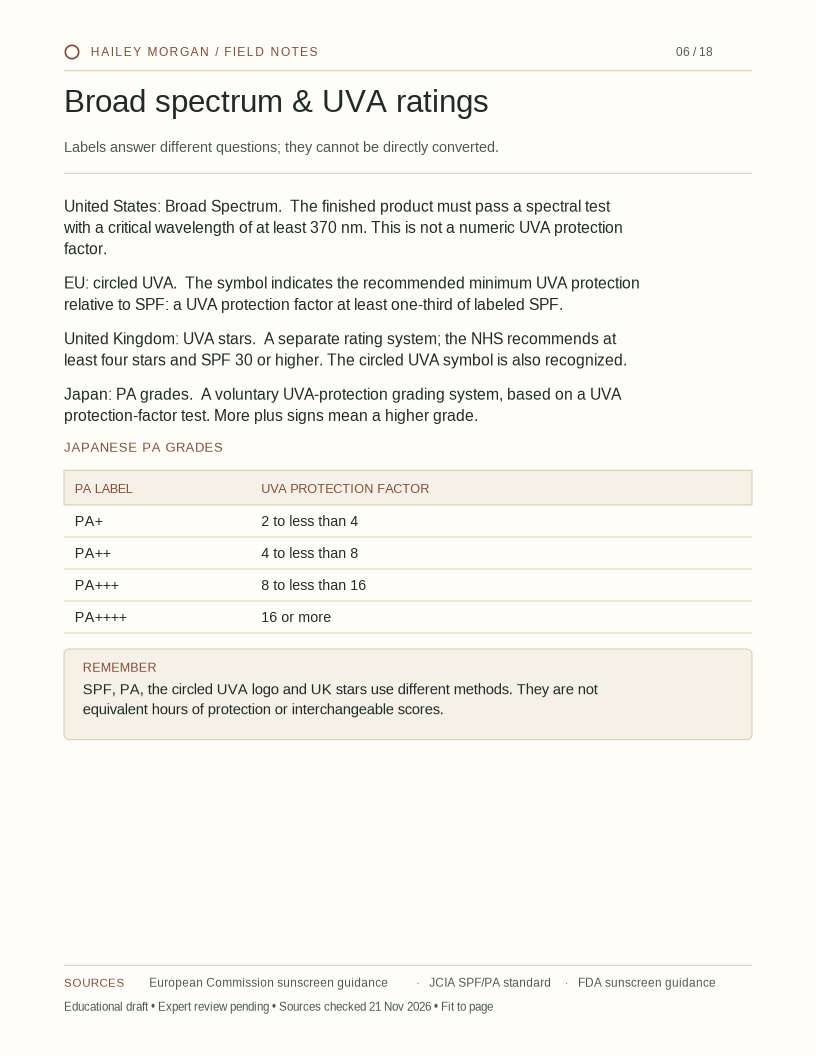
In the EU and Great Britain, sunscreens are generally cosmetics. The UVA-in-a-circle logo indicates that a product meets the recommended minimum UVA protection relative to its SPF. UK products may instead or additionally show UVA stars; the NHS recommends at least SPF 30 and four-star UVA protection. In Australia, primary sunscreens are generally therapeutic goods, and a product’s Australian Register of Therapeutic Goods number identifies its listing or registration. The Australian standard also addresses broad-spectrum performance and water resistance. A listing, notification, or permitted ingredient is not the same thing as a regulator individually approving every finished product’s SPF claim before sale. 96 97 98 99 100
Labels are not interchangeable. Japan’s voluntary PA system grades UVA protection from PA+ to PA++++ using a different measurement from the US critical-wavelength test. An SPF, a PA grade, a UK star rating, and a circled UVA mark cannot be converted directly into one another. No sunscreen is waterproof or gives total protection: follow the package’s reapplication directions, and use shade and protective clothing too. 49 97 101
United States: final FDA actions versus proposals
How products reach the market. Sunscreen is an FDA-regulated over-the-counter drug, including a moisturizer or cosmetic that makes sunscreen claims. A product conforming to the applicable OTC monograph and other drug requirements can be marketed without an individually approved new-drug application; products outside that pathway may need an approved application. GRASE means generally recognized as safe and effective, a legal standard applied to products under specified conditions, not a blanket safety certification for every formula containing an ingredient. 20 2
Bemotrizinol is final, not merely proposed. FDA final administrative order OTC000039, issued in June 2026, added bemotrizinol, also called BEMT, to monograph M020 at up to 6%. The order states that it took effect 9 August 2026, subject to the order’s dispute provision. A qualifying finished product must meet other conditions, including permitted combinations, dosage forms and finished-product testing; a BEMT product is not automatically GRASE merely because it contains up to 6%. BEMT sprays must use no propellant, or a delivery system that keeps propellant isolated from the formulation. The order provides 18 months of statutory exclusivity for DSM Nutritional Products LLC and qualifying licensees, assignees, or successors, under its specified terms. Neither the order nor this research establishes which named finished products are actually on sale. 26 102
The 2021 proposal is not a final ban on 12 filters. The CARES Act created a deemed final monograph in 2020, under which conforming sunscreens containing the 16 then-listed active ingredients were deemed GRASE by law, subject to statutory and monograph conditions. In the separate 2021 proposed order OTC000008, FDA proposed positive GRASE findings for zinc oxide and titanium dioxide, proposed a negative GRASE determination for PABA and trolamine salicylate because of safety concerns, and proposed that 12 other ingredients were not GRASE because more data were needed. Those 12 are cinoxate, dioxybenzone, ensulizole, homosalate, meradimate, octinoxate, octisalate, octocrylene, padimate O, sulisobenzone, oxybenzone and avobenzone. FDA says the request for more data is not a conclusion that those 12 are unsafe. Do not describe mineral filters and BEMT as the only ingredients that can currently be lawfully marketed, or claim all 12 were banned. 20
PABA and trolamine salicylate: finalized, but future-effective. FDA issued final order OTC000008-1 on 11 September 2026, finding products containing either as sunscreen active ingredients not GRASE because of safety concerns and removing them from the monograph. The order says it takes effect 11 September 2027, or under the applicable dispute provision. Once effective, such products require an approved application rather than the monograph pathway. FDA says it is not aware of currently marketed US sunscreens containing either ingredient; this is the agency’s statement, not proof of worldwide absence. 20 103
Other 2021 changes remain proposals. As of FDA’s September 2026 update, these include a maximum labeled SPF of 60+, a proposed maximum formulated SPF of 80, and a requirement that products of SPF 15 or higher meet revised broad-spectrum conditions, including a proposed UVA-I/UV ratio of at least 0.7. FDA says it will address remaining items in future orders. The proposed 60+ cap and UVA-I ratio are not current final requirements. 20
Current US broad-spectrum and water claims. Under monograph M020, the finished product must have a mean critical wavelength of at least 370 nm to use the broad-spectrum claim. Critical wavelength is the wavelength below which 90% of the integrated measured absorbance from 290–400 nm lies; it is not a percentage of UVA blocked and does not itself give a numerical UVA protection factor. For the monograph claim that a sunscreen reduces the risk of skin cancer and early skin aging when used as directed with other protection, it must be broad spectrum and at least SPF 15. Non-broad-spectrum products or those below SPF 15 carry a warning that they have only been shown to help prevent sunburn. 49
Tested US water-resistance claims are 40 or 80 minutes; they are not permission to remain in the sun for that period without considering other exposure. Reapply at the stated swimming/sweating interval, immediately after towel drying, and at least every two hours. FDA does not allow monograph claims of “waterproof,” “sweatproof,” or “sunblock.” 49 104
European Union and United Kingdom
EU. Sunscreens are cosmetics under Regulation (EC) No 1223/2009. The responsible person must arrange a product safety assessment and a safety report before marketing, notify the product, comply with restrictions and the positive list for UV filters, and substantiate claims. Product notification is not an individual premarket government approval of each cosmetic’s effectiveness. 96 105
The European Commission’s 2006/647/EC Recommendation is guidance, not itself a binding regulation. It recommends minimum SPF 6, a UVA protection factor of at least one-third of the labeled SPF, and critical wavelength at least 370 nm. It recommends SPF 50+ only for measured SPF of at least 60. The circled UVA logo is an industry-developed standardized symbol recognized by the Commission to indicate the recommended minimum UVA protection; it is not an EU government approval seal. The Cosmetics Regulation’s separate safety and truthful-claims obligations are legally binding. 96 106
Great Britain and Northern Ireland. Great Britain’s cosmetics regime requires a UK-established responsible person, a qualified safety assessment, a product information file, and notification to the Office for Product Safety and Standards before marketing. UV filters are subject to a positive list. Great Britain and EU requirements can diverge, and Northern Ireland has separate rules; the UK government directs sellers to its separate Northern Ireland guidance. Do not assume a product lawfully notified in one market is automatically notified in the other. 98
The NHS recommends SPF 30 or higher and at least four UVA stars, and recognizes the circled UVA symbol. Stars are a UK labeling system, not the Japanese PA grading scale. The 2006 European recommendation is also cited by UK cosmetic-industry guidance as best practice, rather than treated as a standalone mandatory UK statute. 97 107
Canada
Health Canada’s 27 February 2026 Primary Sunscreen Monograph sets out a pathway for market authorization, including accepted ingredients, concentrations, claims, testing and directions. Depending on ingredients, primary sunscreen products receive an eight-digit DIN for a nonprescription drug or NPN for a natural health product. Products outside this monograph can apply through another authorization pathway, so a monograph condition should not automatically be described as the only possible rule for every Canadian product. 95 108
Within this monograph, a Broad Spectrum claim is optional and requires a critical wavelength of at least 370 nm and active ingredients providing UVA and UVB protection. SPF must be at least 2, and values above 50 are declared SPF 50+ in this pathway. Tested water-resistance claims can state 40 or 80 minutes. The monograph also permits PA information under specific product, evidence and submission conditions; it is not a universal mandatory Canadian UVA rating. 95
Health Canada advises using broad-spectrum SPF 30 or higher, checking the expiry date, and reapplying at least every two hours and more often as needed after swimming, sweating or toweling. It notes that absorption of an ingredient into the bloodstream alone does not establish harm. 108
Australia
Primary sunscreens are regulated by the Therapeutic Goods Administration (TGA) as therapeutic goods. Most are listed in the Australian Register of Therapeutic Goods (ARTG); some products require registration, and some secondary SPF cosmetics fall outside therapeutic-goods regulation. Listed products use permitted ingredients and indications. The sponsor certifies compliance and must hold evidence, but the TGA does not individually evaluate efficacy before listing; it can review evidence and take post-market action. An AUST L number is a listing identifier, not proof of a premarket SPF test by the TGA. 99 100 109
The applicable Australian/New Zealand sunscreen standard, AS/NZS 2604, addresses SPF, broad-spectrum performance, water-resistance testing and label claims. TGA guidance lists SPF 50+ for a measured SPF of at least 60. Water-resistance statements depend on testing under the applicable standard; do not transplant the US 40/80-minute labeling scheme to Australia. The TGA’s October 2026 reform plan proposes staged changes, including periodic testing and submission of testing data at listing, and says further development, consultation or legislative amendments may be needed. These should not be presented as already universally implemented. 99 109 110
PA grades and UVA labels
The Japan Cosmetic Industry Association’s voluntary PA system uses an in-vivo UVA protection factor based on persistent pigment darkening. Its grade is calculated from the integer UVAPF after discarding the decimal portion: 101
- PA+: UVAPF 2 to less than 4.
- PA++: UVAPF 4 to less than 8.
- PA+++: UVAPF 8 to less than 16.
- PA++++: UVAPF 16 or more.
These are absolute UVA protection-factor ranges, not hours and not SPF grades. The EU circle expresses a recommended minimum relative to labeled SPF, while the US broad-spectrum test uses spectral coverage. The different methods and thresholds do not provide a reliable direct conversion. A higher PA category is not the same claim as a higher SPF. 49 101 106
Expiration and recalls
In the US, FDA says a sunscreen without an expiry date should be considered expired three years after purchase; use any printed expiration date and discard it if its age is unknown. Keep it out of excessive heat and direct sunlight. Health Canada says Canadian sunscreens have expiry dates; Australian therapeutic sunscreens must carry an expiry or use-by date supported by stability data. 2 108 109
For EU cosmetics with minimum durability of 30 months or less, the date of minimum durability is normally indicated. If durability is longer than 30 months, a date is not mandatory; a period-after-opening symbol is normally used when relevant. This open-jar symbol is a period after opening, not automatically a fixed unopened expiry date. UK rules and product labels should be checked separately. 97 105
Check current recalls by exact product, market and, where specified, batch or lot. A historical recall is not evidence that every current product of a brand is affected. FDA advises not using recalled sunscreen; Health Canada has recalled particular aerosols for benzene contamination, and the TGA has recalled particular products or batches after concerns about SPF performance. Use the FDA drug recall search 117, Health Canada recalls 118, UK product safety alerts and recalls 119, and TGA sunscreen recall notice 112. Follow the notice and use an unaffected sunscreen with other sun protection. 2 111 112
Environmental restrictions: Hawaii is not one uniform rule
Hawaii statewide: since 1 January 2021, Hawaii Revised Statutes §342D-21 prohibits selling, offering for sale, or distributing for sale sunscreen containing oxybenzone or octinoxate without a prescription from a specified licensed healthcare provider. This statute addresses sales and distribution, not a general statewide prohibition on personal use. Its definition excludes products marketed or intended as facial cosmetics; the precise statutory definitions and exceptions matter. 113
Maui County: Ordinance 5306, effective 1 October 2022, is broader. It restricts sale, distribution and use or application of non-mineral sunscreen without a qualifying prescription. It defines non-mineral sunscreen as sunscreen using an active ingredient other than zinc oxide or titanium dioxide and incorporates the state definition of sunscreen. The county recommends non-nano mineral ingredients, but its recommendation should not be presented as a separate verified statutory nano-size ban. 114 115
Hawaii County, the Island of Hawaii: Ordinance 22-81, effective 1 December 2022, restricts sale, offers and distribution for sale of non-mineral sunscreen without a qualifying prescription; the cited ordinance does not impose Maui’s personal-use prohibition. It has defined exceptions, including how state-banned products are treated. Check local rules and their current text before travel. 116
“Reef safe” or “reef friendly” is not proof of compliance or a guarantee of no environmental impact. Maui County describes those terms as unregulated marketing language. Environmental law restrictions, human-health drug regulation and ecological hazard are distinct questions; an ingredient’s legal status in one context does not settle the others. 115
Sunscreen: clinical research and safety
Evidence current to November 21, 2026.
Sunscreen is one part of sun protection, alongside shade, protective clothing, hats, and sunglasses. The American Academy of Dermatology recommends a broad-spectrum, water-resistant sunscreen with SPF 30 or higher on exposed skin, reapplied about every two hours outdoors and after swimming or sweating as directed. Broad spectrum means protection against both UVA and UVB. Sunscreen does not make unlimited sun exposure safe. 1
What randomized studies show about skin cancer and aging
The Nambour Skin Cancer Prevention Trial in Queensland, Australia, assigned 1,621 adults aged 25–75 to use sunscreen daily or at their discretion from 1992 to 1996. The daily group was asked to apply broad-spectrum SPF 15-plus sunscreen to the head, neck, arms, and hands; people in the comparison group could still use sunscreen. The trial also independently assigned beta-carotene or placebo. Its findings therefore compare an instruction to use sunscreen daily with discretionary use, not sunscreen against no sunscreen at all. 120 121
The 1999 report counted both people who developed a new skin cancer and the total number of tumors. Over 4.5 years, the squamous cell carcinoma tumor rate at the sites of daily application was lower in the daily group: a rate ratio of 0.61, with a 95% confidence interval of 0.46–0.81. That is not the same as a 39% reduction in the proportion of people developing their first cancer. The person-level first squamous cell carcinoma outcome was not statistically different between groups: rate ratio 0.88, 95% confidence interval 0.50–1.56. No clear reduction in basal cell carcinoma was found. 120
In a 2006 report covering a further eight years after the intervention ended, squamous cell tumor rates remained lower in the group originally assigned daily sunscreen: rate ratio 0.62, 95% confidence interval 0.38–0.99. The later follow-up was no longer a period of assigned daily use, and the confidence interval leaves uncertainty about the size of the benefit. 122 123
For melanoma, the 2011 follow-up observed participants through 2006, about ten years after the intervention ended. There were 11 first primary melanomas in the daily group and 22 in the discretionary group. The overall estimate suggested a reduction, but its 95% confidence interval included no reduction: hazard ratio 0.50, 95% confidence interval 0.24–1.02, p = 0.051. Invasive melanoma occurred in 3 versus 11 participants; that subgroup estimate was statistically significant but exploratory and based on few cases. These results support a possible protective effect, not a precise or certain 50% reduction in every population. 121 124
For photoaging, a 2013 analysis of 903 Nambour participants younger than 55 used blinded assessments of skin-surface impressions taken over 4.5 years. The daily group showed no detectable increase in the study's skin-aging measure, and its relative odds of greater measured aging were 0.76 compared with the discretionary group, 95% confidence interval 0.59–0.98. This is an odds comparison of a graded measure, not a promise of 24% fewer wrinkles for an individual. Some outcome data were missing and the study had modest power to detect moderate effects. 125
The cancer trial and its melanoma follow-up received Australian National Health and Medical Research Council support; a melanoma author disclosed separate research funding from L’Oréal Recherche. The photoaging project was funded by the same public council, while sunscreen and beta-carotene were donated by manufacturers. The research institute states that the donors had no other involvement in that project's methods or findings. Nambour was one sunny Australian community, so its results should not be assumed to apply identically to every age group, skin type, climate, or sunscreen product. 124 125 126
Do sunscreen ingredients enter the bloodstream?
Yes. Two FDA-led clinical studies by Matta and colleagues measured certain organic, often called chemical, sunscreen ingredients in blood after application. They were designed to measure absorption, not to establish whether the measured concentrations cause disease.
The 2019 study randomized 24 healthy adults to four commercially available products: two sprays, a lotion, and a cream, with six people per product. Study staff applied 2 mg per square centimeter to 75% of each participant's body surface four times daily for four days. Blood was sampled for seven days. The researchers measured avobenzone, oxybenzone, octocrylene, and ecamsule; not every product contained every ingredient. Concentrations above 0.5 nanograms per milliliter (ng/mL) were reached for all four products after four applications on day one. Twenty-three people completed the study. Rash occurred in four participants, one in each group. Other reported events included itching and milia; one cream-group participant stopped on day two because of milia. Reported adverse events resolved. 127
The 2020 study randomized 48 healthy adults to a lotion, an aerosol spray, a nonaerosol spray, or a pump spray, with 12 people per product. It used the same amount and body-surface coverage: one application on day one, then four applications daily on days two through four. Blood was sampled over 21 days. The six measured ingredients were avobenzone, oxybenzone, octocrylene, homosalate, octisalate, and octinoxate; again, individual products did not all contain all six. All six exceeded 0.5 ng/mL on day one after a single application. Forty-four participants completed the study. Rash occurred in 14 participants; no serious drug-related adverse events were reported. 128
The 0.5 ng/mL figure is a regulatory screening threshold, not a proven toxic level. Under FDA guidance discussed in the trials, a sufficiently low steady-state blood concentration, together with reassuring toxicology findings, can support waiving certain additional nonclinical safety studies. Exceeding the threshold means more safety information may be needed; it does not establish that a concentration is harmful, or measure an individual's cancer risk. Conversely, absorption studies alone cannot prove long-term safety. 127 128
Both studies were small, involved healthy adults, and were conducted indoors without direct sunlight. Their extensive, carefully applied coverage differs from many people's routine use, although the 2020 study also measured absorption after one application. They were not designed to compare products reliably or determine long-term cancer, hormonal, reproductive, pregnancy, or child outcomes. Both publications explicitly said their findings did not mean people should stop using sunscreen. 127 128
The FDA's 2021 proposed sunscreen order identified zinc oxide and titanium dioxide as having sufficient supporting safety data for its proposed generally recognized as safe and effective determination, and requested more data for 12 other ingredients; lack of data is not an FDA finding that those ingredients are unsafe. In June 2026, the FDA added bemotrizinol to the U.S. over-the-counter sunscreen monograph. Regulatory status can change and varies by country. 20
Mineral nanoparticles and breathing in sprays
Zinc oxide and titanium dioxide are sometimes formulated as nanoparticles to reduce visible white residue. An Australian Therapeutic Goods Administration review found that, in the great majority of studies, these particles remained on the surface or outer layers of skin rather than reaching viable skin cells or systemic circulation. This finding about particles applied to skin, particularly intact skin, should not be generalized to every particle formulation, route of exposure, or degree of skin damage. It also does not mean dissolved material can never be detected. 129
Breathing particles into the lungs is a different exposure. In 2018, the European Scientific Committee on Consumer Safety found the submitted data insufficient to assess the safety of nano-titanium dioxide in spray applications that could expose lungs. That is an evidence gap, not proof that an occasional inhalation causes harm. Avoid inhaling sunscreen spray, do not spray directly onto the face or into the wind, and consider a lotion or stick when inhalation is a concern. Some sprays are flammable, so follow their warnings and stay away from flames. 1 129 130 2
Vitamin D
Skin makes vitamin D when exposed to UVB, so sunscreen can reduce that production. A 2019 systematic review found no measurable effect on vitamin D in the randomized field trials then available, but those trials used roughly SPF 16 and did not answer the question for high-SPF products. 131
The newer Australian Sun-D trial, published in 2025, randomized 639 adults who did not routinely use sunscreen or vitamin D supplements to SPF 50-plus on days when the UV index was forecast to reach at least 3, or to discretionary sunscreen use. Among 628 analyzed over about a year, the high-SPF group's blood 25-hydroxyvitamin D change was on average 5.2 nmol/L lower than the control group's. In an exploratory final-sample analysis, vitamin D below the study's 50 nmol/L cutoff was found in 139 of 304 tested in the intervention group and 115 of 312 controls. The trial was open-label, and the deficiency analysis was exploratory. It does not imply that every sunscreen user is deficient. 132
Continue sun protection rather than deliberately seeking unprotected UV exposure for vitamin D. Food and fortified products can provide vitamin D; a clinician can advise whether a supplement or testing is appropriate for a person's diet, health, and risk factors. 1 132
Pregnancy, breastfeeding, and babies
Sun protection remains important during pregnancy. Human pregnancy-specific safety data for individual filters are limited. A broad-spectrum mineral sunscreen containing zinc oxide or titanium dioxide is a reasonable choice for someone who prefers to minimize absorption of organic filters; clothing and shade also help. Discuss individual concerns with an obstetric or other qualified clinician rather than assuming that detection of an ingredient proves fetal harm. A 2025 review offering mineral-sunscreen advice was supported by sunscreen company ISDIN, and several authors disclosed company ties. 20 129 133
For breastfeeding, the U.S. National Library of Medicine's LactMed states that several organic sunscreen ingredients can be detected in milk, but the available milk studies were not designed to establish the dose from a particular application, and published information on effects in breastfed infants was not found as of its February 2026 revision. As a precaution, LactMed suggests avoiding products containing octinoxate, enzacamene, and especially oxybenzone during breastfeeding and notes zinc oxide or titanium dioxide as alternatives. This precaution should not be presented as proof of injury to nursing infants. Avoid putting sunscreen where a baby may ingest it during feeding, and wash hands after application. 134 135
For infants younger than six months, prioritize shade and lightweight protective clothing, avoiding direct sun and overheating. The FDA advises asking a doctor before using sunscreen at this age. The AAD adds that, if shade and adequate clothing are unavailable, a minimal amount of preferably mineral sunscreen can be used on exposed skin; consult the child's clinician when possible. For children six months and older, use a broad-spectrum, water-resistant SPF 30 or higher sunscreen on exposed skin according to the label, alongside shade and clothing. 1 2
Rash, allergy, and when to get urgent help
A sunscreen reaction may be irritation, allergic contact dermatitis, or a reaction that appears when the treated skin is exposed to sunlight. Fragrances and preservatives, as well as UV filters, can be responsible. A rash in an absorption trial does not by itself identify which ingredient caused it or prove an allergy. 127 128 136
For a mild localized reaction, stop using the suspected product and gently wash it off. Seek clinical advice if the rash is persistent, severe, or recurring. A dermatologist can consider patch testing and, when light-triggered allergy is suspected, photopatch testing. A fragrance-free mineral sunscreen may be an alternative, but any formulation can contain other ingredients that irritate a particular person. Use shade and protective clothing while finding a tolerated product. 136 137
Call emergency services immediately for breathing difficulty, throat or tongue swelling, fainting, or other signs of anaphylaxis. If an epinephrine auto-injector is available, use it promptly as directed and still call emergency services. Anaphylaxis from sunscreen is rare, but it is an emergency. 137 138
Melasma and visible light
Melasma is a condition in which darker patches can recur or worsen with light exposure. UVA and UVB protection matters, but visible light can also contribute to pigmentation, particularly in people with darker skin tones. A broad-spectrum tinted sunscreen with iron oxides can add visible-light protection; shade and protective clothing remain useful. SPF measures sunburn protection, not a product's visible-light protection, so SPF alone does not tell the whole story for melasma. 1 139
A small 2025 randomized, investigator-blinded trial assigned 42 women with melasma to a visible-light-protective tinted sunscreen or a similarly UV-protective untinted sunscreen for five months; 41 completed it. The tinted group had greater improvements in some objective measures of color contrast, but the clinical melasma severity score improved in both groups with no significant between-group difference. The study was funded by the company associated with the tinted product, and some authors were company employees. It supports the approach without establishing that every tinted formula is equally effective or that tint alone treats melasma. 139
Coral reefs: laboratory findings and real-world uncertainty
Sunscreen ingredients can enter water directly during swimming and indirectly through wastewater. Laboratory studies have found harmful effects of certain UV filters on aquatic organisms, including corals, under particular test conditions. This demonstrates a potential hazard; it does not, by itself, establish the amount of reef damage caused by ordinary sunscreen use at every real-world site. Exposure depends on the ingredient, concentration, duration, local water circulation, and organism. 140 141
The U.S. National Academies' 2022 review reported that water measurements vary considerably: for several commonly studied organic filters the highest measured concentrations were in the 1–10 micrograms-per-liter range, while most measurements were below 1 microgram per liter. Measurements often represent snapshots rather than complete exposure histories. The review called for a fuller ecological risk assessment, especially in heavily used or wastewater-affected waters. Mineral particles also need assessment; a mineral label alone does not prove a product has no aquatic impact. Coral reefs face major pressures including climate change, pollution, disease, coastal development, and unsustainable fishing. 140 141
To reduce both UV exposure and the amount of sunscreen needed in the water, wear a suitable UV-protective swim shirt and seek shade. Follow local product and conservation rules, but continue protecting exposed skin rather than abandoning sun protection. 140 141
Choosing sunscreen for your skin and routine
Start with a sunscreen you already own if it is in date, comfortable to use, and labeled broad-spectrum SPF 30 or higher. The American Academy of Dermatology (AAD) also recommends water resistance; it is especially important for swimming and sweating. Mineral, chemical, and hybrid sunscreens can all be suitable—the finished formula and how consistently you use it matter more than assigning one filter category to a skin type. AAD sunscreen guidance 1
Twelve skin situations
- Dry-feeling skin: A cream or moisturizing lotion may feel more comfortable than a quick-drying gel. Use your existing moisturizer first, let it settle, and apply a generous layer of your usual sunscreen separately. If the sunscreen itself feels moisturizing, a separate moisturizer may be unnecessary.
- Oily-feeling skin: A light gel, fluid, or lotion may feel more comfortable. If the sunscreen you have feels shiny but is otherwise suitable, try using less moisturizer underneath—not less sunscreen. “Oil-free” is a preference, not a guarantee against breakouts.
- Combination skin: Apply a light layer of your existing moisturizer only where needed, then cover the whole exposed face evenly with sunscreen. A fluid can be convenient, but a comfortable cream, lotion, or other format can work too.
- Sensitive-feeling skin: A fragrance-free formula with zinc oxide or titanium dioxide may be worth trying if a particular product stings. Some people tolerate an organic-filter or hybrid sunscreen well, and mineral formulas can also contain irritating ingredients. Keep using a suitable product you already tolerate; see a clinician for persistent or repeated reactions.
- Acne-prone skin: A light, noncomedogenic-labeled lotion or fluid is an option, though no label guarantees a product will not cause breakouts. If your existing sunscreen is comfortable, use it rather than replacing it automatically. Avoid scrubbing it off, and seek professional advice for painful, scarring, or persistent acne.
- Post-inflammatory hyperpigmentation (PIH): Dark marks can follow irritation, acne, or injury. Keep the underlying trigger and irritation in mind as well as sun protection. If you already have a tinted broad-spectrum sunscreen with iron oxides, it may be useful because visible light can contribute to pigmentation; otherwise, keep using your suitable untinted sunscreen and add shade and a hat. AAD guidance on dark spots 142
- Melasma concerns: Sun protection is part of melasma care. A tinted, iron-oxide-containing sunscreen may be useful, alongside a wide-brimmed hat and shade. Tint and iron-oxide content do not establish identical visible-light protection across products. Your current broad-spectrum sunscreen remains useful if you do not have a tinted one; a dermatologist can assess unexplained patches and discuss treatment. AAD melasma guidance 143
- Mature skin: Choose a texture that feels comfortable on your skin, whether that is a cream, lotion, fluid, or another format. Use moisturizer underneath if needed. Natural aging is not a condition to correct, and there is no required sunscreen category based on age.
- Visible photoaging: A sunscreen you will apply and reapply, plus clothing and shade, can help limit additional UV-related damage. It will not erase established lines or reverse natural aging. Ask a dermatologist to assess any concerning spot rather than assuming it is a cosmetic age spot. AAD sunscreen guidance 1
- Recently irritated skin: Stop a cosmetic product that burns or causes a rash. Use shade and clothing over the affected area while it settles; ask a clinician what is appropriate for broken skin or skin healing after a procedure. Do not force a stinging sunscreen onto injured skin or restart a suspected trigger just to use it up.
- Eye stinging: Keep sunscreen out of the eyes and follow its label. A tolerated stick or less runny formula may be easier to control around, not in, the eyes; a hat and UV-protective sunglasses add coverage. If product gets into an eye, rinse it promptly as described in Medical safety.
- A heavy or visible cast: Try the suitable sunscreen you own in an even layer and allow it to settle before judging the finish; do not reduce the amount to make it disappear. Some tinted mineral, hybrid, or organic-filter formulas may blend more easily, but finish varies by product and skin tone. A cast is a cosmetic effect, not a measure of protection.
For a new product, a small-area home trial can help identify some reactions but cannot rule out an allergy or establish sunscreen protection. Do not retest a product that has caused a significant reaction. Recurrent rashes may need professional patch testing; a rash appearing mainly after sunlight can also merit assessment for photoallergy. AAD: testing skin care products 144 · AAD: medical patch testing 145
Eight sunscreen formats: how to use them
All formats need enough product to cover exposed skin evenly. The finish, ease of application, and water-resistance claim depend on the individual product—not merely its format.
| Format | Practical use and limitation |
|---|---|
| Lotion | Spread generously and evenly; a familiar choice for larger areas and reapplication. It may feel light or rich depending on the formula. |
| Cream | Often comfortable on dry-feeling skin. Work it evenly over the area rather than leaving thick patches and missed edges; it can feel heavy to some people. |
| Gel | May feel lighter or spread more readily through hair, but some formulas sting or feel drying. Apply enough to cover the area; a clear finish does not reveal missed spots. |
| Fluid | A runny texture can spread easily and layer under makeup. Dispense enough according to the directions, and watch for drips near the eyes. |
| Stick | Useful for hands or careful application around—not in—the eyes. The AAD recommends four passes back and forth over each area, then rubbing in for even coverage. A quick swipe may not provide enough. |
| Spray | Generously spray exposed skin until it glistens, then rub in thoroughly. Avoid wind and inhalation; never spray on or near the face or mouth. Spray into hands first, then apply to the face. Avoid heat, flames, sparks, and smoking during application; follow flammability warnings while wearing it. |
| Powder | A convenient cosmetic touch-up, but coverage and amount are hard to judge. Do not rely on a dusting as equivalent to a properly applied primary sunscreen or a dependable full reapplication. Avoid breathing in loose particles. |
| Tinted sunscreen | A labeled sunscreen with pigment can provide coverage and may help reduce a visible cast. Apply as generously as an untinted sunscreen; shade and visible-light protection vary. Check the inactive ingredients for iron oxides if that is your goal. |
See the AAD's stick and spray directions 146 and the FDA's spray and fire precautions 2.
Applying and reapplying without guesswork
Apply sunscreen to dry, exposed skin about 15 minutes before going outdoors, following the product's directions. Most adults need roughly one ounce for a body with most skin exposed; body size and the amount of exposed skin change the amount needed. For the face, the AAD suggests about a teaspoon; finger-length and spoon measures are practical estimates, not exact universal doses. AAD application guide 147
Coverage check: face, ears, neck and back of neck; hairline and exposed scalp; hands and arms; exposed legs and tops of feet. Use an SPF 30 or higher lip product on lips and keep ordinary sunscreen out of the eyes and mouth. Clothing or a hat can cover areas instead; ask for help with areas you cannot reach.
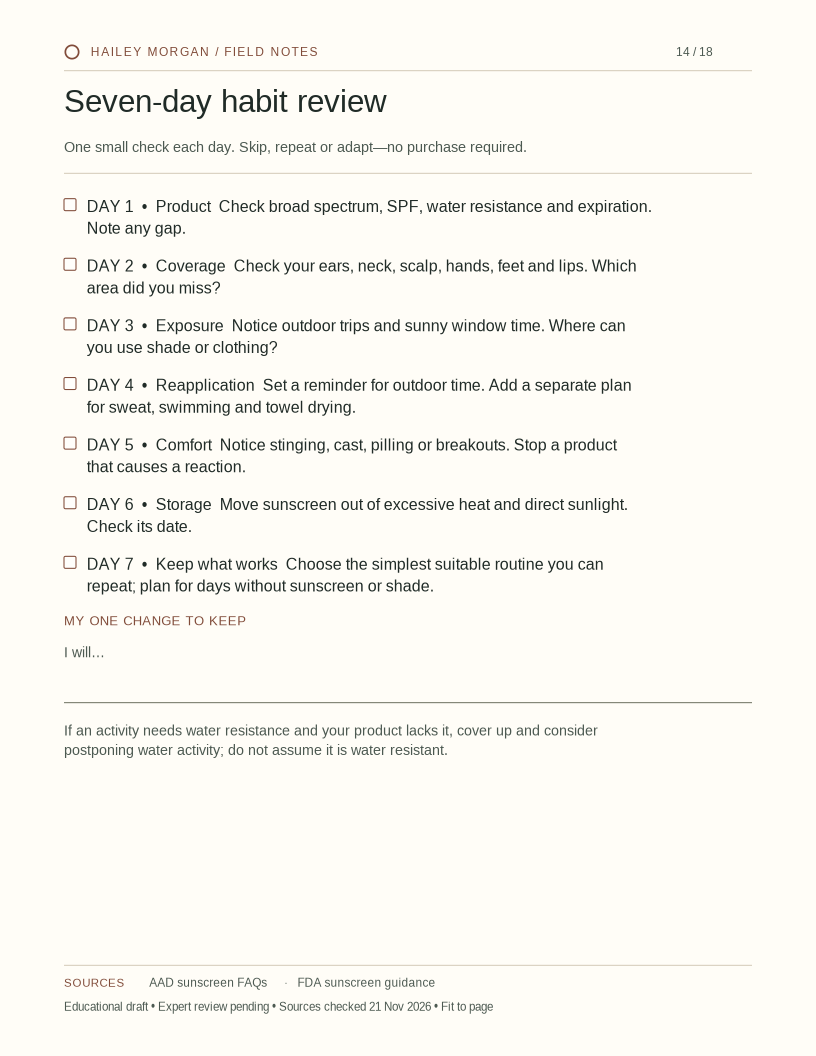
When outdoors, reapply approximately every two hours, and after swimming or sweating, following the label; reapply after towel drying as well. A water-resistant label specifies 40 or 80 minutes in water or while sweating. It is not waterproof, and the stated time does not replace the ordinary outdoor reapplication guidance. FDA sunscreen directions 2
Clouds do not eliminate outdoor UV exposure. Some UVA can pass through certain windows, but exposure depends on the glass, position, and duration. A mostly indoor day away from direct window sunlight does not automatically require sunscreen reapplication every two hours; consider the outdoor time, window exposure, and any medical advice relevant to you. AAD sun guidance 1 · Cancer Council: indoors and windows 148
Sunscreen with skincare and makeup
A workable default is treatment or serum → moisturizer if needed → sunscreen → makeup. Let each layer settle enough to avoid obvious pilling or rubbing, and follow each product's directions. Apply sunscreen as its own even layer; do not mix it with moisturizer, oil, makeup, or another sunscreen in your palm. SPF values do not add together.
| Combination | Order and useful caution |
|---|---|
| Vitamin C | Apply a tolerated serum before moisturizer and sunscreen. It is an antioxidant, not a UV filter or a substitute for sunscreen; stop a product that irritates. |
| Niacinamide | Apply a serum before moisturizer and sunscreen, or use a moisturizer containing it. It can support a skincare routine but does not replace a labeled sunscreen. |
| Retinol | If already using it, follow its directions, often at night; protect skin from the sun the next day. It may irritate skin. The AAD advises against retinoid use during pregnancy. |
| Retinal | Another vitamin A derivative: follow the product directions, commonly in the evening, with sunscreen for daytime exposure. Avoid layering extra irritating products merely to make the routine more elaborate. Discuss use in pregnancy or breastfeeding with a clinician. |
| AHA, such as glycolic or lactic acid | Use as directed before moisturizer, then sunscreen if used in the morning. AHAs may increase sun sensitivity; the FDA advises sun protection during use and for a week afterward. |
| BHA, such as salicylic acid | Use as directed before moisturizer and sunscreen. Too much exfoliation can irritate; avoid assuming the AHA sun-sensitivity evidence applies identically to every BHA product. |
| PHA | Follow its label before moisturizer and sunscreen. It is an exfoliating ingredient; monitor for irritation instead of assuming every formula is gentle. |
| Ceramides | A ceramide moisturizer can go before sunscreen to support a comfortable skin barrier. It does not confer labeled SPF unless the finished product itself has an SPF claim. |
| Hyaluronic acid | Apply a hydrating serum or moisturizer before sunscreen. It helps attract water but does not replace UV protection. |
| Moisturizer | Apply first if needed and let it settle; put sunscreen over it without mixing. A moisturizer labeled broad-spectrum SPF 30 or higher can serve as sunscreen if applied generously and reapplied as directed. |
| Facial oil | If desired, use it before sunscreen and let it settle, or reserve it for evening if daytime layers feel slippery. Oil alone has no verified sunscreen protection. |
| Makeup | Apply over an even sunscreen layer once it has settled. For outdoor reapplication, use enough suitable sunscreen and gently spread or pat it over makeup, or remove and redo makeup if needed. A light dusting of SPF powder or ordinary makeup may not deliver its labeled protection. |
The AAD's retinoid guidance 149 and FDA's AHA guidance 150 explain the relevant sun precautions. If several products sting, simplify the cosmetic routine; do not change a prescribed treatment without consulting its prescriber.
Twelve adaptable sun-protection routines
Use the coverage check and outdoor reapplication guidance above for each routine. “Use what you have” means a suitable, in-date product that you tolerate; it does not mean using an expired product or one that causes a reaction. Shade and clothing help when sunscreen is unavailable, but neither is an exact substitute for sunscreen on exposed skin.
A. Minimal daily routine
Situation: An ordinary day with time outside. Morning: Apply your existing suitable sunscreen to exposed skin before leaving; skip optional serums. Reapply: About every two hours outdoors and after swimming, sweating, or towel drying. Free option: Take an existing hat and choose a shaded route.
B. Dry-feeling skin
Situation: Outdoor errands when skin feels tight or dry. Morning: Use your existing moisturizer if helpful, let it settle, then apply sunscreen separately to exposed areas. Reapply: Follow the outdoor schedule; use a gentle hand if skin feels uncomfortable. Free option: Cover arms with a long-sleeved shirt you already own and seek shade.
C. Oily or combination skin
Situation: A warm day with a walk or commute. Morning: Use your current comfortable sunscreen; apply moisturizer only where needed beforehand. Reapply: Bring the same product for outdoor time, especially if sweating. Free option: Wear your own hat and take shade breaks; do not thin the sunscreen to reduce shine.
D. Sensitive-feeling skin
Situation: Skin that reacts to some products. Morning: Use the sunscreen you already tolerate, avoiding known triggers; cover irritated areas with clothing rather than applying a product that burns. Reapply: Use the tolerated product as directed outdoors. Free option: Choose shade and a hat; arrange care for a persistent or recurrent reaction.
E. Acne-prone skin
Situation: An outdoor commute while managing breakouts. Morning: Apply any prescribed treatment as directed, followed by your tolerated sunscreen; a light or noncomedogenic-labeled option is a preference, not a necessity. Reapply: Use the same suitable product during extended outdoor exposure. Free option: Wear a hat and avoid picking or harsh scrubbing.
F. Deeper skin tones and white-cast concerns
Situation: A day outside when visible residue makes sunscreen hard to wear. Morning: Apply your current suitable formula evenly and let it settle; a tinted, hybrid, or organic-filter formula is an option if you already have one that suits your skin. Reapply: Use enough for even coverage outdoors, not a thin cosmetic layer. Free option: Use an existing brimmed hat and shade; there is no need to change your natural skin tone.
G. Post-inflammatory dark marks
Situation: Time outdoors while dark marks are a concern. Morning: Use your existing iron-oxide-tinted broad-spectrum sunscreen if you have one; otherwise use your suitable untinted sunscreen. Reapply: During outdoor exposure as directed, and avoid irritating skin while doing so. Free option: Add a hat and shade and address the cause of irritation with appropriate care.
H. Outdoor exercise
Situation: Running, walking, gardening, or another activity that causes sweat. Morning: Before heading out, apply an existing broad-spectrum SPF 30+ sunscreen labeled water resistant to exposed skin. Reapply: About every two hours outdoors and after sweating or towel drying; follow the water-resistance directions. Free option: Choose a shaded route, use a hat and covering clothing, and schedule around stronger sun when feasible. If you lack a water-resistant sunscreen, these steps help but do not make your product water resistant.
I. Beach or swimming day
Situation: Water and sand can reflect sunlight. Morning: Apply a water-resistant broad-spectrum SPF 30+ sunscreen before leaving, covering exposed skin including ears, feet, and hands. Reapply: Follow the 40- or 80-minute water-resistance directions, after towel drying, and the usual outdoor schedule; reapply sooner when the label or activity calls for it. Free option: Use an existing shirt, hat, and available shade. If you have no water-resistant sunscreen, cover up, shorten sun exposure, and consider postponing swimming rather than treating an ordinary product as water resistant. FDA water-resistance guidance 2
J. Makeup-wearing workday
Situation: A commute, outdoor lunch, or time by a sunny window. Morning: Apply sunscreen separately before makeup and let it settle. Reapply: For sustained outdoor time, gently apply enough suitable sunscreen over makeup or remove and redo it; powder alone may leave gaps. Free option: Take lunch in shade and wear an existing hat; a day mostly indoors away from direct window sunlight does not require automatic two-hour indoor reapplication.
K. Travel and changing exposure
Situation: A journey with outdoor stops, water, altitude, or snow. Morning: Check local conditions and apply your existing suitable sunscreen before outdoor exposure; pack it away from heat. Reapply: Follow the outdoor schedule and activity-specific directions. Free option: Use existing clothes, sunglasses, and shade; do not assume a cool or cloudy destination means no UV exposure.
L. A $0 routine using what you already own
Situation: No purchase is possible or needed. Morning: Check any sunscreen you own for broad-spectrum SPF 30+, expiration, and tolerability; apply it generously before outdoor exposure if suitable. Reapply: Use the same product as directed when outdoors, after swimming or sweating, and after towel drying. Free option: Wear available covering clothes and a hat, choose shade, and move optional outdoor tasks away from intense midday sun when feasible. If you have no suitable sunscreen, that is a protection gap: cover up, use shade, and limit exposed time where practical. Ordinary moisturizer or oil is not sunscreen.
Twenty zero-cost improvements
These actions use what you already have or information you can access for free. They reduce avoidable gaps but do not guarantee protection.
- Read the label. Check for broad-spectrum SPF 30+ rather than assuming every moisturizer or makeup product provides it. If yours does not, cover exposed skin and seek shade while you consider the gap.
- Check expiration. Do not use a sunscreen past its expiration date. If there is no date, the FDA advises treating it as expired three years after purchase; discard it if you do not know its age. Appearance alone cannot verify its SPF. FDA expiration guidance 2
- Follow the directions. Read the timing, amount, warnings, and reapplication instructions on your own container; dispensers and formulas differ.
- Protect the container from heat. Put it in an existing bag or shade rather than direct sun or a hot car. Shade prevents additional heat exposure; it cannot restore an expired or damaged product.
- Find missed areas. Check ears, neck, hairline, hands, feet, and exposed scalp before leaving; cover them with suitable clothing or sunscreen as appropriate.
- Spread sunscreen evenly. Work across the full exposed area and check edges. A visible sheen or tint can help you see coverage but cannot prove the labeled SPF on your skin.
- Keep sunscreen separate. Apply moisturizer first and sunscreen afterward instead of mixing them; mixing can change the tested formulation and coverage.
- Review what you already own. Use a comfortable, in-date sunscreen with suitable labeling before buying another. If it causes a reaction or lacks the protection your activity needs, do not force it to serve that purpose.
- Choose available shade. Wait under an awning or tree when practical. UV can still reach you indirectly, so shade works best with covering clothing and sunscreen on exposed areas.
- Use covering clothes. Wear a long-sleeved shirt and pants you own when comfortable and practical. Coverage and fabric matter; ordinary clothing does not automatically have a verified UPF rating.
- Put on an existing brimmed hat. It can shade the face, ears, and neck; a narrow brim may leave some areas exposed.
- Use sunglasses you already own if they have UV protection. They help protect the eyes and surrounding area; darkness of lenses alone does not establish UV protection.
- Check the local UV Index. Use a free weather forecast to plan protection. It describes environmental UV intensity, not your personal safe exposure time.
- Shift optional midday tasks. When practical, move errands away from the strongest sun, commonly around 10 a.m. to 2 p.m. Exposure is still possible outside those hours. FDA sun-safety tips 2
- Plan around the activity. Look for a shaded walking route or bring an existing shirt on a boat or picnic; water, sand, and snow can reflect UV.
- Plan for swimming. Read the 40- or 80-minute water-resistance directions on a suitable product and reapply as directed; a product without that label is not a water-resistant substitute.
- Reapply after sweating. Keep the existing bottle accessible and follow its directions after substantial sweating; a reminder helps only if you can actually reapply.
- Reapply after towel drying. Towel contact can remove product; re-cover exposed skin even if the label says water resistant.
- Check a claim before acting on it. Compare alarming posts with FDA guidance 2 or AAD guidance 1. Do not abandon a tolerated sunscreen on the basis of an unsupported blanket claim about a filter category.
- Make the routine repeatable. Put your sunscreen next to your keys or use an existing phone reminder for a long outdoor activity. A reminder is a prompt, not proof of adequate coverage.
A seven-day sun-protection habit review
This is a flexible review, not a treatment or a guarantee of preventing skin cancer. Skip or repeat a day as useful; no purchase is required.
- Day 1 — Check the product: Find broad-spectrum, SPF, water-resistance, and expiration information. Note any gap rather than assuming an unsuitable product is adequate.
- Day 2 — Check coverage: Use the exposed-area checklist and note the places you tend to miss.
- Day 3 — Map exposure: Notice outdoor trips, window-side time, and opportunities for existing clothing or shade.
- Day 4 — Plan reapplication: Identify a practical reminder for extended outdoor time and a separate plan for water, sweat, or towel drying.
- Day 5 — Assess comfort: Notice stinging, breakouts, cast, or pilling. Simplify other layers where appropriate; stop a product that causes a reaction.
- Day 6 — Check storage: Move the container out of direct sun and excessive heat, following its label.
- Day 7 — Keep the workable parts: Choose the simplest suitable routine you can repeat, with alternatives for days when sunscreen or shade is unavailable.
Medical safety: when to get help
Call 911 for a possible severe allergic reaction. Trouble breathing, throat or tongue swelling, fainting, or rapidly worsening symptoms can be an emergency. Use the person's prescribed epinephrine immediately if available, and get emergency care even if symptoms improve. MedlinePlus: anaphylaxis 151
Call 911 for suspected heat stroke. Confusion, slurred speech, collapse, or seizures in a hot environment are warning signs. Move the person to a cool place and begin rapid cooling with cool water or wet cloths while waiting for help. Skin may be dry or sweaty. CDC: heat-related illnesses 152
- Rash or irritation: Stop the suspected product and gently wash it off. A persistent, recurrent, spreading, or severe rash warrants medical advice. Irritation, contact allergy, and a reaction that appears after sun exposure are not the same diagnosis; a dermatologist can assess and may recommend patch testing. AAD patch-testing information 145
- Sunscreen in the eye: Remove contact lenses and rinse immediately with gently running room-temperature water for 15–20 minutes. Call Poison Control at 1-800-222-1222 for guidance. Seek urgent eye care for persistent symptoms; after rinsing, go directly to emergency care for severe symptoms or vision changes. Poison Control: eye exposures 153
- Sunburn: Get out of the sun, cool the skin, and leave blisters intact. Seek prompt medical care for large or extensive blisters, worsening pain, fever, or signs of infection. Confusion, faintness, severe dehydration, or a very high fever with vomiting calls for immediate care. AAD sunburn advice 1 · Mayo Clinic first aid 154
- A new, changing, itchy, bleeding, or nonhealing spot: Arrange an examination. The ABCDE signs are asymmetry, irregular border, varied color, diameter often greater than 6 millimeters, and evolving appearance. A concerning spot can be smaller or lack these features; this checklist cannot diagnose it. AAD: ABCDEs of melanoma 155
- Possible medication-related photosensitivity: Ask your prescriber or pharmacist about a new sun-related rash or a medication warning. Do not stop a prescribed medication on your own. FDA: the sun and your medicine 156
For an infant younger than six months, prioritize shade and protective clothing and ask a pediatric clinician before applying sunscreen. For older infants and children, follow the age and application directions on the product, avoid spray inhalation, and supervise use. FDA infant and child guidance 2
If pregnant, planning pregnancy, or breastfeeding, discuss individual product and medication questions with a healthcare professional. Sunscreen remains one part of sun protection; a preference for mineral sunscreen does not establish that every other category is harmful. The AAD advises against retinoids during pregnancy; discuss any prescribed treatment with its prescriber rather than changing it yourself. AAD retinoid guidance 149
30 sunscreen myths and evidence-informed corrections
Evidence checked 21 November 2026. This is a separate set of beliefs and corrections, not a replacement for the existing mistakes list. It is general education, not individualized medical advice. For exposed skin, the American Academy of Dermatology (AAD) recommends a broad-spectrum, water-resistant sunscreen with SPF 30 or higher, alongside shade, protective clothing, a hat, and UV-protective sunglasses. 1
Myth: “SPF 50 means I can stay in the sun safely for 50 minutes.” SPF compares the UV dose needed to cause sunburn on protected and unprotected skin in a test; it is not a personal sunburn timer. UV intensity, how much product is applied, and how it wears off all matter. 19
Myth: “A very high SPF blocks all UV and lasts all day.” No sunscreen blocks all UV. Reapply at least every two hours while outdoors, and sooner as directed for swimming or sweating and immediately after towel drying; also use clothing and shade. 1 2
Myth: “A high SPF by itself tells me how much UVA protection I get.” SPF primarily indicates sunburn protection, largely against UVB. Look for a broad-spectrum label as well: it indicates that the product meets the applicable UVA/UVB test, but it does not tell you a precise UVA protection factor. Labeling systems differ by country. 2
Myth: “Mineral sunscreen works only by reflecting UV.” Zinc oxide and titanium dioxide also absorb UV. In an optical study, absorption was the primary protective mechanism for the materials tested; mineral particles can also scatter or reflect light. The balance depends on the material and formulation. 11
Myth: “All chemical sunscreens are proven toxic.” Organic filters, often called chemical filters, can provide effective UV protection. The FDA has requested more safety data for certain ingredients and explicitly says that request is not a finding that they are unsafe. That is also not proof that every possible product or long-term use is risk-free. 20
Myth: “Finding a sunscreen ingredient in blood proves it causes harm.” An FDA-led study detected several organic filters in blood after application; it was designed to measure absorption, not determine long-term health effects. Detection is a reason for appropriate safety research, not by itself proof of harm or proof of complete safety. 128
Myth: “The FDA has banned every non-mineral sunscreen ingredient.” The FDA’s 2021 proposal sought further data on 12 ingredients; it was not a finding that all of them were unsafe or a blanket ban. Separately, the FDA added the organic filter bemotrizinol to the U.S. sunscreen monograph in 2026. Regulatory conditions and rules in other countries differ. 20
Myth: “Mineral nanoparticles inevitably enter the bloodstream and poison people.” In its 2017 review, Australia’s Therapeutic Goods Administration found that most studies showed little or no penetration of zinc oxide or titanium dioxide nanoparticles through the outer skin layers and considered harm unlikely when sunscreens were used as directed. This is not proof about every formulation, damaged-skin condition, or exposure route; inhalation is a separate question. 129
Myth: “Mineral sunscreen is universally safer and cannot irritate anyone.” A mineral formula may suit some sensitive skin, but the complete product also contains other ingredients that may irritate or cause allergy. Neither mineral nor organic-filter sunscreen is a universal winner; choose a suitable, effective product you tolerate. 1 136
Myth: “The higher the active-ingredient percentage, the better the sunscreen.” An ingredient percentage alone does not establish the finished product’s SPF, UVA coverage, or even application. Formulation and product testing matter; compare the finished product’s SPF and broad-spectrum labeling rather than one percentage. 100
Myth: “There is no human evidence that sunscreen can help reduce skin cancer.” In follow-up of a randomized trial, 11 people assigned daily sunscreen developed melanoma versus 22 assigned discretionary use. The overall confidence interval included no reduction, so the result suggests a possible benefit rather than a precise guarantee for everyone. Sunscreen is one part of a broader protection plan. 121
Myth: “A base tan is healthy protection, so sunscreen is unnecessary.” A UV-induced tan is a sign of skin damage, not a safe substitute for protection. AAD advises against deliberate tanning and recommends shade, protective clothing, and sunscreen. 157
Myth: “People with darker skin never need sun protection.” People of every skin tone can experience UV damage and skin cancer, although risks differ. A comfortable, appropriately labeled sunscreen, clothing, and shade can be useful across skin tones; a formula that leaves less visible cast may make regular use easier. 1
Myth: “Every tinted sunscreen treats melasma equally.” Visible light can contribute to pigmentation, and some tinted sunscreens containing iron oxides may help. Formulations vary, SPF does not quantify visible-light protection, and tint alone does not guarantee that melasma or dark spots will fade. 158
Myth: “No sunscreen should be used during pregnancy.” Sun protection remains important. AAD suggests a zinc oxide or titanium dioxide product during pregnancy to help avoid irritation; that preference does not establish that all organic filters harm a pregnancy. Discuss individual concerns with a prenatal clinician. 159 20
Myth: “Infants of every age should follow the same sunscreen routine as adults.” For babies under six months, prioritize shade and lightweight protective clothing, avoid overheating, and ask a clinician before applying sunscreen. AAD notes that if shade and adequate clothing are unavailable, a minimal amount of preferably mineral sunscreen can be used on exposed skin. From six months, use a suitable sunscreen as directed with shade and clothing. 2 1
Myth: “Breastfeeding means avoiding all sunscreen.” Sun protection remains useful. LactMed suggests avoiding products containing octinoxate, enzacamene, and especially oxybenzone during breastfeeding as a precaution, and names zinc oxide or titanium dioxide as alternatives. It reports that published information on effects in breastfed infants was not found as of its 2026 revision; the precaution is not proof of harm. Ask a clinician about individual choices. 134
Myth: “Everyone who uses sunscreen becomes vitamin D deficient.” Protection can reduce skin’s vitamin D production. A year-long randomized trial found lower average vitamin D levels with routine SPF 50+ use than with discretionary use, but not every sunscreen user was deficient; the deficiency outcome was exploratory. Discuss food, supplements, or testing with a clinician rather than deliberately seeking unprotected UV. 132 1
Myth: “Cloudy or cold weather means no UV reaches the skin.” Clouds can reduce UV but do not necessarily block it; snow, water, and sand can reflect UV. Consider local conditions and protect exposed skin, even when it does not feel hot. 1
Myth: “All windows block all UV, so indoor exposure is impossible.” Ordinary glass blocks most UVB, but some UVA can pass through; transmission varies with the glass. Consider blinds, clothing, or sunscreen during substantial direct window-side exposure, especially if you are medically photosensitive. An indoor day away from direct sunlight is not identical to being outdoors. 9
Myth: “Water-resistant means waterproof.” In the United States, water-resistance labels specify a tested 40- or 80-minute interval while swimming or sweating; they do not promise unlimited protection or survival through towel drying. Follow the label’s reapplication directions and reapply immediately after toweling. 2
Myth: “A tiny dab gives the labeled SPF over the whole body.” Using too little or leaving gaps can reduce protection. Most adults need about one ounce when much of the body is exposed, though body size and exposed area vary. Cover exposed skin evenly, including easily missed ears, neck, hands, and feet. 147
Myth: “Any light layer of SPF makeup guarantees the protection on its label.” SPF applies to the tested amount of the finished product; a thin cosmetic layer may not deliver that protection or cover all exposed areas. Apply a generous, even layer of suitable sunscreen and reapply as needed when outdoors. 1 15
Myth: “A homemade zinc-and-oil recipe has a known SPF.” Without testing the finished mixture, its SPF, coverage, water resistance, and stability are not established. Use a tested, labeled sunscreen instead; shade and protective clothing are useful additions. 160
Myth: “Sunscreen is still effective after expiry if it looks normal.” Appearance cannot establish labeled protection. Follow the expiration date; for a U.S. product without one, the FDA says to consider it expired three years after purchase and discard it if its age is unknown. Keep the container out of excessive heat and direct sun. 2
Myth: “A quick spray directly at the face is enough and has no precautions.” Spray coverage is hard to judge. Apply generously and rub it in; avoid inhaling mist or spraying into the wind. Spray into the hands first for facial application, keeping product out of eyes and mouth. Follow flammability warnings and avoid flames. 146 2
Myth: “Sunscreen alone guarantees I cannot react to the sun while taking medicine.” Some medicines can increase photosensitivity, and individual reactions vary. Use a broad sun-protection plan and ask a clinician or pharmacist about a new sun-related rash or medication warning; do not stop prescribed medicine on your own. 156
Myth: “A rash from one product proves I am allergic to every sunscreen.” A reaction can be irritation or allergy, and fragrances, preservatives, or UV filters may be involved. Stop and wash off the suspected product; seek clinical advice for a persistent, severe, or recurring rash. For trouble breathing, throat or tongue swelling, or suspected anaphylaxis, call emergency services immediately and use prescribed epinephrine promptly if available. 136 161
Myth: “A ‘reef-safe’ or mineral label guarantees no environmental impact.” Laboratory studies have found effects from some organic and mineral UV filters under particular conditions, but the real-world risk varies by exposure and location and remains incompletely characterized. Follow local rules, use protective swim clothing and shade where practical, and continue protecting exposed skin. 141
Myth: “I wear sunscreen, so a changing or bleeding spot cannot be skin cancer.” Sunscreen does not eliminate cancer risk, diagnose a spot, or treat cancer. Arrange prompt assessment by a dermatologist or another qualified clinician for a new, changing, unusual, itching, or bleeding spot, whatever your skin tone. 155
Sunscreen mistakes, scenarios, and reader FAQs
Sunscreen is one part of a sun-protection plan, not a substitute for shade, protective clothing, a wide-brimmed hat, and UV-protective sunglasses. For exposed skin, the American Academy of Dermatology (AAD) 1 recommends a broad-spectrum, water-resistant sunscreen with SPF 30 or higher. Research and regulations can change, and product labels and local rules differ. This general educational information does not replace personalized medical advice.
30 common mistakes and corrections
“Mineral sunscreen only reflects UV.” Zinc oxide and titanium dioxide absorb much of the UV they filter and also reflect or scatter some. For example, a mineral lotion is not simply a mirror; use a tested broad-spectrum product rather than judging its action by appearance. AAD 1
“Chemical sunscreen is automatically toxic or ineffective.” Organic, often called chemical, filters absorb UV and can provide effective protection. For example, detecting an ingredient in blood does not by itself establish harm; choose a product you tolerate and follow ongoing safety research. FDA 20
“Mineral is universally safer.” A mineral formula may suit sensitive skin, but any product can irritate or cause allergy, including through other ingredients. If a mineral cream causes a rash, stop using it and seek advice rather than assuming every mineral product will suit you.
Choosing by ingredient percentage alone. Percentages do not reveal a finished product’s complete UV protection, which depends on the whole formulation and testing. A higher zinc percentage is not proof of a higher SPF or better UVA protection; check the broad-spectrum and SPF labels instead.
Ignoring broad spectrum. SPF mainly describes sunburn protection, not the full extent of UVA protection. For example, an SPF 50 product without a broad-spectrum label is not equivalent to one with it; choose broad spectrum to address UVA and UVB, while recognizing that UVA protection can vary by product.
Treating SPF as an exposure timer. SPF compares the UV dose needed to cause sunburn in a test; sunlight intensity and real-world application vary. SPF 30 does not make a 30-hour beach day safe. Reapply as directed and take shade breaks. FDA 2
Assuming SPF 100 blocks everything. Even very high SPF does not block all UV or provide all-day protection. A beachgoer using SPF 100 still needs generous application, reapplication, shade, and clothing; SPF 100 alone does not specify the degree of UVA protection.
Applying too little. A thin smear may deliver less than the tested SPF. For example, a few drops rarely cover a whole adult body: most adults need about one ounce for exposed skin when much of the body is uncovered, with the amount adjusted to body size and coverage. AAD application guidance 147
Missing ears and hairline. UV can reach these exposed areas even when the cheeks are covered. Apply carefully to ears and hairline, or use an existing wide-brimmed hat for added coverage; a hat does not cover every angle.
Forgetting hands, feet, neck, or lips. Exposed areas can receive UV too. For example, after applying to your face, cover the backs of your hands and tops of your feet when exposed; use SPF lip balm on lips, or cover skin with suitable clothing where practical.
Applying unevenly. Gaps in the sunscreen film leave gaps in protection. A quick stripe across the cheeks can miss the sides of the nose; spread generously and evenly over exposed skin, asking for help with hard-to-reach areas or covering them with clothing.
Ignoring initial application directions. The product needs to be applied before exposure as directed. If someone waits until reaching the sunny beach, their skin is unprotected in the meantime; the FDA advises applying 15 minutes before sun exposure. Avoid the eyes and mouth and follow the individual label. FDA 2
Skipping reapplication outdoors. Sunscreen can be removed by wear, water, or sweat. A morning application is not a guarantee for an afternoon hike; reapply at least every two hours outdoors and sooner as the label directs after swimming, sweating, or towel drying. Shade and clothing help but do not eliminate all reflected UV.
Treating water resistant as waterproof. Water resistance is tested for a labeled 40 or 80 minutes of swimming or sweating, not unlimited protection. For a swim, choose a water-resistant product and reapply according to its label, including no later than its stated water-resistance interval; use a shirt and shade as additional protection.
Ignoring towel drying. A towel can physically remove sunscreen, even a water-resistant formula. After drying off at the pool, reapply immediately and cover exposed skin while doing so; the 40- or 80-minute label does not override towel-drying directions.
Relying only on SPF makeup. Makeup may be applied too thinly or miss parts of the face, so the labeled SPF may not be achieved. For a commute followed by outdoor lunch, apply a generous layer of broad-spectrum sunscreen beneath makeup and reapply as needed; a hat and shade help if reapplication is difficult.
Relying only on SPF powder. It is difficult to know whether a light dusting supplies the tested amount evenly. A powder touch-up over makeup is not a dependable replacement for a generous sunscreen layer; use a labeled lotion or other suitable sunscreen and cover up when possible.
Mixing separate sunscreen formulas together. Mixing two products changes a tested formulation, so the resulting protection is unknown. Rather than blend mineral and chemical lotions in your palm, use one as labeled or choose a commercially tested hybrid; shade and clothing are free additions.
Adding sunscreen to ordinary moisturizer. Diluting a tested sunscreen can alter coverage and protection. For example, combining equal parts lotion and SPF 50 does not produce a known SPF 25; use a tested SPF moisturizer or apply separate products without mixing.
Adding SPF numbers. SPF 30 plus SPF 50 does not equal SPF 80, and layered products do not have a predictable combined SPF. If you wear two products, do not add their numbers; apply sufficient broad-spectrum sunscreen and reapply during outdoor exposure.
Using expired sunscreen. The labeled protection is not assured after expiration. If last summer’s tube is past its date, replace it; if there is no expiration date, the FDA says to consider it expired three years after purchase and discard it if its age is unknown. In the meantime, use shade and existing protective clothing. FDA 2
Leaving sunscreen in excessive heat. Heat and direct sun can damage the product. For example, avoid keeping a tube in a hot car; at the beach, keep it in shade or wrap it in a towel, and discard it if it has obviously changed color or consistency. A normal appearance does not prove full potency.
Assuming all tinted sunscreens protect equally against visible light. Formulation and pigment content vary. For post-acne marks or melasma, consider a broad-spectrum tinted product containing iron oxides; visible-light protection is not measured by SPF, and a tint does not guarantee a particular level. Review of tinted sunscreens 158
Treating white cast as proof of stronger UV protection. A visible pale film is a cosmetic effect, not an SPF test. If one lotion looks whiter than another, compare broad-spectrum and SPF labels instead; a tinted formula or a sheer organic-filter product can be an alternative.
Assuming darker skin needs no sun protection. People of every skin tone can experience UV damage and skin cancer, although baseline risks differ. A person with deep skin can choose a comfortable broad-spectrum sunscreen and use a hat or shade; neither pigmentation nor sunscreen eliminates cancer risk. AAD 1
Ignoring clouds. Clouds can reduce UV, but they do not necessarily block it. A cloudy walk can still involve exposure; apply sunscreen to exposed skin and use existing clothing or shade as appropriate. Local UV conditions vary.
Treating vitamin C serum as sunscreen. An antioxidant serum is not a tested replacement for a broad-spectrum sunscreen. Someone using vitamin C before work should still protect exposed skin for outdoor travel; a hat and shade add protection at no cost.
Using homemade sunscreen or facial oils as SPF. Ingredient lists and percentages cannot establish a finished product’s SPF, UVA coverage, or evenness. A homemade zinc-oil blend has unknown protection; use a tested sunscreen instead, and use clothing and shade if one is unavailable.
Delaying evaluation of a concerning skin change. Sunscreen cannot diagnose or treat skin cancer. If a spot is changing, bleeding, itching, or looks unlike others, arrange prompt assessment by a dermatologist or another clinician; taking a dated photo may help describe change but must not replace care. AAD warning signs 155
Assuming expensive sunscreen works better. Price does not establish SPF, broad-spectrum coverage, or tolerance. A lower-cost store brand with appropriate labeling can be a practical choice; if buying is not possible, use available shade, covered clothing, and a hat, recognizing that they do not cover all exposure.
12 hypothetical scenarios
These are invented examples, not real patients or verified outcomes. No-cost measures mean using shade, clothing, hats, or other resources already available; their coverage varies.
Choosing mineral or chemical sunscreen. Hypothetically, Maya is choosing between two broad-spectrum SPF 30 lotions. Both can protect when used correctly, so she can choose the one she tolerates, likes, and can afford; the category alone does not guarantee safety or performance. She can wear an existing hat and seek shade for free. If she has recurring reactions or a medical condition that makes her light-sensitive, she can ask a clinician for a tailored plan.
White cast and darker skin. Hypothetically, Jordan has deep skin and dislikes the pale cast from a mineral cream. The cast reflects the formula’s appearance, not a stronger SPF. Jordan could try a sheer broad-spectrum organic-filter or hybrid sunscreen, or a tinted mineral product that matches their skin; shades and visible-light coverage vary. An existing wide-brimmed hat and shade cost nothing. A dermatologist can help with persistent irritation or pigmentation concerns.
Eye stinging or possible sunscreen allergy. Hypothetically, Sam’s lotion stings near the eyes and causes an itchy rash. Stinging can be irritation rather than allergy; ingredients beyond UV filters can also cause reactions. Sam should stop the suspected product, gently wash it off, and ask a clinician about persistent rash and possible patch or photopatch testing rather than retesting a suspected allergen at home. A different, fragrance-free mineral formula or stick may be tolerated, but is not guaranteed allergy-free; avoid the eyes and use a hat or sunglasses already owned. For trouble breathing or suspected anaphylaxis, call emergency services immediately; use prescribed epinephrine promptly if available. DermNet 136 · AAAAI 161
Concern that chemical sunscreen causes cancer. Hypothetically, Lee sees a post claiming absorbed sunscreen ingredients cause cancer. Some filters can enter the bloodstream, but absorption alone does not establish harm, and the FDA says the need for more data does not mean the affected ingredients have been found unsafe. Lee can use a tolerated broad-spectrum sunscreen, including a mineral option if preferred, while also using existing clothing and shade. A clinician can discuss individual concerns; no product eliminates all cancer risk. Certain contaminated sunscreen products have been recalled, which is different from proving all filters cause cancer. FDA safety questions 20
SPF 100 for an entire day. Hypothetically, Alex applies SPF 100 before a long outdoor game and assumes no more is needed. SPF is not a clock and no sunscreen blocks all UV. Alex should apply generously, reapply at least every two hours outdoors and sooner after sweating, swimming, or towel drying as directed, and use the team’s existing shade and clothing. A clinician can advise if sun sensitivity or recurrent burns are a concern.
Makeup with SPF. Hypothetically, Priya uses a light layer of SPF foundation before a sunny outdoor lunch. The applied amount may be too small to achieve its labeled SPF. She can put on a generous layer of broad-spectrum sunscreen before makeup, then reapply a suitable sunscreen evenly over makeup or remove makeup first if needed; a powder dusting alone is hard to dose. Sitting in available shade and wearing an existing hat help. A dermatologist can suggest alternatives if products irritate her skin.
Beach day. Hypothetically, Chris plans to swim and sit on the sand. Water and sand can reflect UV, and no sunscreen is waterproof. Chris can apply a water-resistant broad-spectrum SPF 30 or higher before going out and reapply at least every two hours, immediately after towel drying, and no later than the labeled 40- or 80-minute swimming or sweating interval. A shirt, hat, and shade already available reduce exposure but do not block every reflected ray. Seek medical care for a severe or worsening sunburn.
Post-acne hyperpigmentation. Hypothetically, Nia wants to prevent post-inflammatory hyperpigmentation (PIH), the darker marks that can follow acne. UV and, for some people, visible light can worsen pigmentation. A broad-spectrum tinted sunscreen containing iron oxides may help, although tint formulas vary and evidence is not a guarantee of fading. Existing shade and a hat are useful no-cost additions. A dermatologist can assess persistent or changing marks and discuss acne treatment; sunscreen does not treat every cause of discoloration. Tinted-sunscreen review 158
Working beside a window. Hypothetically, Devon sits beside a sunny office window most afternoons. Some UVA passes through ordinary glass, but transmission varies with the glass, distance, and sunlight; an indoor setting does not mean identical exposure for everyone. Devon can move away from direct sun, close an available blind, or cover exposed skin; sunscreen is another option for substantial exposure. A clinician can tailor advice for a photosensitive condition.
Homemade sunscreen. Hypothetically, Robin finds a recipe using zinc powder and oil. Ingredient amounts cannot establish the SPF, broad-spectrum protection, or even coverage of the finished mixture, so Robin should not rely on it. Use a tested, unexpired sunscreen if available and, at no cost, seek shade and wear existing protective clothing. A clinician can help if a skin condition makes commercial products hard to tolerate.
A changing pigmented spot. Hypothetically, Taylor notices a mole changing in shape and color. Not every change is cancer, but a changing or unusual lesion needs prompt professional assessment rather than treatment with sunscreen or home remedies. Taylor should contact a dermatologist or another clinician; a dated photo can assist the visit, but do not delay care to watch it. Existing shade and clothing can reduce further UV exposure but cannot evaluate or treat the spot. AAD 155
Zero-dollar budget. Hypothetically, Morgan cannot buy anything this month. If Morgan already has a suitable, unexpired sunscreen stored appropriately, they can apply it to exposed skin and follow its label; do not rely on an expired or unknown-age product. Use available shade, a long-sleeved shirt, pants, and a hat, and plan outdoor activities away from strong midday sun where possible. These measures help but do not remove all exposure. If a spot is changing, Morgan should seek professional assessment; local clinics may be able to explain lower-cost options.
45 frequently asked questions
What is the difference between mineral and chemical sunscreen? Mineral sunscreens use zinc oxide, titanium dioxide, or both; chemical sunscreens use organic UV filters. Both can absorb UV, and mineral filters also scatter or reflect some. Choose a tested broad-spectrum product you will use. AAD 1
Which sunscreen category is better? Neither is best for everyone. A broad-spectrum, water-resistant SPF 30 or higher product that you tolerate, can afford, and will apply correctly is a practical choice.
Which sunscreen category is safer? There is no universal winner for every person. Mineral formulas may suit sensitive skin; the FDA says requests for more data on certain other filters do not mean those filters have been found unsafe. Allergies and preferences matter. FDA 20
How does mineral sunscreen work? Zinc oxide and titanium dioxide primarily absorb UV and also reflect or scatter some. Protection depends on the complete formula and proper application.
How does chemical sunscreen work? Organic UV filters absorb UV energy and help prevent it from reaching skin. Different filters cover different wavelengths, so choose a product labeled broad spectrum.
What is hybrid sunscreen? A hybrid combines mineral and organic UV filters in one manufactured formula. Look for the same broad-spectrum, SPF, and water-resistance information as with other sunscreens.
Does mineral sunscreen only reflect UV rays? No. It also absorbs UV, and absorption is a major part of its protective action. AAD 1
What is zinc oxide? Zinc oxide is an inorganic mineral UV filter used in sunscreen. Its presence alone does not tell you the tested SPF or full protection of the finished product.
What is titanium dioxide? Titanium dioxide is an inorganic mineral UV filter used in sunscreen. Check the finished product’s broad-spectrum label and SPF rather than assuming coverage from this ingredient alone.
What are organic UV filters? They are carbon-based sunscreen ingredients often called chemical filters. “Organic” here describes chemistry, not agricultural certification, and does not itself mean harmful or harmless.
What does SPF mean? Sun protection factor compares the UV dose needed to produce sunburn on protected versus unprotected skin under test conditions. It mainly indicates UVB-related sunburn protection, not safe hours in the sun. FDA 2
Is SPF 50 better than SPF 30? When applied as tested, SPF 50 filters slightly more UVB than SPF 30. Neither blocks all UV; adequate application, broad-spectrum coverage, and reapplication remain important.
Does SPF 100 provide complete protection? No. It does not block all UV, guarantee a particular UVA level, or last all day. Reapply as directed and use shade and clothing.
What is broad-spectrum sunscreen? In U.S. labeling, it is sunscreen that meets the applicable broad-spectrum test for UVA and UVB protection. Products can still differ in their UVA protection and do not block all UV.
What is the difference between UVA and UVB? UVA contributes to skin aging and can pass through some window glass; UVB is a major cause of sunburn. Both can damage skin and contribute to skin cancer.
What does PA++++ mean? It is the highest grade in the Japanese PA UVA-labeling system and corresponds to a tested UVA protection factor of at least 16 under that standard. It is not an SPF, a time limit, or a visible-light rating. Japan Cosmetic Industry Association standard 101
What is UVA-PF? The UVA protection factor is a measure of protection against UVA under a specified test method. Methods and labels differ, so numbers are not always directly comparable across systems.
Does chemical sunscreen enter the bloodstream? Some organic filters have been detected in blood after sunscreen use. Absorption differs by ingredient and product, and detection alone does not show harm. FDA 2
Does sunscreen absorption prove toxicity? No. Assessing risk requires evidence about exposure and possible effects, not detection alone. FDA has requested further safety data for some filters. FDA 20
Does sunscreen cause cancer? Current evidence does not establish that sunscreen use causes cancer. Sun protection reduces risks from UV exposure, though questions about some ingredients remain under study; separately, avoid products recalled for contamination. FDA 2
Are mineral nanoparticles safe? The Australian regulator’s review found that most studies showed little or no penetration of zinc oxide and titanium dioxide nanoparticles through skin, and harm is unlikely when sunscreens are used as directed. Evidence continues to develop, and skin application findings should not be generalized to inhalation. TGA review 129
Why does mineral sunscreen leave a white cast? Mineral particles can make a formula look pale or opaque on skin, especially deeper skin tones. Particle size and formulation vary, so not every mineral sunscreen leaves the same cast.
Which sunscreen is suitable for darker skin tones? Choose a broad-spectrum SPF 30 or higher sunscreen you like and can use consistently. Sheer organic-filter, hybrid, or appropriately tinted products may reduce visible cast; everyone can experience UV damage.
Is tinted sunscreen useful for pigmentation? It may be. Some tinted sunscreens containing iron oxides help protect against visible light that can worsen hyperpigmentation, but formulations differ and SPF does not measure visible-light protection. Review 158
Which sunscreen is suitable for oily skin? A lightweight gel or a product labeled noncomedogenic may feel more comfortable. Individual responses vary; still choose broad spectrum and adequate SPF.
Which sunscreen is suitable for dry skin? A moisturizing cream or lotion may be comfortable. Choose a broad-spectrum SPF 30 or higher product, and avoid ingredients that irritate your skin.
Which sunscreen is suitable for sensitive skin? A fragrance-free mineral formula may be easier to tolerate, but no product is guaranteed irritation-free. Ask a clinician if reactions recur.
Can sunscreen cause acne or irritation? Some formulations can irritate skin or contribute to breakouts in some people. Stop an irritating product and consider a different texture or noncomedogenic formula; seek advice if symptoms persist.
Can sunscreen cause allergic reactions? Yes. UV filters, fragrance, preservatives, or other ingredients can be responsible. Stop the suspected product and ask about patch testing; call emergency services for trouble breathing or suspected anaphylaxis, and use prescribed epinephrine promptly if available. DermNet 136 · AAAAI 161
Is mineral sunscreen preferable during pregnancy? AAD suggests a zinc oxide or titanium dioxide sunscreen during pregnancy to help avoid irritation. That preference does not prove all organic filters are unsafe; discuss individual concerns with your prenatal clinician. AAD pregnancy skin care 159
Which sunscreen is suitable for children? For children six months and older, use a broad-spectrum, water-resistant SPF 30 or higher sunscreen as directed, along with shade and clothing. Keep infants under six months out of direct sun, use protective clothing and shade, and ask a clinician before applying sunscreen. FDA 2
Does sunscreen affect vitamin D? Sun protection can reduce skin’s vitamin D production, but it does not mean every user becomes deficient. Discuss diet, supplements, and any individual risk with a clinician rather than seeking unprotected UV exposure. AAD 1
Is sunscreen needed indoors? It depends on exposure. If you spend substantial time in direct sunlight near a window, sunscreen or clothing and blinds may be useful; exposure is generally different farther from the window.
Can UVA pass through windows? Yes, some UVA can pass through ordinary window glass. The amount varies with glazing, sunlight, and distance from the window.
Is sunscreen useful during cloudy weather? Yes, UV can reach skin through clouds. Use protection for outdoor exposure and check local UV conditions where available.
How much sunscreen should I apply? Apply enough to cover exposed skin evenly. Most adults need about one ounce when much of the body is exposed; the AAD advises at least one teaspoon for the face. Body size and exposed area vary. AAD 147
How often should sunscreen be reapplied? At least every two hours while outdoors, and sooner as directed after swimming, sweating, or towel drying. Follow the product’s water-resistance interval when applicable.
What does 80-minute water resistance mean? The product met the water-resistance test for 80 minutes of swimming or sweating; it is not waterproof. Reapply no later than that interval and immediately after towel drying, following the label.
How can sunscreen be reapplied over makeup? Apply a generous, even layer of a suitable sunscreen over makeup, or remove makeup first if necessary. A light dusting of SPF powder is difficult to apply at the tested amount; use shade and a hat as additional protection.
Can mineral and chemical sunscreens be mixed? Do not mix separate products together: the resulting protection has not been established by their individual tests. If you want both filter types, choose a tested hybrid formula.
Can SPF numbers be added together? No. SPF 30 plus SPF 50 does not equal SPF 80, and the combined protection cannot be calculated that way.
Is homemade sunscreen effective? Its protection is unknown without standardized testing of the finished product. Use a tested, labeled sunscreen and add shade and clothing.
Are reef-safe claims reliable? A “reef-safe” label alone does not establish that a product is harmless to marine life. Research on ecological effects continues; check local rules and use protective clothing and shade as additional options. NOAA 140
Does sunscreen expire? Yes. Discard it after its expiration date. If there is no date, FDA says to consider it expired three years after purchase and discard it if its age is unknown; keep containers away from excessive heat and direct sun. FDA 2
When should I see a dermatologist? Arrange prompt assessment of a new, changing, unusual, itching, or bleeding spot, or a persistent skin reaction. Another qualified clinician can assess you if a dermatologist is not readily available. AAD 155
References
Source pages were checked November 21, 2026. Rules and research can change; the links below support the surrounding statements.
- AAD sunscreen FAQs
- FDA consumer guidance
- FDA sunscreen labeling and testing guidance
- Markovitsi and colleagues on ultraviolet radiation and DNA
- World Health Organization ultraviolet radiation questions and answers
- Bernerd and colleagues on the damaging effects of long UVA rays
- Marionnet and colleagues on UVA1 effects in reconstructed skin
- Dumbuya and colleagues controlled study of iron oxides and visible-light pigmentation
- Almutawa and colleagues review of ultraviolet transmission through glass
- Axelson and colleagues study of ultraviolet transmission through vehicle windows
- Cole and colleagues study of metal oxide sunscreen absorption and reflection
- National Academies introduction to sunscreen ultraviolet filters
- Smijs and Pavel review of zinc oxide and titanium dioxide sunscreen particles
- Sohn and colleagues experimental study of sunscreen film thickness
- Kim and colleagues study of sunscreen application amount and SPF
- Holt and colleagues experimental study of avobenzone photostability
- Gaspar and Campos study of sunscreen filter combinations
- U.S. sunscreen labeling and testing requirements under 21 CFR 201.327
- FDA explanation of sun protection factor
- FDA questions and answers on sunscreen regulatory actions updated September 2026
- FDA announcement on adding bemotrizinol to the sunscreen monograph
- Microfine zinc oxide as a photostable UVA/UVB sunblock agent
- FDA Proposed Administrative Order OTC000008
- SCCS Opinion on zinc oxide nano form SCCS/1489/12
- Contact allergy to topical corticosteroids and sunscreens
- FDA Final Administrative Order OTC000039
- Commission Regulation EU 2016/621
- SCCS Opinion on Additional Coatings for Titanium Dioxide Nano as UV Filter
- Commission Regulation EU 2016/1143
- A Retrospective Study on Titanium Sensitivity: Patch Test Materials and Manifestations
- FDA Deemed Final Order OTC000006
- Commission Regulation EU 2019/1857
- Drug Delivery Strategies for Avobenzone: A Case Study of the Current Status and Future Prospects
- Characterization of the UVA protection provided by avobenzone, zinc oxide, and titanium dioxide in broad-spectrum sunscreen products
- Comprehensive review of avobenzone toxicology data and human exposure assessment for personal care products
- European Commission CosIng Annex VI: UV filters allowed in cosmetic products
- Benzophenone-3, a chemical UV-filter in cosmetics
- Photo-stability and photo-sensitizing characterization of selected sunscreens’ ingredients
- SCCS Opinion on Benzophenone-3 SCCS/1625/20
- Rates of allergic sensitization and irritation to oxybenzone-containing sunscreen products
- Commission Regulation EU 2022/1176
- European Commission CosIng ingredient entry: Ethylhexyl Methoxycinnamate
- Regulation EC No 1223/2009, Annex VI, entry 12
- Analysis of photokinetics of 2′-ethylhexyl-4-methoxycinnamate in sunscreens
- Photostability of commercial sunscreens upon sun exposure and after irradiation by ultraviolet lamps
- Photoallergic contact dermatitis from the sunscreen ethylhexyl-p-methoxycinnamate
- Effect of Sunscreen Application on Plasma Concentration of Sunscreen Active Ingredients: A Randomized Clinical Trial
- SCCS Final Opinion on Ethylhexyl Methoxycinnamate, SCCS/1671/24, corrected 26 March 2026
- FDA OTC Monograph M020, effective August 9, 2026
- Regulation EC No 1223/2009 on Cosmetic Products, consolidated 1 May 2026
- SCCS Final Opinion on Octocrylene SCCS/1627/21
- Contact and photocontact allergy to octocrylene: a review
- Review of the safety of octocrylene used as an ultraviolet filter in cosmetics
- FDA OTC Monograph M020, September 2021
- Wong et al., Photostability of the deprotonated forms of the UV filters homosalate and octyl salicylate, 2022
- Ebert et al., Toxicokinetics of homosalate in humans after dermal application, 2024
- European Commission SCCS Opinion on Homosalate, SCCS/1622/20, 2021
- Mahajan et al., Topical Sunscreens: A Narrative Review for Contact Sensitivity, 2024
- Commission Regulation EU 2022/2195
- SCCS Scientific Advice on Homosalate, SCCS/1638/21, 2021
- Ultraviolet Filters for Cosmetic Applications
- Allergic contact dermatitis from octisalate and cis-3-hexenyl salicylate
- Comprehensive review of ensulizole toxicology data and human exposure
- Bastien et al., PBSA photosensitization study, Journal of Investigative Dermatology, 2010
- FDA 2021 Proposed Order OTC000008, Federal Register
- EUR-Lex Consolidated Cosmetics Regulation 1223/2009, Annex VI
- Beeby and Jones 2000 photophysical properties of menthyl anthranilate
- Rodrigues and colleagues 2018 photophysics of menthyl anthranilate
- Regulation EC No 1223/2009 on cosmetic products
- European Commission CosIng entry for methyl-N-methylanthranilate
- European Commission CosIng record for sulisobenzone and benzophenone-4
- SCCS Final Opinion on Benzophenone-4, SCCS/1660/23
- Patch Testing With Benzophenone-3 and -4: North American Contact Dermatitis Group Experience, 2013-2020
- FDA Anthelios SX NDA pharmacology and toxicology review
- Fourtanier et al., clinical study review of Mexoryl SX, PubMed
- FDA 2015 proposed order on OTC ecamsule status
- FDA Scientific Review Supporting Proposed Order OTC000039
- Dobos, Shielding Our Future, Journal of Pediatric Pharmacology and Therapeutics, 2025
- DermNet: Allergy to bemotrizinol
- ECHA: Cosmetic Products Regulation Annex VI allowed UV filters
- European Commission: Cosmetic ingredient database and CosIng legal status notice
- SCCS Opinion SCCS/1546/15 on nano-MBBT
- Commission Regulation EU 2018/885 amending Annex VI
- Guan et al., Sunscreens and Photoaging: A Review of Current Literature, 2021
- González-Pérez et al., Allergic contact dermatitis from MBBT, 2007
- FDA Regulatory Policy Information: Sunscreen Innovation Act
- European Commission CosIng substance entry for DHHB
- Kawakami et al., DHHB as additive to avobenzone in sunscreen formulations, European Journal of Pharmaceutical Sciences, 2017
- SCCS Scientific Advice on the safety of DHHB, SCCS/1678/25, final opinion adopted 26 June 2025
- FDA Final Administrative Order OTC000039 adding bemotrizinol to OTC Monograph M020
- SCCNFP opinion on 2,4,6-trianilino-p-carbo-2′-ethylhexyl-1′-oxy-1,3,5-triazine
- Ultrafast Transient Absorption Spectroscopy of the Sunscreen Constituent Ethylhexyl Triazone
- In vivo Human Skin Penetration of the UV Filter Ethylhexyl Triazone: Effect of Lipid Microparticle Encapsulation
- FDA final order amending OTC Monograph M020 to add bemotrizinol
- Health Canada primary sunscreen monograph February 2026
- European Commission sunscreen products and UVA logo
- NHS sunscreen and sun safety
- UK government guidance for cosmetics in Great Britain
- TGA understanding the regulation of therapeutic sunscreens
- TGA consumer sunscreen SPF testing information
- Japan Cosmetic Industry Association SPF and PA voluntary standards
- Federal Register notice of bemotrizinol final order
- FDA final order OTC000008-1 PABA and trolamine salicylate
- FDA sunscreen labeling and water resistance questions
- EU Cosmetic Products Regulation consolidated May 2026
- European Commission recommendation 2006/647/EC
- UK cosmetics industry guidance on sunscreen claims
- Health Canada sunscreen consumer guidance
- TGA Australian regulatory guidelines for sunscreens 2023
- TGA sunscreen reform plan October 2026
- Health Canada 2021 aerosol sunscreen benzene recall
- TGA multiple sunscreen recall for lower than claimed SPF
- Hawaii Revised Statutes section 342D-21
- Maui County Ordinance 5306
- Maui County mineral sunscreen and reef-safe labeling FAQ
- Hawaii County Ordinance 22-81 on non-mineral sunscreen
- FDA drug recall search
- Health Canada recalls
- UK product safety alerts and recalls
- Green and colleagues, Nambour randomized skin cancer trial, 1999
- Green and colleagues, melanoma follow-up of the Nambour randomized trial, 2011
- van der Pols and colleagues, squamous cell carcinoma follow-up, 2006
- National Cancer Institute skin cancer prevention evidence summary
- Full melanoma follow-up article with limitations and disclosures, 2011
- Hughes and colleagues, randomized sunscreen and skin-aging trial, 2013
- QIMR Berghofer description of skin-aging study funding and donated products, 2013
- Matta and colleagues, randomized maximal-use absorption trial, 2019
- Matta and colleagues, randomized sunscreen absorption trial, 2020
- Australian TGA literature review of sunscreen nanoparticles
- European Scientific Committee on Consumer Safety opinion on nano titanium dioxide in sprays, 2018
- Neale and colleagues, systematic review of sunscreen and vitamin D, 2019
- Tran and colleagues, randomized Sun-D trial, 2025
- Lim and colleagues, photoprotection during pregnancy review, 2025
- NIH LactMed entry on sunscreens, revised February 2026
- InfantRisk Center sunscreen and breastfeeding guidance, 2026
- DermNet sunscreen allergy and patch-testing guidance
- Cleveland Clinic sunscreen reaction guidance, 2025
- NHS anaphylaxis emergency guidance
- Polena and colleagues, randomized tinted sunscreen melasma study, 2025
- NOAA skincare chemicals and coral reefs
- National Academies consensus report summary on aquatic UV-filter exposure and effects, 2022
- AAD guidance on dark spots
- AAD melasma guidance
- AAD: testing skin care products
- AAD: medical patch testing
- AAD's stick and spray directions
- AAD application guide
- Cancer Council: indoors and windows
- AAD's retinoid guidance
- FDA's AHA guidance
- MedlinePlus: anaphylaxis
- CDC: heat-related illnesses
- Poison Control: eye exposures
- Mayo Clinic first aid
- AAD: ABCDEs of melanoma
- FDA: the sun and your medicine
- American Academy of Dermatology tanning misinformation
- Lyons and colleagues review of tinted sunscreens
- American Academy of Dermatology pregnancy skin care
- American Academy of Dermatology homemade sunscreen statement
- American Academy of Allergy Asthma and Immunology anaphylaxis guidance