01 · THE FIBER
Hair anatomy, without the myths
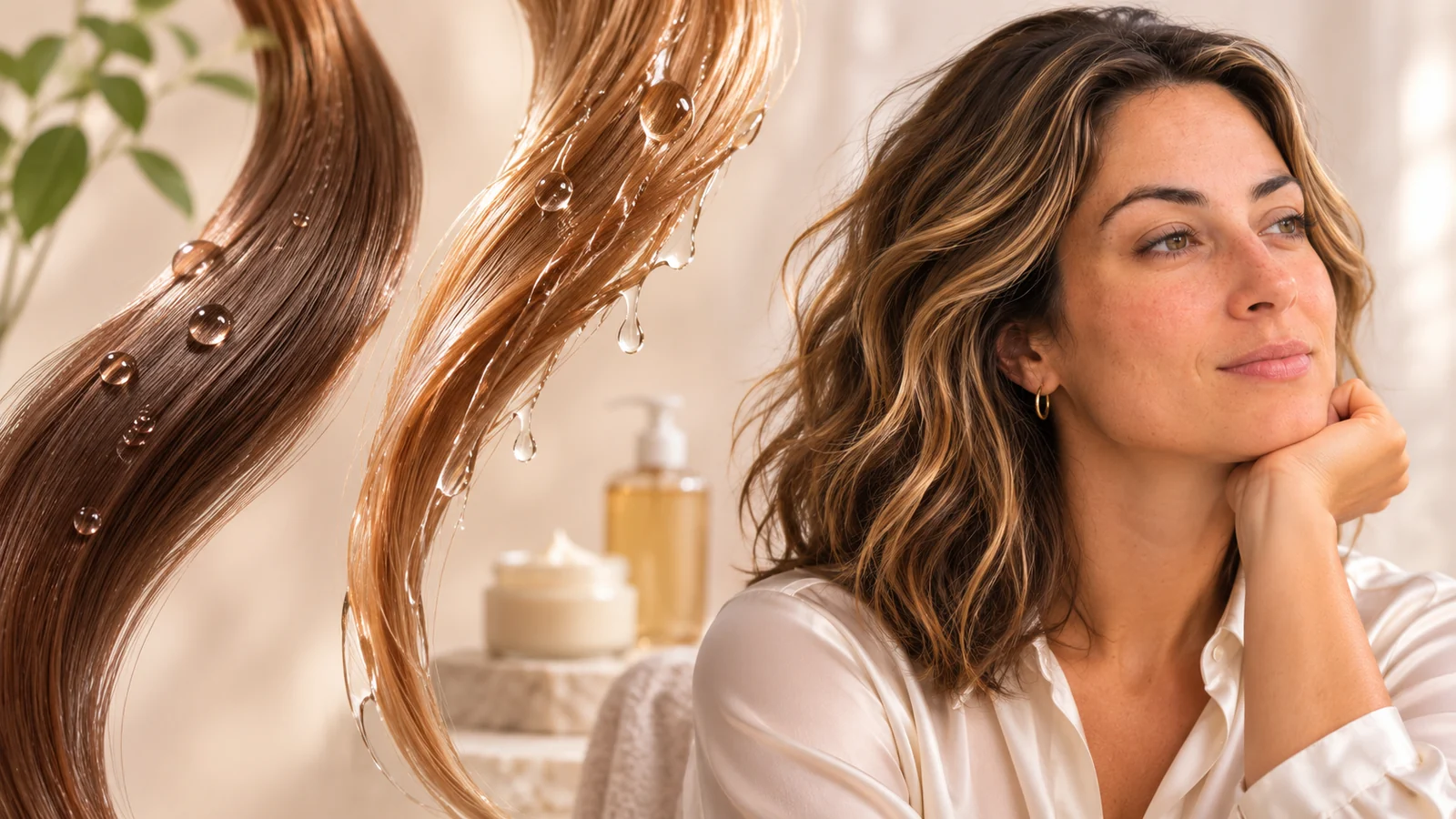
The visible hair shaft is nonliving fiber. Its outer cuticle consists of overlapping cells. The cortex forms most of the fiber and contains keratin intermediate filaments and associated proteins. A medulla may be absent or discontinuous. The cell membrane complex lies between cells and contributes pathways through the structure.
The surface also carries lipid characteristics. 18-methyleicosanoic acid (18-MEA), covalently associated with the outer surface, contributes to hydrophobicity and friction behavior. It is not the sole determinant of softness, shine, or moisture retention.
Relatively low-permeability behavior
Some fibers resist initial wetting or show surface beading. Residue, surface lipids, strand arrangement, and formulation can create similar observations.
Relatively higher permeability behavior
Weathered or treated fibers may show altered water interactions. This does not mean every “high porosity” strand is unhealthy or every intact-looking strand is undamaged.
02 · SEPARATE THE VARIABLES
Porosity is not texture, density, or strand size
Texture describes fiber shape or curl pattern. Strand diameter describes an individual fiber’s thickness. Density describes how many hairs occupy a scalp area. These characteristics are separate: fine hair can be weathered; coily hair can have relatively intact cuticles; straight hair can be chemically damaged.
03 · WATER INTERACTIONS
Wetting, absorption, swelling, and retention
Water on the surface is not a direct readout of internal water content. Adsorption refers to molecules associating with a surface; absorption describes entry into a material. Water can diffuse through a fiber and cause it to swell. Hair also exchanges moisture with air as humidity changes.
How quickly hair dries depends on strand diameter, density, length, airflow, humidity, styling products, and starting water content. Absorbing water readily does not by itself tell you how long it will remain. “Moisture retention” is not the same as a soft feel or a shiny surface.
04 · HOME TESTS
The float test is not a porosity diagnosis
A strand floating or sinking can be influenced by surface tension, trapped air, strand geometry, oils, conditioner residue, and handling. A spray test mainly shows surface wetting; a slide test is subjective; drying time is affected by many variables; product “absorption” is hard to distinguish from spreading or deposition. These tests may prompt observations, but none establishes a precise category.
05 · WHAT CAN CHANGE
Processing and weathering can change fiber behavior
Bleaching and oxidative processing can alter pigment, surface lipids, cuticle morphology, and mechanical properties. Repeated heat or friction can contribute to weathering. Ends have typically experienced more time and handling than newer growth, but individual patterns vary. Cosmetic films may improve lubrication and manageability; they do not regrow missing cuticle cells. Damaged lengths are replaced through growth and trimming, not biological healing of the visible shaft.
Repeated water uptake and drying involve swelling, but “hygral fatigue” is not a standardized clinical diagnosis. Evidence on sorption does not establish that ordinary washing inevitably harms everyone. Gentle handling of wet hair and avoiding unnecessary friction are practical precautions.
06 · FORMULATIONS
Choose products by performance, not ingredient stereotypes
Shampoo surfactants cleanse the scalp and hair. Conditioners commonly use cationic agents, fatty alcohols, polymers, and sometimes silicones to improve lubrication, combability, and feel. Deposition is often intentional. A product that feels heavy may be too rich for your preferences or applied in excess; that alone does not prove low porosity.
Hydrolyzed proteins may deposit or interact with the fiber depending on molecular size and formula. Neither low nor high consumer porosity requires a universal protein rule. Coconut oil has laboratory evidence of reducing protein loss under specific experimental conditions; this is not proof that every oil penetrates or that everyone needs oil. Oils do not add water to hair. Silicones are varied ingredients, not one uniform category.
07 · PERSONALIZE
Build care around real behavior
For residue or heavy feel, try smaller quantities and reduce unnecessary layering before buying something new. If treated lengths tangle, focus conditioner where needed and detangle gently. Use heat protectant according to its directions when heat styling, while remembering it does not eliminate all damage. Comfortable warm water cleanses; hot and cold rinses do not open or permanently seal the cuticle like a door.
LOC and LCO are application preferences, not scientifically mandatory protocols. Steamers are not required for low-porosity hair. Do not use excessive heat or improvised high-temperature steaming devices.
Three steps you can use today
- Cleanse your scalp with a shampoo that suits your needs.
- Condition the lengths based on manageability, fragility, and product feel.
- Reduce avoidable heat, friction, and tight tension.
You do not need multiple masks, oils, a steamer, or a porosity-specific kit by default.
08 · SAFETY
When porosity is not the main question
Do not explain sudden excessive shedding, new bald patches, rapidly progressing thinning, persistent pain or inflammation, or marked unexplained breakage as “porosity.” A dermatologist can assess the scalp and hair and decide whether examination or testing is appropriate. This educational article does not diagnose medical conditions.
Interactive guide · no scores, no diagnosis
Make sense of your hair’s behavior
This guide helps you understand hair behavior and cosmetic care considerations. It cannot measure hair porosity, diagnose hair damage, or identify medical conditions.
Frequently asked questions
Can hair porosity change?
Surface and structural characteristics can change with chemical, thermal, and mechanical weathering; cosmetic products can temporarily alter surface feel. New growth does not inherit damage from older lengths.
Does curly hair automatically have high porosity?
No. Curl pattern and porosity are different characteristics. Avoid assigning porosity based on texture or identity.
Should low-porosity hair avoid protein?
No universal rule is supported. Evaluate the complete formulation, instructions, and how your hair responds.
Can damaged hair be repaired?
Products may temporarily improve feel and manageability, but the visible shaft is nonliving and cannot biologically regenerate missing structure.
Selected references
- Yang FC, Zhang Y, Rheinstädter MC. “The structure of people’s hair.” PeerJ, 2014. doi:10.7717/peerj.619
- Rogers GE. “Known and Unknown Features of Hair Cuticle Structure: A Brief Review.” Cosmetics, 2019. doi:10.3390/cosmetics6020032
- Fernandes C et al. “On Hair Care Physicochemistry: From Structure and Degradation to Novel Biobased Conditioning Agents.” Polymers, 2023. doi:10.3390/polym15030608
- Rele AS, Mohile RB. “Effect of mineral oil, sunflower oil, and coconut oil on prevention of hair damage.” J Cosmet Sci, 2003. PubMed
- Lee Y et al. “Hair Shaft Damage from Heat and Drying Time of Hair Dryer.” Ann Dermatol, 2011. doi:10.5021/ad.2011.23.4.455
- American Academy of Dermatology Association. Hair styling without damage.
Editorial status: Educational research synthesis; not reviewed by a dermatologist or cosmetic chemist. Sources describe different methods and samples; laboratory findings do not automatically establish consumer outcomes.
POROSITY-SPECIFIC CARE & HYDRATION
Recommended Leave-Ins, Protein Masks & Heat Caps
As an Amazon Associate I earn from qualifying purchases. Lightweight leave-ins and heat caps for low porosity absorption, plus protein masks and sealing oils for high porosity cuticles.
Kinky-Curly Knot Today Leave-In Detangler Conditioner
Lightweight leave-in detangler
Neutrogena Anti-Residue Clarifying Shampoo for Hair
Clarifying anti-residue shampoo
SheaMoisture Manuka Honey & Yogurt Hydrate + Repair Mask
Protein hydration repair mask
Cliganic 100% Pure Organic Moroccan Argan Oil
100% Pure Moroccan argan oil
Cordless Deep Conditioning Microwavable Steam Heat Cap
Thermal conditioning heat cap
YoulerTex Microfiber Hair Wrap Towel for Women
Gentle microfiber hair wrap towel